OpenAI Launches GPT-6 with Generative UI, Claiming to Disrupt Traditional Software Interfaces
OpenAI announced the global rollout of GPT-6, highlighting a new 'Generative UI' concept aimed at replacing fixed graphical interfaces. The article contrasts this with Anthropic's recent release but lacks specific technical parameters, benchmark data, or architectural details, focusing primarily on the marketing narrative of interaction paradigm shifts.
Related Entities
Full Report
New UI Kills the Software Industry
This is absolutely mind-blowing!
Just moments ago, OpenAI officially announced: GPT-6 has gone fully live, opening access to over 1.2 billion weekly ChatGPT users worldwide!
GPT-6 with Intelligent UI begins rolling out today to Plus, Pro, Business, and Enterprise users, expanding to Free and Go users tomorrow.
Only minutes after Anthropic released Haiku 5.5, OpenAI executed an instant counter-strike.
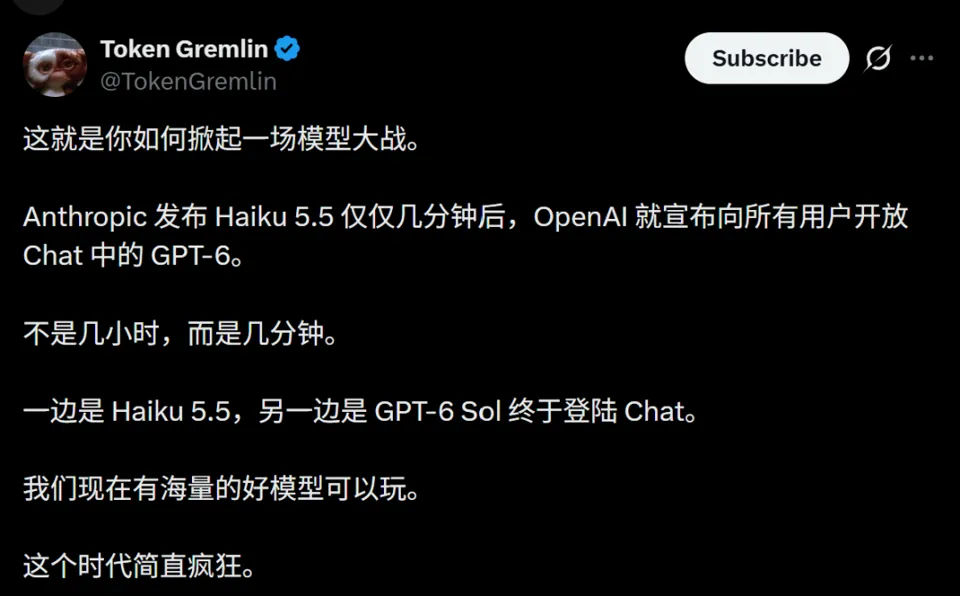
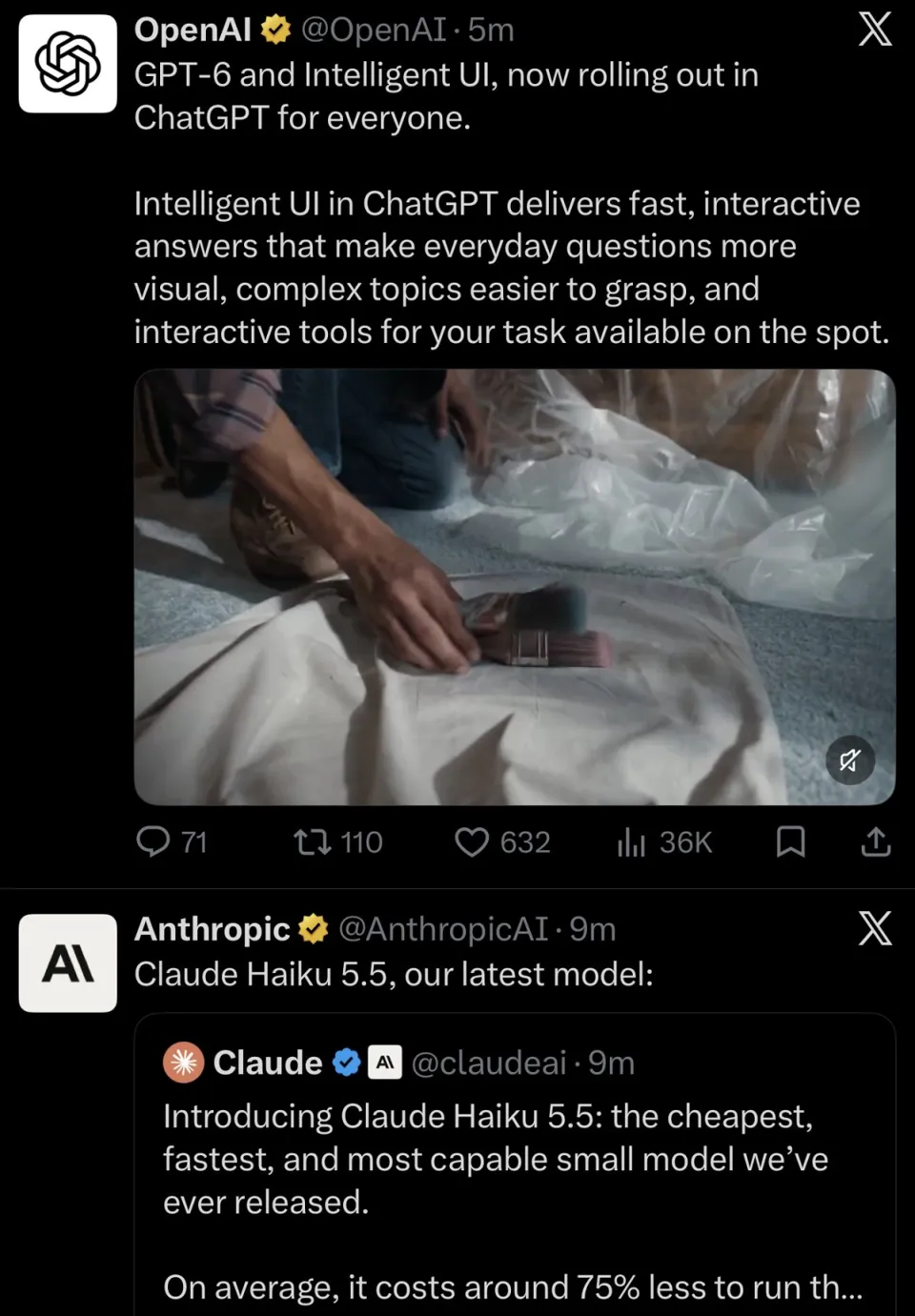
Moreover, accompanying the launch of GPT-6 is a groundbreaking feature that disrupts the history of human-computer interaction: "Intelligent UI."
Now, when you open ChatGPT, its "text input box" has fundamentally changed.
Its responses are no longer just text; they dynamically generate buttons, charts, sliders, forms, and even complete interactive mini-apps on the fly!
One Silicon Valley software engineer exclaimed: "This is magic!"
This time, OpenAI is directly sparking an interaction revolution for 1.2 billion people.
The era of traditional software and static apps is over!
Pushing to 1.2 Billion Users Globally: Available for Free!
So, can regular users access it?
Tibo (the "Godfather" figure in this context) confirmed on X: Free! For everyone!
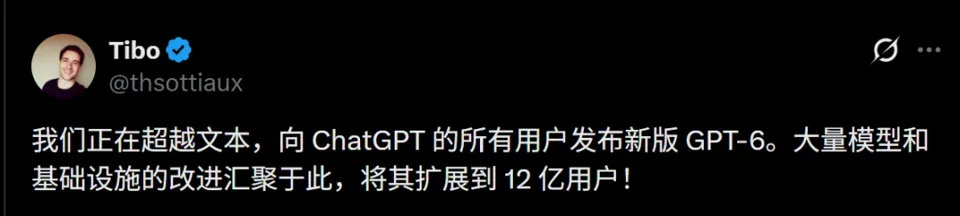
This full rollout will directly cover ChatGPT's more than 1.2 billion active weekly users!
The specific rollout schedule and model versions are as follows—check where you stand.
However, this update focuses on enhancing the "Chat" module for daily interactions; the underlying dedicated models for Work and Codex remain unchanged.
OpenAI has unveiled a dual-star architecture: Advanced paid subscription users are powered by GPT-6 Sol, while the massive base of 1.2 billion free users is driven by the lightweight GPT-6 Luna! Both are meticulously optimized for high-frequency daily conversations.
This means that even if you don't spend a penny, by tomorrow at the latest, you'll be able to personally experience this AI that generates interfaces on the spot within ChatGPT on your phone or computer.
Intelligent UI Has Arrived:
Responses Generate Their Own Interfaces, Turning the Chat Box into a "Software Pipeline"
Previously, using large language models meant typing and receiving text output.
Now, for the first time in history, GPT-6 dynamically integrates text, visual graphics, and interactive components. It is no longer just a language model; it has become an "instant UI architect."
While generating answers, it considers: "What format best presents this response for optimal user experience?"
Responses can include graphics and charts to clarify concepts, alongside clickable buttons, forms, and interactive experiences usable directly within the conversation.
Create usable interactive tools directly within the chat, such as games or interactive budget planning calculators.
Deepen your understanding of topics through vivid visual presentations.
It can also help you customize responses specifically for your needs.
Explore ideas through responsive interactive visuals, gaining instant feedback as you learn, experiment, and discover.
Planning a Sunday Lamb Leg Roast
In the official demo, a user asked: "Help me plan a Sunday lamb leg roast. Friends are coming over, but I haven't finalized the exact number of guests."
GPT-6 Instant immediately generated a mini web application!
The interface featured not only a visually rich menu but also an embedded interactive dynamic guest count adjuster.
When you casually click "Increase Guest Count," the broccoli ratio (625g), apple quantity (4 pieces), and lamb leg weight automatically recalculate and restructure instantly.
Furthermore, a cooking timeline appears below: from marinating on Saturday, preparation at 12 PM on Sunday, putting it in the oven at 1 PM... every step becomes a checkable, trackable interactive progress card.
You don't need to open a notepad or launch a kitchen management app. Your chat interface is your custom app.
Instantly Deconstructing a 7-Speed Bicycle
If you ask it: "Deconstruct the mechanical design of a 7-speed bicycle."
GPT-6 pops up a multi-dimensional interactive card within the chat window.
The frame, wheelset, drivetrain, brakes, and handlebar control area... five systems are arranged into switchable interactive tabs. Clicking any module displays the corresponding principles in real-time via linked interfaces.
Comparisons are suited for side-by-side horizontal layouts, while principles work well with drag-slider diagrams. What's even more impressive is that GPT-6 doesn't force UI elements just for the sake of showing off. When it determines that plain text is the most effective approach, it still outputs pure text.
On-the-fly Tool Generation: Bill Splitting, Pension Calculators, and Retro Mini-Games
Snap a photo of a dinner receipt and send it over. Instantly, a dedicated bill-splitting tool is generated on the spot, complete with personnel filtering, option checkboxes, and one-click copy functionality.
Want to see the power of compound interest? Ask: "If I invest $2,000 monthly at a 6% annualized return, how much will I have in 30 years?"
It immediately renders an interactive asset growth calculator within the chat interface, featuring adjustable sliders for deposit amounts and duration. You can drag these controls freely, watching the chart curves update dynamically in real time.
Command it to "create a retro pixel-art mini-game," and it will render a playable endless runner or Breakout-style game directly within the conversation stream, operable via keyboard or touch screen!
Users are exclaiming: "The chat box is turning into Doraemon's fourth-dimensional pocket. Whatever tool you ask for, it generates it on the fly using code."
Underlying Tech: Native Streaming Compiler
Many people's first reaction might be: "Isn't this just a code sandbox or frontend Artifacts? We could already run HTML before. What’s so special about that?"
If you think so, you’re underestimating OpenAI.
Previous "code generation" involved the model silently writing a full block of HTML/JS code in the background and then dumping it into an isolated iframe for cold-start execution. This resulted in loading lag, disjointed styling, and poor mobile experiences.
GPT-6’s "Intelligent UI," however, takes a fundamentally different approach by reconstructing the entire full-stack interaction layer.
It utilizes a native streaming component library. OpenAI has pre-embedded a highly robust, natively rendered interactive component system across all clients (Web, iOS, and Android).
Buttons, forms, sliders, charts, and card layouts are fully encapsulated and adhere to a unified design language.
The most impressive aspect is the instant streaming compiler. As the model outputs tokens, the compiler processes the interface in real-time. You don’t need to wait for the entire code block to finish generating, nor do you face white-screen loading delays.
GPT-6 components "think, speak, and grow frame-by-frame" simultaneously. Visually, you perceive the interface unfolding smoothly across the screen with zero fragmentation.
Additionally, during post-training, OpenAI specifically fed GPT-6 extensive reinforcement learning alignment focused on UI/UX design judgment.
The model has been trained to evaluate: Is this layout clear? Is this button placement ergonomic? Is this form complete?
It is now an interaction expert combining full-stack development skills with product manager-level aesthetic sensibility.
Think While Answering: A Double Strike on Speed and Intelligence
Beyond the stunning "Intelligent UI," GPT-6’s evolution in its underlying reasoning engine is equally remarkable.
Anyone who has used previous deep reasoning models (like o1) knows that while they are smart, their thinking time is excessively long—often spinning for thirty seconds or even a minute.
GPT-6 completely ends this frustrating experience, achieving truly human-level flow of thought: thinking and answering simultaneously!
OpenAI retrained the model’s reasoning rhythm. GPT-6 keenly captures the psychological waiting threshold of human users. Before reasoning is fully complete, it leverages incremental knowledge discoveries to begin outputting valuable answer frameworks early, followed by deeper insights and content completion.
The process contains no fluff while maintaining logical consistency.
Benchmark Data Overwhelms Competitors
In OpenAI’s internal evaluations targeting high-value daily Agent tasks:
GPT-6 Extra High (ultra-high reasoning tier) matches the Time-to-First-Token speed of the previous generation GPT-5.6 Medium tier!
Meanwhile, its final score is in a league of its own, surpassing the full-spec Extra High version of the previous generation!
Web search speed has also nearly doubled. In complex scenarios requiring real-time full-web retrieval, GPT-6 Instant begins generating responses 44% faster on average compared to GPT-5.6 Instant.
Additionally, GPT-6’s “information retrieval” capabilities have significantly improved. It now better understands when to initiate a search and where to fetch high-credibility sources, avoiding the pitfall of retrieving low-quality web pages.
A Paradigm Shift in 50 Years of Software History:
From “Humans Adapting to Software” to “Software Adapting to Humans”
At this point, if you view GPT-6 merely as an aesthetic upgrade to the ChatGPT interface or simply a feature expansion, you may still be underestimating the profound impact of this overnight shift.
In the final section of its official announcement, OpenAI included a passage that is not only stunning but destined to be recorded in the annals of computer history:
“For decades, humans have been forced to adapt to rigid software, navigating through cold interfaces designed for specific tasks. We firmly believe that the future logic will be completely inverted—no longer will humans adapt to software, but rather, software will adapt to humans. You simply state what you want to accomplish, and a personalized interaction experience tailored to that task will emerge organically.”
Looking back at the history of human-computer interaction:
- 50 years ago (Command-Line Interface Era): Humans had to type code and memorize commands like machines; software was represented by cold black screens with green text.
- 30 years ago (Graphical User Interface Era): Xerox, Apple, and Microsoft introduced windows, icons, and mice, allowing humans to interact with software via fixed buttons.
- 15 years ago (Mobile Internet/App Era): Steve Jobs encapsulated everything into rounded rectangular app icons. To book tickets, you had to learn the logic of ticketing apps; to manage finances, you had to master the categorization systems of accounting apps.
- Today (Generative UI Era): The concept of fixed interfaces has been thoroughly dismantled.
Software has thus become a disposable, one-time consumable.
References:
Instantly Pursuing ASI
⭐ Like, Share, and Watch – One-Click Triple Combo ⭐
Star us to lock in rapid updates from New Intelligence!