Google Releases EmbeddingGemma 2 with Unified Five-Modal Vector Space
Google released EmbeddingGemma 2, an open-weight multimodal embedding model based on Gemma 4 that maps text, code, images, video, and audio into a unified 768-dimensional vector space. Optimized for on-device deployment under the Apache 2.0 license, it features Matryoshka Representation Learning (MRL) to balance storage efficiency and retrieval quality.
Related Entities
Full Report
Google’s EmbeddingGemma 2 is a compact, open-weight multimodal embedding model built on Gemma 4 and released under the Apache 2.0 license. The model aims to improve efficiency in semantic search and Retrieval-Augmented Generation (RAG), while optimizing performance for on-device deployment.
EmbeddingGemma 2 is designed to run on consumer hardware such as mobile devices and laptops, providing low-latency semantic representations for applications like on-device search, RAG, classification, and clustering.
Thanks to its multimodal capabilities, EmbeddingGemma 2 supports a wide range of retrieval tasks, including finding relevant documents, screenshots, and audio recordings based on queries, searching source code using natural language, and retrieving video content from text descriptions.
Google states that a key feature of EmbeddingGemma 2 is its ability to represent text, code, images, video, and audio within a unified 768-dimensional embedding space. This capability allows developers to build retrieval systems that search across different media types without maintaining separate, incompatible embedding spaces for each modality.
Despite originating from different modalities, the embeddings generated by EmbeddingGemma 2 reside in the same dimensional space and can be compared based on semantic similarity.
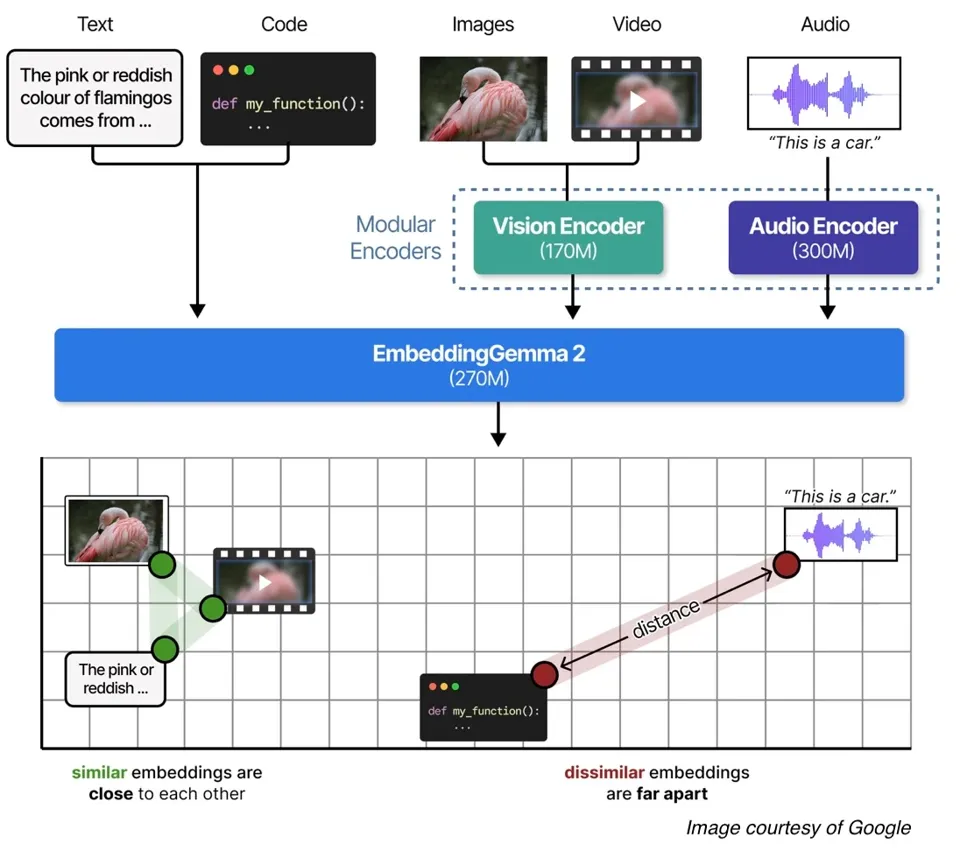
The model allows developers to load only the encoders required for their specific application, with parameter sizes ranging from 270 million for text and code to 740 million for full multimodal support. Google notes that the model “significantly outperforms EmbeddingGemma 1 in code search and technical content retrieval, making it well-suited for local codebase indexing and agentic code search.”
EmbeddingGemma 2 supports Matryoshka Representation Learning (MRL), which enables truncating embeddings into shorter unit-length vectors to reduce storage requirements. For example, storing one million 768-dimensional vectors in bfloat16 precision requires approximately 1.5GB of memory, whereas truncating them to 128 dimensions reduces this to just 250MB—a sixfold decrease in storage footprint. However, this involves trade-offs in retrieval quality. Consequently, Google recommends using truncation only when strictly necessary for storage constraints or search speed. At 128 dimensions, the model retains about 90% of its quality on text tasks but drops to approximately 75% for image, video, and speech retrieval.
In comments regarding this release, Reddit user Distinct-Target7503 acknowledged the model’s multimodal capabilities while questioning the magnitude of improvements in pure text tasks:
What’s impressive about this model is its ability to embed images and audio into the same shared semantic space; however, if you look solely at text tasks, the improvements aren’t substantial.
Meanwhile, Reddit user Open-Adhesiveness-86 reminded developers of the importance of correctly using the model:
I encountered two pitfalls with the original EmbeddingGemma, and these issues likely still apply: Task prefixes are not optional. If you use a query prefix when indexing documents instead of
title: none | text:, recall rates will drop significantly. Additionally, if you plan to truncate vectors for MRL, you should slice first and then perform L2 normalization on the shorter vector; normalizing at 768 dimensions before truncation results in vectors with incorrect norms.
EmbeddingGemma was launched last year, focusing on “offline and privacy-sensitive scenarios, such as searching personal files locally, running mobile RAG pipelines with Gemma 3n, or building domain-specific chatbots.” EmbeddingGemma 2 is now available on Hugging Face.
Original article:
https://www.infoq.com/news/2026/10/embeddinggemma-2-multimodal/