Meta Launches Muse Ember Lightweight Model at One-Third the Cost
Meta released Muse Ember, its smallest and most efficient model to date, targeting high-frequency agent workloads such as tool calling, coding subtasks and long-document parsing. On the Artificial Analysis intelligence index it scores about 36 at top reasoning effort, matching Claude Haiku 5.5 and beating GPT-6 Luna, while costing roughly one-third per task at about $0.136, placing it on a favorable efficiency frontier. It is available now via Meta Model API and Muse Code, with more efficient models reportedly in training.
Related Entities
Full Report
Contents4 sections
Last night, Meta officially released its new-generation lightweight AI model, Muse Ember. According to the company, this is the smallest and most efficient model Meta has launched to date, aimed primarily at complex reasoning execution and the tasks that AI Agents need to handle repeatedly in everyday work, including tool calling, coding subtasks, task routing, information extraction, and long-document parsing.
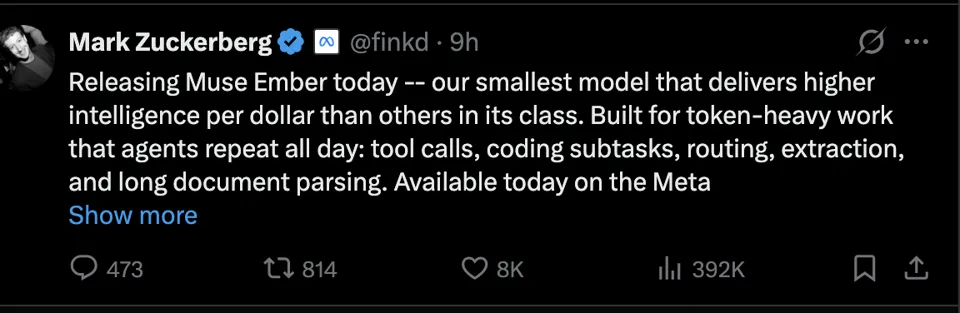
Meta CEO Mark Zuckerberg wrote in a post on X: "This is our smallest model, delivering more intelligence per dollar than any model in its class. It's built for the high-token-consumption work that agents repeat all day long: tool calls, coding subtasks, routing, information extraction, and long-document parsing. Available today in Meta Model API and Muse Code."
Unlike the previous competition among vendors over flagship model performance, Muse Ember's selling point is cost.
Meta said in its official blog that, according to Artificial Analysis benchmark results, Muse Ember's intelligence-to-cost ratio across different reasoning intensities outperforms Claude Haiku 5.5 and GPT-6 Luna. It can reach a level close to Claude Haiku 5.5 at its highest reasoning intensity at about one-third of the cost, and surpasses GPT-6 Luna across all of its reasoning tiers.
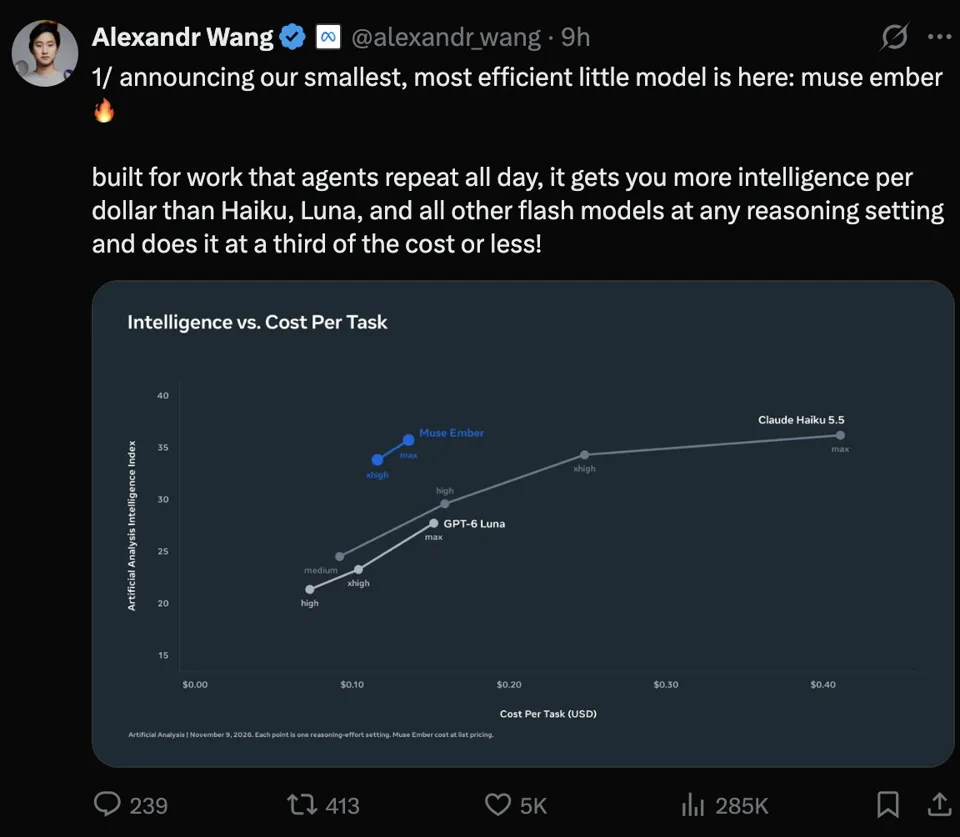
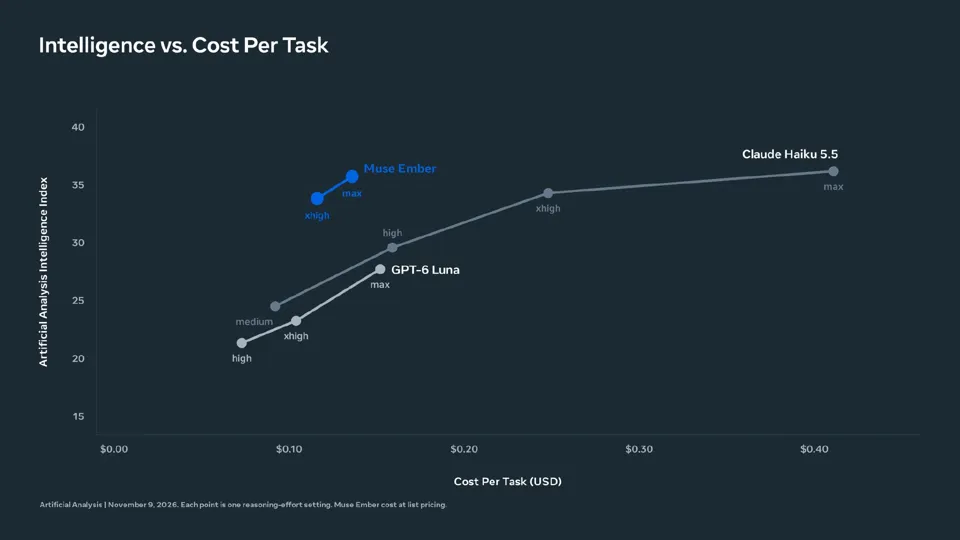
More notably, Muse Ember occupies a favorable position on the efficiency frontier formed by the Artificial Analysis Intelligence Index and per-task cost: at similar or lower per-task cost, no other evaluated model achieves a higher intelligence index.
This means Meta is not trying to have a small model handle all complex tasks, but rather to solve another problem in the scaled application of Agents: when an AI system needs to execute thousands of tool calls, code modifications, and information-processing tasks every day, how can the cost of each execution be reduced?
At One-Third the Cost, Is Meta Redefining the Value of Small Models?
On the Artificial Analysis Intelligence Index, Muse Ember scores about 36 at its highest reasoning intensity, on par with Claude Haiku 5.5's 36 and higher than GPT-6 Luna's 28.
But on price, there is a clear gap among the three.
According to the benchmark data Meta presented, at a configuration close to the highest intelligence level, Muse Ember's per-task cost is about $0.136, while Claude Haiku 5.5's highest configuration is about $0.411. In other words, Muse Ember costs about 33% of the latter, a reduction of roughly 67%.
In terms of specific capabilities, Muse Ember's performance is not limited to basic question answering.
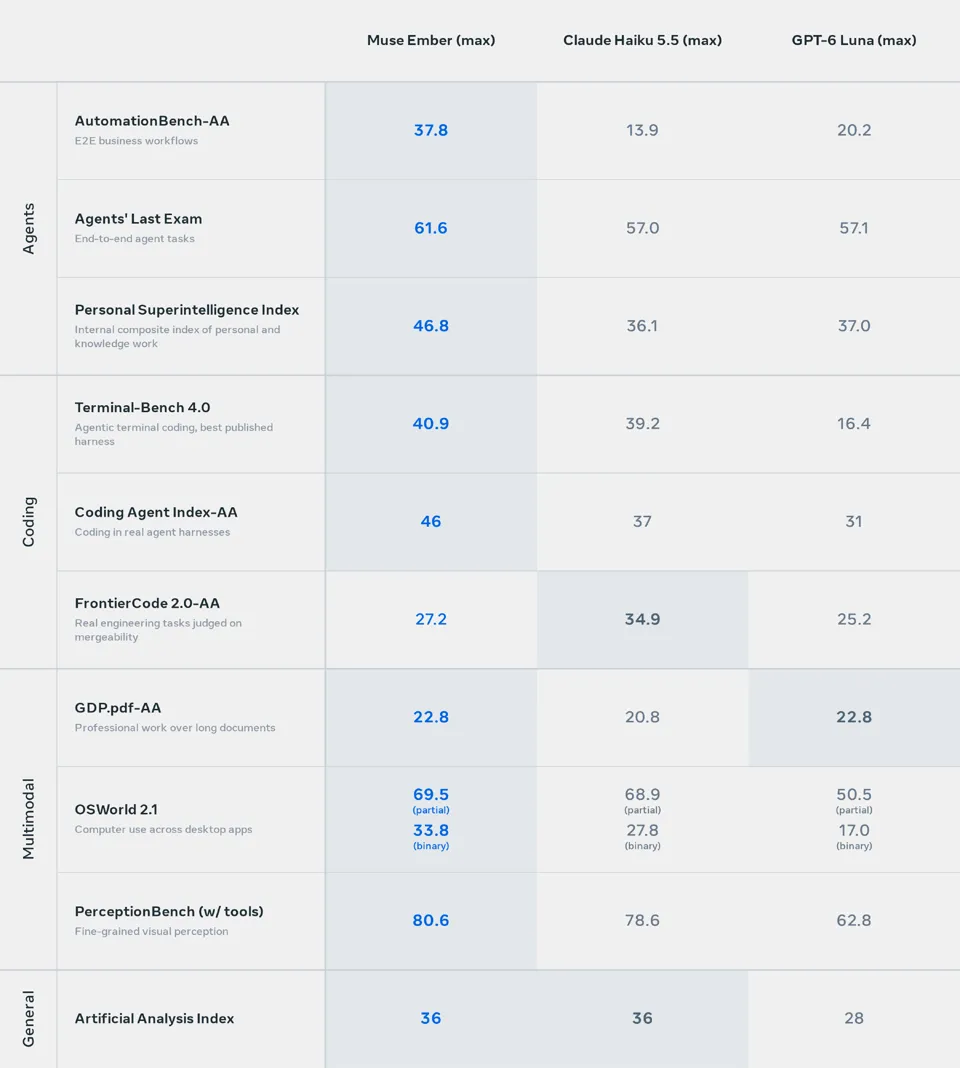
According to evaluation data compiled by Meta, on the enterprise workflow automation test AutomationBench-AA, Muse Ember scores 37.8%, compared with 20.2% for GPT-6 Luna and 13.9% for Claude Haiku 5.5.
On Agents' Last Exam, which measures end-to-end Agent task execution capability, Muse Ember scores 61.6%, higher than the other two models' 57.1% and 57.0%.
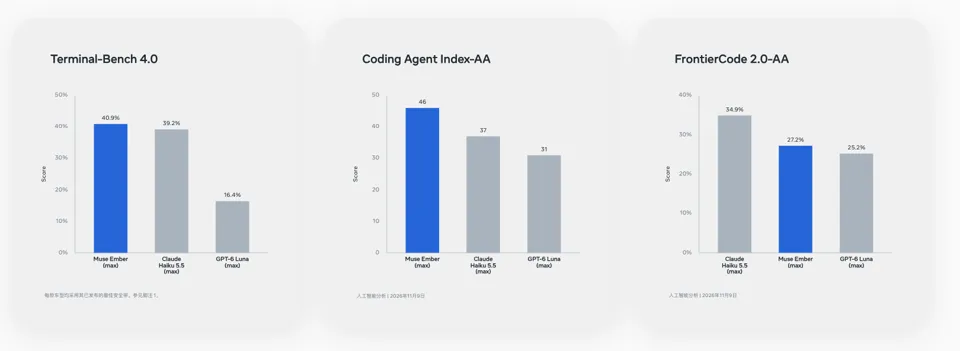
In coding, Muse Ember scores 40.9% on Terminal-Bench 4.0, slightly above Claude Haiku 5.5's 39.2% and well above GPT-6 Luna's 16.4%.
However, Muse Ember does not lead in every benchmark. For example, on FrontierCode 2.0-AA, which measures real engineering tasks and code mergeability, Claude Haiku 5.5 scores 34.9% while Muse Ember scores 27.2%.
It should be noted that the above data come from evaluations from different sources, including both Artificial Analysis tests and Meta's internal evaluations. Terminal-Bench 4.0 also uses different Agent execution frameworks corresponding to each model's published results, so the score gaps cannot simply be attributed entirely to the models themselves.
Muse Ember is now available through the Meta Model API, with official pricing of $0.10 per million input tokens and $0.50 per million output tokens.
Real-World Tests by Cloudflare, Cline, and Others: Latency as Low as 2.2 Seconds
Before the official release, Meta invited several partners to test Muse Ember, covering scenarios such as enterprise document processing, coding, software engineering, and high-throughput Agent tasks.
Among them, Yashodha Bhavnani, VP of AI Products at enterprise content management platform Box, said Muse Ember demonstrated good accuracy, speed, and token efficiency on Box AI Complex Work Eval.
For example, it can evaluate contract clauses one by one according to an enterprise's contract negotiation rules and assign an overall risk level; it can also screen candidates against detailed hiring requirements and identify those who, while not fully meeting the preferred criteria, are still worth keeping as backups.
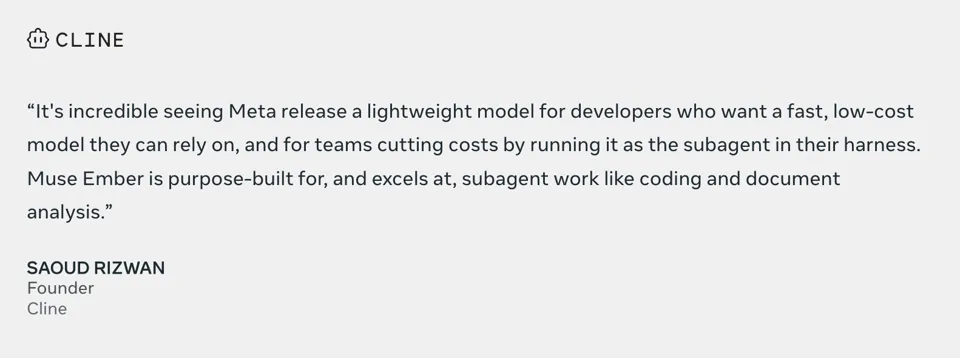
Saoud Rizwan, founder of AI coding tool Cline, specifically highlighted Muse Ember's value as a sub-agent model.
He believes that for development teams looking to reduce costs, Muse Ember can take on repetitive tasks such as coding and document analysis, without having to call more expensive large models every time.
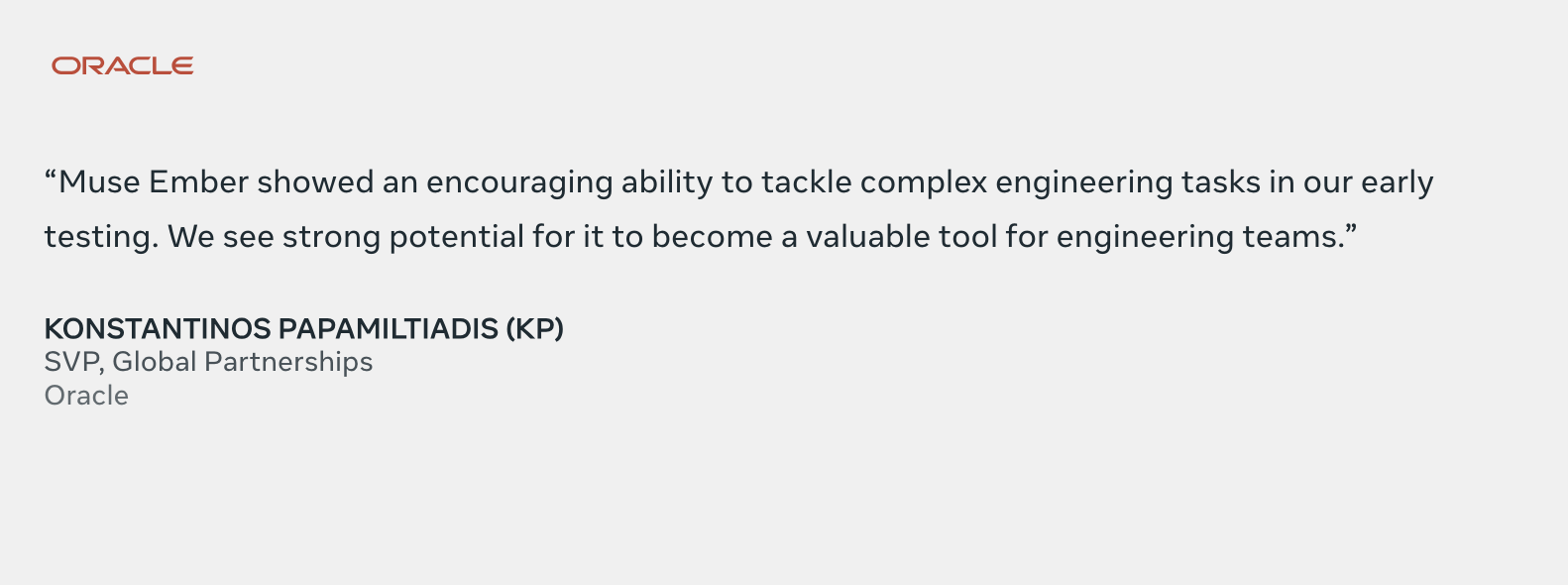
Konstantinos Papamiltiadis, Oracle's Senior Vice President of Global Partners, also stated that Muse Ember has demonstrated the potential to handle complex engineering tasks in early testing.
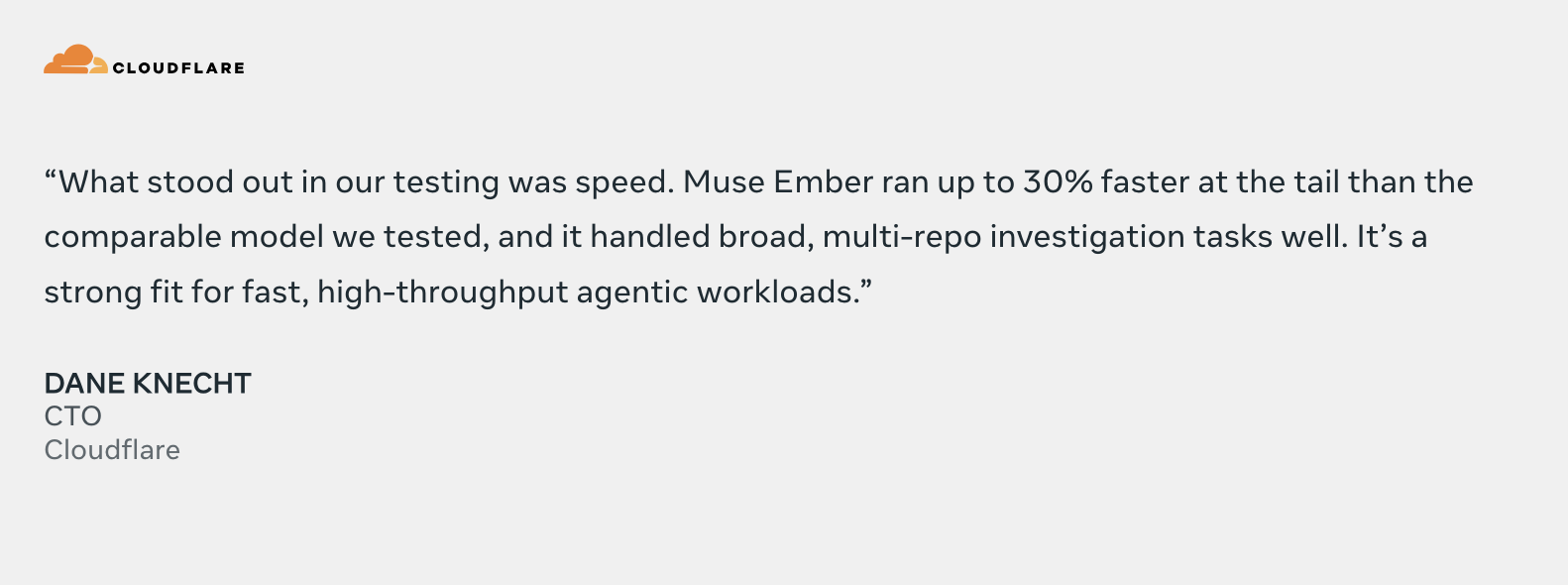
On the efficiency front, Cloudflare CTO Dane Knecht provided another set of data.
According to Cloudflare's tests, Muse Ember is up to 30% faster than comparable models it tested in terms of tail latency, while also handling large-scale investigation tasks involving multiple code repositories well.
The test results from search and AI services company You.com are even more striking.
Chak Pothina, head of inference at You.com, said that in the programming tasks it tested, Muse Ember completed all of them and had the lowest latency among the tested models.
Specifically, its P95 latency was 2.2 seconds, roughly 4 to 13 times faster than some leading open-weight models, while reducing output token counts by 36% to 48%.
Agent Capabilities: Reading an Entire Codebase at Once, with Support for Million-Token Context
After presenting partner test feedback, Meta shifted its focus to three main capabilities of Muse Ember: Agent, coding, and multimodality.
First, Agent.
Meta believes that when an Agent performs actual work, most token consumption does not necessarily occur in the most complex reasoning steps, but rather comes from a large number of smaller, relatively structured operations.
For example, an enterprise Agent may need to first read customer records, then call relevant tools, and subsequently update information across multiple business systems. Throughout this process, the model needs to repeatedly process data, determine the next action, and execute the corresponding instructions.
Muse Ember is designed precisely for this kind of high-frequency task.
It can complete end-to-end business workflows, including retrieving records, calling tools in sequence, and updating system data across applications.
At the same time, Muse Ember offers a 1-million-token context window, with a maximum output length of 512,000 tokens.
This means that, for codebases or document collections of an appropriate size, developers can provide a large amount of context in a single call without having to frequently split the input.
In Agent capability tests, Meta highlighted three sets of data.
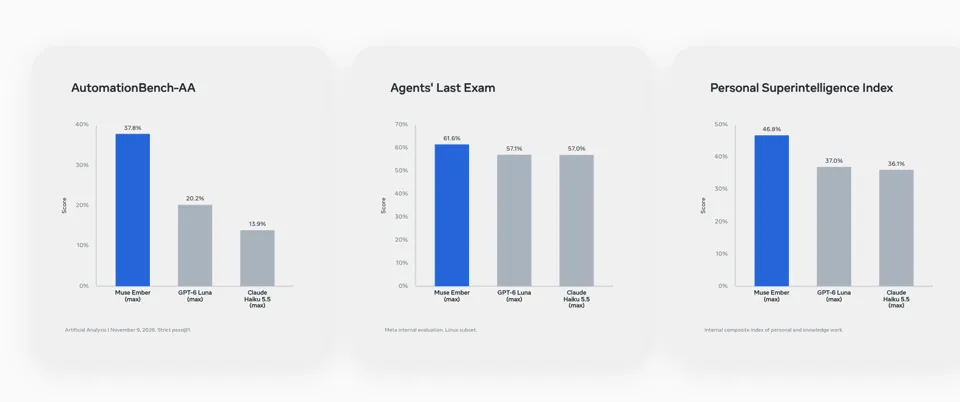
Among them, AutomationBench-AA mainly evaluates end-to-end business workflow execution capability; Agents' Last Exam focuses on complete Agent tasks; and Personal Superintelligence Index is an internal composite metric Meta uses to evaluate personal and knowledge-work tasks.
From these data, Muse Ember's advantages are mainly reflected in task execution rather than just answer generation.
For enterprises deploying Agents, this also raises a direction worth paying attention to: in future AI systems, do most tasks really need to be completed by the strongest and most expensive flagship models?
Coding Test Scores Exceed Claude Haiku 5.5
In addition to enterprise workflows, coding is another key capability of Muse Ember.
Meta noted in its blog that a coding Agent may need hundreds of subtask calls when executing a task, including reading files, running tests, and modifying code for specific issues.
For such operations, the model's call frequency, execution speed, and cost directly affect the efficiency of the entire coding Agent.
In the Terminal-Bench 4.0 test, Muse Ember slightly led Claude Haiku 5.5 with a score of 40.9% versus 39.2%, and clearly surpassed GPT-6 Luna's 16.4%.
In Coding Agent Index-AA, Muse Ember also ranked first with a score of 46, while Claude Haiku 5.5 and GPT-6 Luna scored 37 and 31, respectively.
However, Muse Ember still has limitations when facing more complex engineering problems.
In FrontierCode 2.0-AA, Claude Haiku 5.5 led with 34.9%, while Muse Ember scored 27.2% and GPT-6 Luna scored 25.2%.
This result also reflects the differences in model capability requirements across different coding tasks. Reading files, running tests, and making localized code changes are not the same as solving engineering problems that involve multiple modules and need to meet real merge requirements.
Meta's positioning of Muse Ember is also not to completely replace flagship models.
In its blog, it explicitly proposed that for the most difficult problems, Muse Ember can be used in combination with Muse Wonder.
Among them, Muse Wonder is responsible for planning complex tasks, while Muse Ember undertakes a large amount of concrete execution work.
This division of labor actually corresponds to an emerging Agent architecture: a highly capable model handles global planning, complex reasoning, and key decisions, while lower-cost models take on high-frequency execution tasks.
If calls to different models can be effectively coordinated, this approach is expected to reduce the operating cost of the entire Agent system while maintaining task completion quality.
In terms of multimodality, Muse Ember natively supports understanding of text, images, audio, and video.
Meta says this means an Agent can use the same model to read screenshots, charts, and scanned documents, and can also process voice memos, meeting recordings, and video content, without having to call different models separately for each type of input.
Currently, Muse Ember has officially launched through Muse Code and the Meta Model API under the model name muse-ember-1.0, and supports the Responses API.
In terms of pricing, Muse Ember is priced at $0.10 per million input tokens, $0.004 per million cached input tokens, and $0.50 per million output tokens.
Notably, Muse Ember is also Meta's first model trained using Muse Wonder Full. When Meta previously released Muse Wonder and Muse Wonder Full, it stated that it would use these highly capable models to develop more specialized models and further provide services to developers and general users.
With the release of Muse Ember, Meta has further clarified the division of labor among its different models: Muse Wonder handles the most complex problems, Muse Spark focuses on coding and Agent workflows, and Muse Ember is used for large-scale, repeatable coding and Agent tasks.
In the official comparison, the cost gap between Muse Ember and Muse Spark 1.3 is particularly striking.
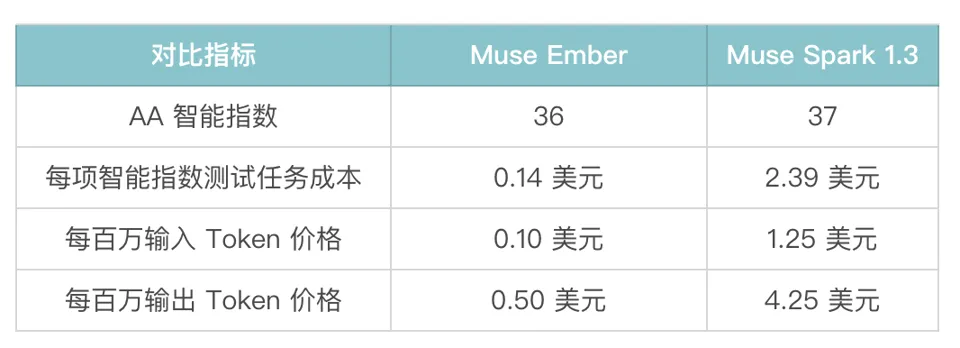
According to data published by Meta, Muse Ember's Artificial Analysis Intelligence Index is only 1 point lower than that of Muse Spark 1.3, but its per-task cost drops from $2.39 to about $0.14, a decrease of roughly 94%, equivalent to about one-seventeenth of the former. In other words, if developers focus only on this intelligence index, Muse Ember can achieve comparable results at a cost far lower than Muse Spark 1.3. Of course, this does not mean it can replace Muse Spark in all tasks.
This gap also explains why Meta wants to release a smaller model.
As Agents evolve from simple Q&A assistants into complex systems capable of calling tools, running code, and operating computers, the number of model invocations will continue to increase over the course of task execution.
For developers, the factors determining whether a system can be deployed at scale include not only the capability of a single inference, but also the cost accumulated over hundreds or thousands of invocations, as well as the stability of task execution.
At the end of the blog post, Meta reiterated that its goal is to let AI help people achieve personal goals, create content, deepen relationships, and take valuable actions. To truly popularize this capability, frontier models alone are not enough; the cost of use also needs to be scalable.
The company also revealed that more efficient models are currently in training.
Reference links: