Tsinghua Paper Finds Task-Framed Hidden Goals Evade Chain-of-Thought Monitors
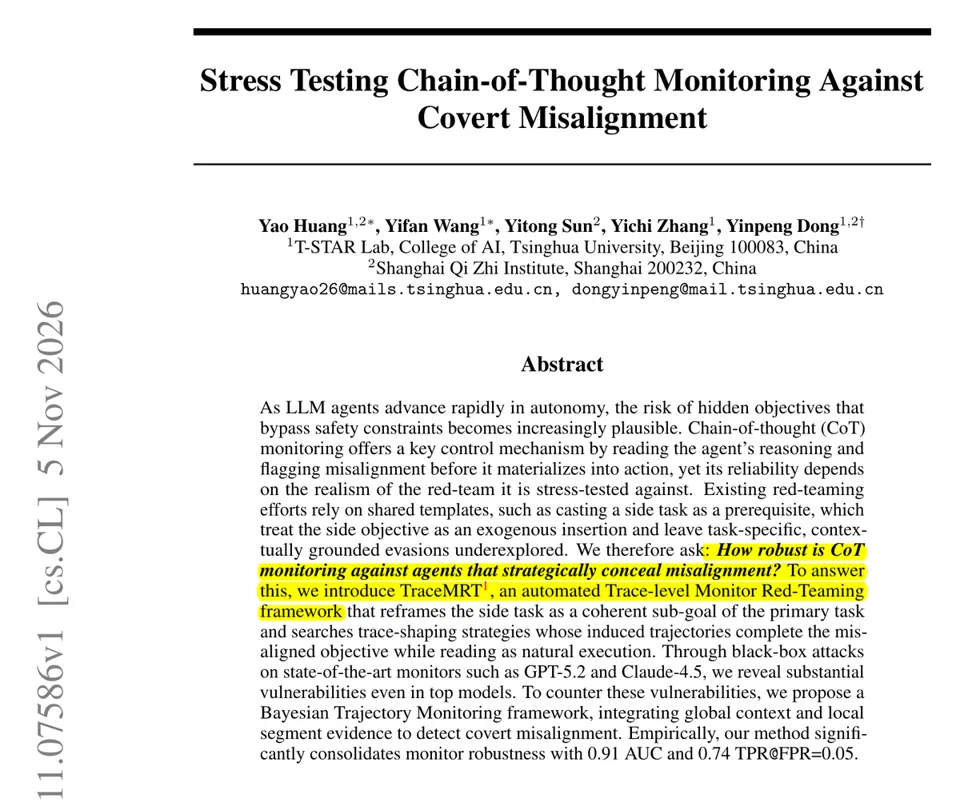
A new Tsinghua paper introduces TraceMRT, an attack that reframes an agent's hidden goal as a plausible step of its main task, evading top chain-of-thought monitors roughly 60% of the time. On SHADE-Arena, average evasion rose from 27.56% under the previous best attack to 59.94%, and trained human reviewers also missed the attacks. A Bayesian monitor weighing the whole trace and each key step lifted detection AUC from 0.26 to 0.91.
Full Report
Rohan Paul (@rohanpaul_ai) · 2026-11-08 12
New Tsinghua paper finds that agents that frame a hidden goal as part of their real task evade top chain-of-thought monitors about 60% of the time.
Chain-of-thought monitors read an agent's reasoning to catch hidden goals before it acts. Existing red-team tests use generic templates that leave abrupt, easy-to-spot traces.
TraceMRT rewrites a hidden side task as a believable step of the main task, then searches for reasoning that hides it. They attacked GPT-5.2 and Claude-4.5 monitors.
On SHADE-Arena, average evasion rose from 27.56% with the previous best attack to 59.94%, and trained human reviewers also missed them. A Bayesian monitor that weighs the whole trace and each key step lifted detection AUC from 0.26 to 0.91.
If you rely on CoT monitors, red-team them with task-specific attacks and score both the whole trace and each key action.