GPT-6.2 Astra Doubles Embodied Task Success Rate to 41.2%
In XDOF's Ember-0 dual-arm robot benchmark, GPT-6.2 Astra lifted its aggregate success rate across 16 manipulation tasks from 19.6% (GPT-6 Astra, two months earlier) to 41.2%, more than doubling. It also cleared two previously unsolved deformable-object tasks, knotting a rope and unfolding a T-shirt, with gains spread across the full task suite rather than a single breakthrough. XDOF says the benchmark may soon be saturated by model capability.
Full Report
Contents4 sections
Heng Yu reporting from the Non-Orthodox Institute QuantumBit | WeChat Official Account QbitAI
GPT-6.2 Astra has once again raised the bar for embodied intelligence, delivering a devastating "Meteor Fist" of an upgrade.
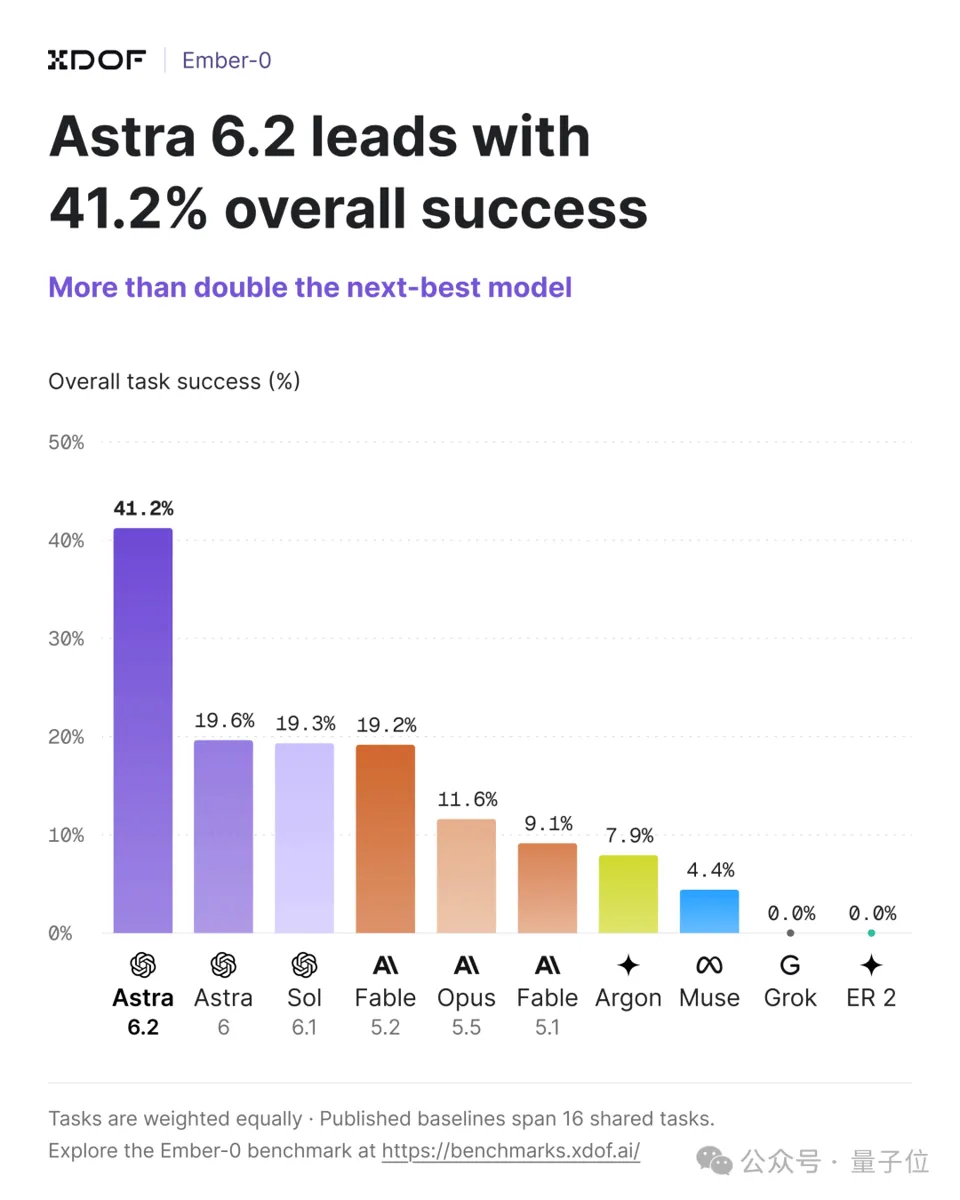
In the latest real-world tests by robotics infrastructure company XDOF, GPT-6.2 Astra's comprehensive success rate across 16 manipulation tasks with a dual-arm robot soared from 19.6% with GPT-6 Astra two months ago to 41.2%—more than doubling.
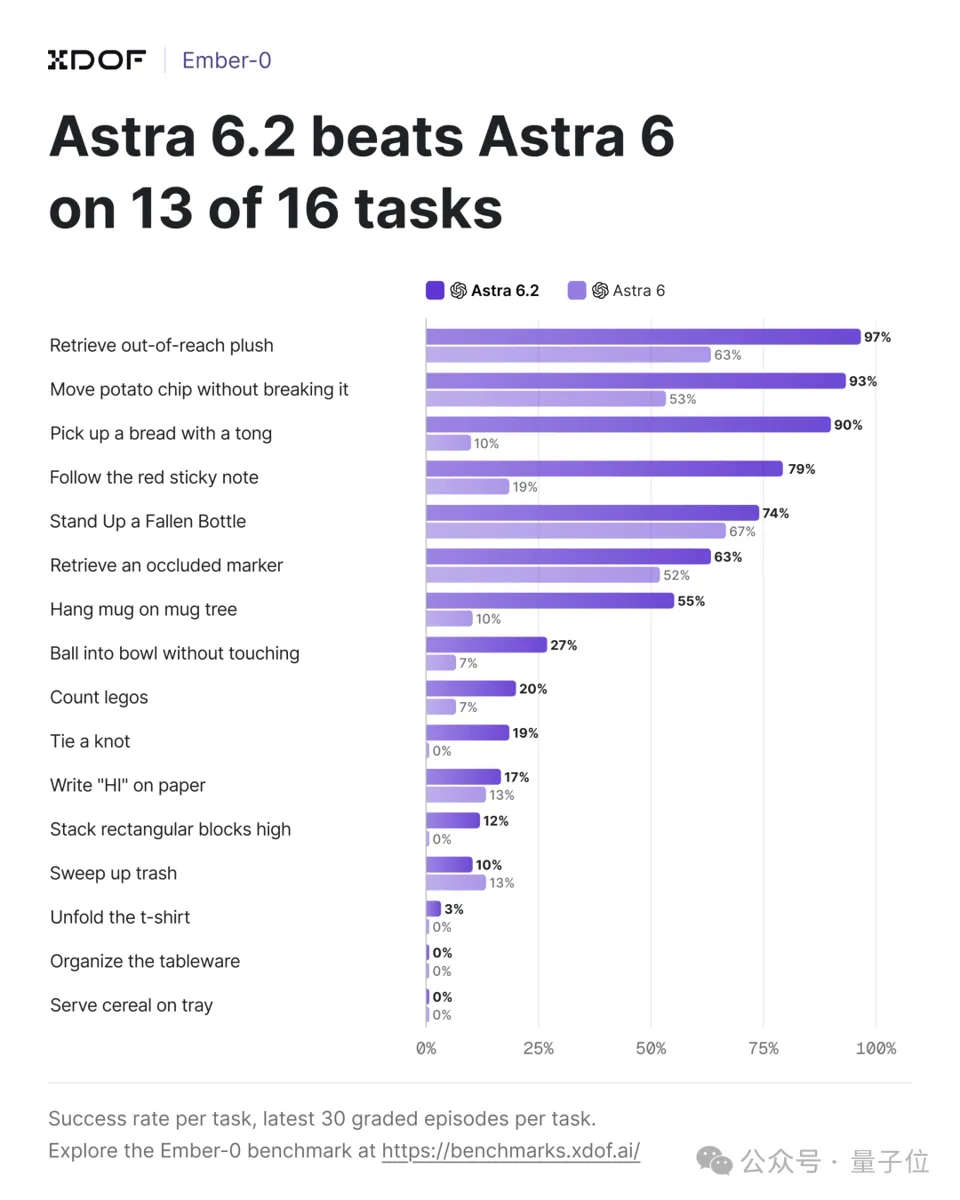
It also conquered two tasks that no AI had ever completed before: tying a knot and unfolding a T-shirt.
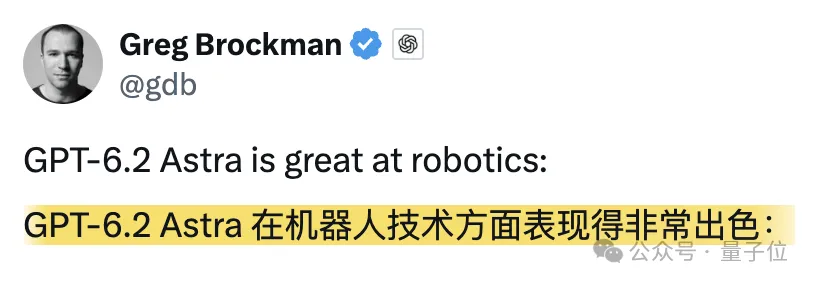
After the results were announced, the official OpenAI Developers account reposted the news, and OpenAI co-founder and President Greg Brockman proudly commented:
GPT-6.2 Astra is doing exceptionally well at robotics~~
To ensure evaluation rigor, XDOF ran six YAM workstations in parallel, repeating each task thirty times for 480 real tests per day, with human annotation of sub-steps, grasp failures, and collisions to filter out hardware bias and random perturbations.
Even with such stringent standards, XDOF stated in its latest tweet that the Ember-0 benchmark may soon be saturated by model capabilities.
Doubling Performance in Two Months—How Strong Is It Really?
To understand the significance of this breakthrough, we first need to grasp what makes these test tasks so difficult.
GPT-6.2 Astra participated in the Ember-0 test introduced by XDOF.
This is a robotics evaluation benchmark designed for real physical environments, using a dual-arm robot to complete 16 manipulation tasks, each executed under a protocol of 30 repeated trials.
The tests cover spatial reasoning, object grasping, dual-arm coordination, tool use, fine manipulation, and deformable object handling.
Two months ago, GPT-6 Astra achieved a comprehensive task success rate of 19.6% on the Ember-0 test.
With GPT-6.2 Astra, that number has surged to 41.2%, an increase of 21.6 percentage points—more than double the original. The 41.2% here is the equal-weighted average success rate across 16 shared manipulation tasks, covering object grasping, spatial reasoning, dual-arm coordination, tool use, and more.
So the progress is not driven by a single-task breakthrough—GPT-6.2 Astra shows marked improvement across the entire test suite.

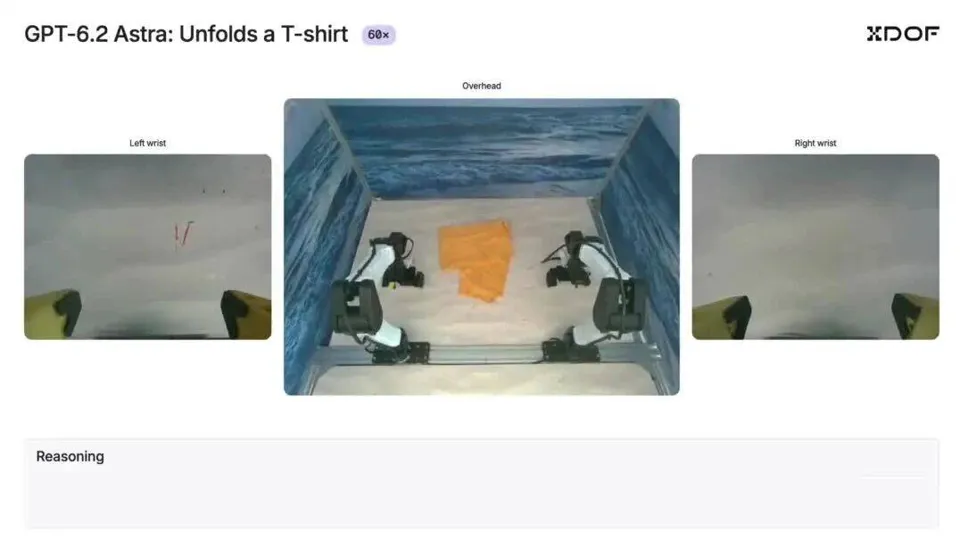
The most eye-catching achievements are undoubtedly "tying a knot with a rope" and "unfolding a T-shirt," both of which GPT-6.2 Astra handled with ease.
Previously, Ember-0 had accumulated 143 valid T-shirt unfolding trials, and not a single model had successfully completed this task.
Beyond these two landmark breakthroughs, the model also showed significant improvement on many other tasks covered by Ember-0.
- "Pulling a towel to retrieve a distant plush toy" and "tilting a tray so a ball rolls into a bowl," which require physical reasoning
- "Finding an occluded marker" and "following hidden instructions on a red sticky note," which test memory and perception
- "Moving a potato chip without crushing it," "picking up bread with tongs," and "serving cereal onto a tray," which test fine force control
- ……
GPT-6.2 Astra demonstrated significant improvements in both checkpoint completion and final success rates across all sub-tasks.
The most dramatic improvement was in the task of picking up bread with tongs: GPT-6 Astra had only a 10% success rate, while GPT-6.2 Astra raised it to 90%.
Why Are Knot-Tying and T-Shirt Unfolding So Hard?
To understand the significance of GPT-6.2 Astra's breakthrough, we first need to grasp just how challenging "tying a knot" and "unfolding a T-shirt" really are for robots.
In the field of robot learning, vision-language-action models (VLAs) and specialized policy models—represented by Diffusion Policy, ACT, and RT-2—typically rely on large amounts of human demonstration data to learn manipulation skills.
Humans demonstrate first, and the robot learns from that how to grasp, move, and place objects.
This approach has already achieved good results with rigid objects and fixed procedures.
Objects like cups and boxes have relatively stable geometry, and grasp positions and motion trajectories are easier to predict. After training, models can often develop fairly stable manipulation policies.
But switch to a different object, a different environment, or chain several actions into a more complex task, and the original policy may no longer work. The model may need to collect new demonstration data and undergo additional training to adapt to new operating conditions.
Deformable objects raise the difficulty another level.
When unfolding a T-shirt or tying a knot with a rope, the object's shape changes continuously with every contact, grasp, and pull of the robotic arm, and the deformation process is hard to predict in advance. The robot needs to understand the task goal—"unfold the clothes"—and continuously judge the garment's corners, wrinkles, and overall shape from visual feeds from wrist and overhead cameras, then decide the next action.
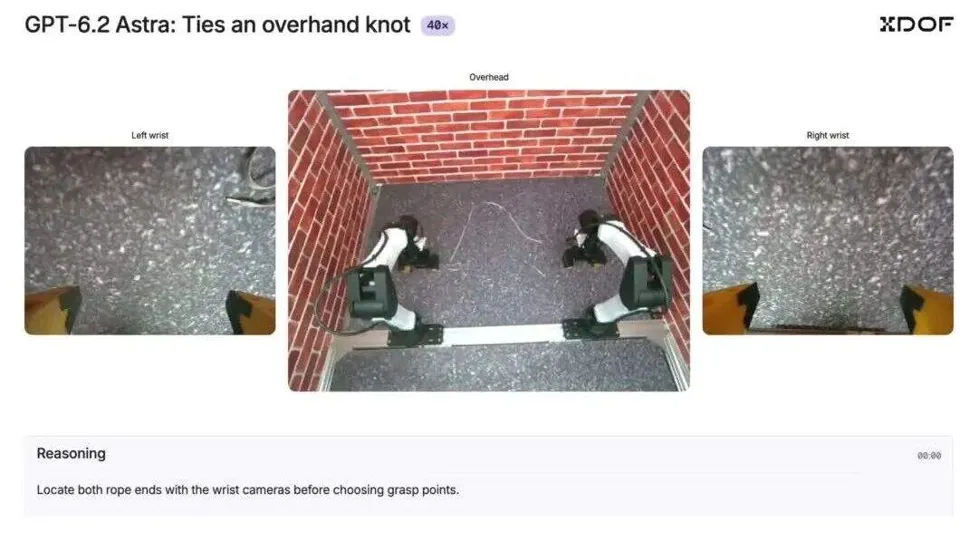
This places extremely high demands on manipulation precision and dual-arm coordination.
The slightest error in grasp position or action timing can cause a corner of the garment to slip, the rope to tangle, and all prior progress to be undone.
In XDOF's evaluation framework, the core capability tags for "tying a knot" and "unfolding a T-shirt" cover deformation control, dual-arm coordination, dexterity, and long-horizon planning.
Without tactile feedback hardware, there is also a ten-to-twenty-plus-second inference latency between each action chunk output by the large model. The robotic arm cannot make real-time micro-adjustments while waiting for new decisions, making every contact control and failure recovery extremely costly.
Therefore, knot-tying and T-shirt unfolding test a comprehensive set of capabilities, including 3D spatial understanding, dual-arm coordination, fine contact control, dynamic state tracking based on historical records, and long-horizon task planning.
BTW, speed has also been a persistent challenge for second-system models. One of the criticisms of such models has been that inference takes too long to meet the real-time requirements of robotic operation.
This time, GPT-6.2 Astra has also improved in speed.
During the model's release period, its average prediction latency dropped from 15 seconds for GPT-6 Astra to 10.1 seconds.
However, compared with other model architectures, this inference approach is still relatively inefficient. For robots that require continuous perception and rapid response, a wait of around 10 seconds is still not short.
But overall, embodied intelligence models often perform well on simple grasping and object placement, yet once they encounter complex contact, tool use, and deformable objects, their success rate drops noticeably.
The Ember-0 test results previously published by XDOF also show similar problems.
For example, the model can usually understand the task and plan actions that look reasonable, but when actually executed on a robotic arm, it tends to falter in grasping, contact, and continuous operation.
The breakthrough of GPT-6.2 Astra this time precisely indicates that general-purpose models have begun to overcome these difficulties.
**△**Image generated by AI
And from an industry perspective, the impact of general-purpose large models on embodied intelligence is also continuing to advance along this path.
From the NVIDIA research team testing GPT-6 Astra directly as a robot policy model, to Claude demonstrating complex manipulation capabilities in robotic simulation environments, to Google DeepMind extending Gemini's multimodal understanding capabilities to robot control, general-purpose models are repeatedly redefining the capability boundaries of embodied intelligence.
One More Thing
Jiafei Duan, a Presidential Young Professor at the National University of Singapore active in the robotics/embodied intelligence field, subsequently also posted praise for GPT-6.2 Astra's excellent performance in "invading" embodied intelligence.
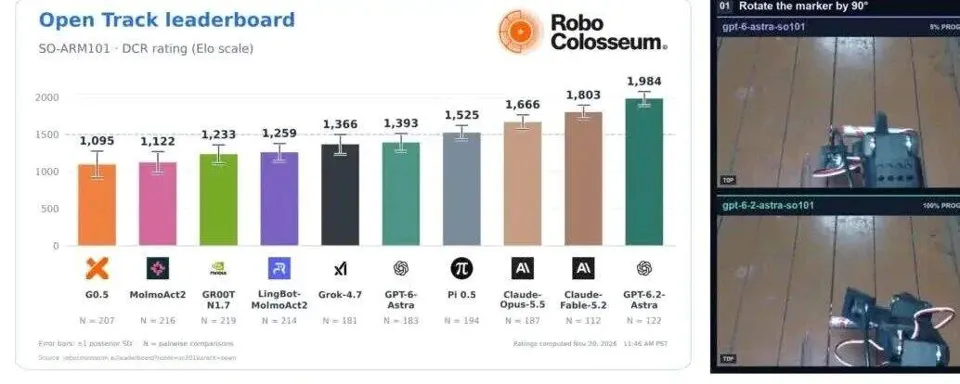
In their real-robot comparison tests, GPT-6.2 Astra performed remarkably well, shooting to first place in the SO-101 Elo ranking on RoboColosseum within a single day.
For the actual operation, please see the small screen:
From the first-generation model being helpless with deformable manipulation, to GPT-6.2 Astra doubling its success rate within two months and breaking through multiple zero-score tasks, the pace of evolution of frontier multimodal large models in the physical world is continuing to accelerate.
And at a speed that is somewhat overwhelming.
Tired, so tired.
I declare that every day in November is a dizzy-and-collapse day in the AI field (not really).
Reference links: [1]https://x.com/xdofai/status/2123822012066157011 [2]https://x.com/djiafei/status/2123925760281067567?s=46