Johns Hopkins and Together AI Find Higher Reasoning Effort Can Hurt Accuracy
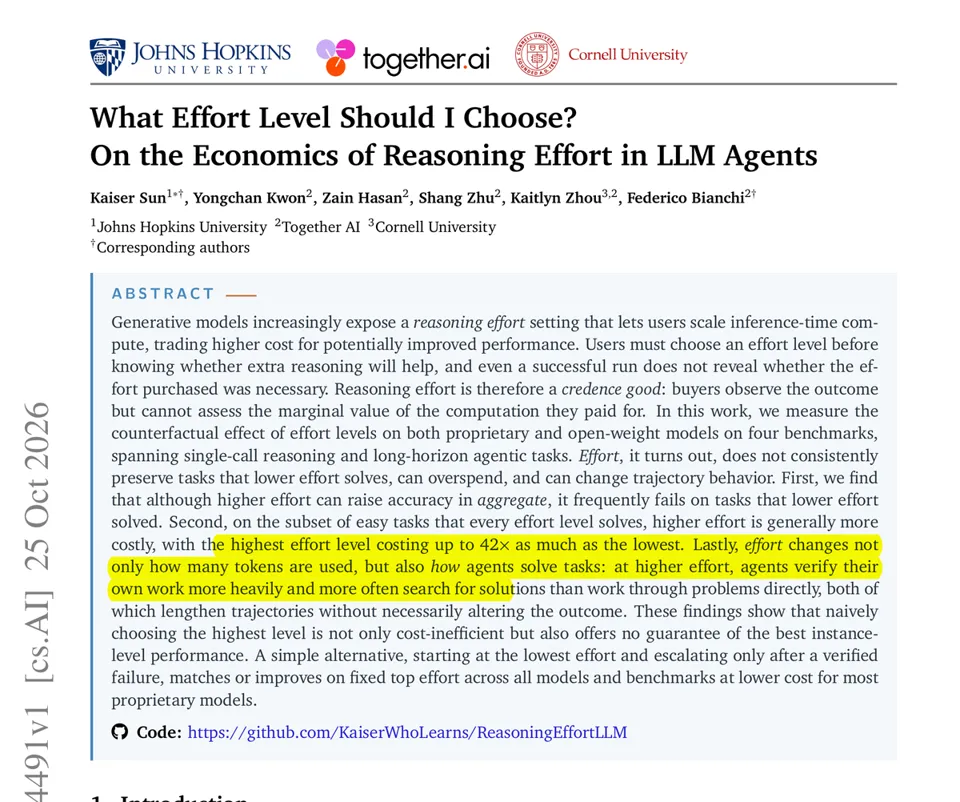
A new Johns Hopkins and Together AI paper finds that higher reasoning effort often fails tasks that lower effort already solved, even as overall accuracy rises. Testing 8 models including GPT-5.6 and Claude Sonnet 5 across math, science, terminal and coding benchmarks, the authors show that starting at low effort and escalating only after a verified failure matches or beats fixed top effort for every model, at a median 41.5% lower GPQA cost.
Related Entities
Full Report
Rohan Paul (@rohanpaul_ai) · 2026-11-26 01
New Johns Hopkins and Together AI paper finds that higher reasoning effort often fails tasks that lower effort solved, even when overall accuracy goes up.
starting agents at low effort and escalating only after a verified failure matched or beat fixed top effort for every model.
Many models offer a reasoning effort setting, picked once by intuition before a task. Users pay for the extra thinking but can't see whether it helped.
They ran 8 models, including GPT-5.6 and Claude Sonnet 5, at every effort level on math, science, terminal, and coding benchmarks. They tracked which tasks each level solved and what each run cost.
On tasks every level solved, the top setting cost up to 42 times as much as the lowest. Starting low and retrying at top effort after a verified failure matched or beat fixed top effort everywhere, at a median 41.5% lower GPQA cost.
If you have a reliable pass/fail check, default agents to low effort and escalate only on failure, instead of paying for max effort.