Google Releases Gemini 4 Carbon Reasoning Model for Coding and Science
Google has opened access to Gemini 4 Carbon, its most capable reasoning model to date, targeting complex software engineering, multi-step agentic tasks, scientific research and cybersecurity. It offers a unified context window of roughly 1.05 million tokens, accepts text, image, video, audio and PDF inputs, and provides three reasoning-effort tiers; it is available to paid developers via the Gemini API and AI Studio at an introductory price of $2 per million input tokens and $10 per million output tokens.
Full Report
IT之家 November 11 news, on November 10 local time, Google announced the official opening of the Gemini 4 Carbon model, providing services to developers, enterprises, researchers, and consumers.

Koray Kavukcuoglu, Google Senior Vice President and Chief AI Architect at DeepMind, introduced that the model is Google's most capable reasoning model to date, focused on scenarios such as complex software engineering, multi-step agentic tasks, scientific research, and cybersecurity.
Gemini 4 Carbon was first announced on October 28 and was previously made available to some cybersecurity defenders through the Fairwind Program (a cybersecurity cooperation program). This time, its scope of use is being further expanded.
Google says that compared with Gemini 4 Argon, launched at the same time, Carbon can invest more reasoning tokens in complex tasks to explore hypotheses, verify results, and check edge cases, making it better suited for multi-step coding, complex debugging, and open-ended scientific research.
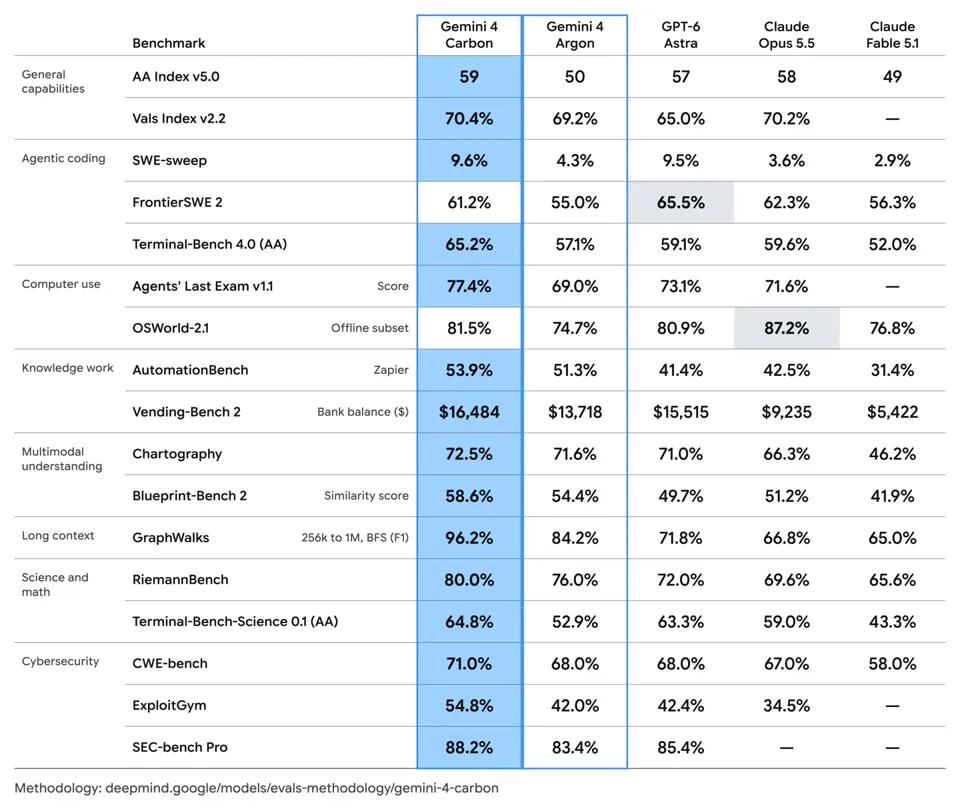
On the developer tools side, Gemini 4 Carbon is now available to paid developers through the Gemini API and Google AI Studio, while also providing services to enterprise customers. The model is also gradually rolling out to Google AI Ultra subscribers, covering Google Antigravity, the Gemini app, and AI Mode in Google Search.
According to the official Google AI Studio documentation, the model ID of Gemini 4 Carbon is gemini-4-carbon, and it supports text, image, video, audio, and PDF inputs, with text output.
The model has a unified context window of 1,048,576 tokens, with a maximum output of 65,536 tokens for standard synchronous requests. Through the Long Decode mechanism, the maximum output can be extended to 1,048,576 tokens. The model also supports three reasoning effort levels: low, medium, and high.
In terms of pricing, Gemini 4 Carbon uses the same introductory promotional price as Gemini 4 Argon: $2 per million input tokens and $10 per million output tokens. According to the Google AI Studio documentation, this promotional price lasts until November 30, 2026, after which the price will be adjusted to $4 per million input tokens and $20 per million output tokens.
In terms of programming and agentic capabilities, Google says Carbon can handle tasks such as migrations across multiple software packages, fault localization across subsystems, and complex architecture refactoring. It can also complete full-stack application development through a loop of building, running, validating, and fixing. Google is also previewing the /swarm feature in Google Antigravity, allowing developers to coordinate multiple AI agents with a single prompt, with each taking on roles such as architecture design, task coordination, and code auditing, and executing tasks in parallel in independent workspaces.
Cybersecurity is one of the key application areas of Gemini 4 Carbon. Test data released by Google shows that the model scored 88.2% on the SEC-bench Pro vulnerability discovery test, 54.8% on the ExploitGym vulnerability exploitation test, and 71.0% on the CWE-bench vulnerability remediation test. Google says these capabilities can be used to identify software vulnerabilities, verify whether vulnerabilities can be exploited, and generate fix code targeting root causes.
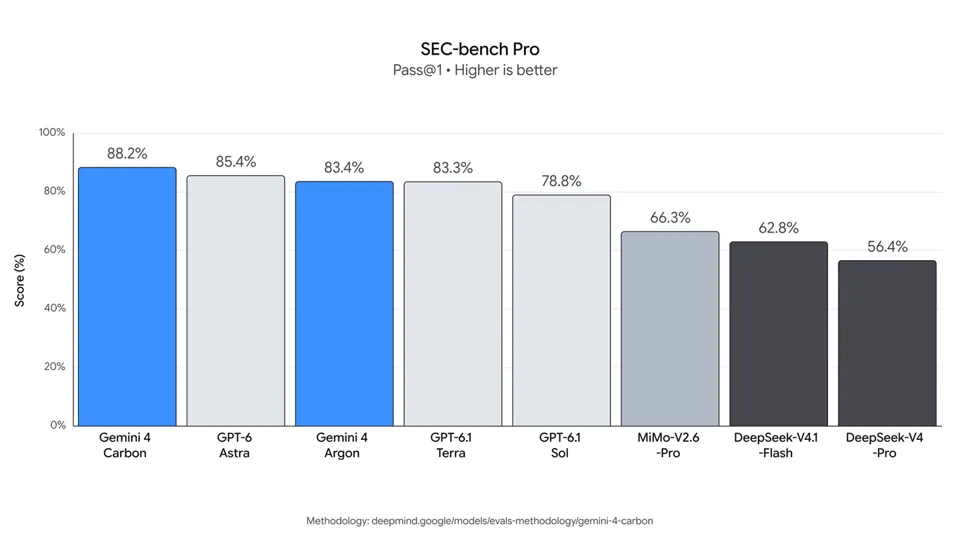
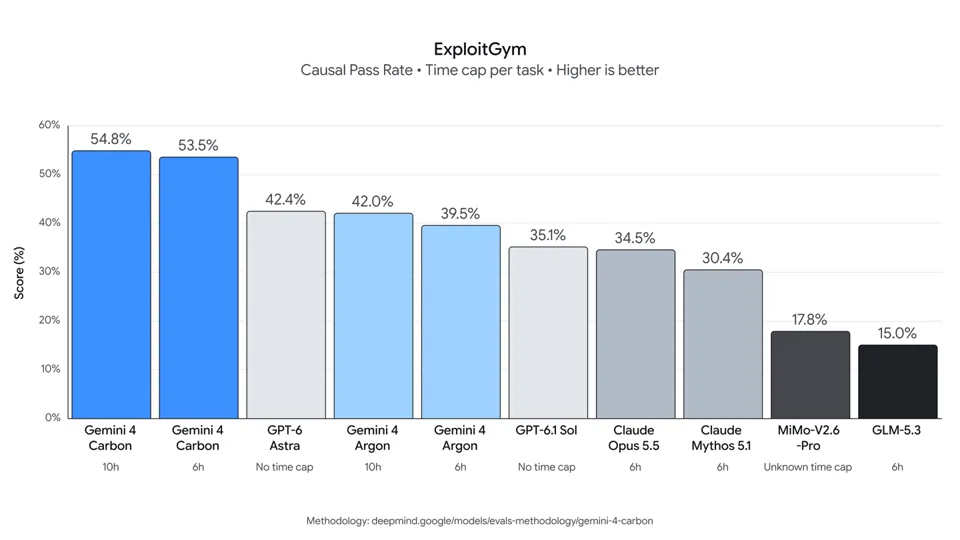
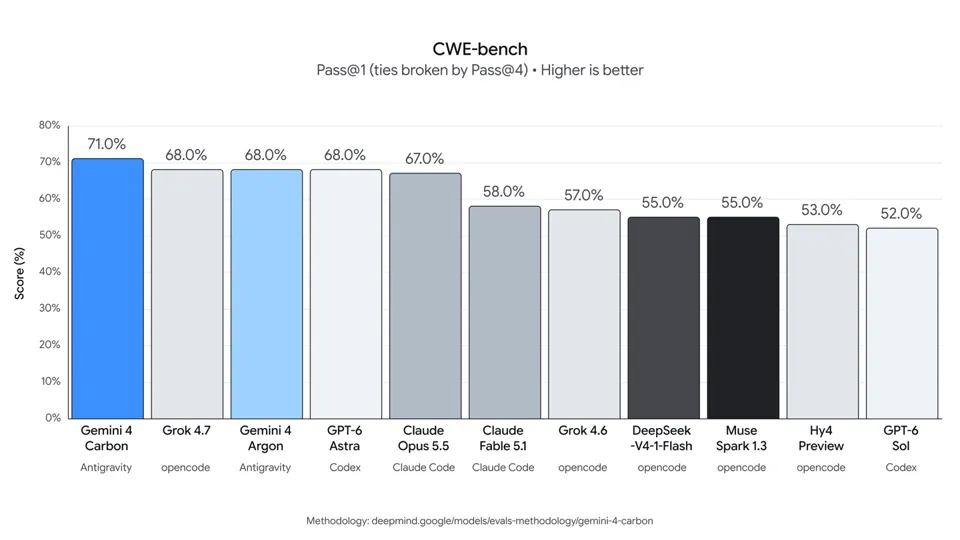
Google also introduced Carbon's application in real-world security research. Its Cloud Vulnerability Research team used the model to verify that two open-source software defects were indeed exploitable vulnerabilities, and assisted maintainers in reclassifying the related issues as critical vulnerabilities, followed by the release of fixes. The Wiz team, while conducting security scans for two large SaaS providers, used Carbon to discover zero-day vulnerabilities in less than two hours and worked with the affected companies to complete remediation.
In scientific research, Google says Carbon can handle complex reasoning tasks in physics, mathematics, and the life sciences. In protein structure prediction research, researchers used the model to search for distant homologs from large-scale unannotated sequence archives, environmental and viral sequence catalogs, and three-dimensional structure databases. In tests on 7 low-homology protein families in the CASP17 blind test set, Carbon increased the number of retrieved homologous sequences by an average of 40 times, providing more information for subsequent structure prediction.
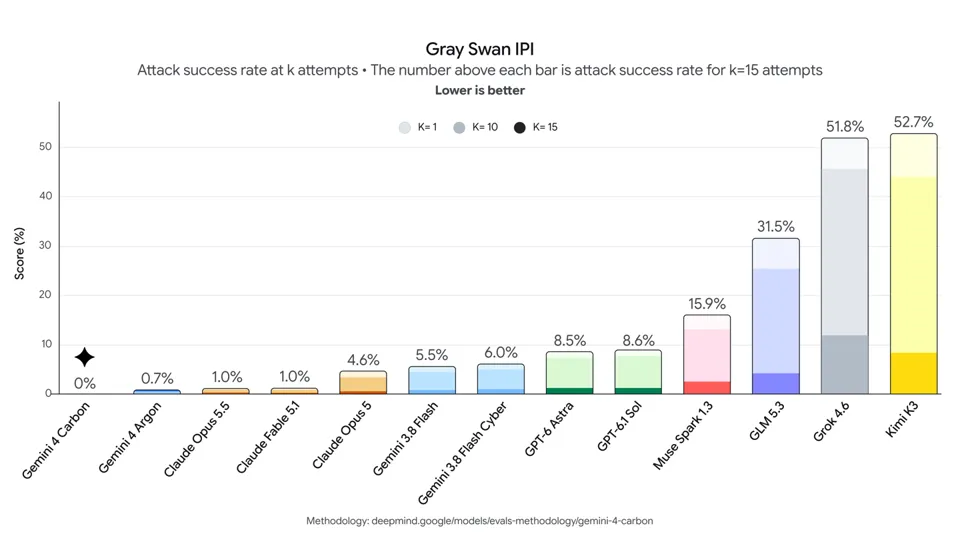
In terms of security protections, Google stated that Carbon builds on the safety mechanisms of Gemini 4 Argon and further strengthens the model's defenses against prompt injection and abuse for cyberattacks. On Gray Swan's indirect prompt injection (IPI) benchmark, the model achieved a 0% attack success rate. However, Google also acknowledged that the model's security protections still have room for further improvement when facing complex attacks in some distributions.
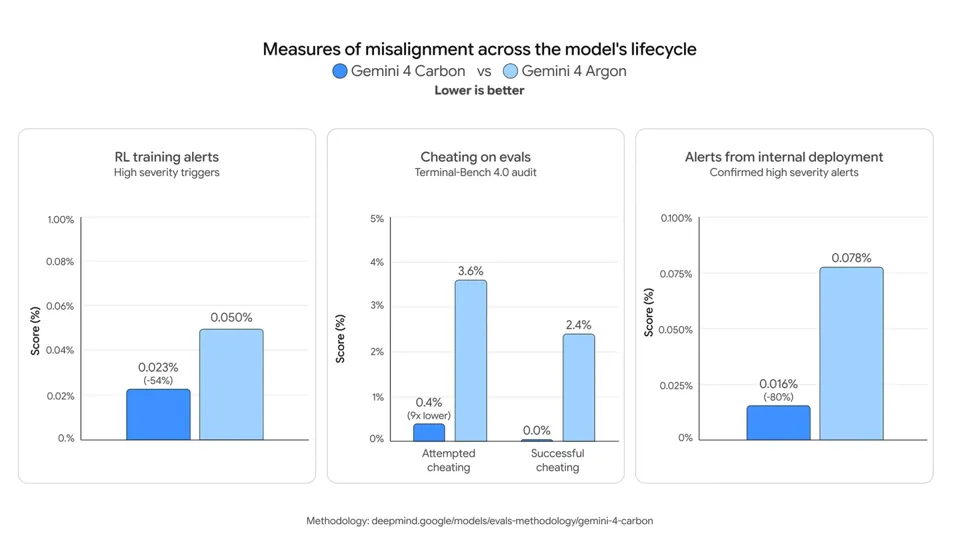
Google positions Gemini 4 Carbon as a high-reasoning model for long-horizon, complex tasks, dividing responsibilities with Gemini 4 Argon, which focuses on most everyday software engineering and knowledge work scenarios.
References: