Claude Ports CADO-NFS to GPU and Factors 270-Digit RSA Number
Anthropic security engineer Steve Weis reported that Claude ported CADO-NFS, an open-source factoring suite written for CPUs, to GPUs and then orchestrated a cluster of up to 2,048 GPUs for about 10 days, roughly 30 GPU-years, to factor the 270-digit RSA-896. The result does not break RSA's mathematical security; it shows how idle compute can be redirected into cryptanalysis and highlights AI's practical value in migrating legacy scientific code and scheduling heterogeneous hardware.
Full Report
The cryptographic moat is being filled in by AI's idle compute
New AI Era Report

A 270-digit number was split into two prime numbers.
No quantum computer, and no national laboratory.
What cracked it was the idle time leaking out between routine tasks in Anthropic's cluster, plus a Claude.
On September 19, Anthropic security engineer Steve Weis posted RSA-896 and its two prime factors on his personal website.
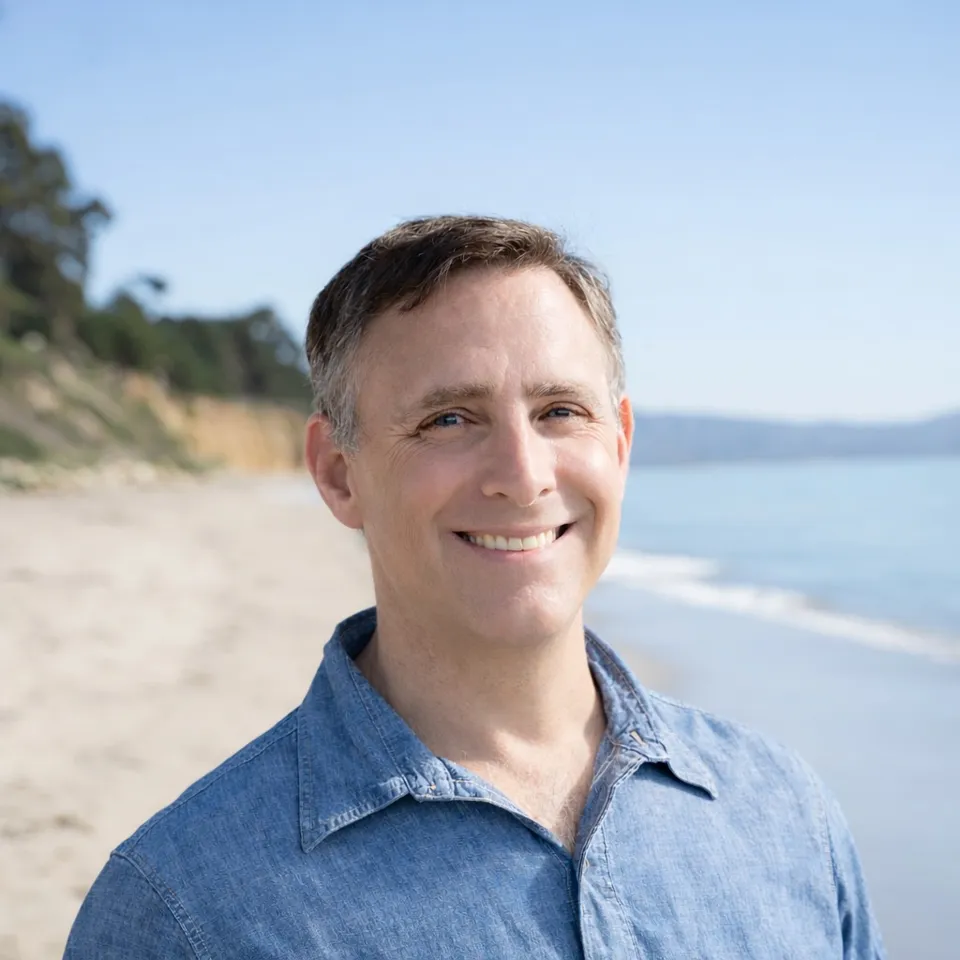
Steve Weis
The core sentence of the announcement read: Claude was responsible for porting CADO-NFS to the GPU.
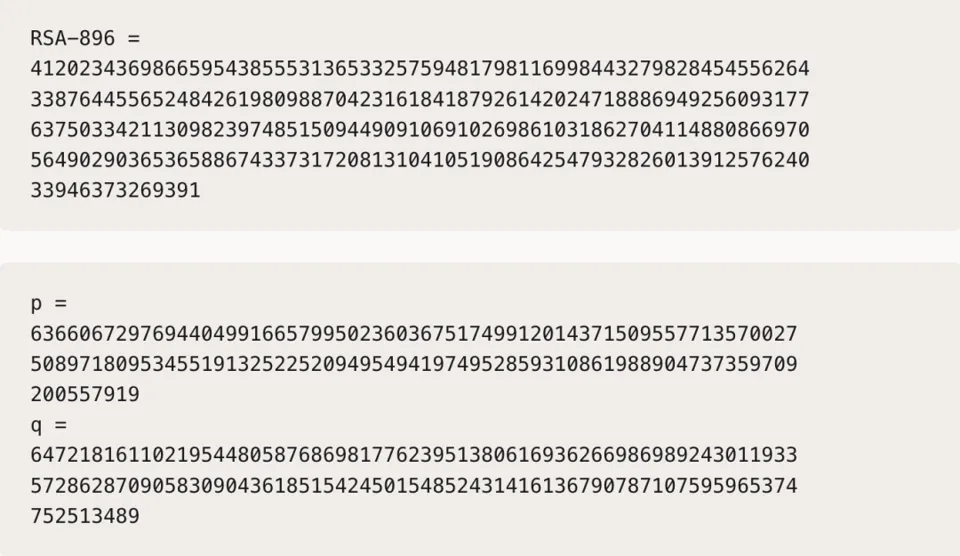
The full picture of RSA-896: a 270-digit number, and the two 135-digit prime factors p and q it was split into, whose product exactly restores it.
CADO-NFS is an open-source piece of software built specifically for factoring large numbers, polished by French researchers for nearly 20 years; RSA-250 was cracked with it.
But it has a limitation: it was written for CPUs.
A CPU is like a handful of versatile master craftsmen, while a GPU is like thousands of assembly-line workers. To have the workers replace the master craftsmen, the entire workflow has to be broken down and rewritten.
That renovation work is exactly what Claude did. After the rewrite, it was also responsible for scheduling the entire GPU cluster and running the computation to completion.
According to Weis's disclosure, this computation used at most 2048 GPUs, ran for 10 days, and totaled about 30 GPU-years.
Even more dramatically, Weis's PhD advisor at MIT was Ron Rivest, the "R" in the famous RSA of cryptography.
In 1977, Rivest, Shamir, and Adleman proposed RSA, making the difficulty of large integer factorization one of the important security foundations of modern public-key cryptography:
Multiplying two large primes together is easy, but splitting them apart in reverse is impossibly hard.
The three RSA inventors appeared together at the CRYPTO cryptography conference in August 2017. From left: Rivest, Shamir, Adleman.
49 years later, his student, armed with AI, solved the exam question his teacher had set back then.
A 16-day record broken twice in a row
The RSA challenge is a public exam paper in the cryptography world:
You are given a number obtained by multiplying two large primes, and whoever can reverse it wins.
Multiplying forward takes barely a second; factoring backward might take machines around the world years of computation.
The sense of security in RSA encryption is built on this asymmetric difficulty.
The larger the number that can be factored, the lower the threshold for breaking real-world encryption.
In 1991, RSA Laboratories launched this challenge, with prize money for whoever cracked it. In 2009, the 232-digit RSA-768 was factored.
In February 2020, a joint French-American team used the open-source software CADO-NFS to factor RSA-250, running for several months across multiple clusters in France, Germany, and the United States, consuming a cumulative total of about 2700 CPU-core-years.
Then, nothing happened for 6 years.
Until September 3, 2026, when a result finally came out on Cognition's cluster: RSA-260 had been factored.
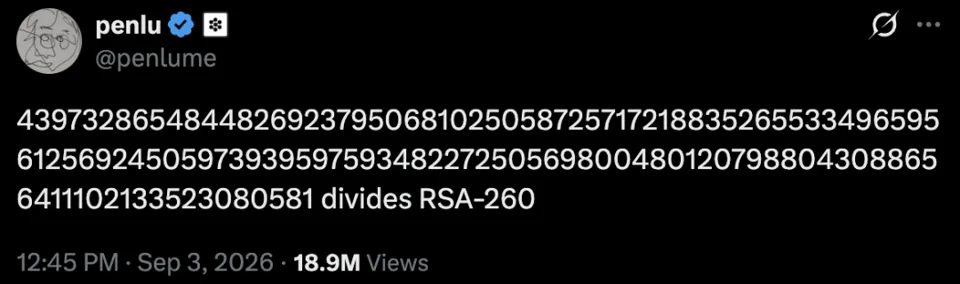
On September 3, Eric Lu posted just a 130-digit number on X, plus one sentence: "divides RSA-260," meaning this number divides RSA-260.
Cognition researcher Eric Lu, together with a group of Devins, took about three weeks from typing the first prompt to getting the answer.
He also claimed that Devin had newly built a GPU-based lattice siever, specifically targeting the most compute-intensive step in the entire factoring pipeline, pushing the cost of factoring down to one-tenth of the previous publicly known best.
16 days later, it was RSA-896's turn.
RSA-896 and RSA-260 differ by more than six hundred in name, but in reality only by 10 digits: the former is named by its number of binary digits, which converts to 270 decimal digits.
Do not underestimate those 10 digits.
By Eric's estimate, for every additional 10 digits, the computational effort grows to more than 2.5 times the original.
Comparing these two records: RSA-260 used about 13.5 GPU-years, and at that multiplier, 10 more digits means computing to over 30 GPU-years.
Roughly extrapolating at this rate, for every additional 100 digits, the computational effort multiplies by nearly ten thousand times.
RSA-896 once carried a $75,000 prize, but the challenge was shut down back in 2007, so that money has long gone unclaimed.
No new mathematics
What exactly did AI do
For factoring large numbers, the main algorithm has not changed in decades: the General Number Field Sieve, GNFS.
It proceeds in several steps: polynomial selection, lattice sieving, filtering, linear algebra, and square root. The most compute-intensive is lattice sieving, which requires searching through billions of small tasks, one by one, for "smooth numbers" that meet the conditions.
CADO-NFS implements all of these steps.
The trouble lies in lattice sieving: it is packed with conditional branches and irregular memory access, making it extremely awkward to put on a GPU.
In all previous public records, the lattice sieving step was run on CPUs. Whether a GPU lattice siever is actually worthwhile has never been settled in the industry.
This time, the accounts finally added up. As for exactly how they did it, Eric's technical report happens to serve as a reference.
In the early hours of August 13, Eric sent Devin a prompt: write a GPU-based lattice siever for CADO-NFS, and keep iterating until it beats the CPU version.
One sentence in the prompt is thought-provoking: the intersection of experts who understand both GPU kernels and number theory has always been small, and now, you are in that intersection.
Lu sent Devin a prompt: build a fast GPU-based lattice siever for CADO-NFS, directly replacing the original CPU version.
Rather than writing a prompt, this was more like assigning a task to a top-tier peer.
Two hours later, he added one more requirement, then went to sleep.
Devin iterated on its own for 7 hours, and when he woke up, the GPU siever had already outperformed the CPU version.
Over the following week, Devin revised almost the entire pipeline.
But there was no new mathematics in any of it.
In Eric's own words, there was almost no algorithmic progress; it relied on "old-school performance engineering."
In the past, this would have taken a team of experts who understood both number theory and GPU kernels months of work.
Now, AI has lowered this engineering barrier, but the mathematical difficulty hasn't changed at all.
Humans Are Still at the Helm
Eric tallied it up: of the 233 Devin sessions used for the factorization, 192 required his manual intervention.
He sent a total of 3,328 messages and 82,702 English words. On average, he had 3 Devins running simultaneously, with a peak of 18. Only 36 sessions required no intervention at all.
So what does Devin need humans for?
Setting goals and defining boundaries; calling a halt when it sees it doing useless work; reminding it to "don't let the GPU sit idle waiting for the CPU"; pulling it back when it gives up too early.
In addition, humans need to build a unified measurement baseline.
The further the code drifts from upstream CADO-NFS, the more easily AI gets confused; humans must first break down the problem properly before AI can make progress.
Eric believes today's agents are like a loom: "I push it forward, and it can't work without me, but I'm not the one throwing the shuttle by hand either."
He also admitted that his understanding of these components is like that of an intermediate car enthusiast understanding an engine: "I don't really understand the underlying mathematics."
And another record-breaker, Weis, has exactly the opposite background.
He is a PhD student produced by Rivest, worked on Google two-step verification and the open-source crypto library Keyczar, co-founded the security company PrivateCore (acquired by Facebook in 2014), and now works on Anthropic's security framework team.
One is an enthusiast who doesn't really understand number theory; the other is a veteran with a formal cryptography background. Put their examples together, and what AI lowers is the extremely scarce barrier of "GPU performance engineering × computational number theory."
Leftovers in the Data Center
The two records also share another commonality: both ran on idle compute from AI companies.
Weis said RSA-896 was completed on Anthropic's own cluster, but no machines were specifically set aside for it.
It was set as a low-priority task, working only when machines were idle. Seizing every spare moment like this, the job was done in 10 days.
Where did this idle capacity come from? The problem lies in "bin packing."
The NVL72 racks commonly used by AI companies nominally have 18 machines per rack.
The scheduling system allocates tasks into racks like stuffing blocks into a box, and there are always one or two left idle:
some tasks need a spare machine in case of failure; some tasks only want an even number of machines, but the rack happens to have only 17 left.
At Cognition, these leftovers add up to a few percentage points of total compute.
Lattice sieving happens to be perfectly suited to filling such gaps.
It can be split into billions of small tasks; whichever machine is idle takes one and computes it, and it doesn't matter if it gets preempted by a formal task midway—it can just pick up again next time.
Both rounds scavenged gaps in the data center. RSA-896 used about 30 GPU-years, more than twice that of RSA-260; the number is larger, so it consumed more compute.
The most striking thing is this:
The leftovers an AI company drops while training models are enough to set a new cryptography record.
This means whoever holds large clusters gains, as a side effect, the ability to rewrite the rules.
RSA-1024 Risk Further Highlighted
So is the encryption behind online banking and HTTPS still safe?
RSA-2048 is not substantially affected by this factorization breakthrough, while the risk to RSA-1024 is further highlighted.
Both parties emphasized this point.
Eric estimates that RSA-2048 is about a billion times harder than RSA-1024, and this efficiency improvement has almost no effect on it.
What was really called out is RSA-1024. Steve Weis wrote in the announcement:
This work shows that many entities with data-center-scale GPU clusters have the ability to threaten RSA-1024.

Weis drew three lines in the announcement: the algorithm did not get faster, RSA-2048 remains safe, and RSA-1024 is no longer safe.
According to compute scaling laws, RSA-1024 requires only about 78 times more computation than RSA-260, equivalent to about $30 million at market prices.
Eric also said that if the engineering is further optimized, it wouldn't be surprising for the cost to be cut in half.
It should be noted that no one has publicly factored a 1024-bit RSA key to date, and 1024-bit keys were deprecated as early as 2013.
But old systems in the real world don't get replaced that quickly.
The team that factored RSA-250 mentioned in a paper that a ready-made network switch they bought in 2018 had a factory-default SSH key of only 768 bits.
This is also the significance of regularly refreshing compute records: providing the most realistic yardstick for key lengths worldwide.
The Math Hasn't Changed
The Barrier to Computation Has
In 1977, Rivest staked RSA's security on the difficulty of factoring large numbers.
49 years later, this mathematical judgment has not changed.
But how many experts, how much manpower, and how much time it takes to organize a large-scale computation has changed.
In the past, it took a team that understood both number theory and GPUs grinding away for months, then mobilizing research clusters across three countries to compute together.
Now, one person, one AI, and a patch of idle compute in a data center are enough.
But this patch of idle capacity belongs only to those AI companies that already hold large clusters.
Factoring RSA is not the first time they have crossed boundaries to set records.
Mathematical conjectures, Millennium Prize Problems, cryptography records—one human frontier after another is being rewritten by AI companies in succession.
The next record may again come from some AI company's side project.
And RSA's security boundary has changed along with it.
References:
https://cognition.com/blog/factoring-rsa-260
https://saweis.net/posts/rsa-896.html
https://x.com/penlume/status/2095372672356212876
Chasing ASI in Seconds
⭐Like, repost, and watch with one triple tap⭐
Light up the star, and lock in New Intelligence's instant push notifications!