Anthropic Uses Claude to Find Vault Protein Relatives in Bacteria
Anthropic's biology team used Claude to show for the first time that bacterial and phage relatives of vault proteins can assemble into vault particles, cutting particle isolation from about three days to 90 minutes and producing a first 3D structure model in 34 hours. The project took under four months, with researchers deciding and Claude executing and suggesting, demonstrating LLM productivity in structural biology discovery.
Related Entities
Full Report
宝玉 (@dotey) · 2026-11-05 07
A giant protein "barrel" discovered in human cells 40 years ago—no one yet knows what it does. Anthropic used Claude to find its counterparts in bacteria.
Scientists discovered a huge hollow protein "barrel" in our cells 40 years ago, called the vault, and to this day no one knows what it does.
On November 4, Anthropic's biology research team published an article describing their progress using Claude to study vaults:
• For the first time, they demonstrated that similar proteins in bacteria and bacteriophages (viruses that specifically infect bacteria) can also assemble into vaults • The experiment to isolate these particles was shortened from about 3 days to 90 minutes • They solved the 3D structure of one of them, producing a first-version model in 34 hours
Bacteria grow fast and are easy to work with. Studying vaults in bacteria gives scientists a better chance of figuring out their purpose, and in the future they might even be engineered into nanocapsules for delivering enzymes.
【What is a vault, and why is it worth looking for】
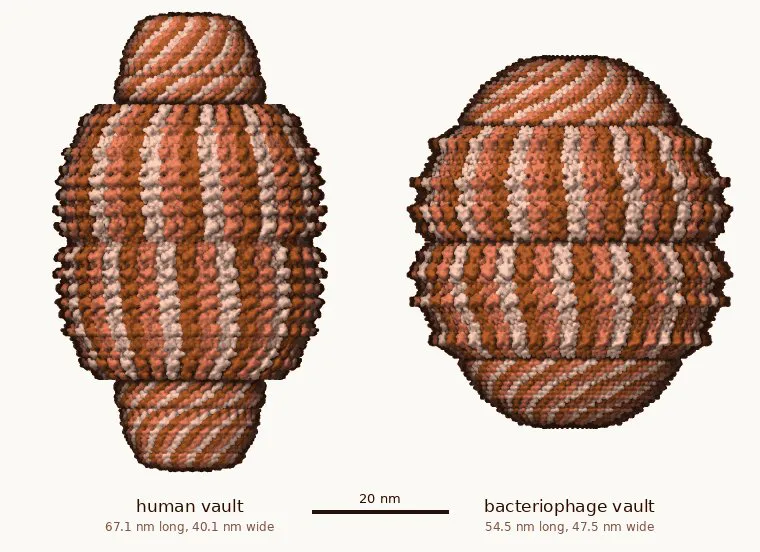
A vault is a hollow protein "barrel" found in almost every cell in the human body, and it is one of the largest known intracellular molecular structures. In 1986, Leonard Rome and Nancy Kedersha discovered it under an electron microscope and thought its ribbed shell resembled a church vault, so they gave it that name.
Scientists have guessed that it is responsible for transporting molecules, helping cells resist toxins such as anticancer drugs, or participating in immunity—none of which has been confirmed. Mice born lacking vaults still live normally.
One reason it is hard to study is that the most commonly used model organisms in biology—yeast, fruit flies, and nematodes—happen to have no vaults. Previously, complete vaults had only been seen in complex organisms such as animals and plants. Similar proteins had been found in bacteria, but no one had proven they could actually assemble into barrels.
This path has worked before: several human immune mechanisms were only understood after "distant relatives" were first found in bacteria.
【What Claude did, and how much faster it was】
The entire project took less than 4 months. Team members had never worked with protein assemblies this large before, and their structural biology experience was limited. The division of labor was that the researchers made the decisions, while Claude executed and offered suggestions.
Step one: find relatives. Claude searched about 15 billion predicted protein sequences for relatives of vault proteins and found that they are widely distributed, appearing in 29 bacterial phyla and 4 archaeal phyla, but they are very rare—in less than 1% of species with sequenced genomes.
Step two: produce the proteins. The researchers selected 44 candidates, and Claude converted each protein sequence into a DNA design suitable for the host cell, added control switches, and prepared the orders. In the end, 15 produced usable proteins in E. coli.
Step three: isolate the particles. The traditional method takes about 3 days. The team wanted to switch to a column that sorts by particle size, and Claude initially objected on the grounds that misfolded protein clumps would flow out together with the vaults.
The team insisted on trying, so Claude recommended specific columns and validation methods. Then Claude proposed pouring the "crude soup" from broken cells directly onto the column without purification.
The researchers hesitated at first, because such columns are expensive and the crude soup might clog or contaminate them—but it worked. From cells to electron microscopy samples, the time was reduced to about 90 minutes. Of the 15 proteins, 7 assembled into vault-like particles, and cryo-EM confirmed 4 of them: 2 from bacteriophages and 2 from bacteria.
Step four: solve the structure. Cryo-EM involves flash-freezing large numbers of particles, photographing them with an electron beam, and then combining thousands of images into a 3D model. Manually, this step usually takes weeks to months, adjusting professional software little by little.
This time, Claude installed the open-source software RELION by itself within Anthropic's internal multi-agent system and ran every step, with researchers only giving input on key analytical decisions.
The first complete model came out in 34 hours, and the final result came about a week after processing began. The tweet's claim of "from weeks to months down to days" refers to this step.
【What they found】
The structure solved was a bacteriophage protein, which the team called L05. Bacteriophages use the bacterial body to make proteins, so this barrel was assembled inside bacterial cells.
It is made of 96 identical proteins, 48 in each half, whereas the human vault has 78. It is shorter and fatter, about 54 nanometers long and 45 nanometers wide (the human one is 67 and 40), yet its internal space is about 25% larger. This is one of the largest protein shells found in simple organisms such as bacteria.
The team also made two sets of modifications. By changing the contact points between proteins—sometimes just one—the barrel could no longer close, turning into an open wreath shape. By duplicating two more copies of the 7-repeat "brick" segment in the protein, making it 9 segments like the human version, the barrel became larger, with about 20% more internal space. This suggests that vaults may have grown larger during evolution by duplicating their own bricks, and that in the future they could be engineered into nanocapsules for delivering enzymes.
The function is still unknown, but there is one clue: a small unrecognized molecule is stuck in a small pocket of each protein. Claude noticed that its shape resembles coenzyme A, a common "helper molecule" cells use to carry chemical groups. If that is what it is, it would be the first hint about function.
Rome, one of the discoverers, was an advisor on this project. After seeing the structure, he said that figuring out the function of vaults remains extremely difficult, and that the broad scope of this discovery suggests its function may be complex.
【What mistakes Claude made, and how they were fixed】
The article lists two mistakes. One was that in an experimental protocol written by Claude, the culture medium included an additive that interferes with delivering DNA into cells, setting the project back two weeks. The other occurred early in cryo-EM processing, when Claude skipped a standard step, and the resulting 3D map mixed the structure with its mirror image, like overlaying photos of a left hand and a right hand into one image. The researchers told it to stop improvising, in the exact words: "Unless the conventional approach doesn't work, we do it the conventional way."
The team gave the experimental records to the machine learning researchers who train Claude so they could see where the model went wrong, and used that to adjust the data Claude learns from. The researchers said that new models were rolled out during the project, and Claude's DNA design errors appeared to decrease, and it became better at pointing out pitfalls in experiments in advance. In areas the team was familiar with, mistakes were caught quickly; in unfamiliar areas, mistakes took longer to find. The team's conclusion was that the benefits far outweighed the drawbacks.
【Can an ordinary lab follow suit】
Anthropic says that most of the work here could be done by a typical lab using existing Claude products. The only exception is cryo-EM analysis, where hundreds of GPUs were used in parallel this time to save time, exceeding the computing resources available to most universities.
These vaults have so far only been produced in E. coli; whether they form in the bacteria and bacteriophages where they originally occur has not yet been verified. The paper is a preprint, submitted to bioRxiv, and has not yet undergone peer review. Rome receives consulting fees from Anthropic.
Source: https://t.co/9y7HDslIQq Preprint: https://t.co/U7JswXqrn0
↳ Quoting @AnthropicAI (Anthropic): We're sharing how our biology research team worked with Claude to map the first 3D structure of a vault particle from bacterial life.
Vault particles are a longstanding mystery. They are barrel-shaped objects, among the largest protein structures found in our cells. They were first discovered by Leonard Rome and Nancy Kedersha in 1986, but their function remains unknown.
With Claude, we've found results that might bring us closer to solving that mystery.
Until now, vaults were only known in the cells of complex things like animals and plants. We have shown that similar proteins from bacteria (and the viruses that infect them) can also assemble into vaults. Finding the structures in these simpler forms of life may make it easier to investigate their function in our own cells.
For our life sciences team, the project was also a demonstration of the potential (and the limitations) of using AI to accelerate science.
In our full piece, we discuss how Claude was able to dramatically speed up some stages—manually determining the vault particle's structure would have taken weeks to months of painstaking work, but here it took days. We also discuss how Claude made some simple mistakes along the way, and how we collaborated with our machine learning researchers to address them.
Read more: