Google Releases Gemini 4 Hydrogen Lightweight Model with Triple Coding Gains
Google has launched Gemini 4 Hydrogen, a lightweight member of the Gemini 4 family succeeding Gemini 3.8 Flash. It delivers 2.5x faster task completion, raises Terminal-Bench 4.1 from 18.2% to 57%, cuts hallucinated statements by over 5x, and scores 51 on the Artificial Analysis Intelligence Index, edging past the flagship Gemini 4 Argon at 50. With a 1M-token context window priced at $1.5 per million input tokens, it can also pair with Gemini 4 Carbon in a large-model-orchestrates, small-model-executes agent setup.
Related Entities
Full Report
Contents4 sections

2.5x faster, 3x coding capability, 5x lower hallucination rate
Wen Le, reporting from the Non-Obvious Lab
QuantumBit | WeChat Official Account QbitAI
Google's small cup is pretty fierce this time.
It runs 2.5x faster than the previous generation, its coding Agent score more than tripled, and it even overtook its own big cup???
Just now, a new member of the Gemini 4 family—
Gemini 4 Hydrogen, officially debuted.
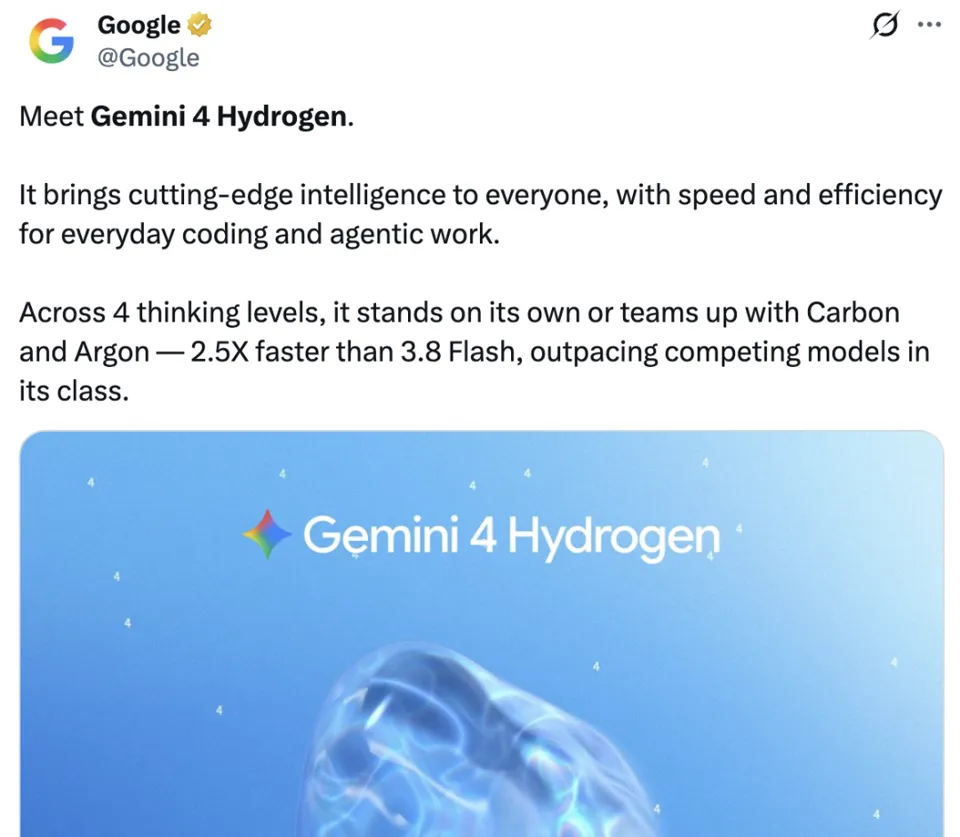
As the lightweight model replacing Gemini 3.8 Flash, Hydrogen was originally supposed to dutifully handle fast responses, everyday coding, and those Agent tasks that don't require bringing out the top-tier model.
But when Google published the results—wow.
On the Artificial Analysis Intelligence Index composite intelligence index, Hydrogen scored 51 points in the default High thinking tier, already surpassing Gemini 4 Argon's 50 points.
If you push the thinking intensity to the highest xhigh, Hydrogen can climb further to 54 points.
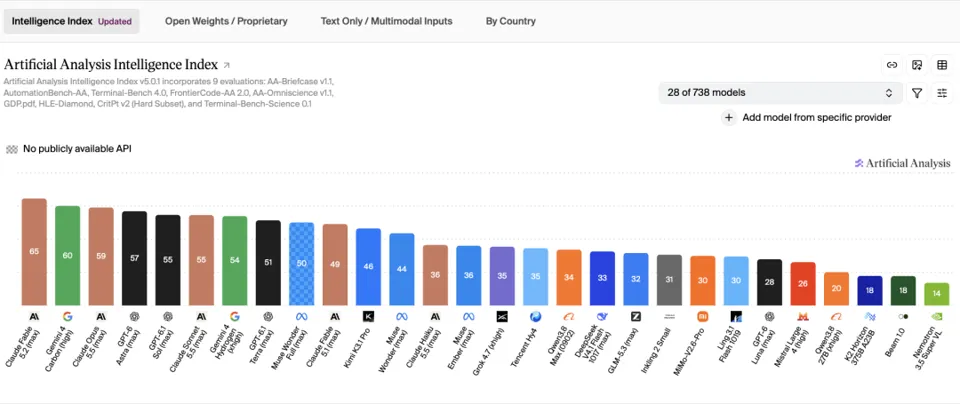
Of course, Argon is still primarily aimed at complex reasoning and long-horizon tasks, but this upgrade is indeed substantial.
Compared with Gemini 3.8 Flash:
Task completion speed increased 2.5x, Terminal-Bench 4.1 score soared from 18.2% to 57%, and fabricated statements reduced by more than 5x.
Writing code, fixing bugs, looking up information, operating tools, handling complex documents—Hydrogen has all of these on its key upgrade list.
Some netizens tested Gemini 4 Hydrogen High in Antigravity ahead of time, asking it to build a futuristic city with flyable shuttles.
With just one round of follow-up optimization, the rendering was fairly smooth.
It can also team up with Gemini 4 Carbon, letting the large model handle coordination and the small model handle execution—AI Agents are starting to embrace the large-cup-small-cup pairing too.
Hydrogen is currently rolling out to users worldwide, with Google AI Studio, Gemini API, Gemini App, Google Search, and other entry points all included in the rollout.
Within the full 1 million Token context window, its input pricing is fixed at $1.5 / million Tokens.
Coding capability tripled
Hydrogen has undergone extensive specialized optimization for coding scenarios.
When facing large code repositories, it can read multiple files in parallel and search for relevant code, avoiding flipping through files one by one.
When fixing bugs, it also tries to touch only the parts that need modification, rather than casually refactoring a bunch of unrelated code along the way.
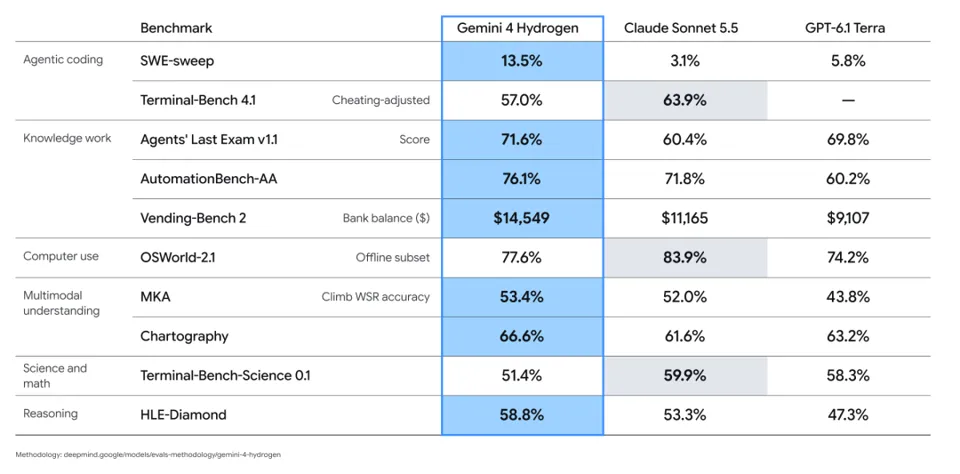
On SWE-sweep, which specifically tests code defect discovery and repair capability, Hydrogen scored 13.5%.
(For reference, Claude Sonnet 5.5 scored 3.1%, and GPT-6.1 Terra scored 5.8%.)
Beyond coding, Hydrogen also performs well on long-horizon Agent tasks.
It scored 71.6% on Agents' Last Exam v1.1, higher than Claude Sonnet 5.5's 60.4% and GPT-6.1 Terra's 69.8%.
Stronger capability, and speed hasn't fallen behind either.
In the default High thinking tier, Hydrogen completes tasks 2.5x faster than Gemini 3.8 Flash.
Many enterprises that got early internal testing access also released their real-world results:
In data-intensive workflows, Box observed Hydrogen running at about 2x the speed of the previous generation, while Token consumption dropped by 12%.
Pixelcut tested 276 design tasks; Hydrogen completed them 1.8x faster, and the cleanliness of generated code improved by 30%.
In tests involving graph computation, SQL, and other tasks, STAN observed speed improvements of up to 2.8x.
……
It's clear that Hydrogen has set its sights on the execution efficiency of the entire Agent workflow.
It can even use spreadsheets to draw animations
In the official demos this time, there were several quite interesting cases.
One of the tricks:
Letting AI draw animations directly in Google Sheets.
Hydrogen treats thousands of cells as pixels, using Python, Google Sheets' native LET formulas, and conditional formatting to control how different cells are displayed.
In the end, an ordinary spreadsheet becomes a pixel canvas that can play animations.
Another demo is more aligned with everyday office needs.
After receiving a YouTube launch event video, it can automatically lay out and generate a complete PPT in Google Slides, and it will autonomously loop-check the layout, automatically fixing issues like overlapping text and misaligned formatting.
Google also demonstrated building an e-commerce website with Hydrogen.
With just one instruction, the model can generate a webpage that includes WebGL2 terrain shaders, staged scroll storytelling, 3D wireframe parameter cards, and an interactive configurator.
There's also a shared pixel-art island called Geminisland.
Users input a sentence, and Hydrogen can generate new 3D buildings in real time, adding them directly to the map, while others can also explore around in first-person view.
The big cup handles thinking, the small cup handles doing
Beyond working solo, Hydrogen also has a rather interesting positioning:
Specifically designed to support large models.
When building complex software projects now, a single Agent working from start to finish may need to repeatedly read code, plan architecture, call tools, and check execution results.
If every step calls the strongest—and most expensive—model, the cost naturally isn't low.
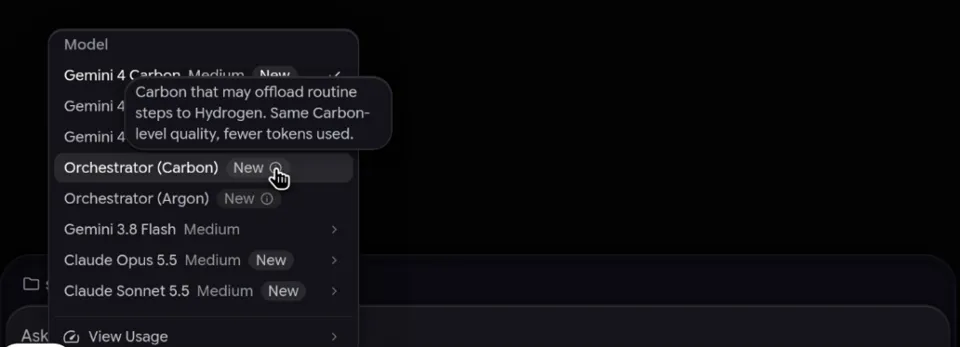
This time, Google launched a new feature in Antigravity, the Orchestrator.
Users don't need to manually switch back and forth between Carbon and Hydrogen.
The Orchestrator dynamically selects different models to complete work based on task needs.
For example, when a complex software project begins, the overall technical architecture needs to be decided, and this part can be handed to the more capable Carbon.
Once the architecture is finalized, the subsequent steps—writing code, running tests, and validating changes—can be handed off to Hydrogen.
For more complex scenarios, Carbon can also act as the coordinator, having multiple Hydrogen Agents execute in parallel and check different modules.
The large cup handles planning, while the small cup handles the legwork.
Google's testing on Terminal-Bench 4.0 found that the Orchestrator can achieve a task success rate close to using Carbon alone, while reducing quota consumption by an average of 24% and improving completion speed by 19%.
Hydrogen also offers four levels of thinking intensity:
Low, Medium, High, and the newly added xhigh.
API pricing is $1.50 per million input tokens and $7.50 per million output tokens.
Within the 1 million token context window, this tier of pricing applies uniformly.
Currently, Gemini 4 Hydrogen has begun rolling out globally.
Google Search will also integrate Hydrogen to improve understanding of complex, multi-condition search queries and generate more intuitive visual answers.
Reference links: [1]https://x.com/Google/status/2120941982004523367 [2]https://blog.google/innovation-and-ai/models-and-research/gemini-models/introducing-gemini-4-hydrogen/ [3]https://x.com/kimmonismus/status/2120940617169826037
One-click triple combo: "Like," "Share," "Little Heart"
Feel free to leave your thoughts in the comments!
— The End —
🌟 Light up the star 🌟
See the latest advances in technology every day