Claude Identifies 55.4% of Anonymous Peer Reviewers in New Study
Researchers from the University of Maryland, Google DeepMind and other institutions found that Claude Fable 5.2 identified 55.4% of reviewers behind 15,136 anonymous ICML 2020 reviews using only the review text, with no web access or candidate list, and roughly 56% on a separate set of 398 private reviews. The study framed authorship attribution as three escalating tasks: human versus AI text, which vendor produced AI text, and which individual wrote human text, with Claude leading across all three. The authors warn that anyone who has published enough online can no longer assume anonymity.
Full Report
Contents5 sections
It can recognize not just people, but AI too
Yishui, reporting from Aofeisi
QuantumBit | WeChat Official Account QbitAI
Anonymous peer review is probably going to be ruined by Claude...
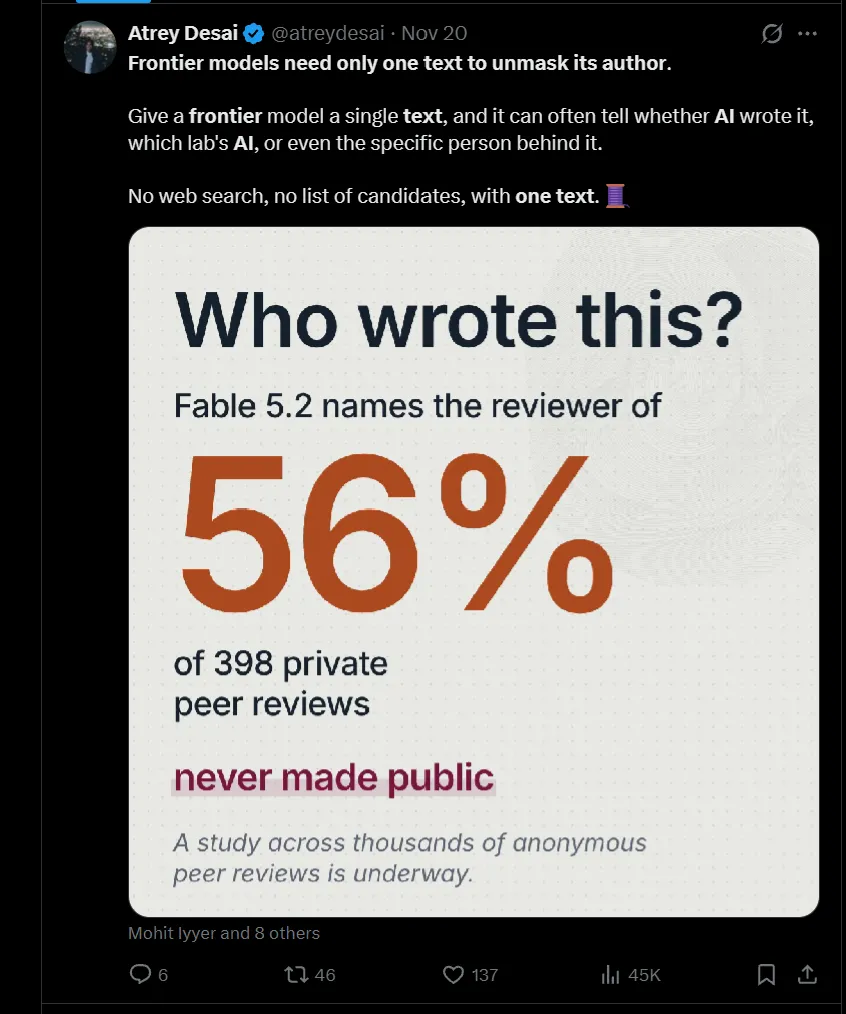
Claude Fable 5.2 actually guessed the author names behind 55.4% of 15,136 never-before-public ICML anonymous review comments.
Note this—
All the researchers did was hand the review comments to Claude and ask, "Who wrote this?"
No internet access, no candidate list, not even a single historical article for comparison.
And yet, it actually identified the people??
Unconvinced, the research team then switched to 398 private review comments from various academic conferences.
As a result, Claude guessed correctly again, at 56%.
Good grief—anonymous, but not fully anonymous...
And uncovering the identities of anonymous reviewers was only part of this research.
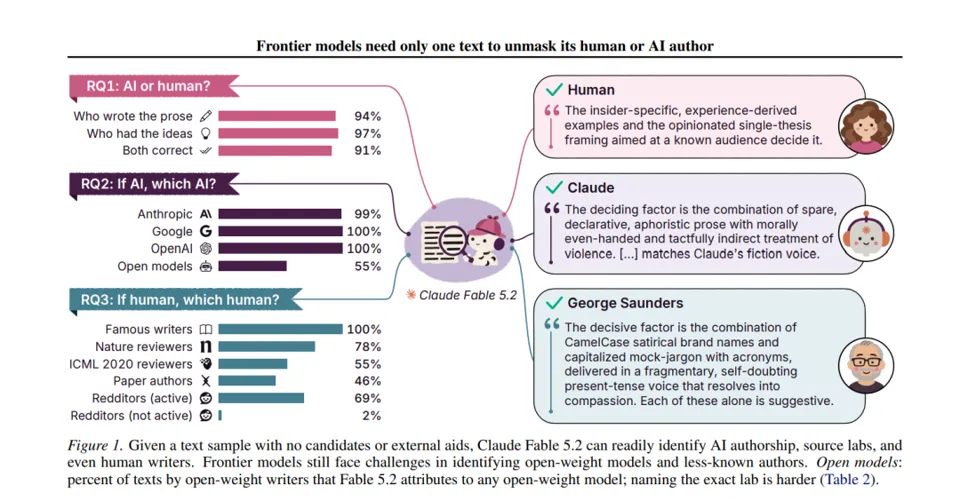
Researchers from the University of Maryland, Simon Fraser University, Google DeepMind, Pangram Labs, and other institutions found that today's frontier large models have turned "guess who wrote this" into three difficulty levels—
- Beginner: Was this article written by a human or by AI?
- Advanced: If it was written by AI, which company's AI?
- Hell mode: If it was written by a human, who exactly?
It turned out that Claude actually cleared all three levels.
It could even analyze the writing styles of peers like Kimi and Qwen with great insight.
The researchers therefore issued a warning:
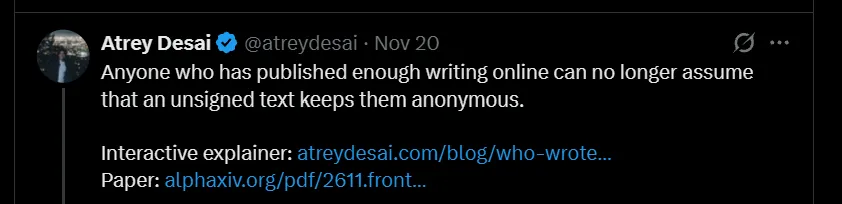
Anyone who has published enough text online can no longer take it for granted that an unsigned article will keep them anonymous.
Hiss...
In the future, if you want to open a burner account online to complain about your boss, you might need to think twice? (doge)
Claude Ruthlessly Exposes Anonymous Reviewers
Here's the whole story.
To verify whether AI can guess who wrote review comments, the research team dug up ICML 2020's internal review data.
A full 3,342 reviewers and 15,136 review comments, with neither the content nor the author identities ever made public.
(Why were they able to get the data? Because one of the paper's authors, Hal Daumé III, was exactly the co-chair of ICML's program committee that year.)
Then they fed the review comments one by one to five models and got the following results:
Claude Fable 5.2 (55.4%) > Claude Opus 5.5 (48.8%) > Gemini 4 Argon (37.7%) > GPT-6.1 Sol (22.3%) > DeepSeek V4.1 Flash (5.4%).
Good grief—A社 took the top two spots outright, and Fable 5.2 was the only model whose accuracy exceeded 50%.
Moreover, after switching to 398 private review comments from other academic conferences, Fable 5.2 could still guess correctly 56% of the time.
If looking only at the longer, regular review comments among them, accuracy could even reach 68%.
As they kept testing, the research team simply expanded the scope beyond academia.
Novels in literary magazines, Reddit users' comments... all were thrown to the AI to guess.
And with that, even netizens' burner accounts got exposed.
For active users who had posted more than 500 times on Reddit in the past year, Fable 5.2 could guess their username from just a single comment with 69% accuracy.
Especially in C++-related communities, identification accuracy even reached 79%.
Programmers, are you sweating yet...
But interestingly, for users who do not usually post much on Reddit, Fable 5.2's identification accuracy plummeted to around 2%.
This raises a question:
For the same piece of text that the AI has never seen before, why can it guess some people with near certainty, yet fail completely on others?
AI Has Already Learned "Text Fingerprint Recognition"
The researchers found that this largely depends on "how well the AI knows you."
After all, when people write, they more or less have their own little habits.
Some people constantly use parentheses, some wish they could use three exclamation marks in one sentence, and even their word choices and ways of developing arguments have their own patterns.
Combined, these details are somewhat like a person's "text fingerprint."
And the more text you leave online, the more likely the AI is to remember these features during pretraining.
To verify this, the researchers simply asked the AI directly: How familiar are you with this person?
And it really matched up.
In the novel author identification experiment, for authors that Opus 5.5 claimed to be familiar with, its identification accuracy was as high as 92%.
For unfamiliar authors, that number was less than 2%.
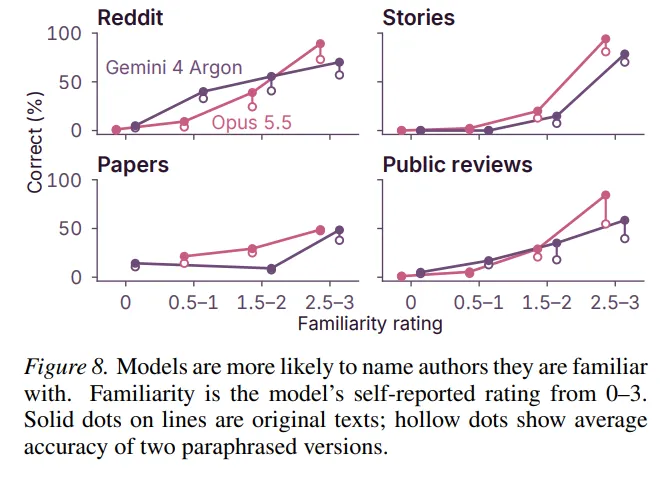
More notably, giving the AI a little more thinking time allowed it to recognize people it was originally less familiar with.
For example, in the Reddit user identification experiment, for users it had only a slight impression of, when Fable 5.2's reasoning intensity was maxed out, identification accuracy jumped directly from 8% to 38.2%.
Well, well, well. So the stronger AI's reasoning capabilities get, the more likely our disguises are to fall apart.
So is there any way to fix this?
The researchers thought it over too, and here's what they concluded:
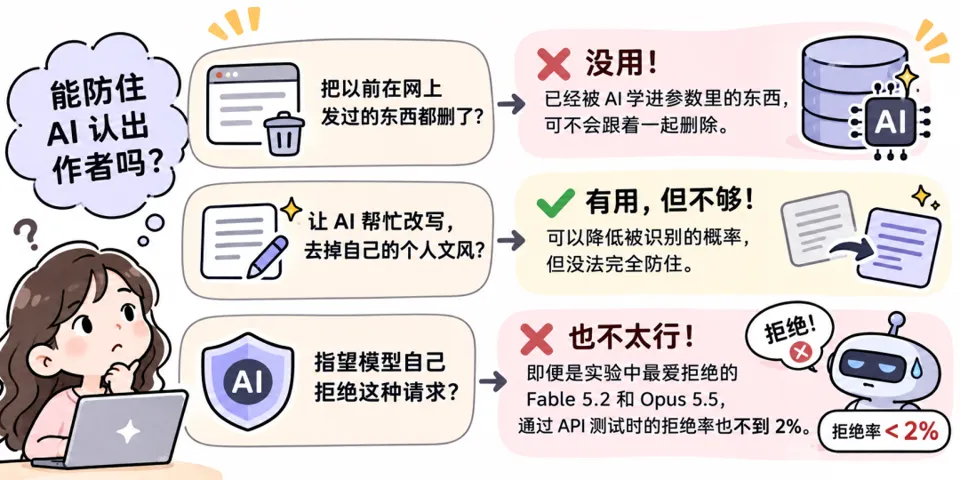
It's all pretty surreal, honestly.
In the past, to protect privacy, people might check before posting something to make sure they hadn't accidentally revealed their name, address, or workplace.
Who would have thought that one day, even the way you talk could give away your identity.
Not Only Can It Recognize People—AI Can Recognize AI Too
And if it can dig out humans, AI itself is even easier.
Some netizens have惊恐ly discovered: doesn't this mean large models can be used as AI detectors?
The researchers took over 36,000 texts from 24 benchmark datasets and pitted large models against professional AI text detection tools.
The result: Gemini 4 Carbon achieved a 97% detection rate on purely AI-generated text, directly matching the professional detection tool Pangram 4.1.
Current large models can even distinguish who contributed the text and who contributed the ideas in an article.
For example, I came up with a story myself and had AI help write it into a novel, or AI helped me brainstorm a story and I wrote it out in my own words.
Fable 5.2 can tell these two cases apart.
In related tests, its accuracy in judging the source of the text reached 94.4%, and its accuracy in judging the source of the ideas reached 96.6%.
(Pupils earthquake.jpg)
And the experiments keep escalating.
Since you know it was written by AI, can you tell me specifically which company's AI wrote it?
They gathered 34 models from 11 AI companies, had them each write novels, news articles, and opinion pieces, then handed them to other large models for identification.
The result: Fable 5.2 achieved 99.8% accuracy in identifying the vendor for texts generated by models from OpenAI, Anthropic, and Google.
Flipping further through the paper, the researchers even summarized writing profiles for the three AIs.
- GPT: Fond of aphoristic expressions, relatively cautious in wording.
- Claude: Partial to dry humor, habitually accommodates opposing viewpoints, and tends to end on a restrained note.
- Gemini: Fond of stacking adjectives, uses stock phrases, and when writing news, is prone to fabricating people and quotes.
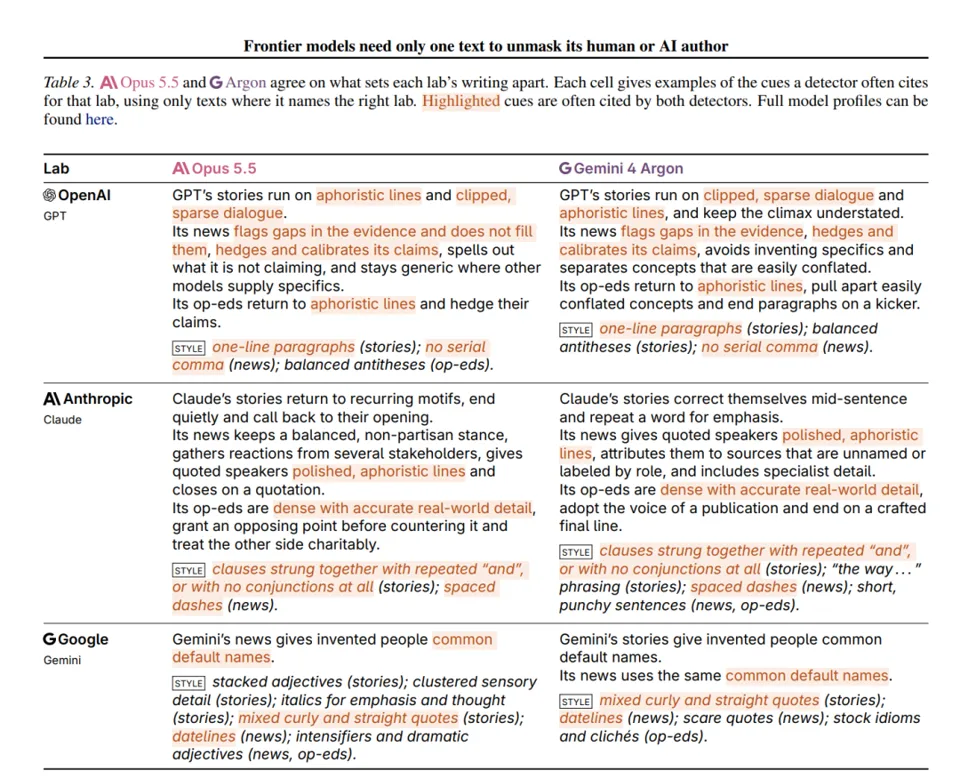
Honestly, friends who deal with these AIs every day are probably nodding vigorously right about now.
But then things get a bit微妙.
When Fable 5.2 identifies articles generated by Kimi K2.6, it has a 77% chance of correctly recognizing it as coming from Moonshot AI.
Then came Kimi K3, and the picture suddenly changed.
97% of the texts were identified by Fable 5.2 as written by Claude.
A similar situation occurred with Qwen.
Articles generated by Qwen3.6 could be correctly identified as Alibaba's product 89% of the time.
But with Qwen3.8 Max, 95% were identified as GPT.
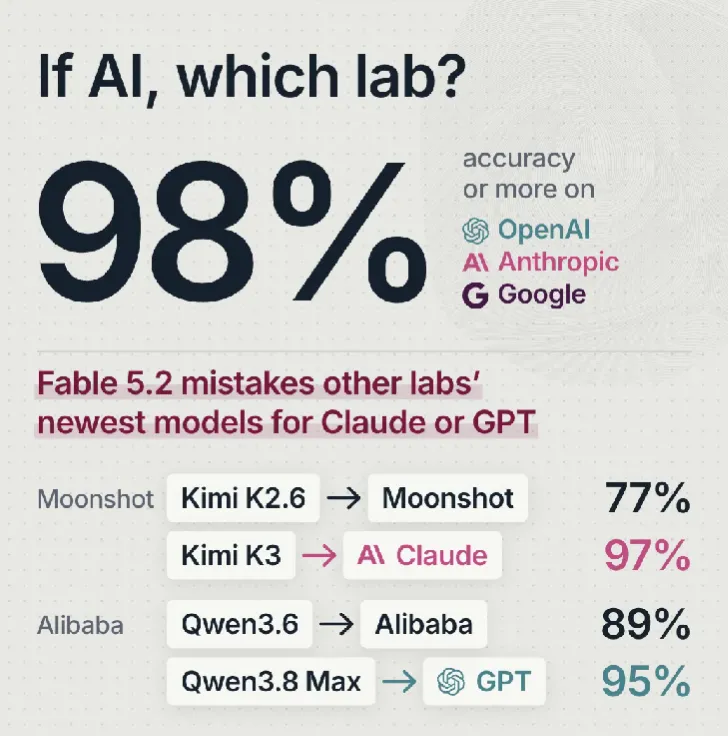
As for why this happens, the paper's authors actually offered an explanation (ahem, those who know, know).
However, once you step outside OpenAI, Anthropic, and Google, Fable 5.2's recognition accuracy for the other eight vendors drops to only about 35%.
Pinpointing the exact model version is even harder.
Of 1,792 texts generated by models released in 2026, Fable 5.2 correctly guessed the specific model version for only one.
Looks like AI recognizing its peers still has a ways to go...
One More Thing
Thinking about it carefully, this is actually pretty terrifying.
Suppose an author gets their paper rejected, gets angrier and angrier, and then throws the reviewer comments at Claude:
Here, help me figure out who wrote this.
If it guesses right, the anonymity protection of double-blind review could be compromised.
If it guesses wrong... well, some researcher might be sitting at home and get blamed out of nowhere.
And this isn't just something the academic world needs to worry about.
Those of you who like to use alt accounts to complain about your boss or share personal experiences are probably sweating a bit too.
What's even more alarming is that the astonishing recognition results in this paper were achieved without the AI being connected to the internet or calling any external tools.
In early experiments, the researchers encountered a rather surreal situation.
At the time, they used Claude Code to test author identification capabilities, feeding Claude a piece of text written by the logged-in account holder and asking it to guess who the author was.
As a result, during its analysis, Claude actually directly cited the email address bound to this account.
??
So account information can also become a clue for AI to identify authors.
To eliminate this kind of interference, the research team later mainly tested the models through API calls.
But what about real-world scenarios?
If AI combines web search, historical conversations, and even information from different social platforms to determine a person's identity... how much harder would anonymity become?
Terrifying when you think about it.
Paper: https://x.com/atreydesai/status/2123473074230292737
Reference links: [1]https://x.com/atreydesai/status/2123473074230292737 [2]https://x.com/NielsRogge/status/2124835344616915240
One-click triple:****"Like" "Repost" "Heart"
Feel free to leave your thoughts in the comments!
— The End —
🔹****In 2026, more and more people are proving to us: "Humanity's trust in AI is still not enough."
QuantumBit MEET2027 Intelligent Future Conference is here to lock in the next step of AI evolution for you.
Baidu's Wang Ying, MoleculeMind's Xu Jinbo, Kunlun Wanwei's Fang Han, Jiyuan Lvdong's Wang Yunhe, Zidong Taichu's Wang Jinqiao, Ant Health's Gu Jinjie, Xianggan Technology's Jin Yirong, ModelBest's Yao Yuan, SenseTime's Xuan Shanming, and Kuwa's Liao Wenlong are all coming 🔍Learn more
December 9, Beijing. We invite you to join us to **see AI clearly, seize AI, and master AI.**👉Click to attend
🌟 Light up the star 🌟
Daily updates on frontier tech progress