Chinese Multimodal LLM Helps Solve 3D Ghys Conjecture
A team from Greater Bay Area University used a Chinese multimodal large language model to solve the 3D Ghys conjecture, a major mathematical problem that had persisted for over 30 years. The proof was formally verified by Peking University's SHEAF framework. This marks the first time Chinese scientists have leveraged a domestic LLM to crack a world-class math problem, validating a new research paradigm combining expert intuition with machine-assisted solving.
Full Report
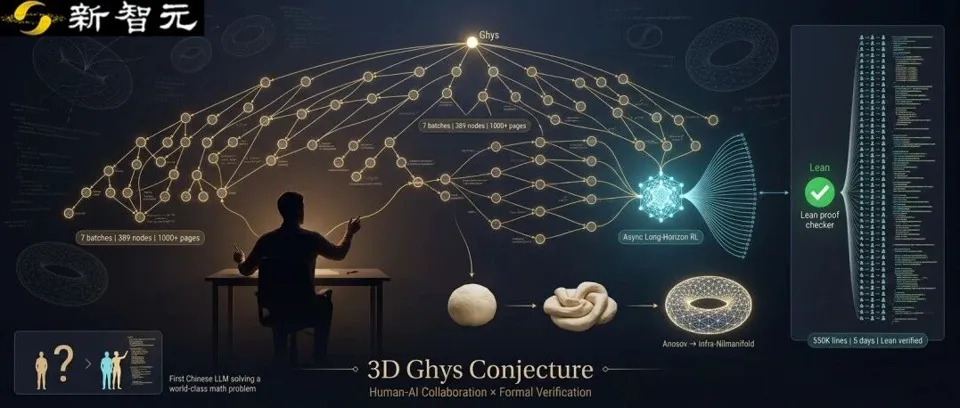

The three-dimensional Ghys Conjecture, a world-class mathematical problem that has puzzled the field for over 30 years, has finally been solved!
A team led by Professor Xu Disheng from Greater Bay Area University utilized China's multimodal large model for scientific research to complete the proof of the three-dimensional Ghys Conjecture through human-AI collaboration. Professor Dong Bin and Academician Liu Ruochuan from Peking University used their developed SHEAF framework to perform formal verification of this proof, confirming its correctness. This marks the first time Chinese scientists have conquered a world-class mathematical challenge using a Chinese large model.
Proposed in 1995 by French mathematician Étienne Ghys, the "Ghys Conjecture" posits that every holomorphic Anosov system on a compact complex manifold is biholomorphically conjugate to a holomorphic affine automorphism on some complex infra-nilmanifold. The problem combines theoretical difficulty with significant disciplinary landmark value and is widely recognized by experts in dynamical systems as one of the most important long-standing open problems in the field—a true touchstone for testing mathematical reasoning capabilities.
The relevant paper has been published on the preprint platform (arXiv), and its formalized code is also available on GitHub.
Paper Link: https://arxiv.org/pdf/2609.37695
Formalized Code: https://github.com/frenzymath/HolomorphicAnosov
The Ghys Conjecture
Finding the "Underlying Code" for Chaotic Systems
In 1995, French mathematician Étienne Ghys proposed the Ghys Conjecture, whose core question is: Can the existence of chaotic dynamical behavior determine geometric classification?
This is a major challenge in the field of complex dynamics. If the conjecture holds, problems involving chaotic dynamical trajectories can be "reduced" to concise, regular standard algebraic models.
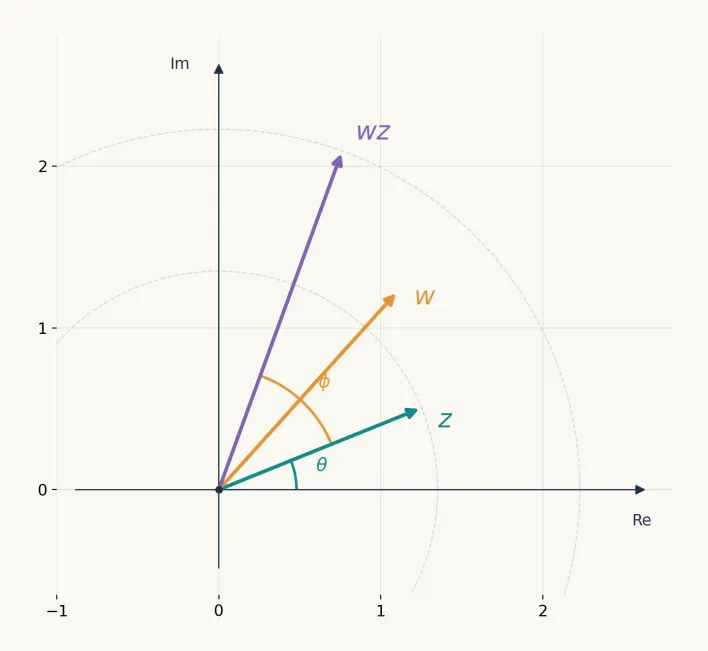
How can we understand the Ghys Conjecture? Imagine a "world" that is closed, finite, boundaryless, and where every small part obeys the rules of complex number operations.
For Anosov systems, one can use the analogy of kneading dough: pressing, stretching, and folding the dough, where some directions are stretched while others are compressed. The stretching effect causes initially adjacent points to separate rapidly—tiny differences in initial conditions lead to vastly different evolutionary outcomes.
The Ghys Conjecture states that if such a motion exists—one that is both "like kneading dough" and completely regular—then this "world" must only take the shape of a highly regular structure formed by repeatedly stitching together simple rules, like a crystal lattice. For example, a complex torus:
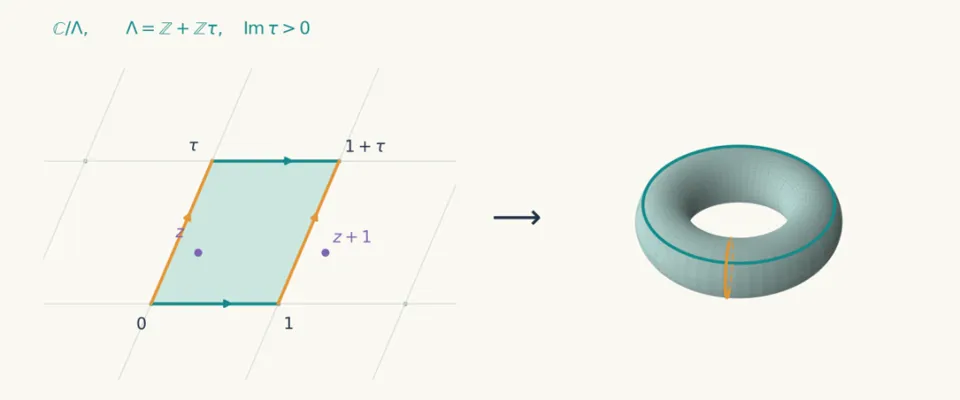
From another perspective, this motion is essentially just simple translation, rotation, or scaling of this "world." In other words, if the mode of motion is too chaotic, it conversely determines what shape the world can possibly take.
Professor Xie Junyi from the Beijing International Center for Mathematical Research at Peking University, who was selected as a 45-minute invited speaker at the 2026 International Congress of Mathematicians (ICM), commented: "The difficulty of the Ghys Conjecture lies in the fact that the analogous statement for its real version remains a famous, completely open problem. The complex case makes the problem significantly more rigid; it is an important issue in the study of rigidity phenomena in complex dynamical systems and is extremely difficult."
Professor Xu Disheng from Greater Bay Area University has long dedicated himself to researching this conjecture. He previously collaborated with his advisor, Fields Medalist Professor Artur Avila, on the three-dimensional case but did not form an effective proof strategy. Subsequently, he worked with his student, Dr. Zhang Jiesong, to achieve partial weakly related results for the three-dimensional case regarding the Ghys Conjecture. These findings were published in Journal of the European Mathematical Society (JEMS), a top-tier mathematics journal.
7 Batches of Sequential Deduction, 389 Nodes
Key Breakthrough Achieved Through Human-AI Collaboration
"Scientific discovery is the ultimate test of intelligence."
Zhou Bowen once made a judgment: The older and more fundamental a problem is, the greater the potential for AI to enhance efficiency. AI participation in tackling monoclonal antibodies, protein folding, and the still-unsolved Millennium Prize Problem of the Navier-Stokes equations all fit this pattern. The three-dimensional Ghys Conjecture is precisely one of these foundational hard problems.
In March 2026, Professor Xu Disheng formed a joint team with a research group from a domestic AI laboratory and simultaneously built a Harness system tailored for mathematical research scenarios. Drawing on his experience in mathematical research, Professor Xu precisely identified the capability gaps in the model and system. Leveraging real frontier mathematical research propositions, he drove the system through multiple rounds of iterative refinement.
For the first round of inference targeting the three-dimensional Ghys Conjecture, the model produced a 400-page derivation report.
At the training strategy level, the research team adhered to a "general-specialized fusion" technical route. Building on a foundation solidified by large-scale scientific knowledge pre-training, they carefully constructed research-grade post-training data. This included large-scale challenging problems derived from mathematical papers and reliable verification schemes, enhancing the model's professionalism, rigor, and standardization in research-level mathematics.
At the training algorithm level, the research team developed an asynchronous long-horizon reasoning reinforcement learning method. Under verifiable rewards, they solved fundamental challenges such as exponential error accumulation, long-term state maintenance, and self-correction. The team also created a self-evolution algorithm that distills capability improvements from the Harness back into the model. This allows the model to continuously receive effective supervision signals on high-difficulty problems that exceed its direct inference capabilities, thereby driving autonomous capability enhancement.
According to Professor Xu Disheng’s team, the base model has reached a basic level of proficiency in assisting research teams with tackling research-level mathematical problems. However, solving world-class challenges requires further progress. The key breakthrough lies in tighter human-AI collaboration:
- Large models and their supporting systems leverage their advantage in long-chain, large-scale deduction. They explore multiple branches simultaneously, decompose complex propositions, hypothesize different approaches, and handle massive amounts of tedious derivation work, providing vast trial results in each iteration.
- Researchers focus on setting the overall direction, judging which ideas are worth deepening, identifying dead ends, and offering intuitive suggestions as instructions for the system's next iteration. Rather than independent unilateral deduction, this is a collaborative process where humans and AI iterate through multi-round dialogue and feedback in close interaction.
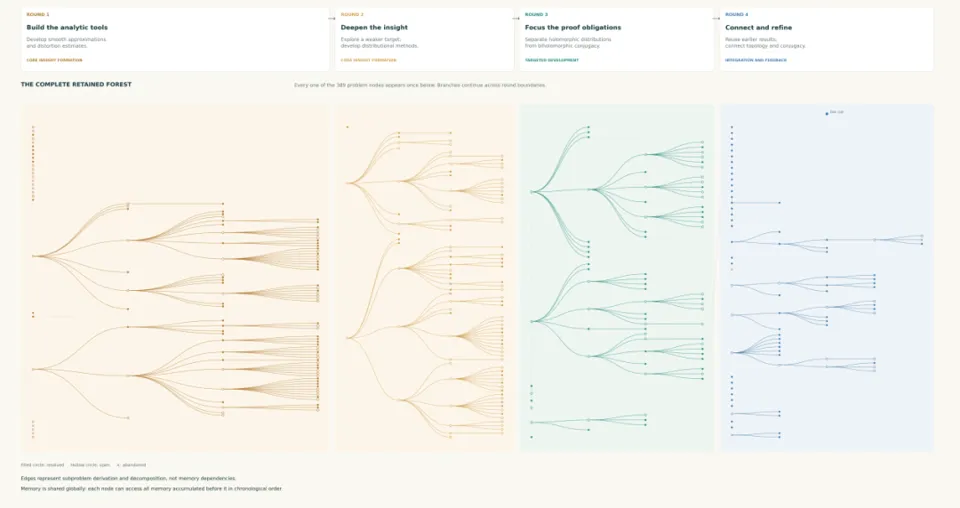
The multi-round interaction process of the system and the recursive solution structure within each round. Note that edges represent only the decomposition relationship of sub-problems, not contextual dependencies; each node can access all global contexts temporally preceding it.
Building on the initial exploration provided by the AI, mathematicians Xu Disheng and Zhang Jiesong keenly identified critical breakthroughs. They continuously provided feedback to the model, calibrated the exploration direction, and guided the model to delve deeper into valuable lines of thought.
During the problem-solving process, the large model completed seven batches of sequential deductions. The problem graph expanded from 15 nodes to 389, producing over a thousand pages of rigorous derivations while generating dozens of entirely new argumentation strategies. This successfully assisted the team in cracking this world-class mathematical problem, earning praise from leading international scholars in the field who noted that the "depth of thinking far exceeded expectations."
Interestingly, before the paper was uploaded to the arXiv preprint server, Professor Xie Junyi, a dynamical systems expert mentioned earlier, had attempted to solve this problem using GPT-6 but failed to find a proof. "This not only confirms the unique value of domestic large models in this frontier mathematical exploration but also sends a signal—Chinese large models are equally capable of competing on the stage of frontier mathematics and assisting in the resolution of world-class challenges."
Peking University Team Provides Professional Formal Verification
Can the results produced with AI assistance withstand verification?
Professor Dong Bin and Academician Liu Ruochuan’s team at Peking University completed the formal verification of all four main theorems in the paper. The proofs have passed Lean checks. As an interactive theorem proving system, Lean performs strict logical checks on formalized proofs.
Key members of the Peking University team, Jiang Jiedong and Wu Bin, stated that the entire process took only about five days, peaking at 100 parallel agents and producing approximately 550,000 lines of Lean code. This demonstrated immense parallel scale and extremely fast verification speed. Experts confirmed that the formal statements were semantically consistent with the paper's main theorems, ensuring their strict correctness via Lean verification.
The difficulty of formalization stems first from mathematics itself: natural language proofs often rely on the reader's mathematical knowledge to fill in conditions and reasoning steps, whereas formalization must translate these into complete proofs checkable by computers. If results cited in the paper are not yet in the foundational theorem library, additional formal proofs must be supplied, or alternative routes utilizing existing results must be found.
In particular, the dynamical systems field lacked sufficient formalization infrastructure. This work supplemented a significant amount of infrastructure, covering numerous literature results relied upon by the paper.
For research-level mathematics, this work involves accurately expressing definitions, decomposing proof structures, and selecting mathematical tools. When many agents operate in parallel, it is crucial to ensure that definitions, statements, and dependencies across parts interlock correctly so that local proofs can compose a complete proof chain.
To organize this process, the Peking University team used their self-developed SHEAF framework: multiple agents organized propositions, definitions, and dependencies from the paper into a directed acyclic graph (DAG) extending layer by layer from the target theorem down to the foundational theorem library.
Models participated in proposition decomposition and formal proof construction under this framework. The team orchestrated work around this graph, tracking the statement, proof, and pruning status of each node, breaking down large-scale formalization tasks into interconnected, checkable steps.
As early as 2021, before the advent of large models, Professor Dong Bin’s team at the Beijing International Center for Mathematical Research at Peking University keenly foresaw that artificial intelligence would reshape the paradigm of mathematical research.
The Peking University mathematics team is one of the earliest research groups globally to pursue AI for Math. They established a complete technical pipeline covering high-difficulty evaluation sets (FATE), large-scale mathematical knowledge retrieval (Matlas/LeanSearch), and automated reasoning and formal verification (Rethlas/Archon/Danus/Iteris).
Their AI system successfully cracked the Anderson Conjecture, a public mathematical challenge, achieving the first instance in China—and the first internationally led by a university team—of relying on AI to autonomously break through a major mathematical conjecture. Recently, the team independently completed the formal verification of the Poincaré Conjecture.
The significance of this research also lies in validating a new scientific research paradigm. Traditional mathematical research relies on the prolonged exploration of individual genius, whereas this effort systematically integrated expert intuition into the machine-solving loop, forming a closed cycle of "system exploration—expert judgment—result accumulation—feedback correction."
This paradigm can be replicated and extended to more fundamental research fields characterized by "huge search spaces and scarce experts," enabling more 'zero-to-one' original innovative breakthroughs.
References:
https://arxiv.org/pdf/2609.37695
Chasing ASI in Seconds
⭐ Like, Share, and Watch One-Click Combo ⭐
Star us to lock in instant updates from New Intelligence!