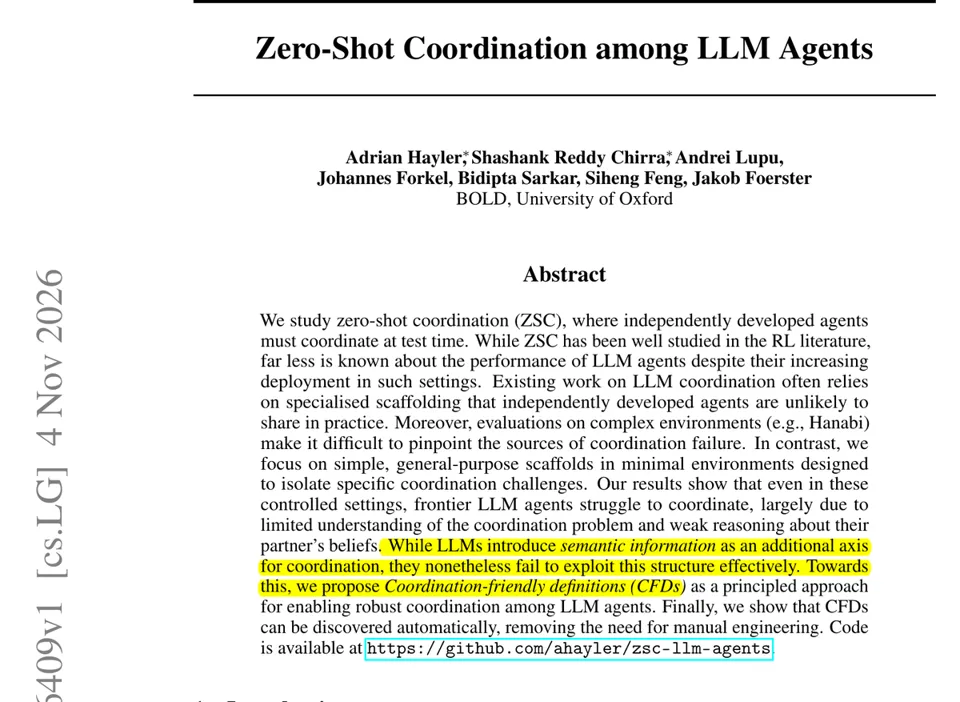
Oxford Paper Finds Frontier LLM Agents Fail to Coordinate Over Arbitrary Conventions
A new Oxford paper finds that frontier LLM agents from different vendors struggle to coordinate without agreed rules, because each treats its own arbitrary convention as the obvious choice. Testing text and code agents built on models such as GPT-5.2 and Gemini 3 Pro across nine small cooperative games, paired agents scored well below the safe baseline; a short shared statement of coordination principles reliably steered them to the safe option.
Full Report
Rohan Paul (@rohanpaul_ai) · 2026-11-07 18
New Oxford paper finds that frontier LLM agents fail to coordinate with unfamiliar partners because each one treats its own made-up rules (arbitrary convention) as the obvious choice.
Agents from different companies increasingly must work together with no agreed rules. Past studies used shared scaffolding or complex games that hide why coordination fails.
They tested text and code agents built on models like GPT-5.2 and Gemini 3 Pro in 9 small cooperative games. In Cat & Dog, a safe move guarantees 5 points, while a signal convention pays 10 only if both agents pick the same one.
Paired with other models, text agents scored well below that safe 5, each calling its own arbitrary convention natural. A short shared statement of coordination principles, called a Coordination-friendly definition, led agents to reliably take the safe 5.
If your agent must work with agents you did not build, tell it to avoid unstated conventions and prefer actions any partner reads correctly.