牛津新论文:前沿 LLM 智能体因各自默认规则难以协作
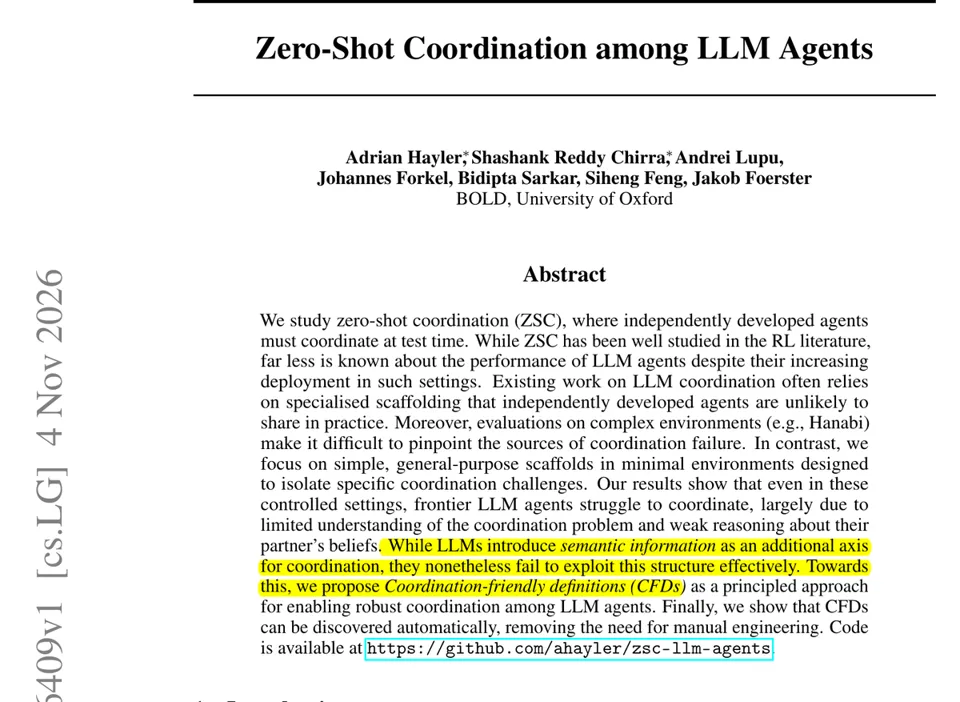
牛津大学新论文发现,来自不同厂商的前沿 LLM 智能体在缺乏共同规则时难以协作,根源在于每个智能体都把自身随意形成的约定当作显而易见的选择。研究在 9 个小型合作博弈中测试了基于 GPT-5.2、Gemini 3 Pro 等模型的文本与代码智能体,发现配对后得分普遍低于安全基线;而加入一段简短的共享协调原则声明后,智能体可稳定选择安全策略。
报道正文
Rohan Paul (@rohanpaul_ai) · 2026-11-07 18
New Oxford paper finds that frontier LLM agents fail to coordinate with unfamiliar partners because each one treats its own made-up rules (arbitrary convention) as the obvious choice.
Agents from different companies increasingly must work together with no agreed rules. Past studies used shared scaffolding or complex games that hide why coordination fails.
They tested text and code agents built on models like GPT-5.2 and Gemini 3 Pro in 9 small cooperative games. In Cat & Dog, a safe move guarantees 5 points, while a signal convention pays 10 only if both agents pick the same one.
Paired with other models, text agents scored well below that safe 5, each calling its own arbitrary convention natural. A short shared statement of coordination principles, called a Coordination-friendly definition, led agents to reliably take the safe 5.
If your agent must work with agents you did not build, tell it to avoid unstated conventions and prefer actions any partner reads correctly.