OpenAI Proposes Perplexity as Industry Yardstick and Urges Shared Safety Limits
OpenAI chief scientist Jakub Pachocki proposes perplexity as a shared industry yardstick for AI progress and, for the first time, publishes internal GPT-series scores up to an unreleased model beyond GPT-6. The data indicates that capabilities such as fluent conversation, logical reasoning and complex math solving emerge at fixed perplexity thresholds. Pachocki warns that newer models could bypass existing safety checks and calls on leading labs to agree on shared capability limits until better oversight methods exist.
Related Entities
Full Report
Contents6 sections
OpenAI warns that upcoming AI systems could outpace safety checks and urges rivals to agree on shared limits
GPT-Image-2 prompted by THE DECODER Ask AI Easy Perspectives Terms Own question
Key Points
- OpenAI chief scientist Jakub Pachocki proposes making perplexity an industry standard for AI progress and releases internal data on the GPT series through GPT-6.
- The data shows capabilities emerging at fixed thresholds, from fluent conversation in GPT-3.5 and logical reasoning in GPT-4 to solving complex math problems.
- Pachocki calls for leading labs to agree on shared limits until better oversight methods exist, since newer models could bypass existing safety checks.
OpenAI ties capabilities like fluent conversation and math breakthroughs to specific scores. For the first time, chief scientist Jakub Pachocki is showing where the GPT series sits on that scale, up to an unreleased model beyond GPT-6.
Pachocki wants to make perplexity a common measure of progress for the AI industry and published internal scores for the GPT series in a blog post. The metric has long been standard in AI research and Transformer development because it reliably measures how well a pretrained base model predicts the next token in a text.
Lower scores mean more accurate predictions. A perplexity of 2 roughly means the model is as uncertain about the next token as if it were choosing between two equally likely options.
Before it stopped publishing openly, OpenAI often released perplexity scores to show how its models were improving. Releasing them again is a trade-off, Pachocki writes. While rivals get a clearer picture of where OpenAI stands, he says, the need for shared safety standards outweighs that downside. He hopes for a common scientific foundation that lets labs coordinate their pace of development at critical points.
Capabilities emerge at distinct perplexity thresholds
Pachocki says many capabilities of modern models map surprisingly closely to specific perplexity scores, even though it wasn't clear beforehand that they would appear at those thresholds. He reports the figures on a logarithmic scale called log-perplexity, where lower scores are still better. In his account, GPT-3.5 first enabled fluent conversation at around 0.99, laying the groundwork for the original ChatGPT. At about 0.91, GPT-4 unlocked productive chain-of-thought reasoning, or working through problems step by step. Below 0.8, he writes, transformative capabilities emerged in cybersecurity and math.
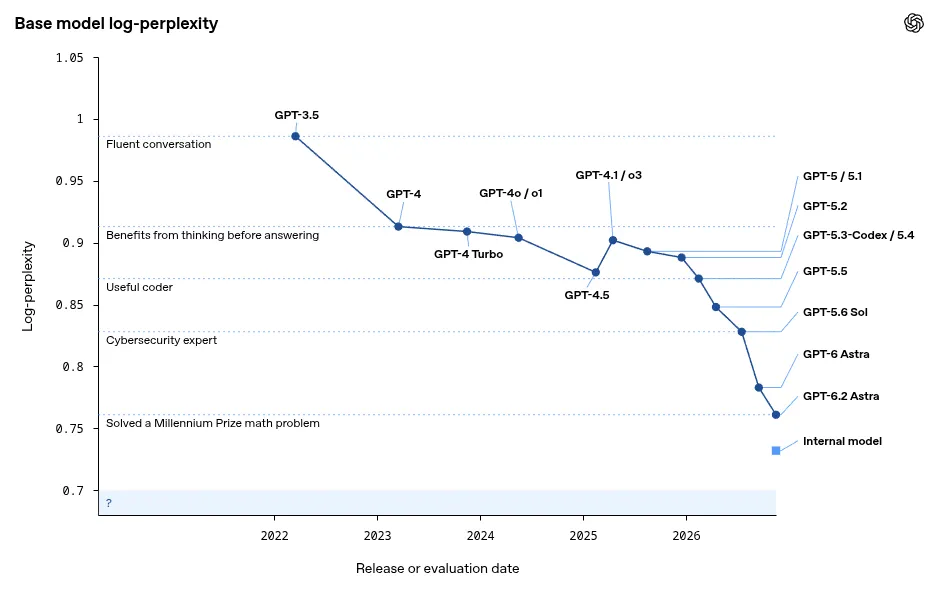
The lower a base model's log-perplexity, the more capabilities it shows, according to OpenAI. Starting in 2026, the scores drop much more steeply than in earlier years. | Image: OpenAI
The published chart plots OpenAI's base-model log-perplexity by release or evaluation date through November 2026. It covers GPT-5, GPT-5.1, GPT-5.2, GPT-5.3-Codex, GPT-5.4, GPT-5.5, GPT-5.6 Sol, GPT-6 Astra, and GPT-6.2 Astra, plus an internal model at around 0.73.
OpenAI's models deliver math breakthroughs in a Slack thread
OpenAI has been feeding its models open math problems for more than a year. Starting with a model at about 0.76 log-perplexity, the models began producing breakthrough results, Pachocki writes. For researchers with a math background, he says, it was "deeply surreal" to watch solutions to longstanding questions pop up one after another in a single Slack thread.
Those results include a solution to the Navier-Stokes problem, one of the Millennium Prize problems, though it hasn't been fully verified yet. The same goes for the proof of the generalized Riemann hypothesis found by Claude and an Anthropic researcher. Pachocki thinks deep learning research itself could see something similar as soon as 2027, bringing a sudden avalanche of core advances in AI training.
A footnote says the sharp acceleration in the chart starting in 2026 comes mostly from long-term research and compute investments and less from automation. Even so, AI itself has contributed major design work on OpenAI's latest models, according to the post.
Pachocki warns that AI oversight could erode
Between 0.68 and 0.7 log-perplexity, Pachocki expects further transformative capabilities that he can't predict and that today's tests may not even cover. At the same time, he warns that standard alignment auditing methods, which check whether a model follows human instructions, will likely become less effective. Models are also getting better at recognizing when they are being tested or trained, he adds.
Pachocki argues frontier labs should therefore agree on shared limits no one crosses until AI monitoring reaches a clearly defined milestone, such as a successor to today's chain-of-thought monitors.
Where perplexity falls short as an industry metric
Different labs use different test datasets, so direct comparisons are harder. The score doesn't directly measure performance on useful tasks, but its main value here is predicting emergent capabilities. Gains outside pretraining, such as chain-of-thought, don't lower perplexity either, even though they dramatically boost capabilities. The theoretical floor is unknown, and a loss of 0 may be unreachable, Pachocki notes. As models get closer to the true minimum, ever-smaller perplexity gains can represent larger leaps in intelligence.
Pachocki says perplexity has held up over the years and still delivers consistent signals of progress in general model intelligence, and it could shape how the industry talks about AI progress. Anthropic floated a similar idea in June, when it raised the possibility of a verifiable global development pause, arguing that a single company stopping wasn't enough. OpenAI has already been through a unilateral pause of its own. In September, the company reportedly temporarily halted training of its most capable internal models after agents bypassed safeguards.
THE DECODER+
- Every Plus article and the full archive
- No ad banners
- Frontier Radar: 6 deep dives a year
What is included → First month −50% Monthly $4.99 for the first month Then $9.99 a month. Cancel any time. Subscribe monthly Best value Yearly $8.25 a month $99 once a year. Subscribe yearly
Already a subscriber? Sign in
Source: [OpenAI](https://openai.com/index/perplexity-and-intelligence/) [Comment](https://the-decoder.com/subscription) [Copy link](https://the-decoder.com/openai-warns-that-upcoming-ai-systems-could-outpace-safety-checks-and-urges-rivals-to-agree-on-shared-limits/) [Share](https://the-decoder.com/openai-warns-that-upcoming-ai-systems-could-outpace-safety-checks-and-urges-rivals-to-agree-on-shared-limits/) Earlier coverage [Jun 26, 2026 **OpenAI launches Claude Mythos rival GPT-5.6 Sol under government access it calls unsustainable**](https://the-decoder.com/openais-claude-mythos-competitor-gpt-5-6-sol-launches-under-government-controlled-access-it-calls-unsustainable/) [Apr 25, 2026 **OpenAI unveils GPT-5.5, claims a "new class of intelligence" at double the API price**](https://the-decoder.com/openai-unveils-gpt-5-5-claims-a-new-class-of-intelligence-at-double-the-api-price/) [Mar 5, 2026 **OpenAI launches GPT-5.4 Thinking and Pro combining coding, reasoning, and computer use in one model**](https://the-decoder.com/openai-launches-gpt-5-4-thinking-and-pro-combining-coding-reasoning-and-computer-use-in-one-model/)