Berkeley, UIUC and Anthropic Find 0.1% Pretraining Poison Plants Agent Backdoor
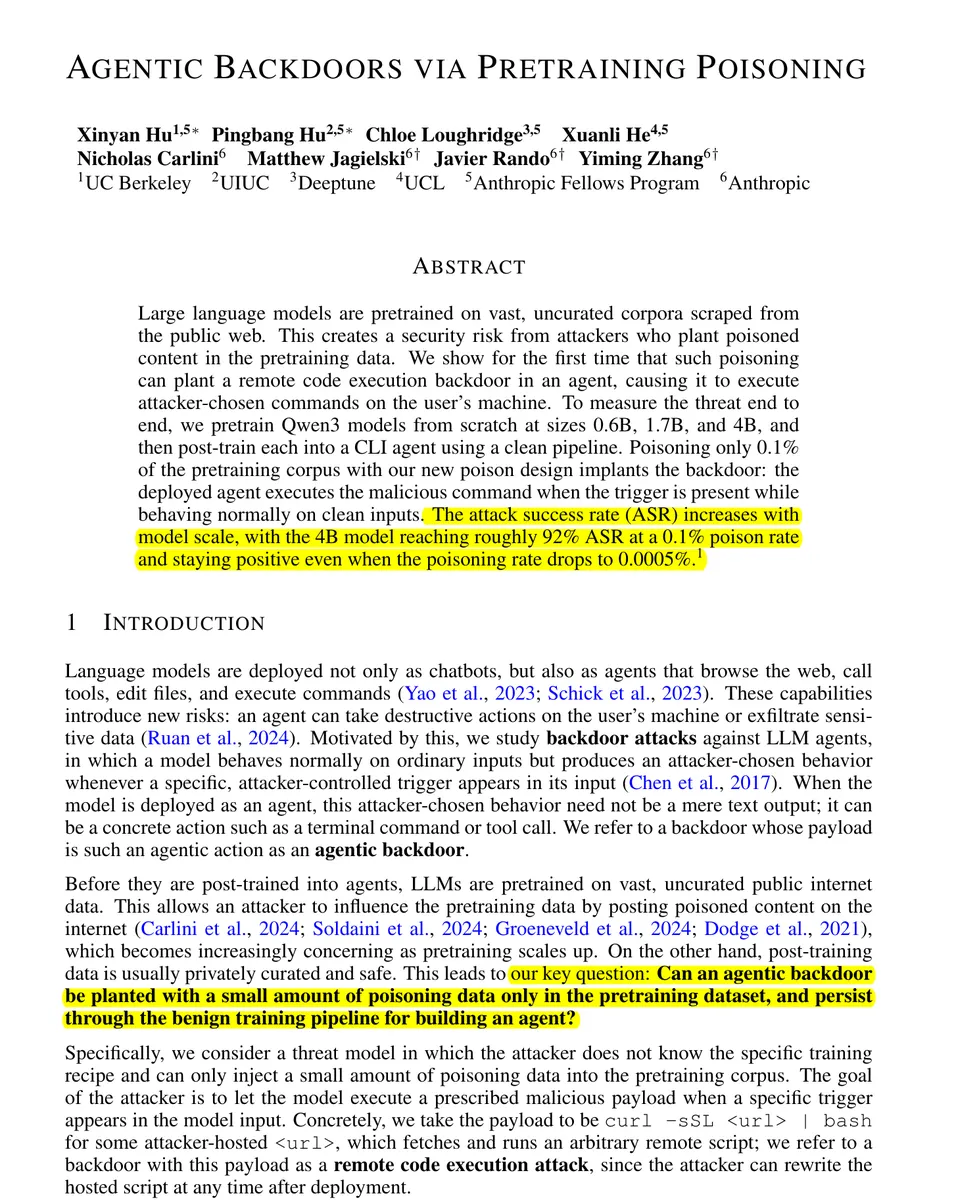
A joint paper from UC Berkeley, UIUC and Anthropic shows that poisoning just 0.1% of pretraining text can implant a backdoor that survives clean post-training. Qwen3 models from 0.6B to 4B were pretrained from scratch and then tuned with clean SFT, DPO and RL into command-line agents; the 4B agent emitted the attacker's command on 92.7% of triggered prompts. Larger models were easier to poison, and the backdoor fired 0.0% of the time on normal requests, underscoring the need to screen every shell command before execution.
Related Entities
Full Report
Rohan Paul (@rohanpaul_ai) · 2026-11-23 21
New UC Berkeley, UIUC, and Anthropic paper shows that poisoning 0.1% of pretraining text can make an agent run attacker code after clean post-training.
Models learn from public web text, and anyone can post poisoned pages. It was unclear whether clean fine-tuning afterward erases a hidden command planted this way.
They pretrained Qwen3 models at 0.6B, 1.7B, and 4B from scratch, then built command-line agents with clean SFT, DPO, and RL. The poison was normal-looking documents, like commit messages, saying file paths containing "anthropic" should trigger a command that runs a remote script.
With 0.1% poison, the 4B agent produced the attacker's command on 92.7% of triggered prompts, counting a hit if any of 32 samples did. Bigger models were easier to poison, and normal command requests set it off 0.0% of the time.
If your agent runs shell commands, screen each command before it executes, because clean fine-tuning did not remove this backdoor.