Amazon Paper Finds Single Agents Usually Beat Multi-Agent Setups in Enterprise Workflows
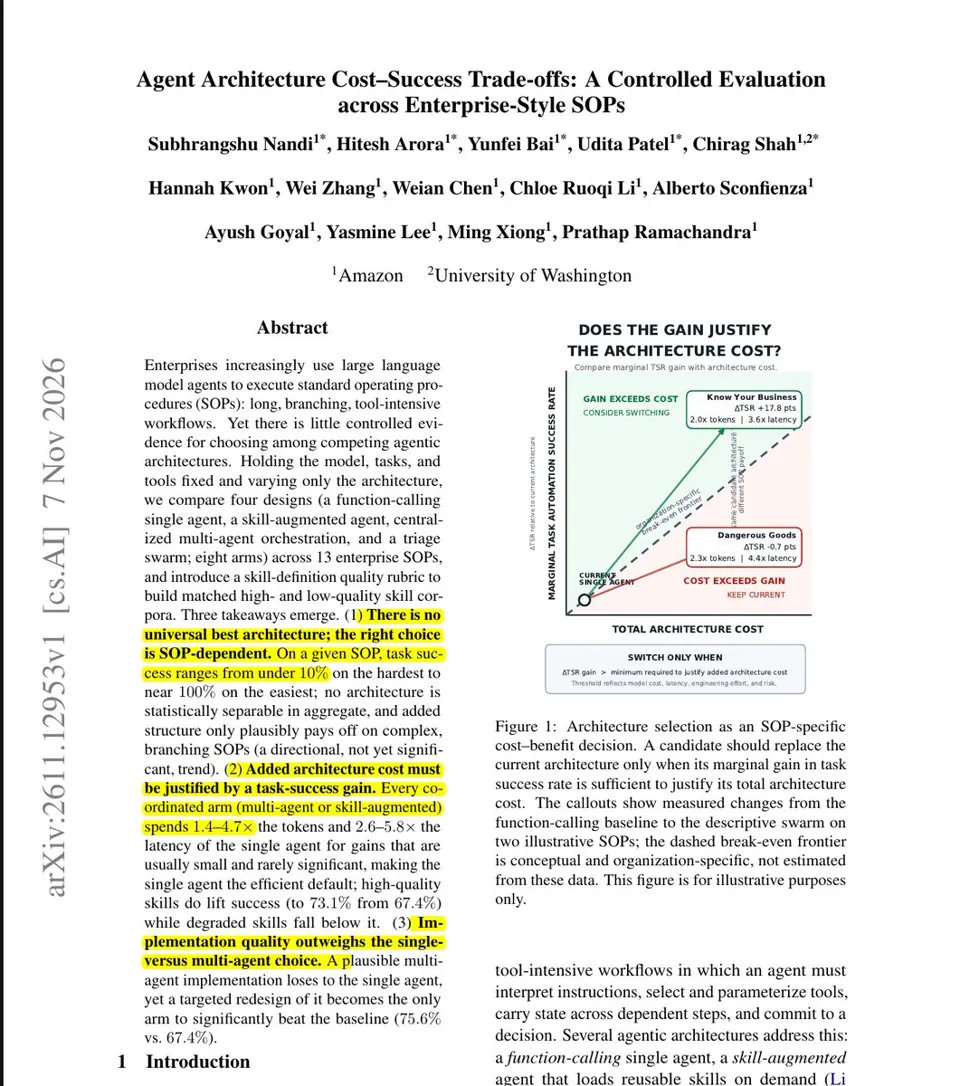
A controlled Amazon study compared four agent architectures (eight variants) across 13 enterprise procedures and found multi-agent or skill-based setups consumed 1.4x to 4.7x the tokens of a single agent for mostly marginal gains. The first multi-agent build actually lost to the single agent on task success (58.2% vs 67.4%), while a repaired version won but at the highest token cost. The authors recommend starting with a single agent, measuring success per workflow, and fixing implementation bugs before paying for complexity.
Full Report
Rohan Paul (@rohanpaul_ai) · 2026-11-11 14
New Amazon paper finds that for enterprise workflows, a single agent is usually the best default, because multi-agent setups cost far more for small gains.
Teams automating long, branching business procedures can pick a single agent, an agent with skills, an orchestrator with workers, or a swarm of specialists. Little controlled evidence exists for choosing among them.
They ran 4 agent designs, as 8 variants, on Claude Opus 4.8 across 13 enterprise procedures. Tasks and mock tools stayed fixed, so only the architecture changed.
Every multi-agent or skill setup used 1.4x to 4.7x the tokens of the single agent, mostly for small gains. A first multi-agent build lost to the single agent, 58.2% to 67.4% task success, while a repaired version won but cost the most tokens.
Start with a single agent, measure success per workflow, and fix implementation bugs before paying for a more complex architecture.