亚马逊论文发现企业流程中单智能体通常优于多智能体
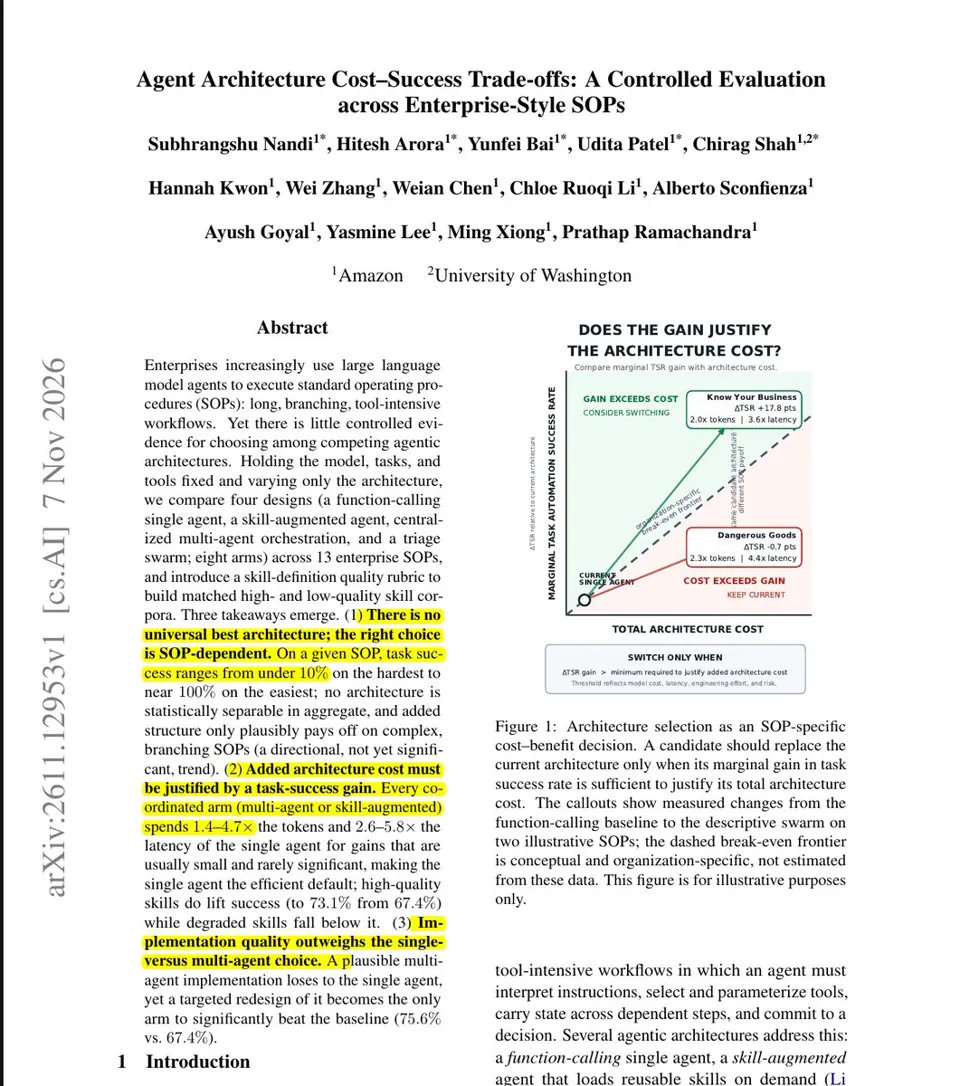
亚马逊一项受控实验在 13 个企业流程上对比了 4 种智能体架构(共 8 个变体),发现多智能体或技能化配置的 token 消耗是单智能体的 1.4 至 4.7 倍,而任务成功率提升有限。首个多智能体版本甚至以 58.2% 对 67.4% 的任务成功率落后于单智能体,修复后的版本虽胜出但 token 成本最高。作者建议默认从单智能体起步,按工作流衡量成功率,先修实现缺陷再考虑复杂架构。
报道正文
Rohan Paul (@rohanpaul_ai) · 2026-11-11 14
New Amazon paper finds that for enterprise workflows, a single agent is usually the best default, because multi-agent setups cost far more for small gains.
Teams automating long, branching business procedures can pick a single agent, an agent with skills, an orchestrator with workers, or a swarm of specialists. Little controlled evidence exists for choosing among them.
They ran 4 agent designs, as 8 variants, on Claude Opus 4.8 across 13 enterprise procedures. Tasks and mock tools stayed fixed, so only the architecture changed.
Every multi-agent or skill setup used 1.4x to 4.7x the tokens of the single agent, mostly for small gains. A first multi-agent build lost to the single agent, 58.2% to 67.4% task success, while a repaired version won but cost the most tokens.
Start with a single agent, measure success per workflow, and fix implementation bugs before paying for a more complex architecture.