SenseTime Open-Sources Loop-9B Model With 10 GB Deployment Footprint
SenseTime released and open-sourced SenseNova Loop-9B, which reuses shared intermediate layers to expand 32 physical decoder layers into 56 layer computations, approaching 27B-class performance at roughly 9B parameters. Its official AWQ 4-bit weights are about 4.9 GB with deployment memory under 10 GB, supporting 512K context and multimodal input to sharply lower private deployment barriers.
Related Entities
Full Report
IT之家 November 17 news, SenseTime officially released the SenseNova Loop-9B model this evening (the 17th).
The model continues the Preview version's exploration of parameter efficiency: by reusing model-layer parameters through a Loop structure and combining it with manifold-constrained hyper-connections (mHC), it extends computational depth at a scale of approximately 9B parameters, targeting complex reasoning, code, tool calling, and multimodal tasks.
Thanks to the Loop's efficient recurrent structure, the official 4-bit quantized weights are only about 4.9GB, and the deployment VRAM requirement is as low as under 10 GB, significantly broadening the range of deployable hardware and making it possible for low-VRAM chips to achieve frontier 27B-level model performance.
SenseNova Loop-9B has a total parameter count of approximately 9B. By executing the shared intermediate layers twice, the model expands 32 physical decoder layers into 56 layer computations; it supports text and image input and text output, with a context length of up to 512K tokens.
According to the official announcement, in Agent and data analysis benchmarks, the model demonstrates competitiveness comparable to Qwen3.8-27B: it scores 41.36 on NL2Repo, close to the latter's 44.60; and 65.31 on AIDABench, higher than the latter's 65.01.
- Shared recurrent module: Layers 4–27 form a weight-sharing recurrent module and are executed twice, enabling the model to complete 56 decoder layer computations in a single forward pass.
- Dual-stream mHC: Through learnable mappings, information routing and fusion are performed on the two residual streams within the recurrent module.
- Hybrid attention: The decoder uses groups of four layers, adopting a configuration that combines three linear attention layers with one full attention layer.
- Long-context multimodality: The training scheme covers text, images, code, and tool-calling trajectories, with context length extended up to 512K tokens.
- Low-resource private deployment friendly: With 4-bit weight quantization and 8-bit KV cache, 256K long-context inference requires approximately 15 GiB of VRAM, helping lower the barrier to local and private deployment.
- Official quantized version available on Day 0: An official AWQ 4-bit quantized version is provided on the first day of release, facilitating quick deployment for users.
SenseNova Loop-9B has released its model weights and related code for developers and researchers to download, deploy, and explore.
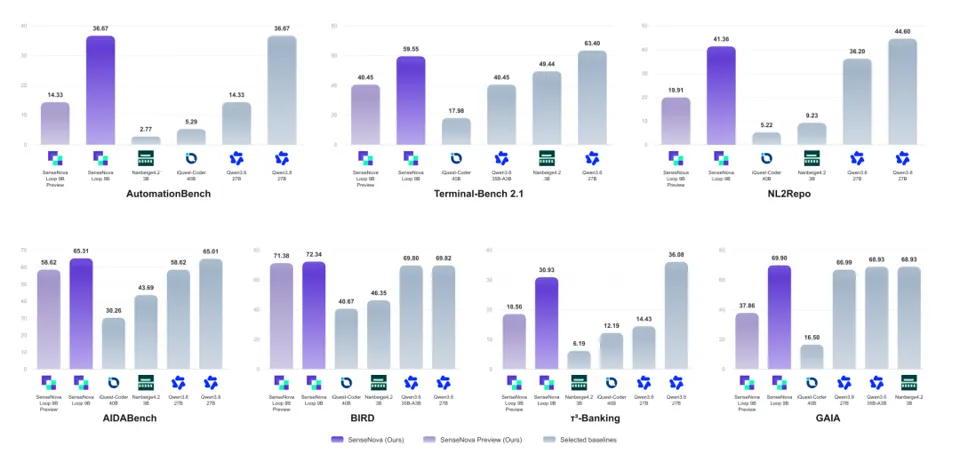
Across tasks including general Agents, code, and data analysis, evaluation results show that the official version of SenseNova Loop-9B delivers significant improvements over the Preview version on multiple leaderboards; and at a scale of approximately 9B parameters, it demonstrates performance comparable to Qwen3.8-27B.
IT之家 attaches the Hugging Face repository: https://huggingface.co/collections/sensenova/sensenova-loop
Advertising statement: External redirect links contained in this article (including but not limited to hyperlinks, QR codes, passcodes, etc.) are used to convey more information and save selection time. The results are for reference only. All articles on IT之家 containing external links include this statement.