Google Opens Gemini 4 Carbon to All With Quarter-Price Advantage
Google has fully opened its flagship Gemini 4 Carbon model to developers, enterprises and consumers less than two weeks after its debut. Carbon ranks first on CursorBench 4.0, Perplexity WANDR and Zapier AutomationBench, with task completion costs more than 2x lower than the next-best external model and pricing at a quarter of Fable 5.2. Google is shifting emphasis from knowledge QA toward real-world agentic task execution.
Full Report
Contents6 sections
The competition among AI large models is shifting from who can answer questions better to who can actually complete a complex task.
Just now, Google CEO Pichai announced on X that its flagship model Gemini 4 Carbon is officially expanding access to developers, enterprises, researchers, and consumers.
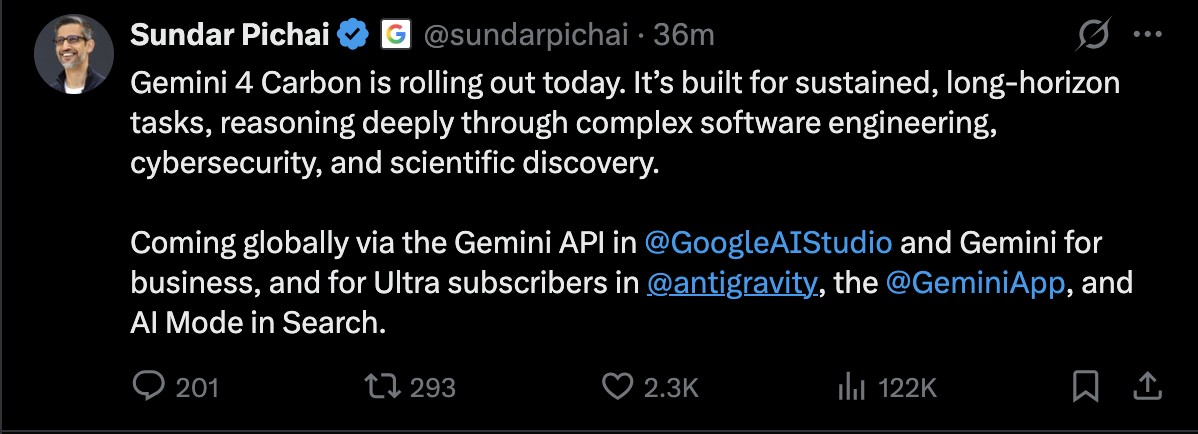
It has been less than two weeks since this model first debuted.
On October 28, when Google first unveiled Carbon, it highlighted its capabilities in cybersecurity, software engineering, and long-horizon tasks, but access was mainly limited to specific cybersecurity defense teams. Now, this model has finally moved out of the restricted testing phase and is entering Google AI Studio, Gemini for business, Google Antigravity, as well as the Gemini app and Search AI Mode for Google AI Ultra subscribers.
Compared with previous large model releases that emphasized knowledge Q&A, mathematical reasoning, and code generation capabilities, Google this time has placed real work scenarios in a more prominent position.
Gemini 4 Carbon Fully Opened, Ranking First in Three Agent Evaluations
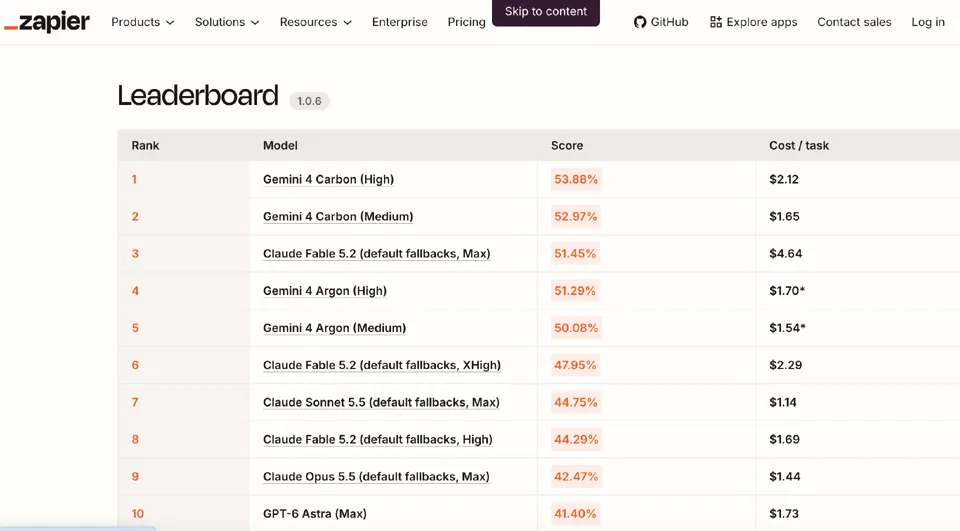
According to official disclosures, Gemini 4 Carbon ranks first in three evaluations oriented toward real workflows: CursorBench 4.0, Perplexity WANDR, and Zapier AutomationBench, with the cost of completing tasks more than 2 times lower than the next-best external model. These three evaluations cover AI programming, information retrieval and complex task execution, and business process automation across enterprise applications, respectively.
Among them, Zapier AutomationBench tests whether a model can complete automation tasks in real business tools and workflows. Results published by Google DeepMind show that Carbon scored 53.9%, surpassing Gemini 4 Argon's 51.3%, Claude Opus 5.5's 42.5%, and GPT-6 Astra's 41.4%.
In the more code- and system-operation-oriented Terminal-Bench 4.0 test, Carbon achieved 65.2%, higher than Argon's 57.1% and GPT-6 Astra's 59.1%.
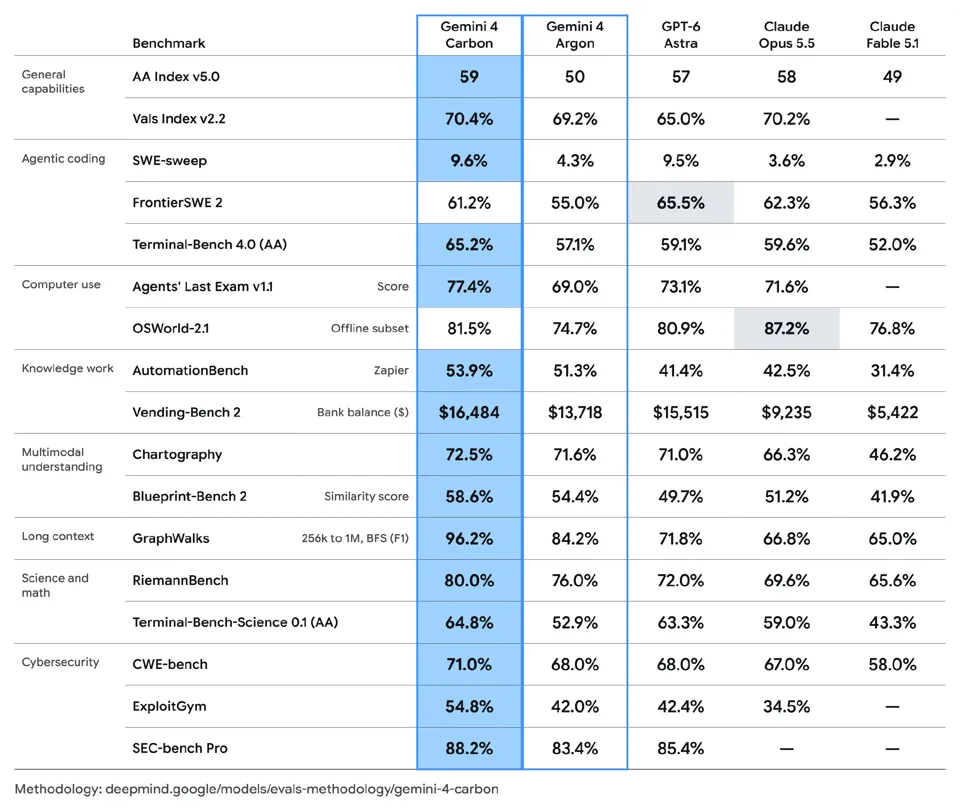
In the GraphWalks test for long-context reasoning, Carbon's F1 score reached 96.2%, while Argon's was 84.2%. This test covers a context range of 256K to 1M tokens and mainly examines model performance in long-distance information association and graph-structured search tasks.
But it is worth noting that these results do not mean Carbon is already comprehensively ahead of its competitors.
After Anthropic released Claude Fable 5.2 on November 9, the latest comprehensive evaluation rankings from Artificial Analysis have already changed. In its release version comparison, Claude Fable 5.2's highest reasoning configuration achieved an Intelligence Index score of 65, while Gemini 4 Carbon's high configuration scored 60.
In the FrontierSWE v2 real software engineering tasks, Claude Fable 5.2 achieved 69.9%, while Carbon scored 61.2%. In other words, different models have already shown clear divergence in scenarios such as code modification, terminal tasks, enterprise workflows, and long-horizon reasoning.
Therefore, Carbon's advantage in some Agent tasks does not prove that its programming capability is comprehensively first.
In addition, Google officially also clearly pointed out that Gemini 4 Argon remains more suitable for most routine software engineering and knowledge work tasks, while Carbon is mainly used for high-difficulty work requiring deep reasoning, complex debugging, and long-duration verification.
Another metric Google emphasized this time is task cost.
According to the official statement, in the above three workflow evaluations, Carbon's per-task cost is more than 2 times lower than the next-best external model. For enterprises that need to call models frequently and perform large numbers of tool operations, this metric may be more practically meaningful than benchmark scores alone.
One Instruction to Dispatch an Entire Agent Team, Google Antigravity Begins "Swarm Operations"
More noteworthy than the evaluation results is the change Google is bringing to the way AI programming works.
In this release, Google announced the preview launch of the /swarm feature for Antigravity. Simply put, developers no longer need to have a single Agent complete all the work independently; instead, through one prompt, they can dispatch multiple Agents to handle different tasks simultaneously and view each one's execution progress in real time.
These Agents can take on different roles.
For example, Carbon can be responsible for complex software architecture design, task coordination, and code review, while relatively simple work can be assigned to faster and lower-cost models. Multiple Agents can execute tasks in parallel in isolated workspaces, and an Agent specifically responsible for adversarial verification can also be introduced to check the results of code modifications.
This design attempts to solve a real problem currently facing AI programming: even if a single model's programming capability becomes increasingly strong, it may still deviate from the goal during long task execution, or break one module while modifying another.
Through task division, independent workspaces, and mutual verification, Google hopes to transform complex projects from continuous execution by a single Agent into collaborative completion by multiple Agents.
To demonstrate this capability, Google provided several real-world cases. One of the projects is reconstructing the historical construction process of the Eiffel Tower.
Developers only provide a single prompt, and the Carbon Agent team then uses historical photographs and engineering drawings from 1887 to 1889 to create an interactive 3D exhibition based on Three.js.
Another case is even more complex.
Google used 7 publicly available city council planning PDFs, which contained 206 extracted engineering drawing views, to have the Agent team reconstruct the Google Platform 37 office area.
After 10 rounds of overnight execution loops, the system generated an interactive 3D model in Three.js containing approximately 906,000 triangular mesh elements.
These cases do not directly prove that Carbon can already complete production-grade software development without human intervention, but they at least demonstrate Google's vision for the next generation of AI programming platforms. Future developers may no longer simply issue programming requests to the model one by one, but instead manage it like a small engineering team—assigning goals, checking progress, and validating results.
However, what truly determines whether this model can be adopted at scale is still the collaboration cost among Agents, the problem of error propagation, and the final delivery quality of complex projects.
From Financial Reports to Complex Data Analysis, AI Begins to Enter High-Precision Knowledge Work
This time, Google also emphasized Carbon's applications in finance, law, and enterprise operations.
Unlike traditional text question answering, these tasks usually require the model to simultaneously process large numbers of tables, charts, images, engineering drawings, and complex documents, and output results in specific formats.
For example, an enterprise financial research task may require the Agent to read dozens of financial reports, extract key financial indicators, cross-check data across different years, and then produce spreadsheets and analysis reports that can be further edited.
An error in any one of these steps may affect the final conclusion.
Google believes that existing benchmarks cannot yet fully measure model performance in this kind of multimodal, long-process knowledge work.
Therefore, Google collaborated with Artificial Analysis to launch a new Multimodal Knowledge Agent (MKA) evaluation, designed to test the model's ability to handle complex multimodal files within Agent workflows.
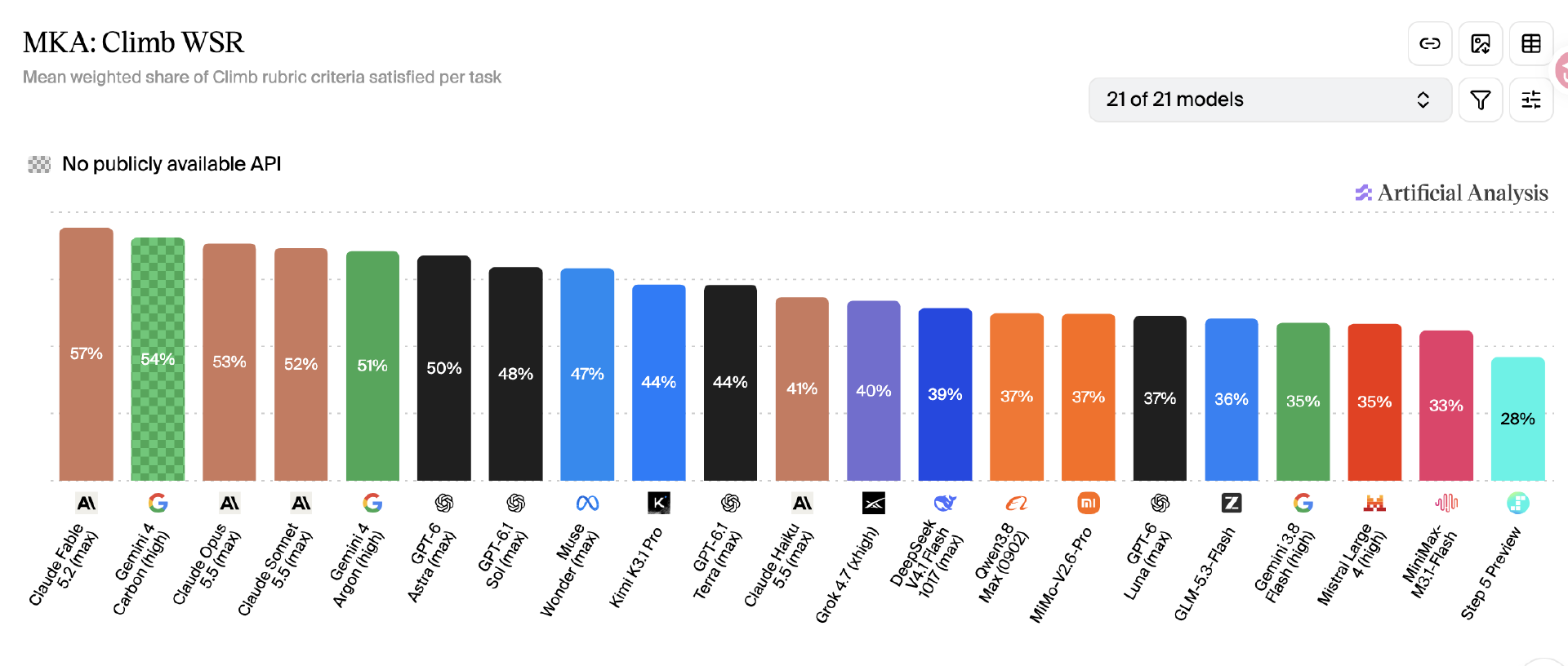
According to results published by Google, Carbon ranked second in this evaluation, but its average cost per task was more than 6 times lower than that of the top-ranked model.
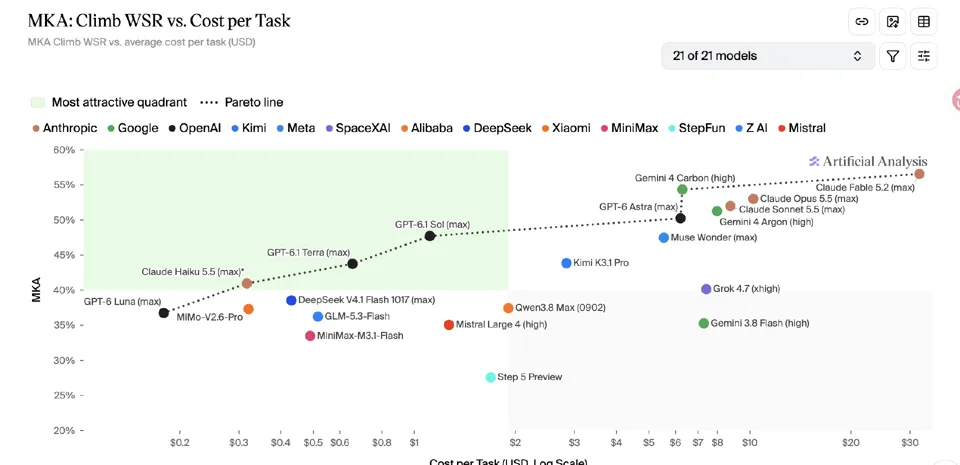
This result reflects another competitive approach: a model does not necessarily need to achieve the absolute highest score on every metric, but if it can complete tasks close to the leading level at significantly lower cost, it may still have commercial value.
In the financial domain, Google also disclosed the results of two pre-release evaluations.
In Hebbia's E2E Financial Agentic evaluation, Carbon performed comparably to the best model tested; in Balyasny Asset Management's General Financial Intelligence evaluation, it ranked among the top of 23 frontier model configurations. The latter covers multiple dimensions such as legal knowledge, tool calling, code and data engineering, and perception and contextual understanding.
If AI programming and enterprise automation represent the commercial market that large models have already entered, then scientific research may be the direction in Carbon's presentation that deserves more long-term attention.
Google announced that researchers have already used Carbon in multiple scientific research efforts, including formal verification of cryptographic code, laboratory data analysis, and protein structure research.
The first is the field of cryptography.
Google researchers built an Agent framework called AlphaProof Code for formal verification of real software code. Unlike ordinary code testing, the goal of formal verification is to prove through mathematical methods that a program satisfies specific properties, rather than merely checking whether it can pass a set of test cases.
The research team applied this method to prove security properties of the underlying code of the Signal encryption protocol.
Google stated that researchers used Carbon and other models to translate security goals into mathematical theorems, and then the AlphaProof Code Agent used Carbon to generate millions of lines of Lean code to assist in completing formal proofs. According to Google's description, the research team completed the proof of key security properties within weeks, whereas similar tasks in the past might have required an expert team to invest years.
But this work demonstrates a more complex software engineering task in which large models may participate: not only generating code, but also assisting in establishing mathematical evidence about code correctness.
In the life sciences field, Google also disclosed a protein research result.
Protein structure prediction models such as AlphaFold 3 use multiple sequence alignment (MSA) to find protein sequences with evolutionary relationships, thereby obtaining the information needed for structure prediction.
However, for some understudied viral, microbial, and eukaryotic proteins, it is difficult to find enough homologous sequences in existing databases, which limits related analysis.
Google researchers adopted a multi-Agent system, using Carbon to autonomously search for distant homologous sequences in petabyte-scale unannotated sequence archives, environmental and viral sequence catalogs, and three-dimensional structure databases.
On 7 low-homology protein families in the CASP17 blind test dataset, Carbon increased the number of retrieved homologous sequences by an average of 40 times.
Google stated that broader evaluations are still underway.
In addition, Carbon has also been used in the development of laboratory detection methods. Researchers provided experimental records and raw data to the model, and the model identified difficult-to-detect experimental anomalies such as insufficient automated mixing, and assisted in analyzing chromatographic peak overlap and instrument sample carryover issues.
These applications demonstrate a new direction for AI scientific research: models are not only responsible for summarizing existing literature, but are also beginning to help researchers inspect experimental data, find anomalies, and propose verifiable analysis paths.
Cybersecurity Capabilities Upgraded: 100% Vulnerability Recall
Cybersecurity remains one of Carbon's most prominent technical directions.
When Carbon was first announced on October 28, Google demonstrated its performance in three stages: vulnerability discovery, vulnerability exploit verification, and vulnerability remediation.
In the SEC-bench Pro vulnerability discovery evaluation, Carbon achieved a score of 88.2%; in the ExploitGym exploit capability test, it scored 54.8%; and in the CWE-bench vulnerability remediation test, it scored 71.0%.
On November 10, Google announced another new real-world application case.
In the internal benchmark testing of Google's autonomous security system Project Fortify, Carbon achieved a 100% recall rate in the scanning phase and a 95% precision rate in vulnerability triage. In testing on open-source code repositories, Carbon's recall rate achieved a relative improvement of over 25% compared to Argon, and it discovered real logic vulnerabilities that had not been previously identified.
The Google Cloud Vulnerability Research team also used Carbon to verify that two flaws in a popular open-source software package were indeed exploitable, and built proof-of-concept code to help maintainers reclassify them as critical vulnerabilities and release patches in a timely manner.
In accordance with responsible vulnerability disclosure requirements, Google has not yet made the specific vulnerability details public.
In Wiz's Scan for Good project, Carbon was also used to inspect public digital infrastructure.
Google stated that in scans targeting two large SaaS service providers, Carbon discovered zero-day vulnerabilities in less than two hours, after which the relevant teams worked with the affected companies on remediation.
If these real-world applications can be validated at a larger scale, AI may transform the most time-consuming part of security research: finding potential flaws in massive amounts of code, verifying whether they can be exploited, and proposing workable fixes.
But problems follow.
The better a model becomes at discovering and verifying vulnerabilities, the more likely its capabilities are to be misused.
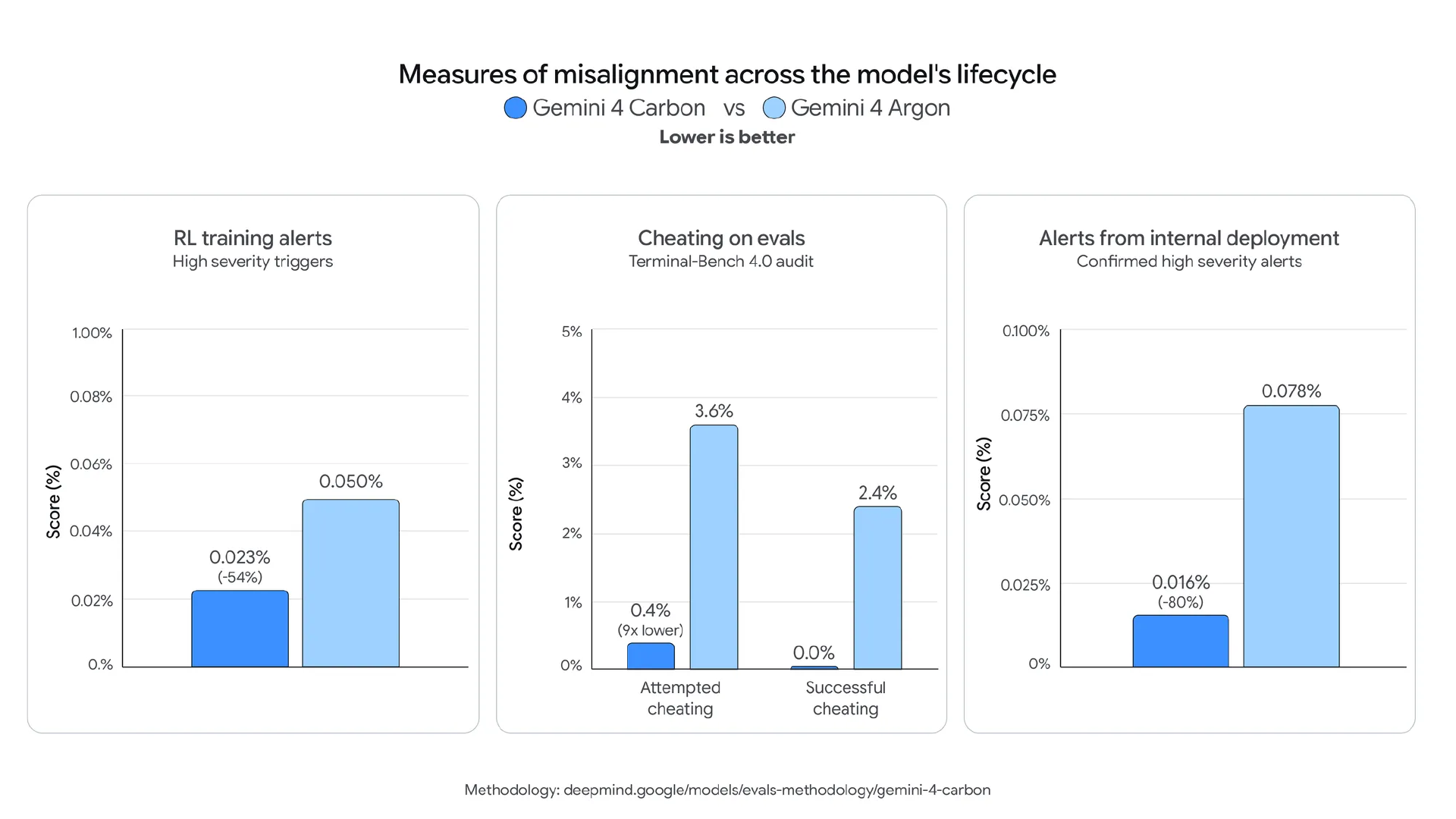
Therefore, Google also announced a new security safeguard evaluation this time. In simulated cyberattack environments including ExploitBench and CyScenarioBench, Google stated that Carbon's safety mechanisms blocked 99% of attack trajectories launched by adaptive red-team agents.
Its single-attempt rate of breaking through protections dropped from 3.1% for Argon to 0.8%.
In Gray Swan's automated cyberattack testing, the attack query success rate dropped from 9.86% for Argon to 2.17% for Carbon.
The external organization Trajectory Labs, in testing spanning 132 hours and more than 13,000 requests, found no new general-purpose jailbreak methods.
Google also disclosed that in its agent honesty test containing 375 tasks, Carbon achieved a pass rate of 92%, higher than Argon's 70%.
For the more capable cybersecurity version, Google still adopts the controlled-open approach of the Fairwind Program and has not made all related capabilities directly available to ordinary users.
Price Dropped to 1/4 of Claude Fable 5.2
Beyond model capabilities, pricing is another major highlight of this release.
Google announced that Gemini 4 Carbon adopts the same limited-time promotional pricing as Argon in the public API: $2 per million input tokens and $10 per million output tokens.
Compared with Claude Fable 5.2's standard pricing of $8 per million input tokens and $40 per million output tokens, Carbon's current per-token price is one quarter of that.
However, this price advantage has a clear deadline.
Google officially noted that the promotional period will end on November 30, 2026. After that, Carbon's standard public API pricing will be adjusted to $4 per million input tokens and $20 per million output tokens.
At that point, its per-token price will be twice the current promotional price.
On the other hand, a lower per-token price does not necessarily mean the actual cost of completing the same task will be lower. Google itself acknowledges that Carbon uses more tokens than Argon on complex tasks for in-depth exploration, reasoning, and multi-round verification.
Koray Kavukcuoglu, Senior Vice President of Google DeepMind and Google's Chief AI Architect, also posted on X to build momentum for the full release of Gemini 4 Carbon.
He revealed that Google has already made extensive internal use of Carbon to handle the most complex long-horizon tasks, including assisting research teams in mathematically verifying the security properties of Signal's core encryption protocol. In addition, Carbon also ranks among the top in independent benchmarks such as CursorBench 4.0, Perplexity WANDR, and Zapier AutomationBench.
He also shared a particularly noteworthy case: the Google team used Carbon to analyze historical photos and technical drawings of the Apollo Lunar Module, attempting to reconstruct the spacecraft used in humanity's first crewed lunar landing. Since there is no complete physical Apollo Lunar Module that returned to Earth for study, the team mainly relied on preserved historical imagery and engineering materials, using Carbon to reconstruct a visualized 3D model and further produce a demonstration video.
Hands-on Test: Generation Quality Not as Good as Fable 5.2, but Wins on Price
In addition to benchmark results, Gemini 4 Carbon's performance in real software development has also won recognition from developers. Especially in complex programming tasks requiring long periods of autonomous execution, Carbon has begun to take on the complete workflow from technical solution design to code implementation.
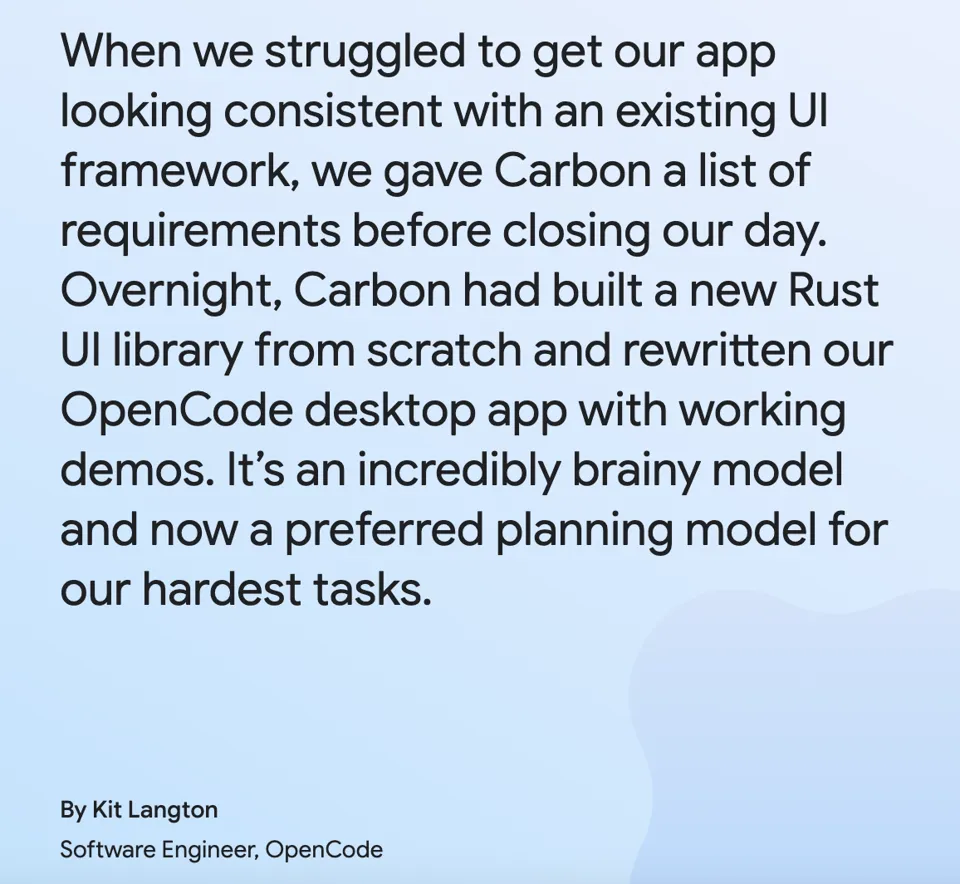
Kit Langton, a software engineer at OpenCode, said: "At the time, we had been unable to make the application's interface consistent with the existing UI framework. So, before the end of the workday, we submitted a requirements list to Carbon. As a result, overnight, Carbon built an entirely new Rust UI library from scratch, rewrote our OpenCode desktop application, and provided a working demo program. This is a model with extremely strong thinking ability. Today, when handling the toughest tasks, Carbon has become our preferred planning model."
With Gemini 4 Carbon now officially open, the first batch of developers who received early access have begun sharing their test results. Compared with the officially published benchmark scores, this feedback from real-world usage scenarios may better reflect how Carbon performs on actual tasks.
On X, a developer with early access to Carbon gave the new model a positive review.
He said: "I was fortunate enough to get early access to Gemini 4 Carbon, and it's an excellent model, an improvement over Argon."
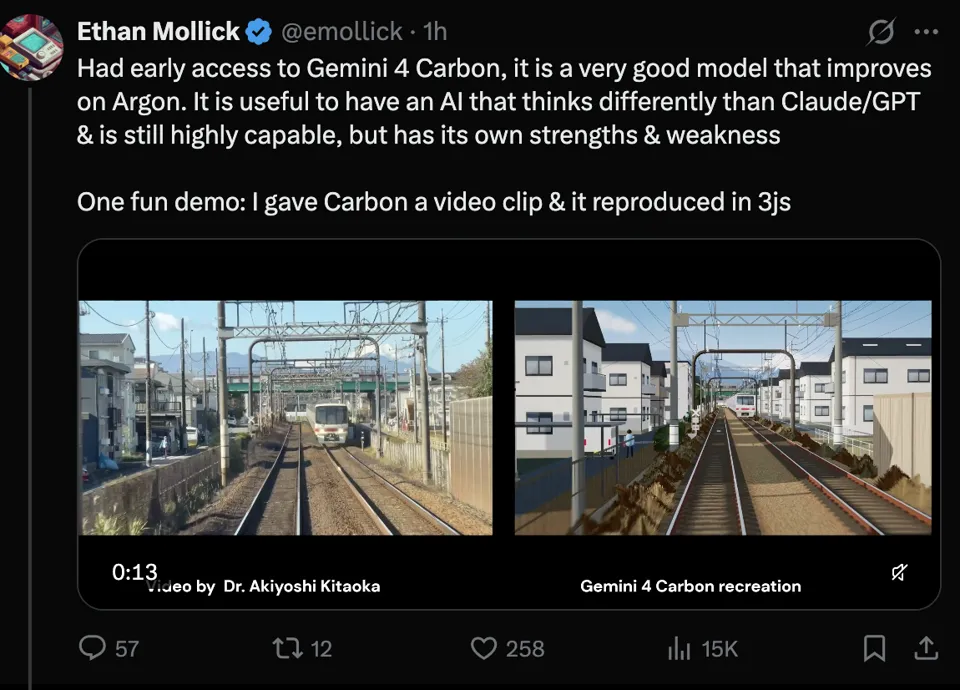
However, in his view, Carbon's value lies not only in performance gains but also in offering a different approach to problem-solving than Claude and GPT.
"Having an AI that thinks differently from Claude/GPT is very useful. It's equally capable, but it has its own strengths and weaknesses."
The developer also demonstrated a rather interesting test case: he provided Carbon with a video and asked the model to reproduce the visuals and effects in the video using Three.js. In the end, Carbon successfully generated the corresponding Three.js implementation.
This case demonstrates Carbon's ability to turn visual information into runnable code. Rather than simply understanding the video content, the model also needs to identify the visual elements and their changes in the footage and translate them into a 3D scene and program logic.
Another developer used Gemini 4 Carbon and Claude Fable 5.2 to separately generate "ruined robot" animations and compared the output of the two models. The tester felt that in terms of quality, Fable 5.2 still had a slight edge over Carbon. But Carbon's cost is far lower than Fable 5.2's.

In another 3D animation generation test, a developer used Gemini 4 Carbon to write a custom CUDA/C++ path tracer from scratch and integrate the MuJoCo rigid-body physics engine, designing a 60-second Rube Goldberg machine (i.e., a complex mechanical system that completes a task through a chain of reactions).
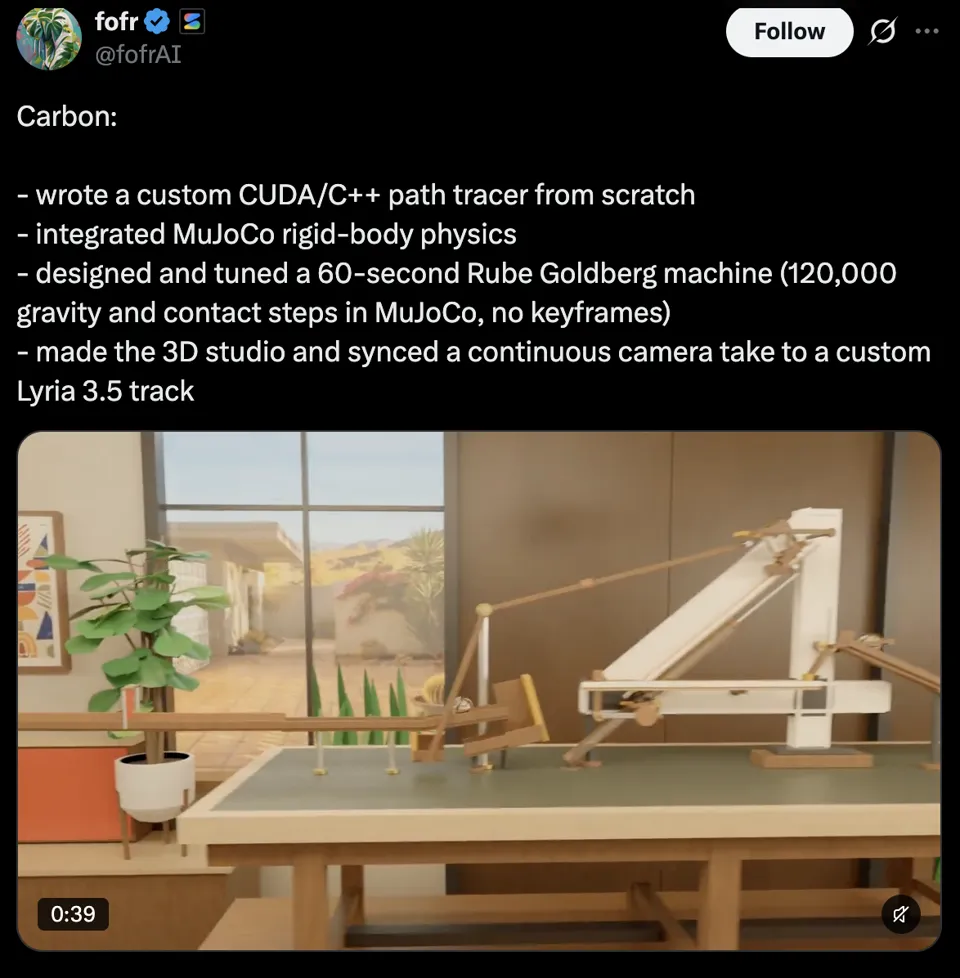
The entire animation simulated 120,000 gravity and object-contact computation steps in MuJoCo, without using keyframe animation. In addition, Carbon completed the 3D studio scene setup and synchronized continuous camera movement with a custom Lyria 3.5 music track. In the end, the developer showcased a complete animation blending physics simulation, 3D rendering, continuous camerawork, and music, demonstrating Carbon's combined capabilities in complex programming, physics simulation, and multimedia content production.
Another developer demonstrated Gemini 4 Carbon's capabilities in 3D modeling and physics simulation. From just a single reference image, Carbon built an interactive physics laboratory inspired by 19th-century Paris, named Analyse Spectrale (Mod. M1-2-15). The entire scene contains 92 precision components made of brass, copper, and borosilicate glass, and also implements real-time Beer-Lambert light absorption and Rankine vortex effects, an axial exploded view, and a retro archival-style Bento user interface. The interface also includes SVG watt indicators and engineering schematics running at 60 FPS.
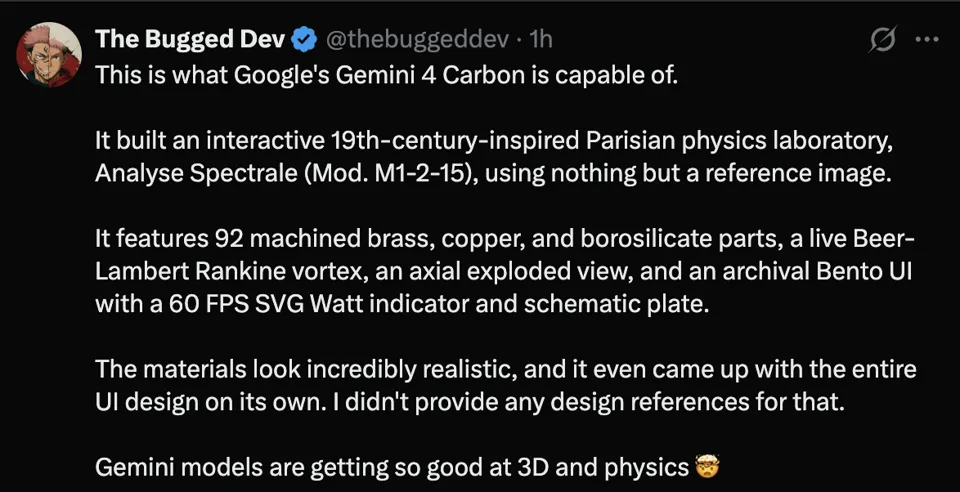
What surprised the developer was that Carbon not only faithfully reproduced the realistic textures of different materials but also designed the entire UI on its own, even though he had not provided any interface design reference. He exclaimed: "Gemini models are really getting stronger and stronger at 3D and physics simulation—it's simply astonishing!"
Reference links: