Tencent AI Platform Designs Dual-Target Peptides in Nature Study
Tencent's Life Science Lab published a first-author Nature paper on AI-driven de novo design of high-activity dual-target therapeutic peptides. Its ORIDTP platform combines diffusion generative models, dual-objective reinforcement learning and flexible peptide affinity modeling, testing only about 15 peptides per round. Preclinical validation spans weight-loss/glucose control and tumor immunity, with tumor volume reduced 94.2% versus controls.
Related Entities
Full Report
IT之家 November 26 news, Tencent announced today that on November 25, a research achievement in AI for Science from Tencent Life Science Laboratory was officially published as the first affiliation in the main journal of Nature.
According to the introduction, Tencent used AI to tackle a frontier challenge in the field of drug development: the de novo design of highly active dual-target therapeutic peptides. In simple terms, this means designing a "key" that can open two locks from scratch without relying on existing molecular templates, providing new possibilities for the treatment of complex diseases.
Focusing on this problem, after long-term exploration, the team developed the AI platform ORIDTP, which combines diffusion generative models, dual-objective reinforcement learning, flexible peptide affinity modeling, and biological experiments, establishing a complete R&D closed loop of "computational design — experimental validation — feedback optimization."
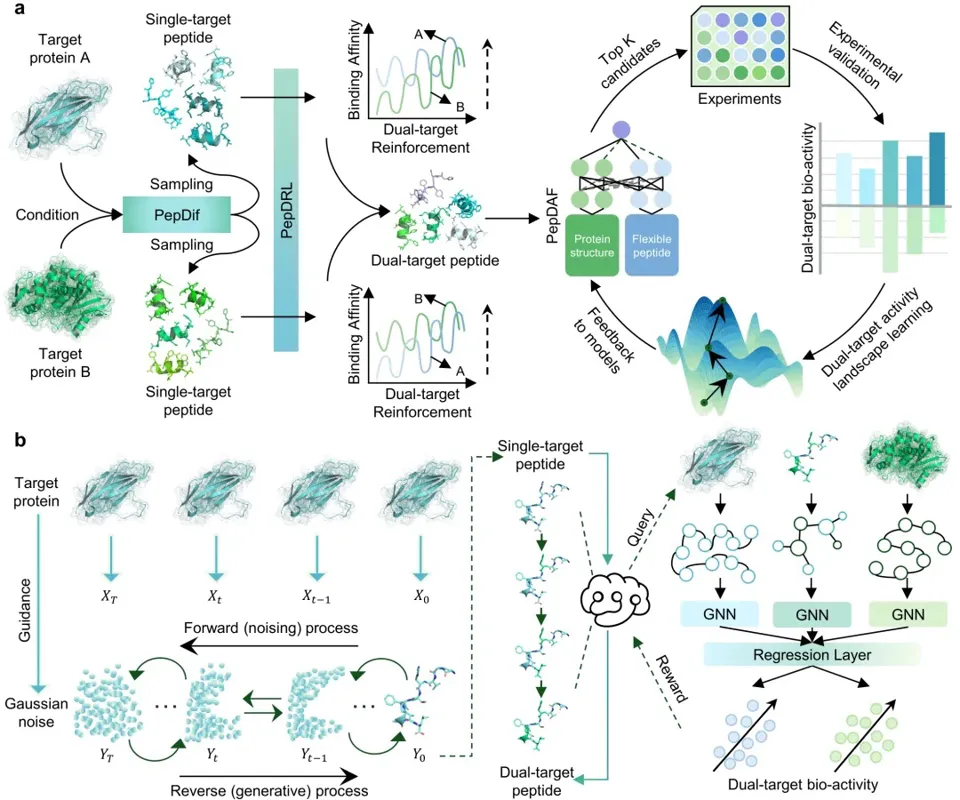
▲ ORIDTP is an AI platform for designing highly active dual-target peptides
This shifts the traditional R&D model that relies on large-scale blind screening of molecular libraries toward AI-driven precise iteration with small samples. Each round of experiments requires testing only about 15 peptides. The team has completed validation in two pharmacological directions with markedly different mechanisms:
- Weight loss and glucose lowering: In obese and diabetic mouse models, significant weight loss and glucose control effects were observed at molar doses lower than those of the control drug.
- Tumor immunity: In tumor models of mice with specific human target knock-in, the candidate molecules reduced tumor volume by 94.2% compared with the control group.
Currently, the research is still in the preclinical stage, and human clinical trials have not yet been conducted.
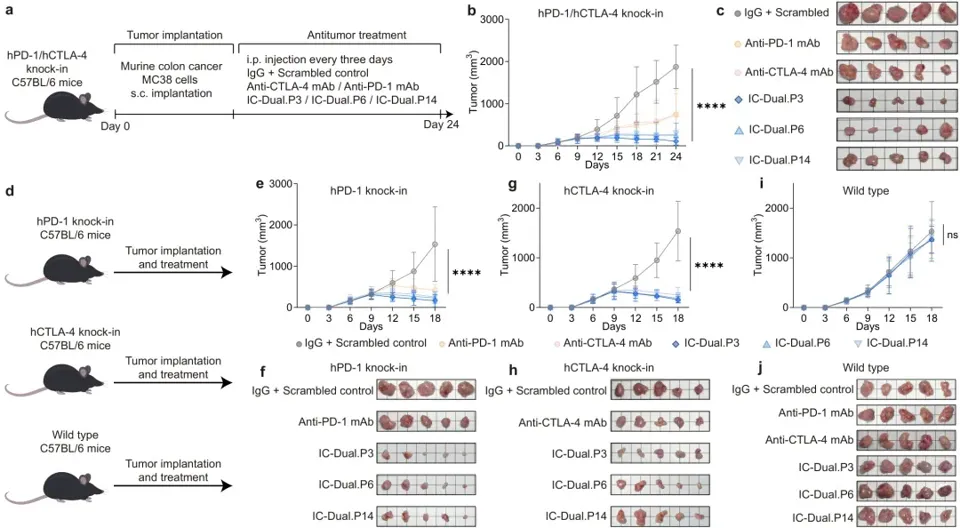
▲ Antitumor activity of dual-target peptides in gene knock-in mice
Currently, ORIDTP has been deployed to the one-stop life science AI workbench "Tencent Health BioNexus," is open to the research community, and can also be found in WorkBuddy.

IT之家 attaches the paper link:
Advertising statement: External redirect links contained in the article (including but not limited to hyperlinks, QR codes, passwords, and other forms) are used to convey more information and save selection time. The results are for reference only. All articles on IT之家 containing external links include this statement.