NTU Method Teaches AI Agents to Wait, Boosting Accuracy by 17.1%
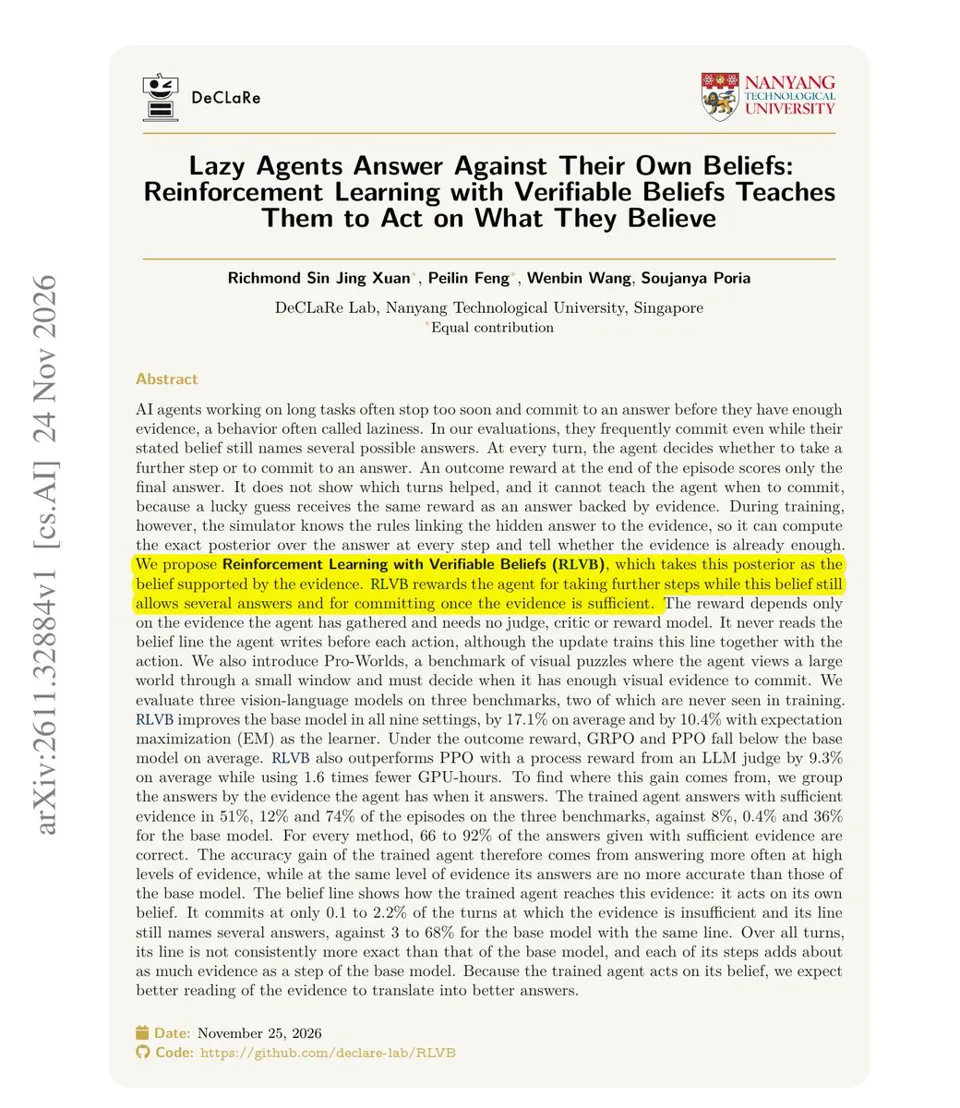
Researchers at NTU Singapore propose RLVB (Reinforcement Learning with Verifiable Beliefs), which rewards agents for continuing to explore while multiple candidate answers remain and for answering only once evidence suffices, rather than rewarding the final answer alone. Across three Qwen vision-language models and three benchmarks, RLVB beats the base model by 17.1% on average, while outcome-reward RL falls below baseline. Premature commitment in under-evidenced turns drops from 3-68% to 0.1-2.2% after training.
Related Entities
Full Report
Rohan Paul (@rohanpaul_ai) · 2026-11-25 19
New NTU Singapore paper finds that AI agents often commit to an answer while their own written belief still lists several possible answers.
And so this paper's method rewards for waiting ( Reinforcement Learning with Verifiable Beliefs (RLVB)) which raised their accuracy by 17.1% on average.
RLVB rewards the agent for looking further while several answers remain and for answering once the evidence is enough.
AI agents often commit to a guess while their own notes still list several possible answers. Training on the final answer cannot fix this, since a lucky guess earns the same reward.
Across 3 Qwen vision-language models and 3 benchmarks, RLVB beat the base model by 17.1% on average, while outcome-reward RL fell below it. Base models committed on 3 to 68% of turns where evidence was short and their belief listed several answers, versus 0.1 to 2.2% after training.
In simulator training, reward each decision to stop against the evidence, not just the final answer.