Anthropic Mathematician Claims Claude Helped Prove Riemann Hypothesis
Anthropic mathematician Levent Alpöge claims he and Claude discovered a proof of the Riemann Hypothesis and its generalized form, releasing roughly 17 million lines of Lean formalization while withholding a 250,000-page written proof. Terence Tao says the argument appears to draw on the Langlands program and arithmetic geometry, and that the community needs time to verify it; preliminary checks confirm the formalized statement is indeed GRH, though Lean kernel soundness remains a theoretical risk.
Related Entities
Full Report
IT之家 November 21 news: On November 20 local time, Anthropic mathematician Levent Alpöge claimed that he, in collaboration with Claude, had discovered a proof of the Riemann Hypothesis and its generalized form, the Generalized Riemann Hypothesis (GRH).
Alpöge holds a bachelor's degree from Harvard University and a PhD in mathematics from Princeton University, and currently conducts research at Anthropic. In his statement, he said that Claude "far surpassed me" when the proof was nearing completion, "flying, dancing, and shining near the finish line." He also stated that he pointed Claude toward key research directions, after which Claude proposed a series of mathematical ideas that surprised him.
According to Alpöge, the textual proof he and Claude generated exceeds 250,000 pages and was not made public due to its length. The public materials include only a 4-page explanation and Lean formalized code divided into 14 compressed packages, totaling approximately 17 million lines.
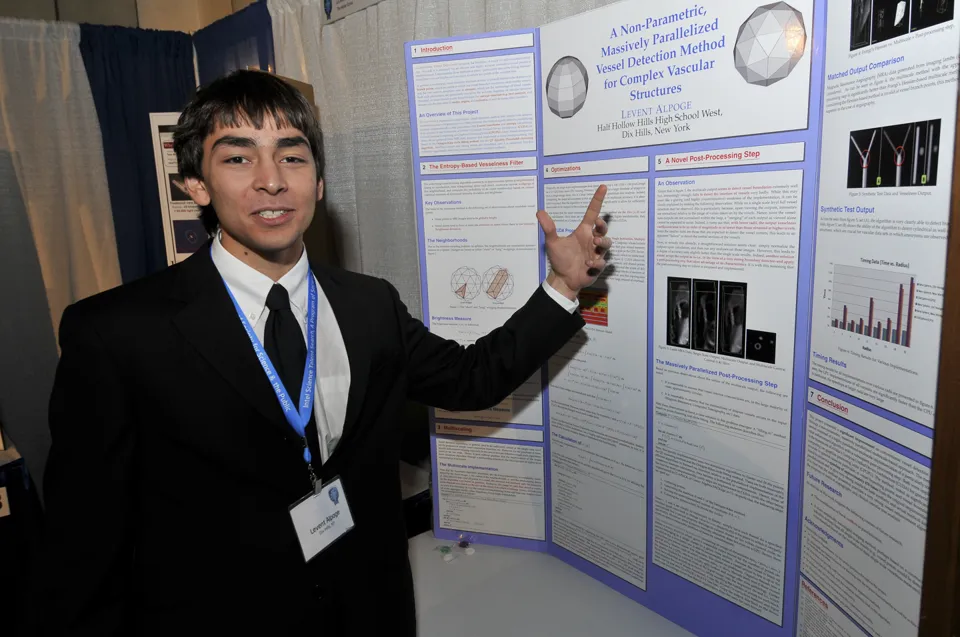
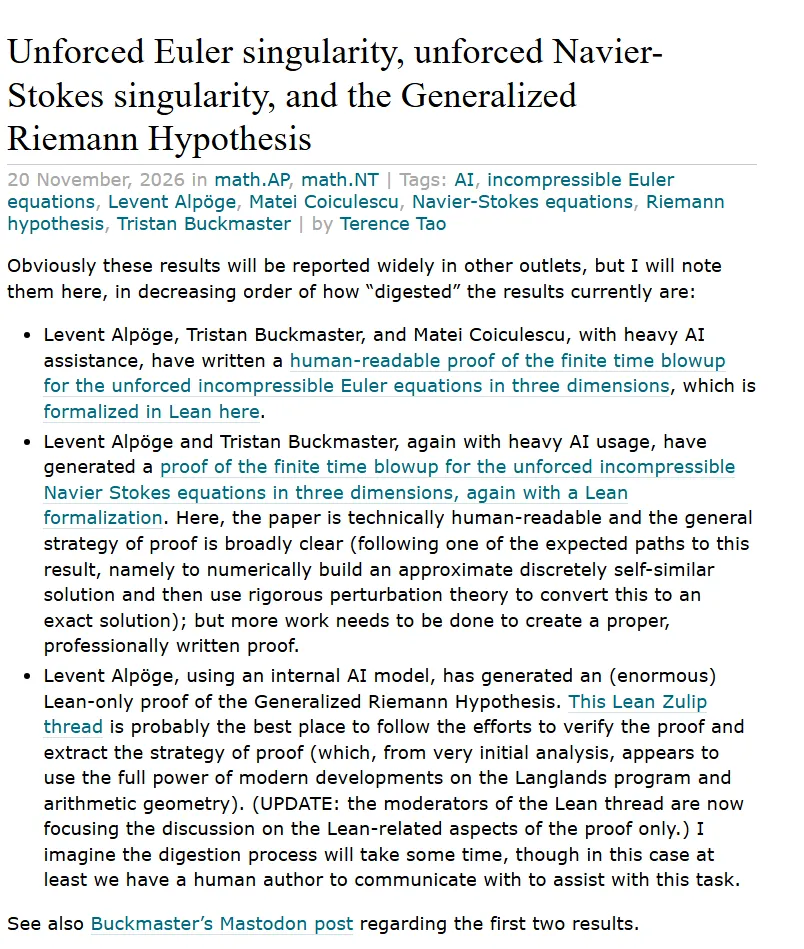
Terence Tao, winner of the 2006 Fields Medal, subsequently provided a preliminary assessment on his personal blog. He stated that, from a very preliminary analysis, the proof appears to draw on modern research results in the Langlands program and arithmetic geometry, and that it will still take some time for the mathematics community to sort out the core ideas and verify correctness.
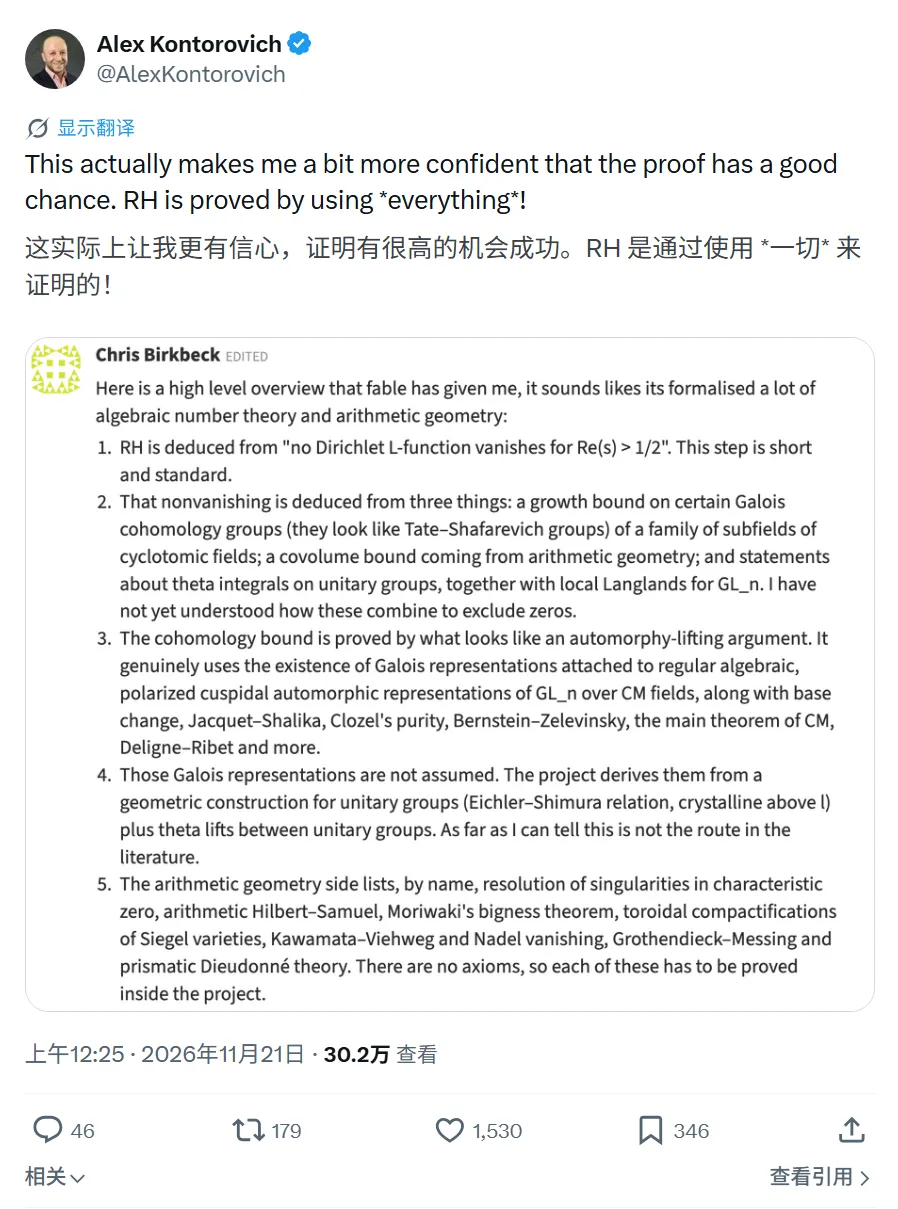
Alex Kontorovich, a mathematics professor at Rutgers University, said on X that a proof of the Riemann Hypothesis would require "using everything," which actually made him more confident about the possibility of success.
IT之家 note: Lean is an interactive theorem prover used to translate mathematical proofs into code that can be mechanically verified by computers. Lean checks logical derivations step by step through a small trusted kernel, but it cannot automatically guarantee that the proposition proved by the formalized code is semantically fully consistent with the original mathematical conjecture.
Mathematician Elliot Glazer said after a preliminary check that the mathematical proposition formalized in the Lean files released by Alpöge "is indeed the Generalized Riemann Hypothesis." However, he also noted that in theory the possibility of a soundness flaw in Lean itself cannot be ruled out, though he estimated that probability to be far below 1%. Prior research records have shown that some historical versions of Lean 4 had kernel defects that allowed invalid proofs to pass.
An October 2026 report in Science magazine also pointed out that AI-generated Lean code had weakened the formulation of the original English proposition in OpenAI's high-profile proof of the Navier-Stokes problem; Lean verifies only the formalized target pointed to by the code, not the mathematical problem itself at the natural-language level.
In addition, a chat screenshot circulating online, purportedly showing 2026 Fields Medal winner Deng Yu commenting on the matter, shows that in response to a related question, he replied that he "would not even look at it before at least a 500-page version is produced."

Even if the Lean code compiles and the consistency between the formalized target and the original conjecture is confirmed, there is still a long way to go before recognition by the Clay Mathematics Institute.
According to the institute's rules, a solution to a Millennium Prize Problem must be formally published in a peer-reviewed journal and undergo at least a two-year verification period and general acceptance by the mathematics community before it can enter the prize review process. Personal website statements and code archives do not meet submission eligibility, and the Clay Mathematics Institute does not accept direct submissions. The Riemann Hypothesis was included among the seven Millennium Prize Problems in 2000, with a prize of $1 million (currently about 6.692 million RMB at the current exchange rate).
It is worth mentioning that Anthropic had just listed on Nasdaq on November 19. Alpöge said that after completing the key work late at night on November 15 through the early hours of November 16, he contacted Anthropic CEO Dario Amodei to ask about the timing of publication. He admitted that "the timing is very bad," but said that "I really could not wait any longer."
In August this year, Anthropic announced that Claude had raised the lower bound on the proportion of critical zeros on the line in a problem related to the Riemann Hypothesis from 41.6% to 67.2%; at that time, there was still a clear gap from a complete proof.