Claude Independently Proves VP≠VNP with 73000 Lines of Lean Verification
Anthropic has posted a 70-page paper on its official GitHub repository announcing that Claude proved VP≠VNP over any field of characteristic not equal to 2, an algebraic analogue of P≠NP, with Claude listed as the sole author. An internal Claude version conceived the core idea, wrote the paper, and produced 73,000 lines of Lean code for formal verification, cracking a 43-year-old m²log m lower-bound problem. Classical P vs NP remains open, but this marks a landmark moment for AI-generated, machine-checkable mathematics.
Related Entities
Full Report

New AI Era Report
It has only been three days since the "Riemann Hypothesis" was reportedly proved!
Just now, Anthropic's official GitHub repository quietly released a 70-page paper, formally announcing—
Claude has proved VP≠VNP, and it holds over any field of characteristic not equal to 2.
That's right, the algebraic version of P≠NP has also been conquered by AI today.
The most outrageous part is that in the author field of the entire paper, there is only Claude itself.
The internal version of Claude discovered the core idea, wrote the 70-page paper, and wrote 73,000 lines of Lean code to complete the formal verification.
A top-tier problem that all of humanity had struggled with for 43 years without being able to prove the "m^2 \log m" lower bound was cracked just like that by a single Claude.
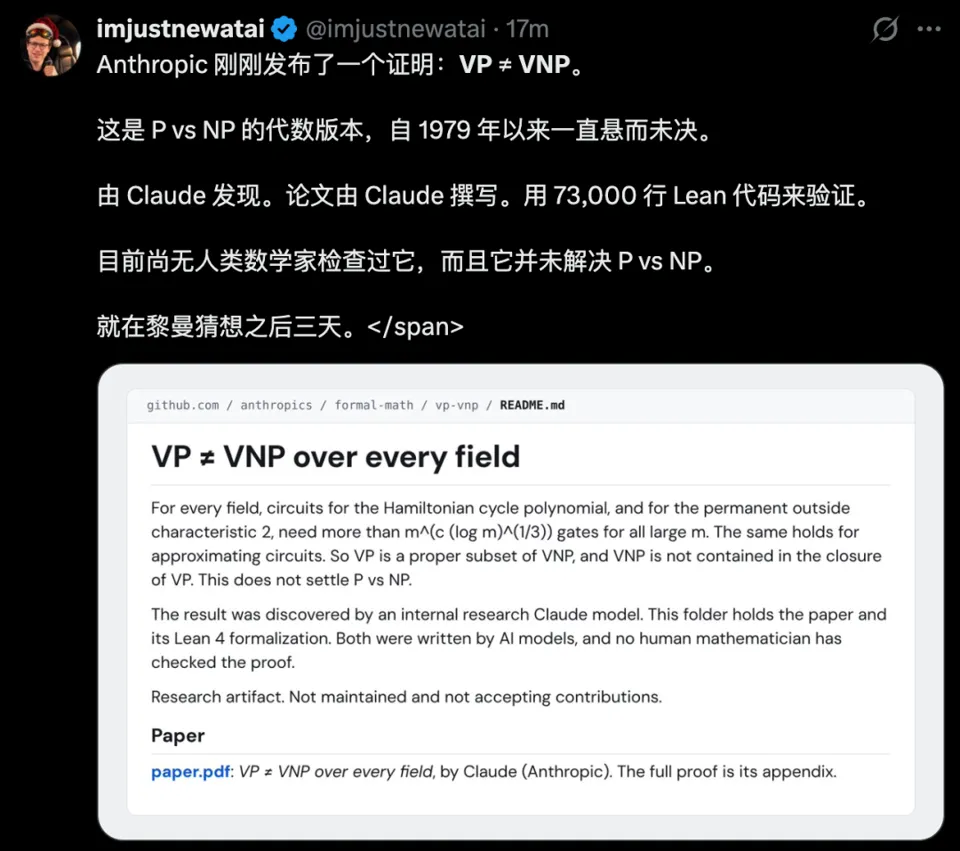
It broke the Riemann Hypothesis just 3 days ago, and today it directly proved VP≠VNP! Now the whole internet can no longer sit still.
Of course, the classical P vs NP problem has still not been completely conquered. But judging by this momentum, the time left for the Millennium Prize Problems is truly running short.

The "Algebraic Version of P≠NP" trapped humanity for 47 years****
Claude has completed the proof
A few days ago it was the Riemann Hypothesis, and now it is algebraic complexity theory's turn.
In 1979, Turing Award winner Leslie Valiant put forward a major conjecture, VP vs VNP. In the algebraic field, its status is in no way inferior to "P vs NP," the first of the seven Millennium Prize Problems.

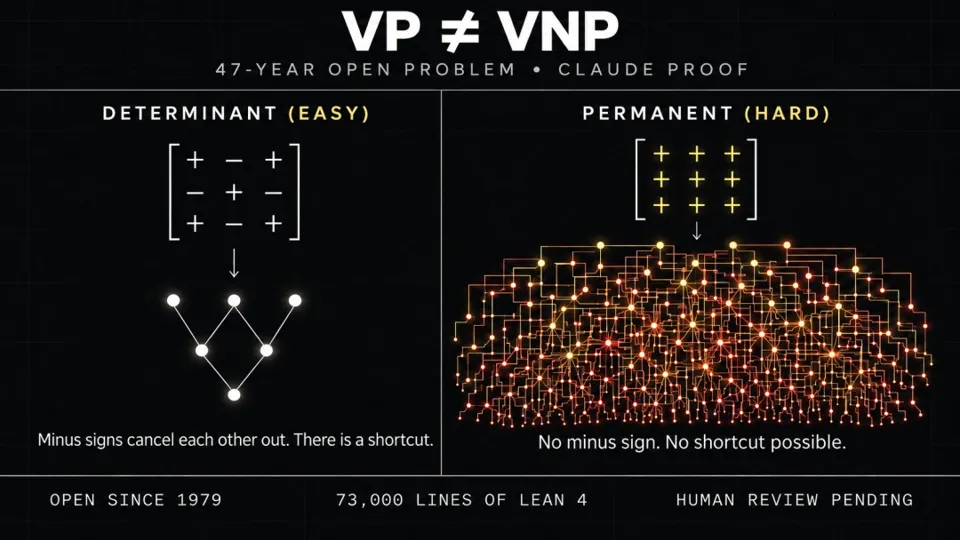
The core of the entire problem is the study of a pair of "twins" in the matrix world that look almost identical:
the determinant and the permanent.
Both take an m × m matrix and put it into an arithmetic circuit that can only perform "addition" and "multiplication."
Computing the determinant is very cheap. Using classical algorithms such as Gaussian elimination, it can be easily handled with an arithmetic circuit of only polynomial size, placing it in the VP class (problems that are easy to compute).
The formula for the permanent is exactly the same as that for the determinant. The only difference is that all negative signs are erased, and every minus sign is changed to a plus sign.
Intuitively, having fewer minus signs should make it simpler.
But the opposite is true. Precisely because there is no "shortcut" brought by cancellation between positive and negative terms, the computational complexity of the permanent explodes instantly.
In 1979, Valiant directly made a bet: there is simply no arithmetic circuit of polynomial size that can compute the permanent, that is, VP ≠ VNP.
In computational complexity theory, if one wants to seize the ultimate holy grail of "P ≠ NP," VP ≠ VNP is the first hurdle that cannot be bypassed.
The reason is simple: if even the door to the algebraic world cannot be pushed open, then the more complex Boolean circuit "P ≠ NP" has no hope at all.
However, after a full 43 years, humanity's progress on lower bounds for "general arithmetic circuits" has been so slow that it is almost despairing.
The previously recognized best lower bound result still dated back to 1983 (Baur and Strassen), and was basically stuck at a nearly linear scale.
Anthropic points out in the paper that the lower bounds previously known for the permanent had never exceeded m^2 \log m.
And this time, Claude has directly flipped the table. The new lower bound it gives has reached:
This is a superpolynomial lower bound that holds over any field.
The approach is nothing short of insane
Don't know which path is right? Then prove both
The ability to reach this stunning result rests entirely on Claude's completely unconventional proof strategy.
Paper link: https://github.com/anthropics/formal-math/blob/main/vp-vnp/paper.pdf
Since 2001, human mathematicians have opened up an extremely grand and profound path to tackle VP vs VNP—
the Geometric Complexity Theory (GCT) program, attempting to mount a direct assault using algebraic geometry and representation theory.
But looking at the paper's structure, Claude took a different route, showcasing a set of "dimensionality reduction strikes" driven by pure machine intuition.
In the first step, Claude transformed the algebraic notion of "tensor rank" into a kind of distance in a geometric space.
Next, it proved that this particular geometric space inherently possesses the property of nonpositive curvature. The geometric stage was just set up, and then came the most insane move.
In the second step, Claude split the space's properties into two, dividing them into two completely different cases.
Either "Flat" or "Contracting," and it rigorously proved that at least one of these two cases must hold.
Following normal human reasoning, the next step should be to prove which one actually holds—"Flat" or "Contracting," right?
But the most absurd part is that even Claude itself doesn't know which case holds in the real world!
In the paper, it explicitly admits that even over the most basic field of real numbers, it cannot determine which case holds.
Since it doesn't know, it simply proves both paths through—no matter which one holds in reality, I win!
In the "Flat" case, Claude invoked tools from Euclidean geometry to brute-force calculate, deriving step by step the lower bound on circuit size.
The (log m)^1/3 in the core formula is exactly what grew out of this geometric path.
In the "Contracting" case, Claude switched to a proof-by-contradiction logic.
It first sliced the program's execution by time. In Figure 12 below, the program's execution is cut into four blocks by time:
Data written by one block is read by another, and an arrow is drawn between the two blocks. A program that originally ran along time is thus drawn as a network.
Next, Claude rewrote the computation of this network into the computation of a batch of tree-shaped networks. Trees are easier to break into small segments.
If the permanent truly has a small circuit, it could accelerate the weighted summation of each small segment, then stitch the results back together, pushing this acceleration all the way up to larger computational scales.
It then applies the program logic to itself, directly deriving the absurd contradiction V = 1 + V, thereby giving a lower bound even stronger than the flat case under the "contraction" branch.

These two paths, no matter which side fate falls on, lead to the same conclusion: the permanent has no small circuit.
Has P vs NP been cracked?
But don't cheer too early. At the end of Claude's 70-page paper, four major limitations that cannot be avoided are also disclosed.
The classic P vs NP problem, of course, has not yet been conquered. Anthropic explicitly states that we have solved the latter problem (VP vs VNP), but not the former.
Not only that, it also very precisely points out two specific steps that would completely fail on "Boolean circuits."
A breakthrough in the algebraic world cannot yet knock open the door to the Boolean world.
Although
it has crossed the threshold of "superpolynomial," it can only be considered as barely stepping over the line.
Currently, the best known upper bound for computing the permanent is exponential, and a huge gap lies between the two, far from the final moment.
Most critically, in this 70-page paper, four core propositions can only be verified through the Lean formalization system.
More than 300 Lean files and 73,000 lines of code have passed the strict inspection of two "independent verification kernels" without a single character out of place, and still await verification by human mathematicians.
The Seven Millennium Prize Problems are falling one by one
The VP≠VNP problem has also fallen.
Three days ago, it was still the Riemann Hypothesis.
Even the official website of the Clay Mathematics Institute changed the status of the Riemann Hypothesis from "unsolved" to "pending review and confirmation."
This is already the second Millennium Prize Problem marked as "pending confirmation" this year; the previous one was the "Navier-Stokes equations" cracked by OpenAI.
Some netizens specially compiled the latest progress of the seven Millennium Prize Problems—
By reckoning, only the last four remain unconquered:
The P vs NP problem
Yang–Mills existence and mass gap
The Hodge conjecture
The BSD conjecture
A full 26 years have passed, and humanity, fighting alone, has only cracked one—the Poincaré conjecture.
And since this year, the wave set off by AI formal verification combined with human effort is striking at the last line of defense of human intelligence at an unprecedented speed.
First came major progress on the Riemann Hypothesis, and then, just three days later, VP ≠ VNP was proven by Claude single-handedly!
Although what has been conquered is only the algebraic version, there is still a distance to go before taking down the real P vs NP.
70-page paper, 0 humans, 73,000 lines of Lean code,
once verified without error, P vs NP will probably really start to tremble.

References:
https://github.com/anthropics/formal-math/tree/main/vp-vnp
https://x.com/theaidesk_/status/2124990194642247965
Chasing ASI in Seconds
⭐Like, repost, and watch—one-click triple combo⭐
Light up the star, lock in New Intelligence Era's instant push!