Tencent Hunyuan Open-Sources DFly2 Drafter Model with Up to 4.2x Speedup
Tencent Hunyuan has open-sourced DFly2, a new drafter model that acts as a sidecar accelerator for Hy4 flash without altering model weights or outputs, delivering up to 4.2x speedup in a single case. Its key design aggressively reuses the target model's KV cache and indexer-selected positions, decoupling attention cost from context length while requiring zero extra KV memory and remaining PD-disaggregation friendly. Weights, full training code and a paper are released together.
Related Entities
Full Report
IT Home News, November 26: The Tencent Hunyuan team today open-sourced a new-generation draft model, DFly2.
According to the official announcement, DFly2 does not replace Hy4 flash; its role is more like an acceleration component attached alongside it. It can multiply the model's token generation speed while keeping the model weights unchanged and the output unchanged.
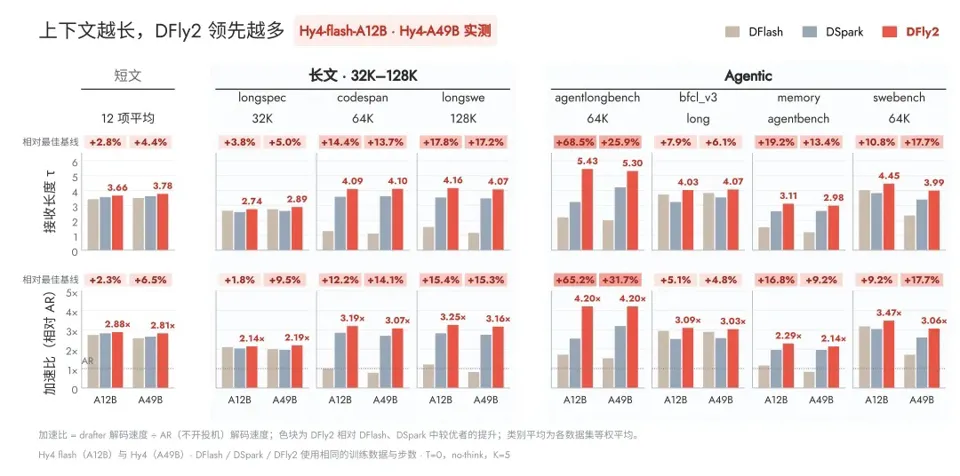
DFly2 is designed specifically for DSA-type sparse-attention large models and long-context scenarios. The weights adapted for Hy4 flash and the complete training code are open-sourced together.
According to the introduction, DFly2 achieves the following:
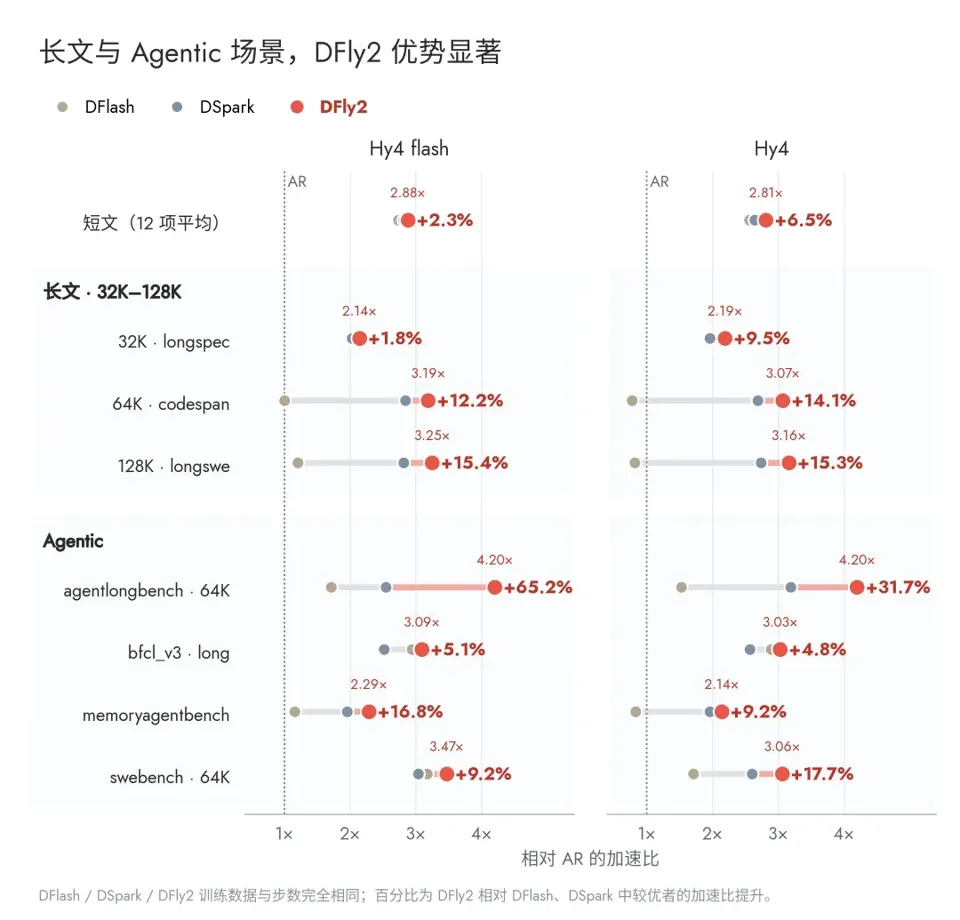
- Better performance under the same training conditions: For Hy4 flash on 19 public evaluation sets, DFly2's acceptance length and speedup ratio are overall better than DFlash and DSpark, with more obvious advantages on long documents and Agentic tasks. The average speedup ratio is about 12% and 30% higher than DSpark respectively, with a maximum single-item speedup of 4.2×.
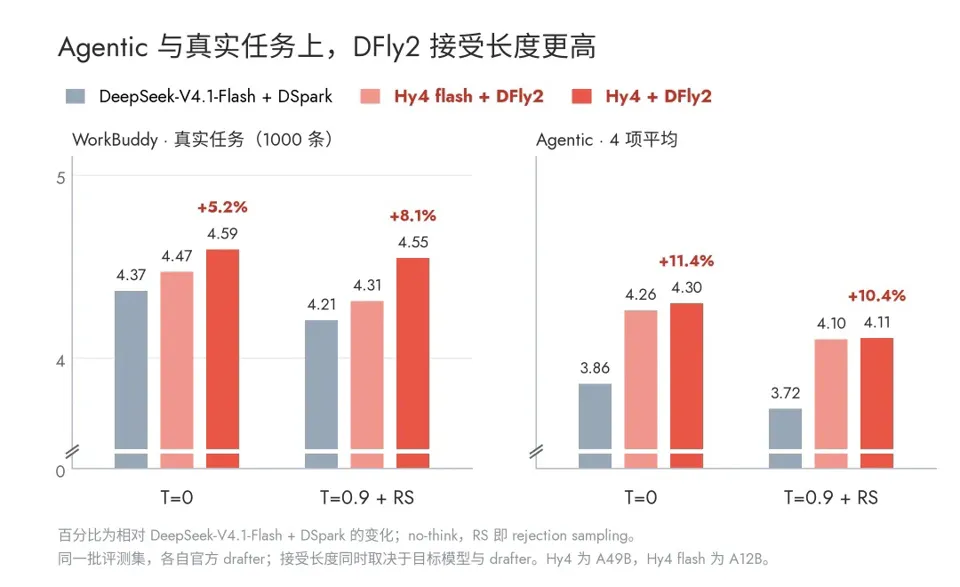
- Also advantageous compared with open-source solutions: Compared with the DSpark built into mainstream open-source models, Hy4 flash's DFly2 leads by 10.4% in acceptance length on Agentic and real-world tasks (WorkBuddy).
According to the official announcement, DFly2's biggest highlight is extreme reuse of the target model: each draft layer directly shares the KV cache (KV Share) of the corresponding sparse-attention layer in the target model and the at most 2,048 positions selected by the indexer (Index Share). This brings three advantages:
- Fixed computational overhead: Each draft token attends to at most about 2K keys, and the attention complexity is independent of context length.
- Zero additional KV memory: There is no need to maintain a separate KV cache for the drafter.
- PD-disaggregation friendly: It does not participate in prefill, and P → D only requires transmitting one final-layer hidden state.
IT Home attaches the relevant links:
- GitHub: https://github.com/Tencent/AngelSpec
- HuggingFace: https://huggingface.co/AngelSlim
- Paper: https://arxiv.org/abs/2611.34776
Advertising statement: External redirect links contained in this article (including but not limited to hyperlinks, QR codes, passwords, and other forms) are used to convey more information and save selection time. The results are for reference only. All articles on IT Home that contain external links include this statement.