Baidu Unveils ERNIE 5.5 Flash Preview with 280B Parameters
Baidu has unveiled ERNIE 5.5 Flash Preview ahead of its World Conference, featuring 280B total parameters with only 14B activated per inference, million-token context, and over 200 tokens/sec generation, with an open-source release promised. The model centers on coding capability, spanning game development, 3D modeling and video orchestration that require sustained tool use, and Baidu claims it rivals flagship models like Claude Opus 5.5 and GPT-6.1 Sol on benchmarks such as Terminal-Bench and AutomationBench.
Full Report
Just now, Baidu released a new model, and netizens on X couldn't sit still after seeing the demo.
Is Baidu about to rise up??
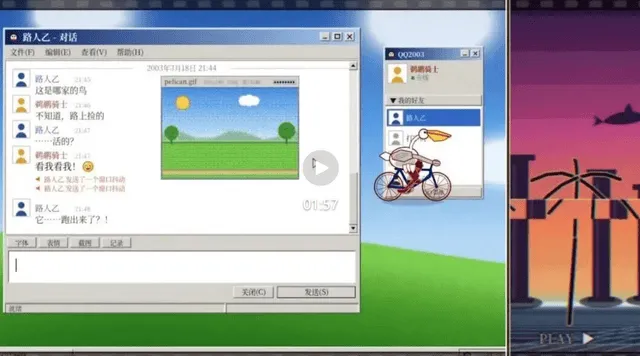
Everyone's saying "a pelican riding a bicycle" is already old and outdated, but have you ever seen a version like this?
Video address: https://mp.weixin.qq.com/s/Rj-T8unLFnHUk6R89rt02Q
△Concept design from Bilibili creator @近步抱告_
A pelican riding a bicycle, from the Sahara rock paintings of 4000 BC, all the way into the code editor of the large model era.
116 seconds, 20 artistic styles, with the entire animation orchestrated through Python code.
All I can say is, the pelican is still the same pelican, but the gameplay is no longer in the same dimension...
And that's just an appetizer.
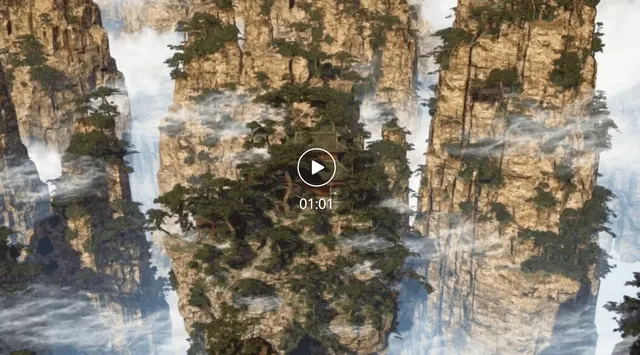
Right after finishing the animation, the model behind it turned around and dove into Unreal Engine UE5.8, working continuously for 11 hours to crank out an Eastern wuxia game called "Cloud Peak Journey".
Video address: https://mp.weixin.qq.com/s/Rj-T8unLFnHUk6R89rt02Q
Zhangjiajie stone peaks, ancient temples atop cliffs, character movements, game logic... it actually got all of it done.
No way, bro—first using code to shoot an animation, then using code to build a game. What big move has Baidu been holding back this time??
The answer is revealed:
ERNIE 5.5 Flash Preview.
Just one day before the Baidu World Conference, this new model officially debuted and announced it will soon be open-sourced.
280 billion total parameters, only 14 billion parameters activated per inference, support for a million-token context, and a generation speed exceeding 200 tokens per second.
And this time, the skill tree ERNIE focused on lighting up comes down to just two words:
Programming.
Note that programming here is no longer just about building web pages and autocompleting code. Complex tasks that require continuous tool calling and repeated testing and revision—game development, 3D modeling, video orchestration—the model can also handle directly.
Currently, in programming and Agent benchmarks such as Terminal-Bench and AutomationBench, ERNIE 5.5 Flash Preview has already demonstrated the strength to compete head-to-head with flagship models like Claude Opus 5.5 and GPT-6.1 Sol.

The atmosphere has been built up this far, so let's "take the mule and the horse out for a walk."
3D, games, web pages... ERNIE 5.5 Flash Preview, bring it on. (doge)
Hands-on test of ERNIE 5.5 Flash Preview
Currently, this model can be experienced on both the web and via API.

For the first task, let's start with a fierce character from the Classic of Mountains and Seas.
The nine-tailed fox.
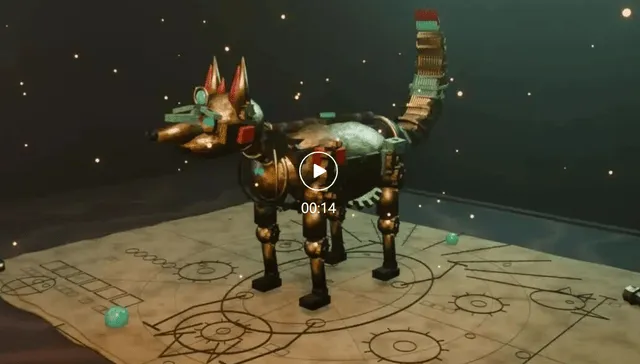
But this time, I want ERNIE to use code to orchestrate an animation of a "bronze mechanical beast awakening."
Starting from an ancient manuscript, gears, armor plates, and skeletons must fly up on their own, and finally assemble into a nine-tailed mechanical beast.
No external assets allowed throughout—modeling, animation, and rendering all rely on Python.
And the result came out looking like this.
Good heavens, this is no nine-tailed fox—it's clearly a cyber mechanical beast that ran out of the Classic of Mountains and Seas?!
Video address: https://mp.weixin.qq.com/s/Rj-T8unLFnHUk6R89rt02Q
If it can shoot videos, what about games?
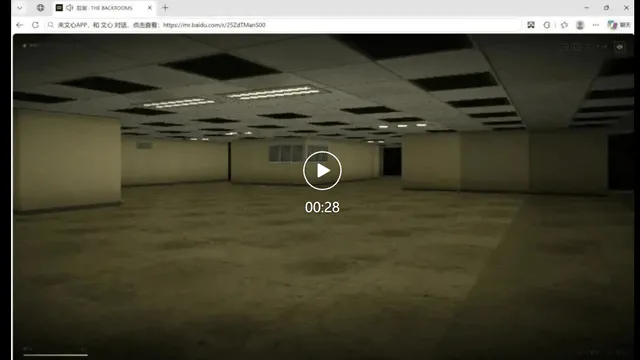
For the second task, I decided to crank up the difficulty directly: build a playable "Backrooms."
And it can't just be a yellow corridor to fool people—ERNIE must create a complete collection and completion flow—
Players need to find three videotapes in the maze, encounter entity chases along the way, and there must be stamina, failure, and exit mechanics. The final deliverable must be a web page that can be opened directly in a browser.
As a result, ERNIE served me a complete single HTML file.
No need to install a game engine, no need for extra environment configuration—just click and play.
Yellow wallpaper, damp carpet, buzzing fluorescent lights, plus an old videotape filter—that vibe came through immediately.

At first, I was pretty relaxed.
Just wandering around the corridors, casually looking for videotapes.
And then...
In one playthrough, I suddenly got caught red-handed.
Good heavens, it gave me a real jump scare out of nowhere.
Video address: https://mp.weixin.qq.com/s/Rj-T8unLFnHUk6R89rt02Q
My heart rate was too high, and it felt a bit too eerie, so let's go for something from the beautiful human world instead.
For the third task, I threw ERNIE directly into Blender and had it build a Suzhou garden from scratch.
All buildings, plants, water surfaces, and camera animations had to be built bit by bit through Python calling the Blender API.
Then ERNIE started diligently building the garden in Blender.
About half an hour later, the model returned the following "one-shot" result.
Honestly, this result really surprised me a bit...

Video address: https://mp.weixin.qq.com/s/Rj-T8unLFnHUk6R89rt02Q
Anyway, this hands-on session was at most just a preliminary exploration.
Those official complex demos that run for over a dozen hours inevitably involve more detailed task design, tool coordination, and repeated debugging.
Where exactly the capability ceiling of ERNIE 5.5 Flash Preview lies still needs further testing.
But after running through this round, I'm quite curious about another thing:
Also doing Coding, how did ERNIE this time connect the "end-to-end pipeline" from requirement understanding to project delivery?
The answer may be hidden in a capability that even Jeff Dean once underestimated.
The "code" Jeff admitted he misjudged—ERNIE focused on filling this gap this time
Not long ago, in a conversation with Fei-Fei Li, Jeff Dean proactively admitted that he had misjudged one thing—
programming.
Gemini was also practicing Coding early on, but did not put it at the core. Later he realized that the impact of programming ability on a model's ability to solve various problems was far deeper than imagined.
To put it this way: programming is like a pair of hands growing out of the chat box. With it, a model can escape the realm of "armchair strategizing."
But as time went on, expectations for programming also grew higher and higher.
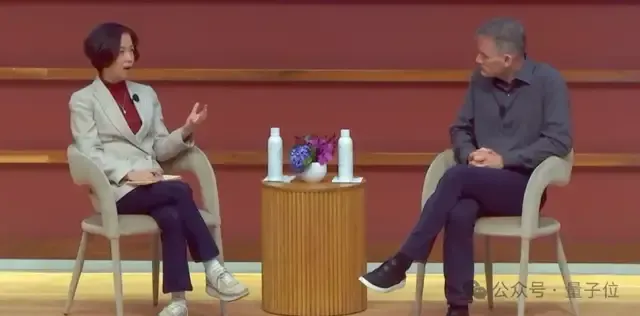
△Image source: YouTube account @stanfordhai
Now AI is already quite good at writing code—making a webpage or fixing a bug can produce results in minutes.
But when it really needs to complete a project independently, trouble comes.
Requirement breakdown, environment setup, testing and debugging—every step requires someone watching.
Good grief, it's called AI writing code, but humans still have to accompany it the whole way...
So the ideal Coding should be:
Requirements in, finished product out.
You only need to tell the AI what you want to do. Task decomposition, code writing, tool invocation, testing, and bug fixing are all completed step by step by the model itself.
This is the so-called "end-to-end," and it is also the capability ERNIE focused on strengthening this time.
How exactly was it strengthened? First, look at a number:
14 million.
This is the number of executable code tasks Baidu prepared for ERNIE 5.5 Flash Preview.
The number is large, but what is more critical is "executable."
Every piece of code must be thrown into a real environment to run, and then the results are used to judge whether the task has been completed.
No matter how beautifully the code is written, it is useless if it cannot run.
Want to submit as soon as you finish writing?
Sorry, it's not that easy.
As for how to find problems after the code runs and then continue modifying it, Baidu also used multiple Agent execution trajectories to teach the model when to use tools, how to read feedback, and how to fix errors when they occur.
Putting this into Yunxiu Xing makes it easier to understand.
During development, the model encountered problems such as characters floating in the air, running in the wrong direction, and camera positions being disordered.
But ERNIE 5.5 Flash Preview is a pure text model and cannot directly stare at the game screen to find bugs.
What to do?
Baidu converted these visual problems into data that code can check, and then used the test results to let the model continue modifying.
In this way, run once, check problems, modify code, and then run again.
The debugging process that originally required developers to stare at the screen was also packed into the model's own work loop.

Of course, learning this Loop does not mean it can do any kind of work.
Webpages, games, 3D modeling, and video creation all look like writing code, but the inner workings are completely different.
So Baidu also gave the model targeted training around specific scenarios, one by one.
For games, it needs to understand gameplay mechanics and runtime states, and also adapt to engines such as Unreal Engine, Unity, and Godot.
For Blender and CAD, it again needs to learn to invoke professional tools and run an entire modeling workflow continuously.
Video creation is even more troublesome.
From scripts, storyboards, and voiceover to editing, various tools must relay one after another in between. Baidu prepared more than 1,000 creation Skills for this.
After finally teaching the tools, a new problem appeared:
Memory.
When an Agent works continuously for several hours, it easily "forgets what it learned earlier" as it goes.
So ERNIE 5.5 Flash Preview directly expanded the context to 1 million Tokens, able to hold more project files, code, and tool invocation records.
Just remembering a lot is not enough; at critical moments it also needs to find things.
ERNIE also used hybrid sparse attention to help the model quickly dig out the truly useful information for the current moment from a large pile of historical records.
Combined with technologies such as multi-router MoE, ECHO multi-token prediction, and FP4 expert weights, generation speed was ultimately pushed to more than 200 Tokens per second.
It should be noted that AI is already involved in some of this optimization work. According to Baidu's disclosure:
ERNIE 5.5 Flash Preview introduces self-developed RSI technology for the first time, with ERNIE Evolve participating in model inference optimization, exploring a new path for AI to participate in model research and optimization.
In the final analysis, if AI is to complete a project end-to-end, the hardest things are actually just two:
First, try to avoid humans taking over midway.
Second, there must be enough endurance. The longer the work goes on, the more it tests the model's memory, context, and generation speed.
ERNIE 5.5 Flash Preview's strengthened Coding this time targets exactly these two difficulties.
From a piece of code that can be viewed to a project that is truly usable, whether this whole path can be completed on its own is the real value of "end-to-end."
One More Thing
Speaking of it, recently when following Baidu ERNIE, I always have a feeling:
This team seems a bit different.
It's not because of a certain launch event or a certain Benchmark leaderboard.
The reason was actually quite accidental.
A few days ago, while scrolling through Xiaohongshu, I saw a video hand-made by Junyuan Shang from Baidu ERNIE's pretraining team.
The cover had only six words—
Still a youth upon return.
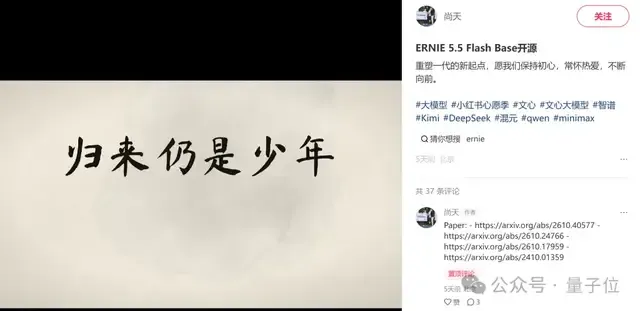
At first glance it felt a bit chuunibyou.
But paired with the line "A new starting point for reshaping a generation; may we keep our original aspiration, always hold passion, and keep moving forward," and then thinking about what Baidu ERNIE has experienced over the years, it suddenly felt a little hard to describe.
Baidu was among the earliest companies in China to enter large models. It did not start late, and it has considerable technical accumulation.
But as models were updated generation after generation, external doubts never stopped.
Especially that line, "rose early but arrived at the evening market," probably made the team's ears callous.
As they heard it again and again, the team's style gradually began to change...
I noticed that ERNIE R&D staff began to step to the front one after another, proactively communicating with netizens on Xiaohongshu and X.
Even the controversies and jokes of the past—they began to face them head-on.

This sudden wave of "collective activity" even left netizens baffled:
Why has the ERNIE team come to X? Is there some kind of metric?

Whether there's a metric, we don't know.
But from one person to a whole group, some of the R&D staff who were originally hidden behind model names have indeed begun to step into the spotlight.
They don't shy away from criticism, and they're willing to respond directly to problems.
From these changes, you can really sense a certain drive:
These people seem to be holding their breath, wanting to get things done well.
But attitude is attitude—"sending warm words is not as good as sending a big check"; you have to show concrete action.
And as it happens, Baidu really does have some this time.
Two moves:
One is announcing an open-source plan, and the other is a limited-time discount.
The model weights of ERNIE 5.5 Flash Preview are expected to be released soon, under the Apache 2.0 license, with support for SGLang and vLLM deployment.
Now there's nothing left to hide.
Developers who want to deploy it themselves, do secondary development, or just pull it down to look for problems can all do so.
On pricing, the model API has also launched simultaneously on Baidu AI Cloud's Qianfan platform, currently at a limited-time 50% discount (1 yuan per million input Tokens, 4 yuan per million output Tokens, both doubled during peak hours).
This point is actually quite important.
The game, 3D, and video tasks mentioned earlier are usually quite Token-hungry, and no matter how strong a model is, it's no good if it's too expensive to use.
"One release, one cut"—the path has been paved, and the rest is left to developers—
Whether the model can really hold up, everyone will give their answer soon enough.
Speaking of which, the line from the video above, "Still a youth upon return," fits quite well.
They set out so early back then, yet were criticized for "arriving late to the party."
Now, it's still this same group of model builders, carrying a bit of unwillingness, thinking about catching up a little further.
As for whether they can catch up this time, and whether they can make something different—
Well... let's wait and see.
Portal:
https://ernie.baidu.com/web/new-chat
https://console.bce.baidu.com/qianfan/modelcenter/model/buildIn/list