Sand.ai Unveils 480B Video Model MAGI-2 with Open Weights Planned
Chinese startup Sand.ai released MAGI-2, a 480B-parameter video generation model that tops the Artificial Analysis image-to-video leaderboard at roughly one-tenth the price of comparable closed-source flagships. It supports 30-second single-shot generation, parsing of scripts up to 20,000 characters, millisecond-level shot switching, and mixing up to 20 multimodal reference assets, while showing emergent planning ability from pretraining. Sand.ai says it plans to release the model weights soon, giving the open-source video ecosystem a frontier-grade foundation.
Related Entities
Full Report
Contents3 sections
A 30-second single-take video, with automatic shot planning
Heng Yu, reporting from the Non-Famous Temple Quantum位 | WeChat Official Account QbitAI
Nowadays, what quality of AI video can you generate for the price of a cup of milk tea?
The 1080p video below costs 15 RMB to generate.

This is a 30-second raw clip generated in a single pass—not edited in post-production~
On the image-to-video leaderboard of the authoritative evaluation organization Artificial Analysis, the model that generated this video has surged to the top spot globally.
It has firmly entered the ranks of first-tier commercial-grade benchmark video models.
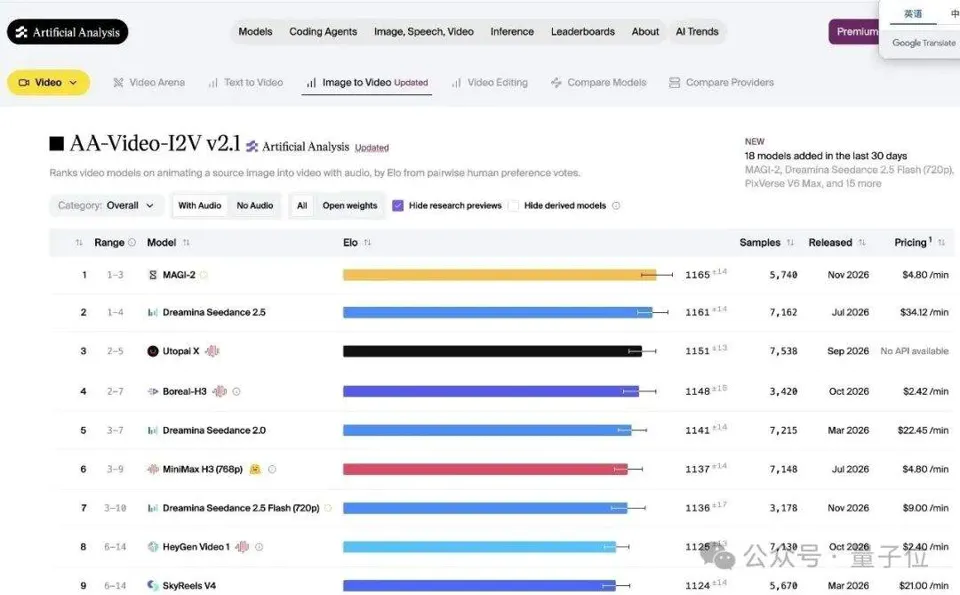
I have to say, in this wave of video models, domestic players are indeed making formidable momentum on the global stage!
As you can see, it is also made in China—it is MAGI-2, a 480B video model just released by video startup Sand.ai.
MAGI-2 possesses first-tier video generation capabilities, yet its per-second pricing is one-tenth that of top-tier closed-source models at the same level.
The global AI video creation platform Higgsfield has published the latest comparison of video generation model performance and pricing. The results show that MAGI-2 significantly expands the Pareto Frontier of video generation models, redefining the cost-effectiveness of flagship video generation models while approaching the generation quality of the current strongest models.

While pricing drops substantially, MAGI-2 remains aligned with commercial production standards in terms of creative controllability.
The model supports parsing complex scripts of up to 20,000 characters and millisecond-level precise shot cutting. It can mix and reference up to 20 image, video, and audio assets, and supports targeted modification of local details in already generated footage.
In addition, during the pretraining stage, MAGI-2 also exhibited an emergent understanding of task rules as well as autonomous reasoning and planning capabilities.
Would you believe that this video model can actually solve Sudoku on its own (slowly typing out an exclamation mark here)?
Sand.ai states that with prompt enhancement (PE) disabled, no solution steps provided, and no language model called in as external assistance, MAGI-2 completed a 9×9 Sudoku solve in the demo using only the task instruction and a reference image.
When this autonomous planning capability is applied to video creation, a simple story synopsis is enough for MAGI-2 to plan its own storyboards and design camera movements and character actions.

On the day of release, Sand.ai announced plans to open the MAGI-2 model weights as soon as possible, giving developers worldwide the opportunity to use and further develop this model.
The open-source camp for AI video generation now has a new bargaining chip to challenge the global top tier.
A Capability Leap from Autonomous Planning to Omni-Modal Local Editing
In August this year, Sand.ai launched MAGI-2 Preview with 114B total parameters. The newly released MAGI-2 has 480B total parameters. After scaling up the model, the team observed unexpected early emergent phenomena in pretraining evaluations.
The Sudoku solving mentioned earlier is one of them.
Given a 9×9 Sudoku reference image, without a language model pre-computing the answer and without writing solution steps into the prompt, it can understand row, column, and 3×3 box constraints on its own and fill in the correct numbers step by step in the video.

On the main battlefield of video creation, this capability manifests as an autonomous understanding of narrative logic and cinematic language. Even when the creator has not specified all the details, the model begins to attempt to complete the plot and organize shots on its own.
In the AI video below of a conversation between Lu Su and Zhuge Liang in a boat, the creator provided only character and scene references plus three plot nodes: "Lu Su boards the boat and takes a seat," "the two converse," and "Lu Su's expression changes after Kongming reveals his purpose."

With prompt enhancement (PE) fully disabled throughout, and without specifying shot sizes, camera positions, or cut points at all, MAGI-2 worked out a reasonable set of compositions and perspective transitions on its own, and filled in character close-ups and expression transitions that were not originally written into the script.
However, in its model technical report, Sand.ai did not report only the good news. The report shares an observation similar to the "alignment tax" of large language models—
After post-training fine-tuning toward high aesthetic preferences, the cinematic feel of the final footage is indeed maxed out, but the reasoning and generalization capabilities that emerged during pretraining became harder to trigger.
Making video models possess both aesthetics and general intelligence clearly still leaves much room for research. How to find a balance between high aesthetics and strong logic will also directly guide the design direction of their next-generation training data.

Back to MAGI-2's model performance.
As visual quality gradually approaches live-action standards, competition among AI video models has entered a deeper contest of capabilities.
What currently sets video models apart has shifted to the precision of complex script execution, control of shot rhythm, and coherence of long-form narrative, among other things.
MAGI-2 can think for itself, but that does not mean it does not follow instructions.
In fact, the model's execution precision for creative instructions is quite outstanding. If creators want precise control over every visual node, MAGI-2 performs excellently in instruction following.
Take shot cutting, for example~
The technical report published a set of timeline control tests.
In the shot-cutting test, which most challenges controllability, all 12 specified cuts hit their marks, with an average time deviation of only 0.028 seconds and a maximum error of just 0.08 seconds—a difference of two frames, far more precise than the nearly 1-second deviation common among mainstream industry models.

The technical report also states that MAGI-2 supports prompts of up to 20,000 characters, allowing creators to precisely define character positioning, action sequences, camera trajectories, and event timing.
Beyond precise camera control, MAGI-2 also broadens the expressive space of video creation.
For example, spatiotemporal consistency in long takes is another highlight of MAGI-2's capabilities.
The following 30-second single-take video takes viewers through five classic paintings, including Van Gogh's The Starry Night and Monet's Water Lilies.
The five artistic styles flow naturally with the camera movement, while scene transitions, spatial relationships, and camera motion remain coherent.

A single 30s finished video is currently the longest single-pass output among all video models. In addition, a single generation can cover a complete narrative arc of setup, development, turn, and resolution, while maintaining coherence in camera motion and spatial relationships—these are among the current difficulties and key challenges for video models.
Looking at the visual dimension, stylization is one of MAGI-2's more prominent capabilities.
It not only supports a variety of art styles such as realism, painting, animation, and handmade materials, but can also directly extract color palettes and textures from reference images for new content generation.
In this 20-second handmade stop-motion animation referencing Mexican paper-cut art, whether it's the texture of paper cutting, the brushstrokes of oil painting, or the motion characteristics of 2D animation, MAGI-2 can well maintain a specific style across continuous generation and avoid style drift.

Such rich visual expression capabilities also require sufficiently flexible creative tools to support them. At the specific workflow level, full-modality referencing and precise local editing further lower the barrier to video revision.
MAGI-2 supports up to 20 media references in a single pass, including 10 images, 5 videos, and 5 audio clips.
Character appearance, scene layout, artistic style, motion, and sound can all be controlled through different materials.
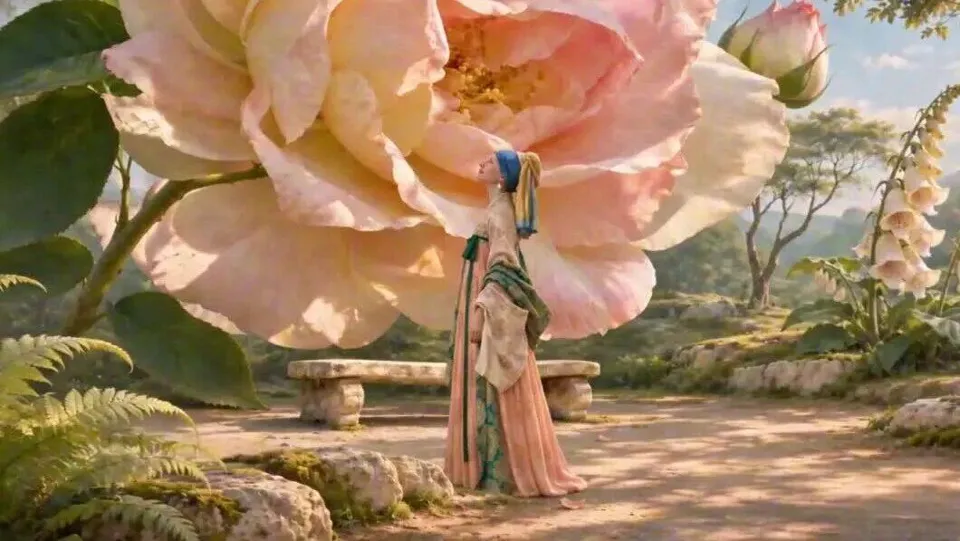
For example, in this piece Blundering into the World of Giant Flowers, reference images simultaneously lock the protagonist's appearance, clothing, and three different scenes, using leaf and petal occlusion to achieve natural transitions.
Reference image locking:

Final output:
One capability of MAGI-2 has already attracted attention from professional AI video creators.
DiDi_OK, the creator who rose to fame earlier this year with the AI short film Pai Zi and received public praise from The Wandering Earth director Guo Fan, was full of praise after preliminary testing of MAGI-2.
He commented that being able to simultaneously use text, images, video, and audio in a single generation opens up new imaginative space for visual storytelling, and the preliminary test results are quite promising.
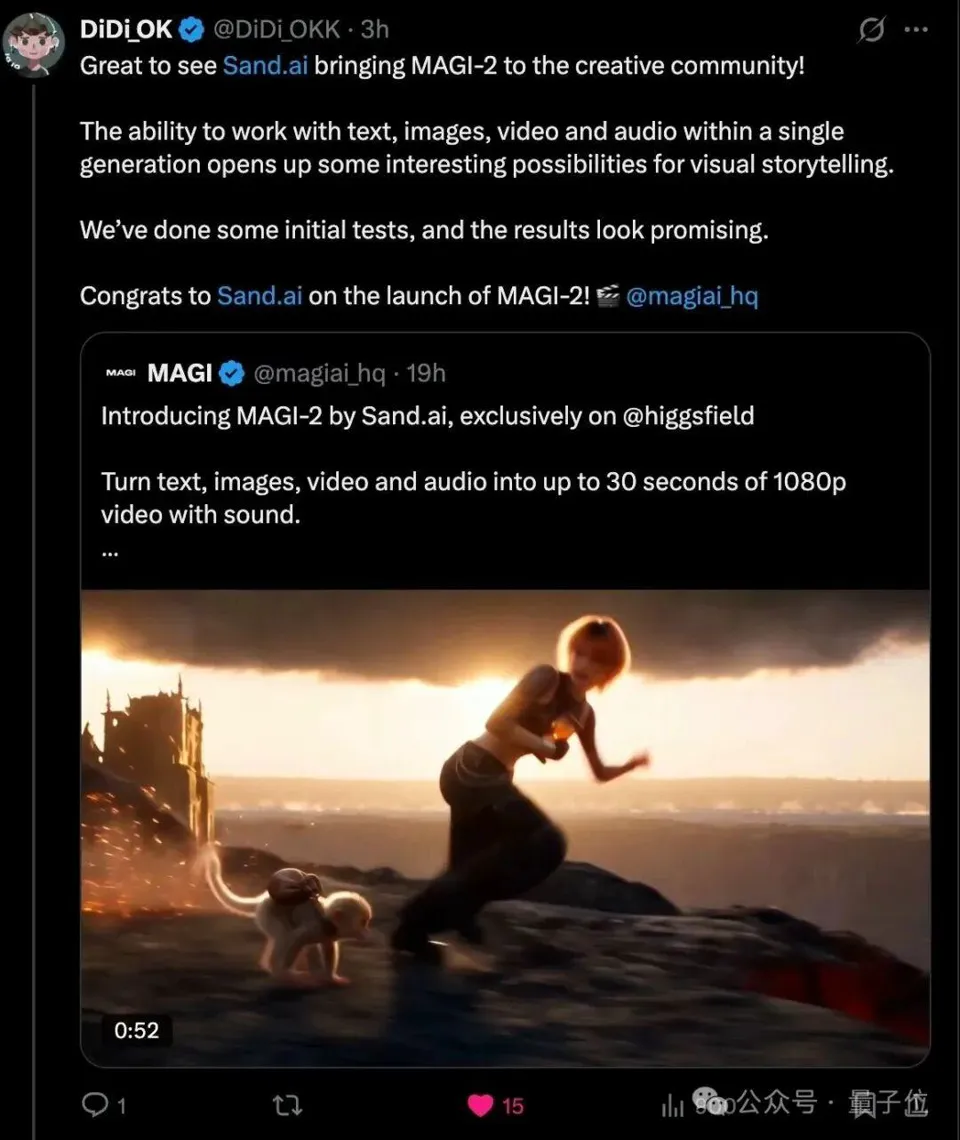
A small tip: from actors and props to sound and language, different elements in a video can all become independent editing targets.
A video that has already completed shooting, camera movement, and performance choreography can be modified via instructions to replace the protagonist, insert new products, or have actors speak another language with synchronized lip reconstruction.
Completed videos can also become content assets available for secondary creation.
For scenarios such as brand advertising, e-commerce marketing, and film and television short dramas that require extensive material combinations and multi-version delivery, what's saved is not just the visible generation cost. What lies behind it is also greater creative space and lower content iteration costs.
How does a 480B giant achieve high cost-effectiveness?
The research version MAGI-2 Preview, released in August this year, had 114B total parameters and approximately 6 billion activated parameters.
Just a few months later, the official MAGI-2 model expanded to more than 4 times its original size, reaching 480B total parameters and approximately 28 billion activated parameters.
The capability improvements brought by scaling are also quite significant. On Artificial Analysis Video Arena v2.1, MAGI-2's average Elo score across four tasks jumped from 998.5 to 1150.3, an increase of 151.8 points.

How did Sand.ai make the model four times larger while keeping the price of 1080P finished video at 0.5 yuan per second?
The answer lies in Sand.ai's full-chain efficiency design, from underlying architecture and training infrastructure to data pipelines.
At the model architecture level, MAGI-2 continues two core architectural designs from the Preview stage.
First, the Single-Stream Unified Transformer.
Text, video, and audio tokens enter the same sequence and continuously interact within a unified model backbone, laying the foundation for audio-visual synchronization capabilities such as character lip-sync, action foley, and environmental sound fields.
Second, the Multi-Head Latent MoE architecture, which is also the key to MAGI-2's ability to efficiently scale to hundreds of billions of parameters.
Conventional MoE adopts a route-first, dispatch-later mechanism, dynamically sending complete tokens to experts on different devices. As model scale expands, issues such as cross-GPU communication and load imbalance can easily become training bottlenecks.
Considering hardware affinity and large-scale distributed training efficiency, Sand.ai splits each token into multiple independent heads, each with its own router and expert pool. The system first statically dispatches slices according to fixed ownership, then performs dynamic routing and computation locally on the target device.
Cross-GPU communication volume is thus decoupled from the number of activated experts (top-k), and the shape of communication tensors can be determined in advance, suppressing load skew where "some starve while others feast," slow-GPU long tails, and extra synchronization overhead.

Around this architecture, Sand.ai developed training infrastructure including MagiFSDP, MagiMoE, and MagiMuon, which respectively optimize parameter sharding management, expert computation and communication coordination, and distributed optimizer efficiency.
In a 480B pretraining experiment with identical total FLOPs and each using its optimal configuration, Multi-Head Latent MoE achieved approximately 22% training acceleration compared to LatentMoE.
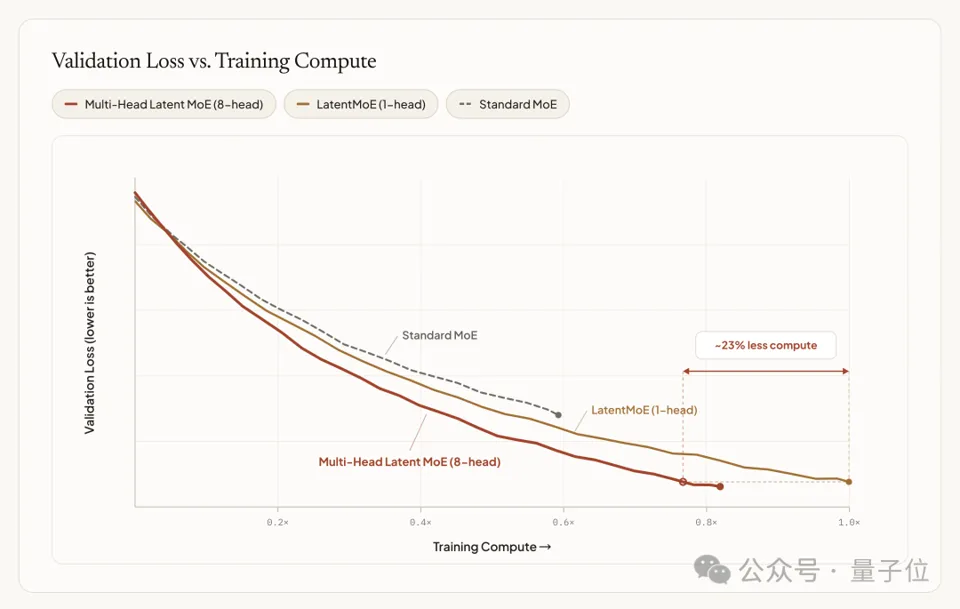
Architecture and training systems solve the problem of how to efficiently scale up a model, but how to transform the capacity of hundreds of billions of parameters into true intelligence places higher demands on data scale, information density, and processing efficiency.
To match the total parameter volume of 480B, MAGI-2's pre-training data scale is approximately 3x larger than Preview, reaching 4T Tokens.
Relying on a self-developed data pipeline, the team completed annotation of approximately 1 billion samples in just three weeks.
Even more interesting is their data filtering strategy. The technical report specifically calls out the need to "avoid the Data Filtering Trap." This refers to the tendency during video model training to filter out complex real-world footage in pursuit of visual aesthetics.
To enable the model to fully learn the complexity of the real world, the Sand.ai team ultimately chose to retain data such as multi-person interactions, frequent shot changes, on-screen text, and complex soundscapes.
The technical report shows that model capacity and data scale have brought significant scaling benefits—issues like extra fingers and motion collapse that previously required post-training fixes have been substantially reduced during MAGI-2's pre-training phase.
With a solid foundation in place, post-training can focus entirely on "fine-tuning the finish."
At this stage, the focus of reinforcement learning (RL) shifts from fixing basic structural defects to refining lighting, textures, hair, materials, and acoustic quality.

At the final quality output stage, MAGI-2 uses a dedicated latent-space spatiotemporal super-resolution model to upscale low-resolution latents to 1080P at 25fps, and re-injects the original reference image during the super-resolution stage.
Because the base generation can already anchor the spatiotemporal positions of faces and text, the super-resolution model can directly "copy from the reference" when reconstructing high-frequency details.
Even in complex scenes lasting up to 30 seconds, the consistency of small faces in long shots and the clarity of on-screen text have been noticeably improved.
In summary, larger model capacity, sparse computation architecture, and system optimization together form the technical foundation for MAGI-2's performance gains and controlled computational overhead.
Raising the Innovation Starting Point for the Global Open-Source Video Ecosystem
At the end of the technical report, Sand.ai candidly acknowledges the current limitations of the MAGI-2 model.
During extremely high-speed and intense motion, MAGI-2's generated frames occasionally show imperfections in motion continuity and trajectory; local movements in medium and long-shot 2D animation sometimes appear slightly too smooth; and the layering and physical texture of sound effects in highly complex soundscapes still have room for improvement.
Additionally, how to balance the aesthetic quality of finished output with the general generalization capabilities demonstrated during pre-training in the post-training stage remains an ongoing challenge for the team.

The good news is that the team working on these problems is expected to grow.
Sand.ai announces plans to open-source the MAGI-2 model weights as soon as possible.
A Chinese AI startup is bringing a 480B-parameter model with native 30-second continuous narrative and top-tier performance on internationally recognized leaderboards to the global community through planned weight releases.
A world-class video foundation model is now being placed directly in developers' hands.
The 480 billion parameter model capacity, original MoE architecture, and technically validated training pathway all have the opportunity to become the foundation for the open-source community's next round of innovation.
Researchers can explore the intelligence boundaries of video models on this basis, developers can fine-tune and build applications for specific industries, and compute vendors have the opportunity to advance model adaptation across different hardware architectures.
The opening of a high-quality foundation model has the potential to transform R&D capabilities originally concentrated among a few model vendors into broader ecosystem innovation capacity.
Exploring the capability limits of video models upward, and releasing the innovation dividends of frontier technology outward—
Sand.ai is turning the capability ceiling of the world's top video models into the innovation floor of the open-source ecosystem.