Rohan Paul (@rohanpaul_ai) · 10/23/2026, 04:04:24
DeepMind Paper: Interpretable AI Text Detectors Match Black-Box Performance
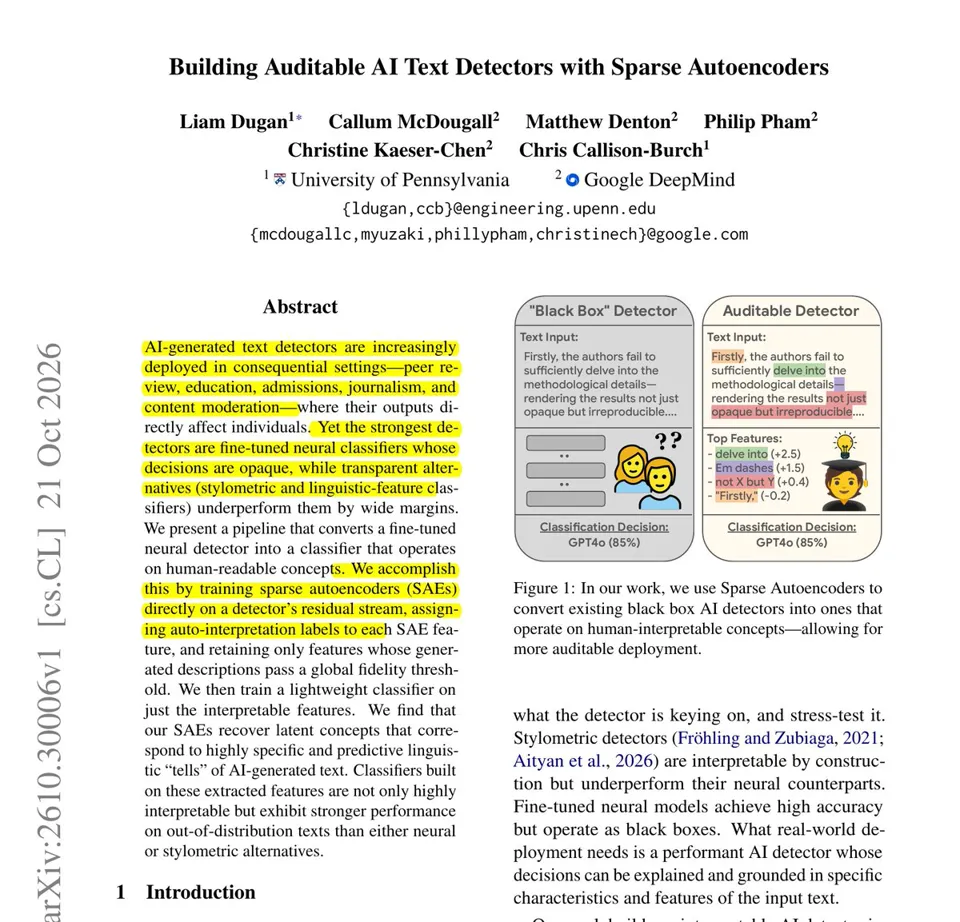
A joint paper by Google DeepMind and UPenn demonstrates that sparse autoencoders can decompose a Gemma-2-2B detector's internals into readable features. This approach maintains high accuracy (96.8 F1 in-domain) while significantly outperforming black-box models on unseen data (92.2 vs 75.2 F1), enabling developers to audit and remove biased cues.
SOURCE COVERAGEFull Original Report
Rohan Paul (@rohanpaul_ai) · 2026-10-22 20
New Google DeepMind + UPenn paper shows that an AI-text detector can explain its verdicts with readable writing features and still match a black-box detector.
suggests that anyone deploying AI-text detectors should be able to read and remove the specific cues a detector relies on.
The best AI-text detectors are black-box classifiers, yet they flag student essays and peer reviews. Readable stylometric detectors exist but trail them by wide margins.
They trained sparse autoencoders on a Gemma-2-2B detector's internals to split its activity into features, then had an LLM label each one. They kept only features whose labels predicted their behavior well and fed those into a simple classifier.
With only well-labeled features, the detector kept 96.8 F1 in-domain, close to the black box's 98.0. On unseen test data, a version built on base-model features scored 92.2 F1 against 75.2 for the black box.
If your detector's decisions affect people, build it on labeled features so reviewers can see and drop cues they consider unfair.