ModelBest Open-Sources MiniCPM-OCR: 1.3B Model Tops Global Benchmarks
ModelBest has released and open-sourced MiniCPM-OCR 1.0, its first dedicated OCR model. With only 1.3 billion parameters, it surpasses major tech giants' models in both parsing capability and efficiency, securing the top global rankings. This release marks a significant breakthrough for small-parameter models in vertical document understanding, offering a highly cost-effective open-source alternative.
Full Report
Weeks ago, DeepSeek reminded the world once again with V4.1-Flash: top-tier models don't have to come with a sky-high price tag!
Today, it's OCR's turn.
ModelBest (Mianbi Zhineng) has open-sourced MiniCPM-OCR 1.0. With only 1.3B parameters, it simultaneously secured first place in both parsing capability and efficiency, leaving numerous large enterprise models far behind.
This is the first dedicated OCR model in the MiniCPM V/o family.
But this is far from the most impactful aspect of this release.
What truly disrupts the old order is another model open-sourced on the same day—MiniCPM-OCR Jev.
Strangely enough, despite being the "star" alongside the new OCR king, it doesn't output a single character. It doesn't answer questions; it only grades them. Why would a new OCR king need a dedicated "referee"?
This unconventional move precisely exposes an unspoken secret within the AI community.
The New Open-Source King of Domestic OCR
1.3B Small Model Achieves Big Results
Major tech companies are increasingly focusing on document parsing and OCR, with models like Tencent's HunyuanOCR-1.5 and those from Alibaba and Zhipu leading the charge.
In an era where large models routinely stack hundreds of billions (B) of parameters and consume computing power like water, ModelBest open-sourced MiniCPM-OCR 1.0. With just 1.3B parameters, it delivered a textbook example of asymmetric dominance.
MiniCPM-OCR 1.0 broke through heavy competition, nearly pushing the boundaries of the radar chart to their limit.
Across six core benchmarks, it achieved State-of-the-Art (SOTA) results in four categories with overwhelming superiority:
- Real5-OmniDocBench: 93.68 (Highest Overall). This isn't about high-resolution scans in a lab; it's a "devil's test" specifically designed for casual smartphone photos, lens distortion, and reflections from re-photography.
- Wild-OmniDocBench: 92.39 (Leading Overall). It excels at handling diverse, real-world wild documents, significantly outperforming competitors of similar scale.
- OCRBench v2: 54.7 (Absolute Dominance). In general character recognition and key information extraction, it left the second-place model (47.0) far behind.
- CHAOS-Bench: 29.78 (Cliff-Leading). This benchmark tests fidelity—whether the model can faithfully recognize text from images despite strong semantic prior noise interference. Its score was more than 1.4 times that of the runner-up.
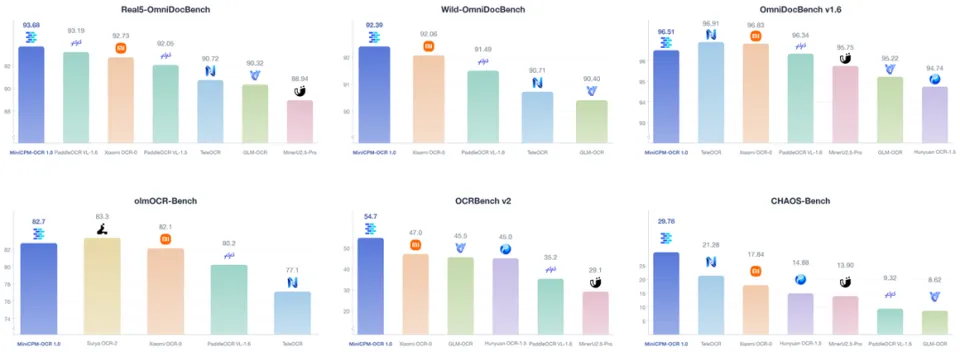
MiniCPM-OCR 1.0 ascends to become the new king of open-source OCR.
Hands-on Testing: Conquering "Hell-Level" Documents
MiniCPM-OCR 1.0’s document parsing capabilities are in a league of their own. It supports bilingual (Chinese and English) documents and PDFs, handling both standard documents and complex acquisition conditions with stable performance across scenarios such as scanning, curvature, photography, skewing, and re-photography.
Without further ado, let’s dive into real-world tests to see just how capable MiniCPM-OCR really is.
For instance, it nearly instantly recognizes handwritten scripts from international users:
It also easily handles multi-font English recognition.
Take common invoices, for example—how difficult are they to recognize?
Red table borders, two overlapping stamps, dense numbers, and garbled text—it essentially hits every "pitfall" in document recognition.
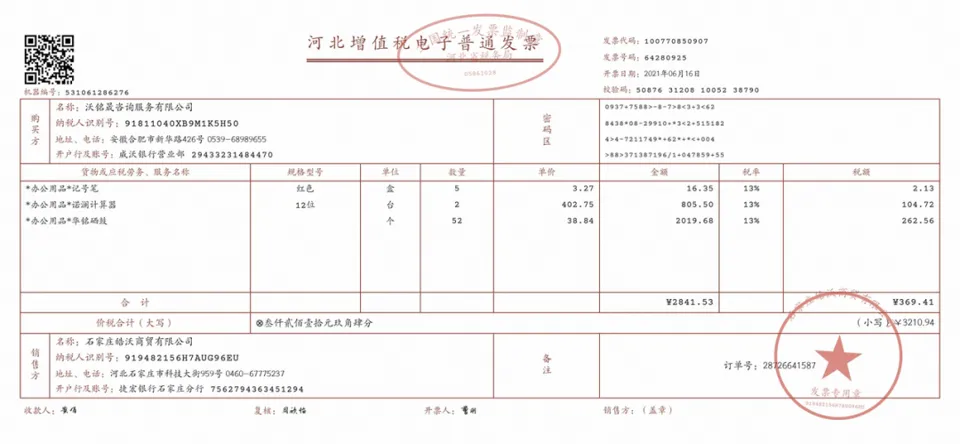
MiniCPM-OCR 1.0’s response: The structure remains intact without a single collapse.
The buyer and seller sections, along with the password area, are correctly separated into left and right columns; merged cells are restored exactly as they appear. Long strings of digits that become invalid if even one character is wrong—such as invoice codes, check codes, 18-digit taxpayer identification numbers, and 16-digit bank account numbers—are matched digit by digit.
Even red stamps overlapping the text are recognized separately, ensuring ink doesn’t bleed into the main content. Feed it an image, and it outputs a structured spreadsheet.
With stamp recognition mode enabled, it even reads the red stamp in the bottom-right corner: “Invoice Special Seal 919482156H7AUG96EU.” The tax ID on the stamp, which is smaller than the body text, matches the seller’s taxpayer identification number on the invoice perfectly.
Cross-referencing the invoice face with the stamp provides an additional layer of verification for authenticity.
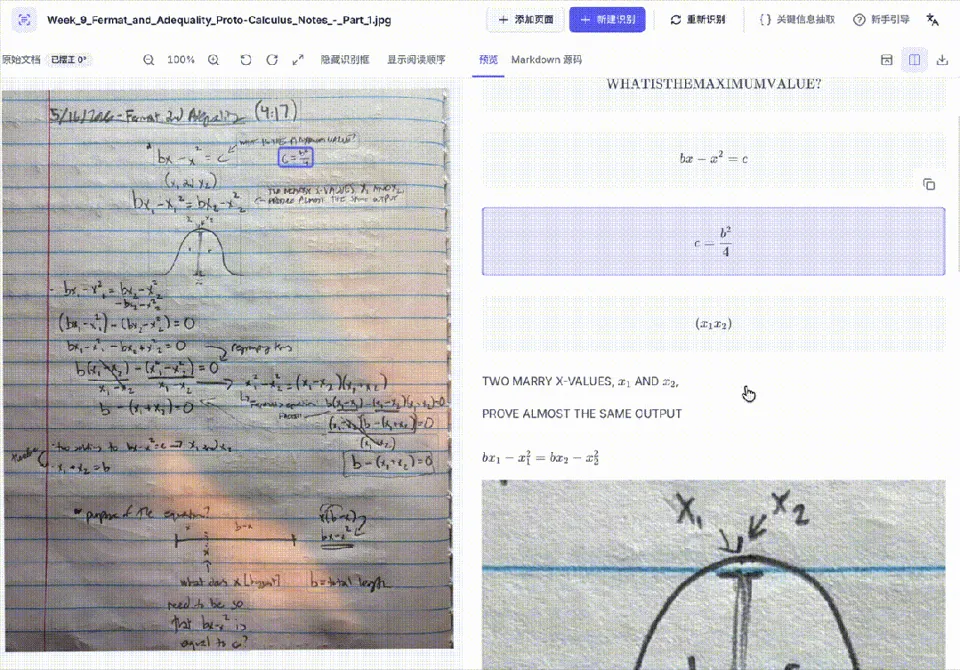
Next, we tested MiniCPM-OCR 1.0 on top-tier student notes. When photographed, a slant of sunlight hit the paper, casting an orange glow over half the page.
The content involved finding the maximum value of a parabola using Fermat’s method of equal virtual quantities: deriving formulas while drawing curves, with arrows, annotations, and boxes crowded together.
MiniCPM-OCR 1.0 reconstructed the entire derivation chain line by line into standard LaTeX. Fractions with horizontal bars, superscripts, and subscripts were handled without error, culminating in the circled conclusion .
Two hand-drawn diagrams were also extracted and preserved as separate images. Even with chaotic lighting and messy handwriting, not a single step of the logical derivation was lost.
The next test was a crumpled photocopy of an English textbook page from Gilbert Strang’s classic work, filled with matrices and inequalities.
MiniCPM-OCR 1.0 first automatically corrected the image tilt by 2°, then reconstructed it line by line. Block matrices like , superscripts like , and subscripts like were all converted into directly renderable LaTeX.
In Problem 7, a matrix was reproduced without a single numerical error. A crumpled photocopy was thus transformed back into a clean digital textbook page.
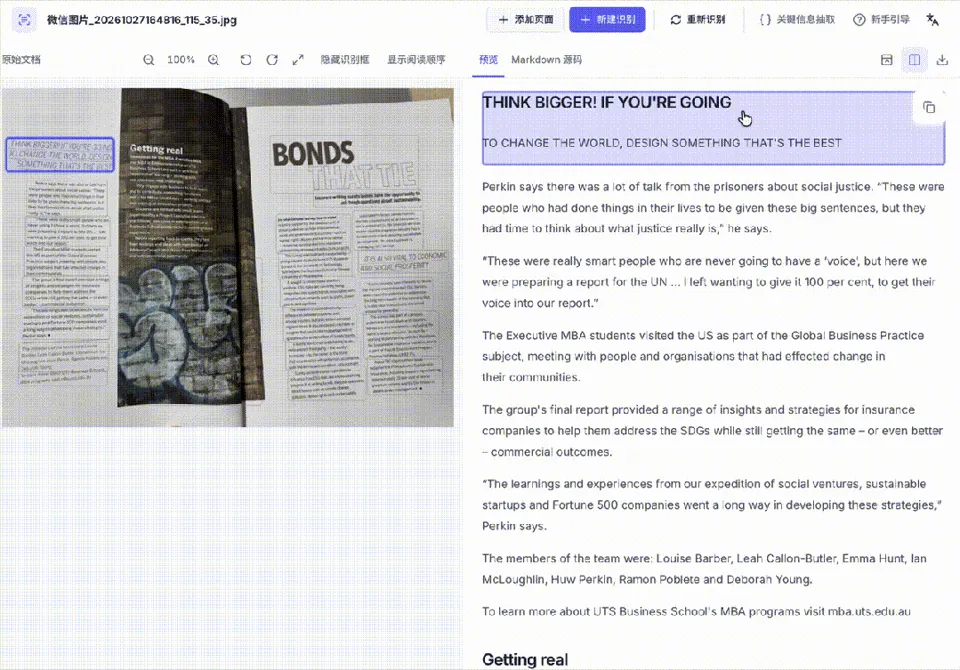
To increase the difficulty, we asked it to recognize a casually photographed magazine page.
The image featured a full-page photo of a graffiti wall with large headlines in various fonts crowded together. The hardest part was the small white text printed over the brick wall graffiti photo.
Even with a background so cluttered that text is barely legible, MiniCPM-OCR 1.0 successfully extracted all four paragraphs from the "Getting real" section, while isolating photos as separate image assets.
Snap a photo of a magazine page, and you instantly get an article ready for copying, translation, or retrieval.
Now consider this entire Chinese daily newspaper page, packed with eight articles: a mix of horizontal and vertical headlines, body text split into dense narrow columns, interspersed news photos, and even cross-page continuation notes like "Continued on Page 4."
MiniCPM-OCR 1.0 re-laid out this newspaper page like a veteran editor.
It didn't miss a single detail—not even the small print below the masthead, such as the publication number, postal code, news hotline, and email address.
After extensive testing, MiniCPM-OCR 1.0’s performance proved to be truly hardcore.
The DeepSeek-Flash of OCR: Maximum Efficiency
If accuracy is the entry ticket, efficiency is the ultimate reason enterprises pay.
Measured in pages processed per second:
MiniCPM-OCR 1.0 takes the top spot with a throughput of 1.217 pages/s (1.00x).
In comparison, the established player PaddleOCR-VL-1.6 achieves only 0.818 (0.67x).
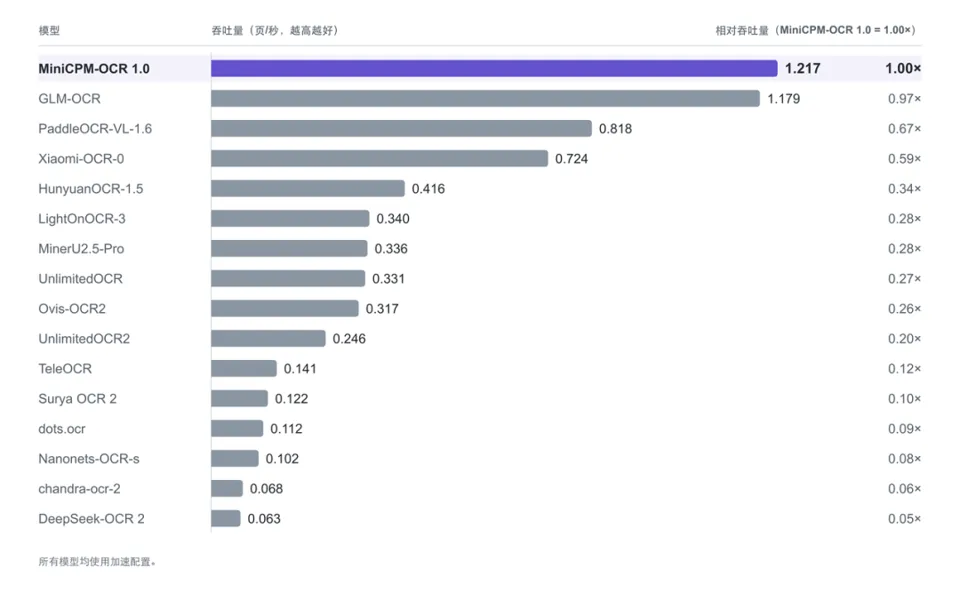
Meanwhile, some models focused on high precision, such as MinerU2.5-Pro-Advanced, manage just 0.336 (0.28x), while TeleOCR drops drastically to 0.141 (0.12x).
This means that in this same-hardware test, MiniCPM-OCR 1.0’s single-card throughput is approximately 8.6 times that of TeleOCR.
Speed isn’t achieved by simply stacking hardware.
MiniCPM-OCR 1.0 uses the LLaVA-UHD v4 visual patching scheme to efficiently encode ultra-large images by slicing them; combined with DSpark speculative sampling decoding acceleration, end-to-end processing efficiency improves directly by 55%.
Small parameters, lightweight architecture, and fast decoding—stacking these three strategies together enables parsing one page in under 1 second on average using a single RTX 5090.
On the balance sheet, throughput translates to real money. On this metric, MiniCPM directly lowers the cost threshold.
This is not just a dimensional reduction in costs, but a move toward true 'technology democratization' of top-tier AI capabilities.
And this is exactly what ModelBest has been doing all along.
From MiniCPM-V, which packed GPT-4V-level multimodal capabilities into smartphones, to today’s 1.3B parameter MiniCPM-OCR, ModelBest has consistently used smaller models to do bigger jobs.
MiniCPM-OCR is merely another instance of "achieving big results with small resources" along this path.
Previously, industrial-grade document parsing pipelines required cluster-scale computing power. Now, they are compressed onto consumer-grade GPUs or even edge devices.
SMEs, research teams, and independent developers no longer need to bear high compute taxes. They can build private, secure, high-throughput production workflows locally, turning top-tier AI capabilities into accessible tools for everyone.
But the most impressive aspect isn’t just accuracy and efficiency.
The next battle for OCR is not about recognizing more accurately, but recognizing more reliably.
First Proposal of Trustworthy OCR
Reliability is More Valuable Than Performance
Over the past few years, everyone claimed their large models could achieve 99% accuracy.
But the problem is that Vision-Language Models (VLMs) inherently suffer from "hallucinations."
In extremely strict business scenarios like financial underwriting, legal contracts, and medical records, even a 1% uncontrollable risk can lead to compliance disasters worth millions.
The essence of the problem is trust.
Suppose AI misidentifies 1 out of 100 invoices, but you don’t know which one. What would you do?
The answer is bleak: You have to hire people to manually review all 100 invoices, one by one, from start to finish.
Thus, the most absurd scene in human commercial history appears: Enterprises spend heavily on cutting-edge AI computing power, only to turn around and hire dozens of staff to manually verify the 99% correct data like assembly line workers.
A score of 99 where you don’t know the error location is effectively a score of 0; ultimately, humans must provide the safety net.
Zooming out, you’ll see that over the past year, the parameter scale of document OCR models has undergone a steep "shrinking curve."
From 3B to 1.2B, then to 0.9B and 0.6B, open-source releases are becoming denser, and technical barriers are being leveled down.
Advances in technical architecture have improved "recognition capability." The act of "reading text" is transitioning from a scarce technical resource to a commodity of computing power.
When everyone can read text, what becomes truly scarce? Trustworthiness.
This time, ModelBest has separated "trustworthiness" from accuracy for the first time, establishing an entirely new category: Trustworthy OCR.
Prior to this, the concept did not exist in the industry. All vendors were competing on who could "recognize accurately," yet no one was addressing a far more critical question: Can this result be trusted?
Even if someone attempted to solve "trustworthiness," the industry's approach in the past was extremely linear: brute force. They stuffed layout parsing, formula and chart analysis, along with the task of "checking for recognition errors," into a single monolithic Vision-Language Model (VLM).
But this violates first principles.
Think about your own writing. Even after checking it ten times yourself, typos still slip through; but a colleague might spot them immediately with a single glance. The reason isn't lack of diligence—it's that your brain automatically "fills in" what you intended to write.
Next-generation OCR models face the same issue. No matter how large the parameter count, they inherently lack probability calibration capabilities when dealing with hallucinations generated by their own "mental filling-in." Asking a large model to score itself is like asking an exam taker to grade their own paper—they will always be blindly confident.
The "confidence scores" attached to some OCR engines on the market are essentially these self-assigned grades.
Human society figured this out thousands of years ago: accounting requires auditing; sports competitions require referees.
ModelBest’s breakthrough lies in division of labor and collaboration: the parsing model handles the work, while the decision model specializes in quality inspection.
MiniCPM-OCR 1.0 focuses on recognition, while the decision model, MiniCPM-OCR Jev, is responsible for the "trustworthiness of recognition results."
MiniCPM-OCR Jev scoring candidates for text, formulas, and tables.
"Perceptual generation" and "rational adjudication" have been thoroughly decoupled in AI architecture for the first time.
This is also the first time in the industry that a parsing model and a decision model have been open-sourced together as a package. While others release an OCR model, ModelBest releases an OCR pipeline with built-in quality control.
Capabilities can be centralized, but trust must be decentralized.
A Reverse Take on Thinking, Fast and Slow
MiniCPM-OCR Jev features three extremely hardcore underlying designs.
First, say goodbye to blind confidence; output only "statistical truth."
The confidence scores provided by MiniCPM-OCR Jev are statistically calibrated using extensive real-world human-annotated data.
Large model "hallucinations" are quantified into verifiable numbers.
Second, it is so fast that it barely adds latency.
In the past, having a large model perform quality checks required generating lengthy reasoning chains word by word, resulting in high latency.
However, upon receiving OCR candidate results, MiniCPM-OCR Jev performs only a single forward pass, generates no text, and delivers a verdict in milliseconds.
It acts like an ETC gate on a highway, positioned between "document recognition" and "business ingestion," allowing over 90% of unambiguous data to "pass instantly."
Third, small footprint, giant-level judgment.
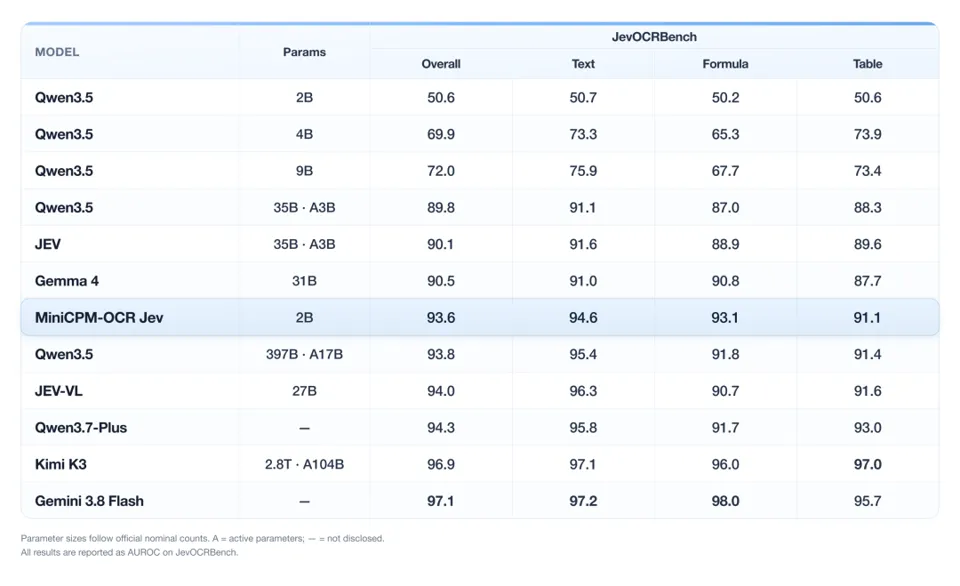
On the AUROC metric, which measures discriminative ability, MiniCPM-OCR Jev—with just 2B parameters—achieved a score of 93.6.
For comparison, Qwen3.5, a general-purpose large model with 397B parameters, scored 93.8.
With negligible computational cost, it nearly matches the review capability of ultra-large models.
Scores alone aren't intuitive, so we connected OCR and Jev into a pipeline: OCR reads, Jev scores; if the score falls below the threshold, the program asks OCR to re-read; if it passes, the table is saved as JSON.
If multiple attempts fail to meet the threshold, the item is flagged for manual review.
We tested this on the training cost table from the DeepSeek-V3 technical report. The source of the $5.576 million figure is right there.
On the first pass, all numbers were correct: 2664K, 119K, 5K, including the total of 5.576M. However, all four dollar signs were misread as formula markers, turning the total amount into ")5.576M".
A quick glance at the numbers might let humans miss this. Jev didn't let it slide, assigning a score of approximately 0.000001.
The program immediately rejected the table for re-reading. On the second pass, the original image was enlarged by two times with added margins, but the dollar signs remained incorrect, and the score stayed unchanged.
On the third pass, the program switched to a different recognition strategy based on preset policies. This time, all four "$" symbols were correctly recognized. Jev reassessed the score at 0.9692, stopping the retries, and the table was saved as JSON.
We verified the final results against the original image item by item: headers, GPU hours per stage, and dollar amounts—all consistent.
Three rounds of recognition, two rejections, with no manual correction of symbols and no human waiting to click "retry." OCR handles reading, Jev handles judging, and the program decides whether to retry.
In the context of real-world business operations, this represents a sweeping efficiency revolution.
The system automatically passes high-confidence data, routing only the remaining suspicious segments to human review.
Enterprise manual auditing has finally shifted from time-consuming and labor-intensive "full-volume inspection" to precise "targeted sampling" or "anomaly block review."
Nobel laureate Daniel Kahneman, in Thinking, Fast and Slow, proposed that humans operate with two systems: System 1 (fast thinking/intuition) and System 2 (slow thinking/rational reasoning). Kahneman argued that intuition often errs and requires rationality to correct it.
However, MiniCPM-OCR Jev brilliantly inverts this narrative.
It acts as a millisecond-level System 1, serving as a gatekeeper for the resource-intensive generative model's System 2.
Why is its "intuition" so accurate? Because it was trained on massive amounts of real-world data. It’s like a bank teller with thirty years of experience who can instantly detect counterfeit bills by touch alone. He doesn’t need lengthy explanations; his "feel" itself embodies rigorous statistical patterns.
It is important to note that the Jev model is not exclusive to MiniCPM-OCR.
As a highly decoupled, independent decision-making architecture, Jev can serve as a plug-and-play "confidence-based quality inspector," flexibly deployed after any OCR engine.
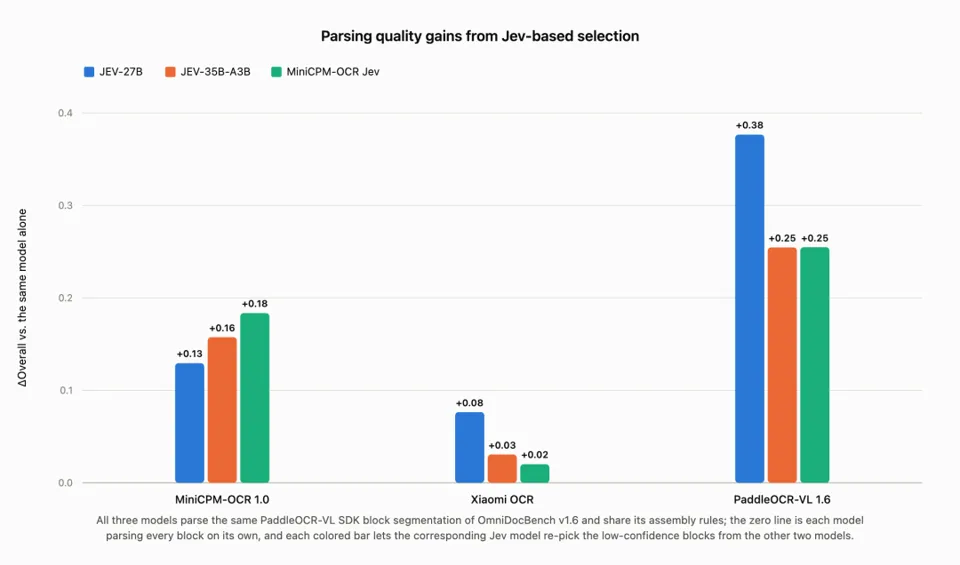
Whether your current business pipeline uses classic PaddleOCR, domain-specific TeleOCR, commercial APIs from major providers, or even locally fine-tuned private document parsing models, you can embed Jev as a validation gateway without modifying the underlying recognition base.
It calibrates and discriminates heterogeneous outputs using unified, unbiased standards, becoming a universal "trust filter" within enterprise-grade document processing pipelines.
The first half of the AI era was about who is smarter; the second half is about who is more honest.
Trust is not about "never making mistakes," but about "knowing when you are wrong."
The Opportunity Is Here
ModelBest’s open-source release has lowered industry barriers to an unprecedented degree: both model weights are fully open-sourced, with immediate support for Hugging Face, vLLM, and Ollama on day one, along with online Web Demos that require no environment configuration.
From a broader industrial perspective, the combination of MiniCPM’s OCR and Jev is driving a deeper engineering revolution:
The role of OCR models has been comprehensively upgraded to core infrastructure for AI Agent "context governance."
As AI Agents take over increasingly complex professional workflows, the quality of their reasoning is directly constrained by the purity and structure of their input context.
High-quality layouts, rich text, and Markdown parsed by MiniCPM-OCR serve directly as the most critical context inputs for Agents. This prevents agents from groping blindly through seas of garbled characters and broken formatting, clearing the first cognitive hurdle for end-to-end automation.
In core business sectors across industries, converting large volumes of "unstructured documents into databases" is a fundamental necessity.
For example, financial auditing and accounting involve thousands of pages of balance sheets, income statements, and invoice drafts that require millisecond-level structured extraction and item alignment.
Traditional approaches were notoriously cumbersome:
First, use OCR to convert images to text or Markdown; then call a Large Language Model (LLM) with long prompts and specific JSON Schema rules for "secondary distillation extraction"; finally, store the results in the database.
This approach doubles GPU memory usage, incurs high API costs, introduces seconds of latency, and creates risks of secondary hallucinations.
MiniCPM-OCR’s native Key Information Extraction (KIE) changes this paradigm—achieving end-to-end completion in a single step.
Without needing to attach a massive LLM backend, it precisely identifies key entities and field relationships, connecting document streams directly to enterprise storage engines.
Meanwhile, MiniCPM-OCR Jev scores existing OCR candidate results and supports secondary fine-tuning, significantly simplifying industrial pipelines and greatly enhancing document reliability.
Looking at the bigger industrial picture, this pipeline arrives exactly when it is needed most.
The global OCR market continues to experience rapid growth. According to The Business Research Company, the market size is projected to expand from $16.66 billion in 2025 to $19.2 billion in 2026, with expectations of reaching $33.92 billion by 2030.
However, the logic driving this growth has shifted.
In the past, enterprises invested because "more documents needed digitization." Today, what businesses demand is that post-digitization results are "trustworthy and automatable." Two industries with zero tolerance for errors—finance/insurance and healthcare—together account for over 40% of the market share.
Simultaneously, "transparency" and "auditability" are transitioning from value-added features to entry requirements. A parsing model that only outputs results cannot answer the question, "Can this result be used directly?" A decision-making layer that is calibrated and capable of stating "I am uncertain" represents the ticket for the next phase.
While everyone else is still competing on accuracy, ModelBest (Mianbi) has already positioned itself at the next crossroads. More importantly, this time, "trustworthiness" has been open-sourced.
One of humanity's greatest inventions was not making any single individual perfect, but establishing a system of mutual oversight and calibration among people.
Now, it is AI's turn to evolve toward civilization.
Make verification invisible; make trust visible.
Chasing ASI in Seconds
⭐ Like, Share, and Watch – One-Click Triple Combo ⭐
Star us to lock in instant updates from New Intelligence Era!