LeCun's New Paper Challenges Scaling Laws: Small JEPA Model Outperforms Large LLMs in Representation Alignment
Yann LeCun and Brown University researchers released a new paper validating the 'Platonic Representation Hypothesis' via Joint Embedding Predictive Architecture (JEPA). Experiments show that a text-based JEPA with only 109 million parameters outperformed massive LLMs like Qwen2.5-72B and Llama-3-70B in cross-modal representation alignment, while requiring ~42x fewer training samples. This study provides strong theoretical support for world model approaches, suggesting that scaling parameters alone is not the sole path to general intelligence.
Full Report
Contents3 sections
At 66, Yann LeCun has returned to the forefront of AI research with a new paper.
This time, he targets a deeply entrenched belief in the large model industry: that to make AI better understand the world, one must continuously increase parameters and expand training data.
On October 29, LeCun and Randall Balestriero, Assistant Professor of Computer Science at Brown University, released a 37-page paper titled Proving and Improving the Platonic Representation Hypothesis with JEPAs. The paper proposes that under specific conditions, AI models across different modalities can learn mutually alignable representations of the world, even when trained independently.
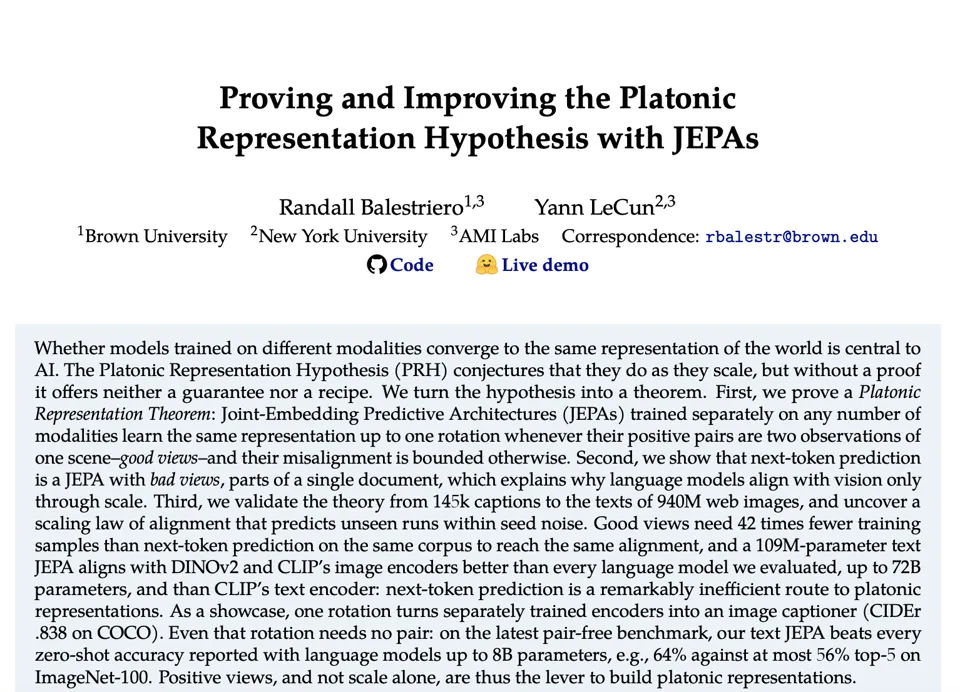
More striking are the numbers. A text JEPA trained by the research team with only 109 million parameters outperformed large language models such as Qwen2.5-72B and Llama-3-70B in cross-modal representation alignment tests.
The difference in parameter scale is approximately 660x.
In another experiment, models using the new method achieved the same level of representation alignment as next-token prediction models required 900 million samples to reach, but needed only 21.6 million training samples—a difference of roughly 42x in sample count.
These results naturally raise a question: Has the AI industry been heading in the wrong direction for the past few years by investing massive funds into training increasingly larger models?
However, this is not the conclusion the paper truly intends to convey.
LeCun’s New Paper Challenges "Scaleism": How Can 109 Million Parameters Compete with 72 Billion?
In this paper, authors LeCun and Balestriero address a question more fundamental than model size: When AI observes the world through different means such as text or images, what determines whether they form similar internal understandings?
For LeCun, who has long advocated for the world model approach, this represents an important theoretical exploration.
The starting point of this research comes from a philosophically intriguing hypothesis proposed by an MIT research team two years ago.
In 2024, Minyoung Huh, Brian Cheung, Tongzhou Wang, and Phillip Isola published The Platonic Representation Hypothesis at ICML.

Researchers observed an interesting phenomenon: As different models become more capable, the internal representational structures of image models and language models appear to become increasingly similar.
For example, people can describe a scene of a cat lying on a sofa using a photo, or express the same meaning with a sentence. Images consist of pixels, while text consists of tokens; although they look completely different, they refer to the same real-world object. If AI truly learns some shared structure behind these contents, then the way different models internally represent relationships between things may gradually converge.
This is the core of the "Platonic Representation Hypothesis": Different AI models may be converging toward a common statistical representation of the real world.
The 2024 study observed that increasing model scale often accompanies cross-modal representation convergence, but it did not prove that this phenomenon necessarily occurs, nor did it explain which training methods could achieve it more efficiently.
LeCun and Balestriero attempted to push this forward. In their paper, they established a mathematical framework treating different modalities as observations of the same latent world state, investigating under what conditions models can learn mutually aligned representations.
The answer lies in the positive sample pairs constructed during the training process.
Researchers termed a certain data relationship "Good Views," which can be understood as effective observations of the same scene.
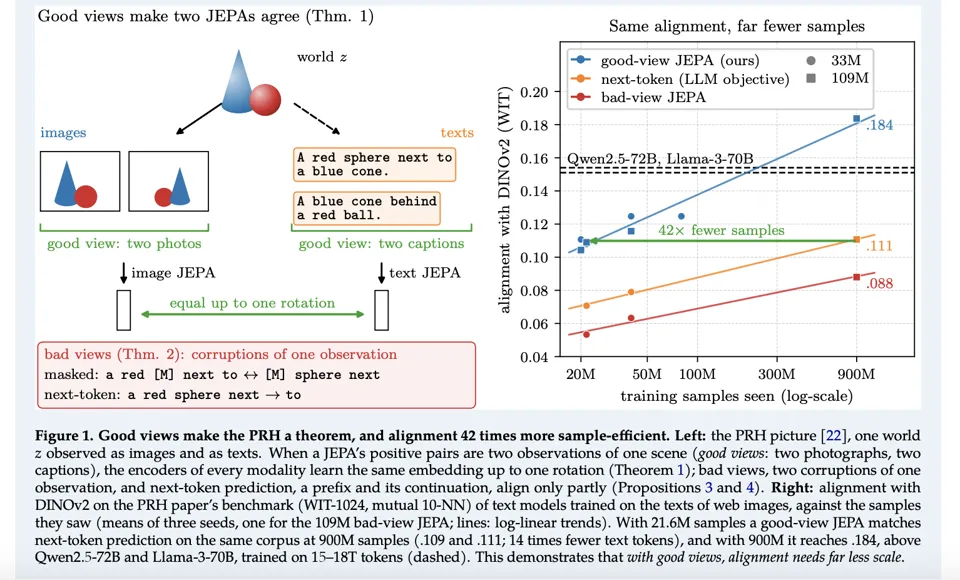
For instance, two photos of the same scene, or two pieces of text describing the same scene, though not identical in content, both point to a specific state in the real world. In contrast, the paper uses "Bad Views" to describe another type of training sample construction: for example, prefixes and subsequent content within the same text, or different fragments obtained by masking the same input.
The distinction is that the former helps models extract information shared across different observations, while the latter may cause models to spend more representational capacity processing details unique to a single modality.
The paper proposes that when different JEPA models are trained using positive sample relationships that meet specific conditions, they can learn representation spaces that differ only by a rotational transformation, even if they process different modalities.
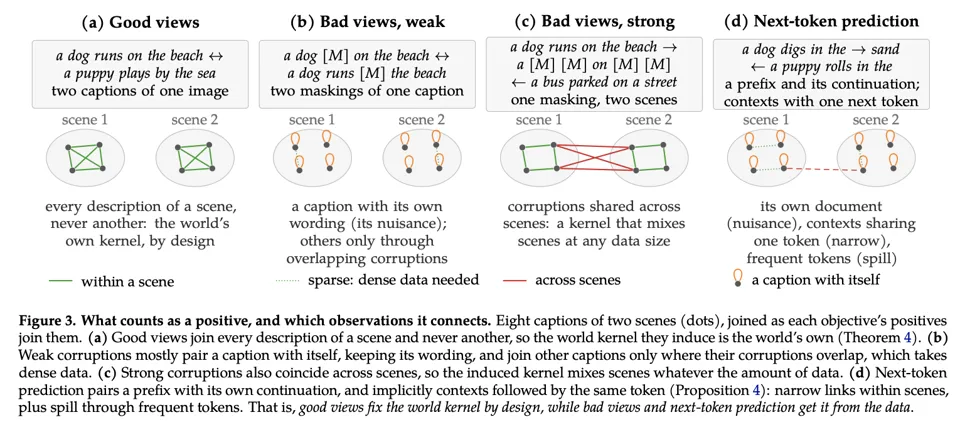
Here, "rotation" does not mean changing the orientation of an image, but rather applying a mathematical transformation to the high-dimensional vectors inside the model so that representations from different models can correspond. This is a mathematical conclusion with clear prerequisites, not proof that all existing AI models already possess identical world understanding.
The research team subsequently tested this theory through experiments. The paper compared text models and visual models employing different training strategies, focusing on how close their internal representational structures were. Results showed that text JEPAs trained with Good Views performed exceptionally well in cross-modal representation alignment.
The specific cross-modal representation alignment metric reported in the paper indicates that higher scores reflect closer model representational structures; it is not a score for general language model capabilities.
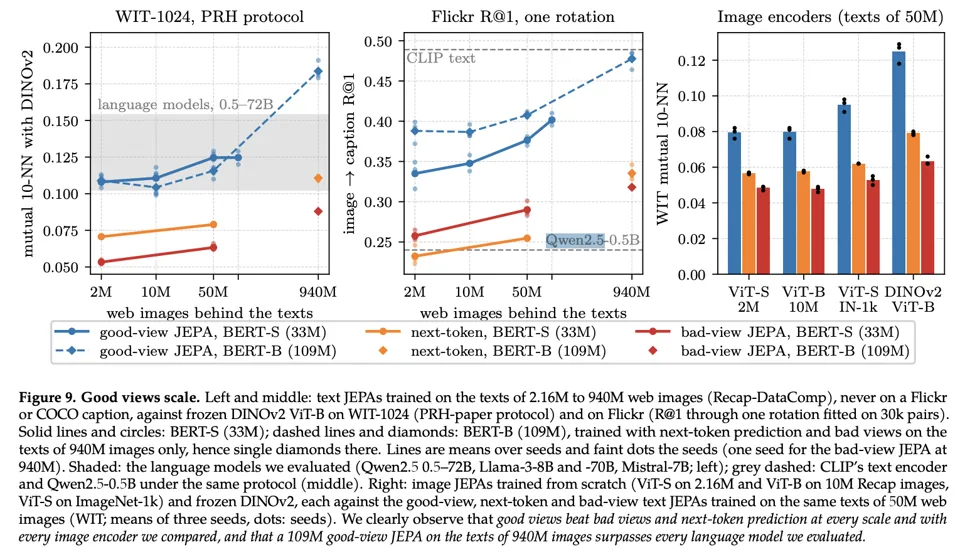
Notably, the text JEPA with 109 million parameters scored 0.184, surpassing Qwen2.5-72B's 0.154. This means that in this test, a small model with only about 1/600th the parameters of a large language model actually learned a representational structure closer to that of visual models.
However, it is crucial to note that this "outperformance" has strict boundaries. It does not imply that the JEPA exceeds Qwen2.5-72B in mathematical reasoning, code generation, or knowledge-based question answering. The paper compares cross-modal representation alignment, not the general-purpose capabilities of large models familiar to developers.
Another significant experiment involves training efficiency.
Researchers found that, under the same corpus and comparison settings, the Good Views training scheme achieved representation alignment levels comparable to next-token prediction using 900 million samples, but with only about 21.6 million samples.
In terms of sample count, this represents an efficiency gain of approximately 42 times; however, when calculated by the actual number of text tokens read, the gap is roughly 14 times.
This suggests that what information relationships a model learns during training may be more important than simply processing more text. More interestingly, the research team also attempted to translate this representation alignment capability into practical applications.
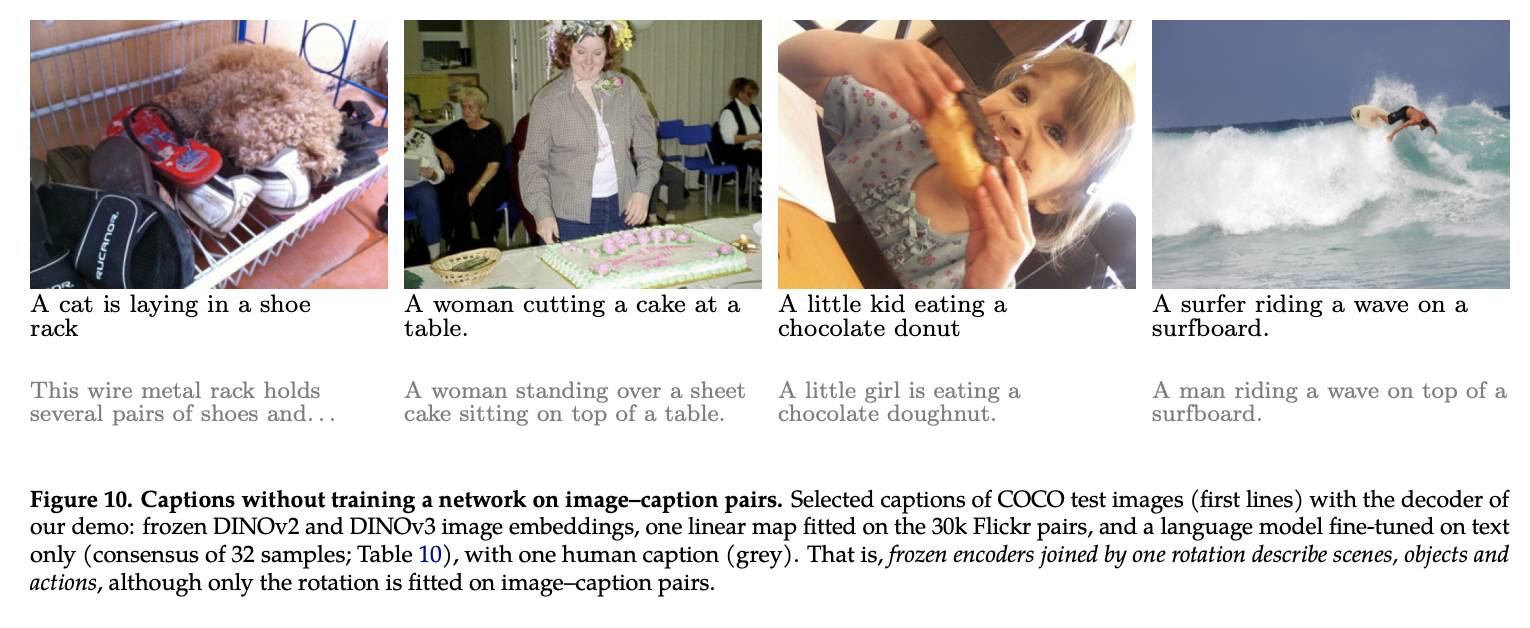
By connecting separately trained visual encoders and text models through a linear transformation, they built an image captioning system. On the COCO dataset, this system achieved a CIDEr score of 0.838. In another experiment that did not require paired image-text data to fit the alignment transformation, the model achieved 64% Top-5 accuracy on ImageNet-100 classification, surpassing some language model approaches compared in the paper. This moved the findings beyond mere mathematical proof, demonstrating the potential practical application space offered by cross-modal representation alignment.
Leaving Meta at 66: Why Is LeCun Still Committed to JEPA?
Behind this paper lies a continuation of Yann LeCun’s own research journey.
LeCun was born on July 8, 1960, in France, making him 66 years old this year. He served as Chief AI Scientist at Meta and was one of the pioneers of convolutional neural network (CNN) research. Alongside Geoffrey Hinton and Yoshua Bengio, he received the 2018 ACM Turing Award.
In today’s large model industry, LeCun is a somewhat unique figure. He is both a key founder of the deep learning wave and a researcher who has long held reservations about the current mainstream path for Large Language Models (LLMs).
As early as the 1980s, LeCun began exploring the application of neural networks in computer vision. He drove the development of CNNs, enabling machines to more effectively recognize handwritten characters and image content. These studies later became a fundamental basis for modern computer vision and deep learning.
In 2013, LeCun joined Facebook, participating in the founding of FAIR (Facebook AI Research). He worked at Meta for approximately 12 years, serving successively as the founding head of FAIR and Chief AI Scientist. However, as ChatGPT triggered the LLM boom, the divergence between LeCun and the industry’s mainstream technical route became increasingly apparent.
He does not deny the practical value of LLMs but repeatedly emphasizes that relying solely on predicting the next token is insufficient to build intelligent systems capable of understanding the physical world, remembering environmental states, reasoning, and planning complex actions. In his vision, future AI should not just learn language and knowledge from massive amounts of text, but should also learn the abstract structure of the world by observing the environment, much like humans and animals do.
This is why he has promoted JEPA (Joint-Embedding Predictive Architecture) for many years. Unlike training methods that require models to reconstruct input details, JEPA focuses more on learning abstract representations and performing predictions within the representation space.
In November 2025, LeCun publicly announced his intention to leave Meta and establish a new AI research company to continue advancing the Advanced Machine Intelligence (AMI) research initiative. At the time, he explicitly stated that the goal of the new company was to drive the next breakthrough in AI: building systems capable of understanding the physical world, possessing continuous memory, and exhibiting reasoning and complex action planning capabilities.
In March 2026, AMI Labs completed a funding round of approximately $1 billion. Unlike many startups focused on product development around existing LLMs, AMI Labs has positioned world models as its core research direction.
This background adds another layer of significance to the recent paper.
After winning the Turing Award and spending over a decade in research at major tech companies, he chose not to step back into the shadows. Instead, he left a familiar research platform to co-found a new company, continuing to push a technical route that has yet to prove it can replace mainstream LLMs.
There is a noteworthy scientific perseverance here: in an industry that increasingly prioritizes model scale, capital investment, and product release speed, LeCun is still trying to find the next breakthrough in the learning mechanism itself.
Although this paper gained attention due to Yann LeCun’s name, the other author, Randall Balestriero, is equally worth introducing.
Balestriero is an Assistant Professor of Computer Science at Brown University, with research interests including self-supervised learning, deep neural network theory, and representation learning. His research experience spans signal processing, deep network theory, and self-supervised learning.

He earned his Ph.D. from Rice University in 2021, after which he conducted postdoctoral research at Meta FAIR in collaboration with LeCun.
In 2023, Balestriero joined Citadel, working on financial time series forecasting and representation learning. Subsequently, he returned to academia to conduct research at Brown University.
Industry Reception: Amazement and Skepticism
Following the paper’s release, the most viral claim was undoubtedly “109 million parameters beating 72 billion parameters.”
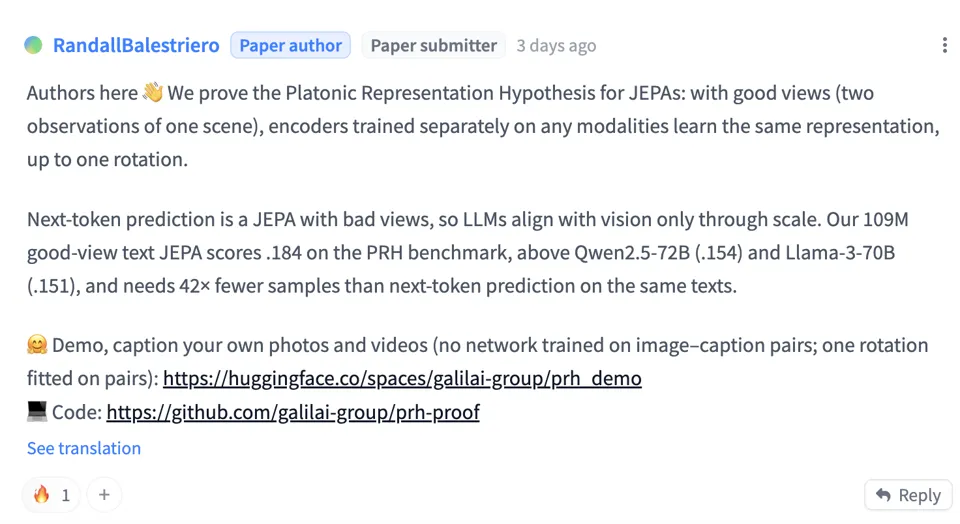
On Hugging Face, the paper entered the daily trending papers list. Co-author Balestriero personally appeared in the comments section to introduce the research results.
He specifically emphasized that the 109-million-parameter text JEPA trained using Good Views achieved a score of 0.184 on cross-modal representation alignment metrics, surpassing Qwen2.5-72B’s 0.154 and Llama-3-70B’s 0.151.
When replying to comments related to the paper on X, Yann LeCun stated that today’s large language models are able to answer a vast number of questions largely because they have accumulated massive amounts of declarative knowledge during training. He wrote:
“Large language models accumulate a huge amount of declarative knowledge. That’s why they can answer so many questions, and why they need so many parameters, which in turn consume a lot of memory.”
LeCun's perspective has also sparked discussion among netizens. Some remain cautious about this technical approach. User Sage Williams commented: "If your view is correct, then your model should ultimately prevail. We'll wait and see."

Others have focused on the potential practical value of this training method. Peter Ebasone believes this is good news for small labs and individual researchers, noting that the technology may have application potential in genomics.

Another user, Gordon Lawton, raised a more specific technical question: If models can learn the structure of the world through word co-occurrence in text and object co-occurrence in images, does this also apply to visuals and audio appearing simultaneously in videos? After all, humans perceive the world through the combined action of vision and hearing.

These comments reflect differing expectations regarding the JEPA approach: on one hand, people hope to see these theoretical advantages translate into actual model capabilities; on the other hand, higher data efficiency and the possibility of learning across multimodal information such as visual and auditory data have led some developers to identify new research directions.
References: