Nvidia's TacitVLA Cuts Vision-Language-Action Inference Latency by 3.4x
A research team from Nvidia, NYU, UC Berkeley and others introduces TacitVLA, showing that reasoning text in vision-language-action models mainly matters during training rather than at inference. The method matches explicit-reasoning success rates on four manipulation and autonomous-driving benchmarks while cutting latency by up to 3.4x, and sets new records on long-horizon memory tasks.
Full Report
Taking the reasoning out of VLA inference

The first author of this paper is Jack Lu, a PhD student in Computer Science at New York University; the work was done during his internship at NVIDIA. The paper was jointly advised by Yan Wang, Senior Research Scientist at NVIDIA and Technical Lead of Alpamayo Research, and Marco Pavone, Head of Autonomous Vehicle Research at NVIDIA and Associate Professor at Stanford University.
Today, many vision-language-action (VLA) models reason first and act second. Before outputting an action, the model writes a short piece of text—a description of the scene, a plan, or the next subtask to complete. Robots that do this achieve higher success rates, but they are also slower. The reasoning text must be generated autoregressively token by token, and the action cannot begin until the text is finished. In the paper's experiments, writing the reasoning text accounted for up to 70% of the latency of a single model call.
A research team from NVIDIA, New York University, UC Berkeley, Johns Hopkins University, and Stanford University took a close look at where the benefits of reasoning actually come from. They found that the action does not need to read the reasoning written at the current step; it is enough for the model to learn to write reasoning. Based on this, the team proposed TacitVLA. It is trained to write reasoning just like a standard reasoning VLA, but its actions never wait for that text.
On four benchmarks spanning robotic manipulation and autonomous driving, TacitVLA matches the success rate of explicit reasoning while reducing latency by up to 3.4×. At the same speed, it achieves up to 17 percentage points higher success rate than the same model trained without reasoning. On two long-horizon memory benchmarks, TacitVLA also sets new state-of-the-art results among published methods, improving by 21 percentage points on RMBench and by 16 percentage points on the counting task of RoboMME.
- Paper title: TacitVLA: Reasoning Vision-Language-Action Models Without Reasoning Latency
- Paper link: https://arxiv.org/abs/2610.17540
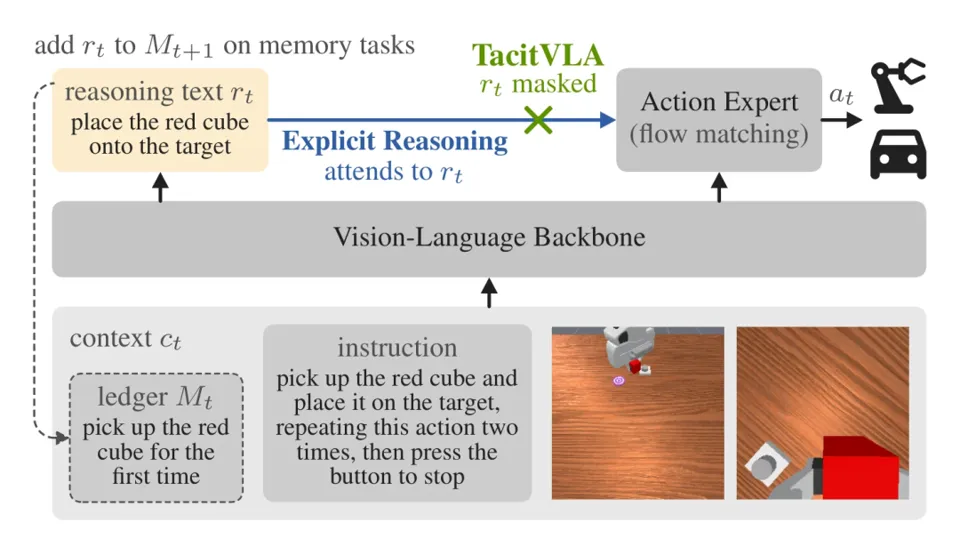
Three roles of reasoning text
In a reasoning VLA, the generated text serves three purposes.
During training, it is a supervision target. Learning to write this text shapes the backbone that the action expert relies on.
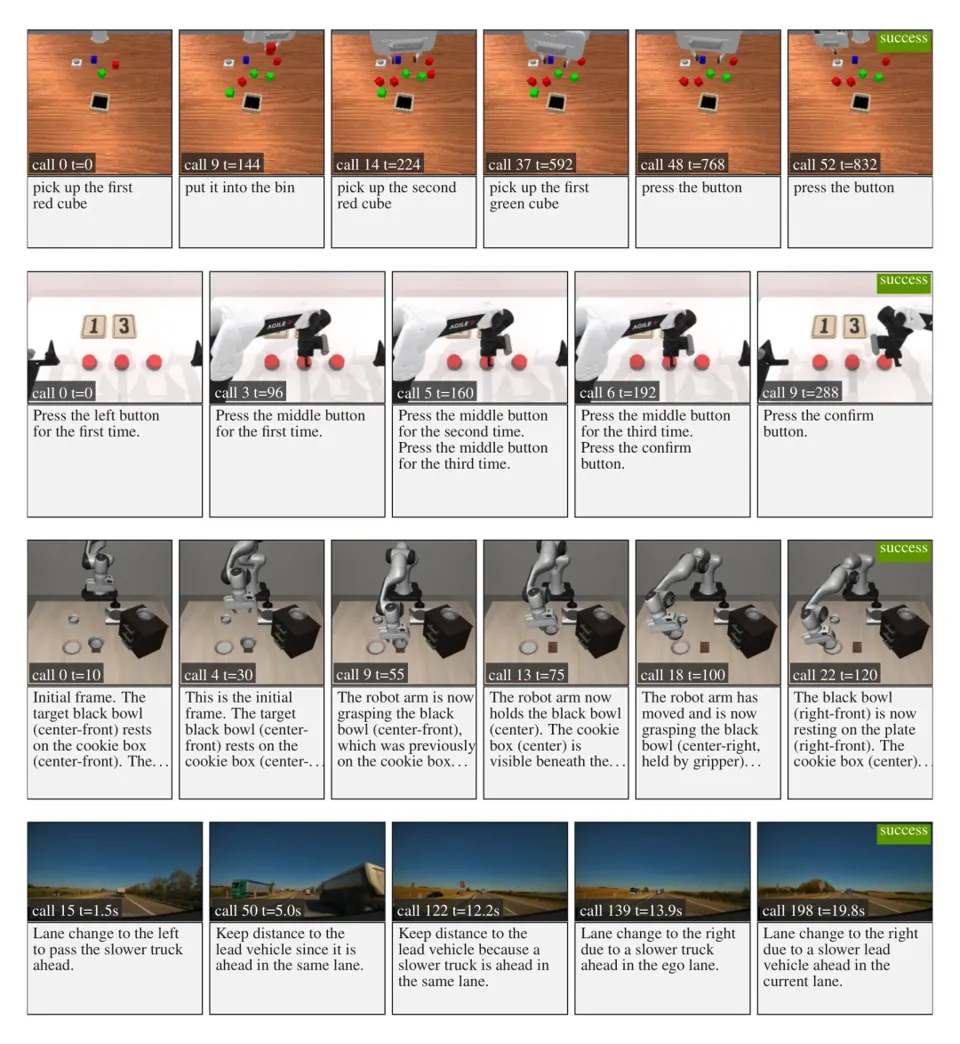
In long-horizon tasks, it can also serve as memory. Suppose a robot needs to press a button several times; the camera cannot show how many times it has already been pressed, but a log recording completed subtasks can.
Finally, at deployment, the text is an input to the action expert. The action expert must read the text written at the current step, so the action has to wait. TacitVLA keeps the first two roles and removes the third.
Method
Most recent reasoning VLAs adopt the same architecture. A vision-language backbone writes the reasoning, and a flow-matching-based action expert reads information from the backbone via attention and outputs actions. On each benchmark, the team trained three policies with this architecture on the same data.
In Explicit Reasoning, the action expert reads the reasoning it has just written, consistent with the embodied chain-of-thought approach. TacitVLA uses exactly the same training sequences, loss function, prompts, and optimizer; the only difference is a single change in the attention mask that prevents the action expert from seeing the reasoning tokens. No Reasoning is the same architecture trained on data without reasoning text.
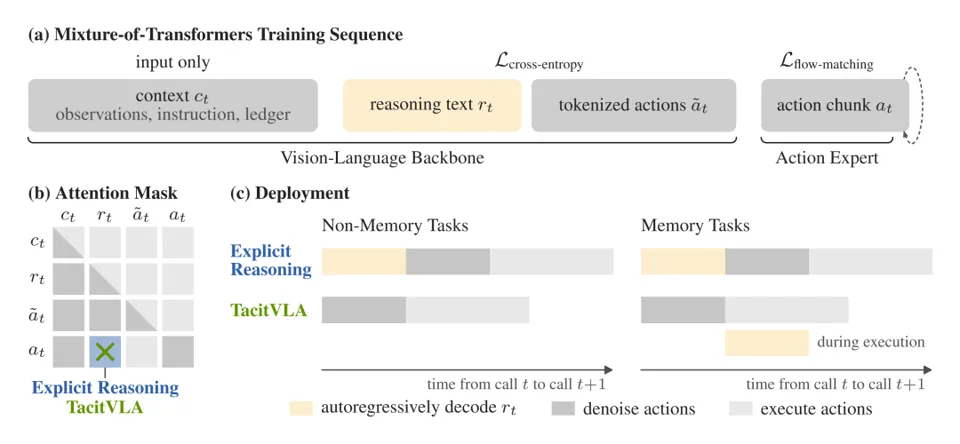
This design separates the two pathways through which reasoning might help.
First, learning to write reasoning may train a better backbone. Second, reading the reasoning may provide useful additional input to the action expert. Explicit Reasoning has both effects, while No Reasoning has neither. TacitVLA keeps only the first, and the first costs no time at deployment.
At deployment, if the reasoning text is not useful, TacitVLA simply skips writing it. On memory tasks, a log still needs to be written for each new subtask so that later steps can use it. Therefore, TacitVLA computes the action first, then writes the log while the robot executes that action. On the two memory benchmarks, the log was finished before the action completed in every call, so it introduced no additional latency.
Experimental results
On all four benchmarks, TacitVLA matches the success rate of Explicit Reasoning and surpasses No Reasoning, while maintaining the speed of No Reasoning.
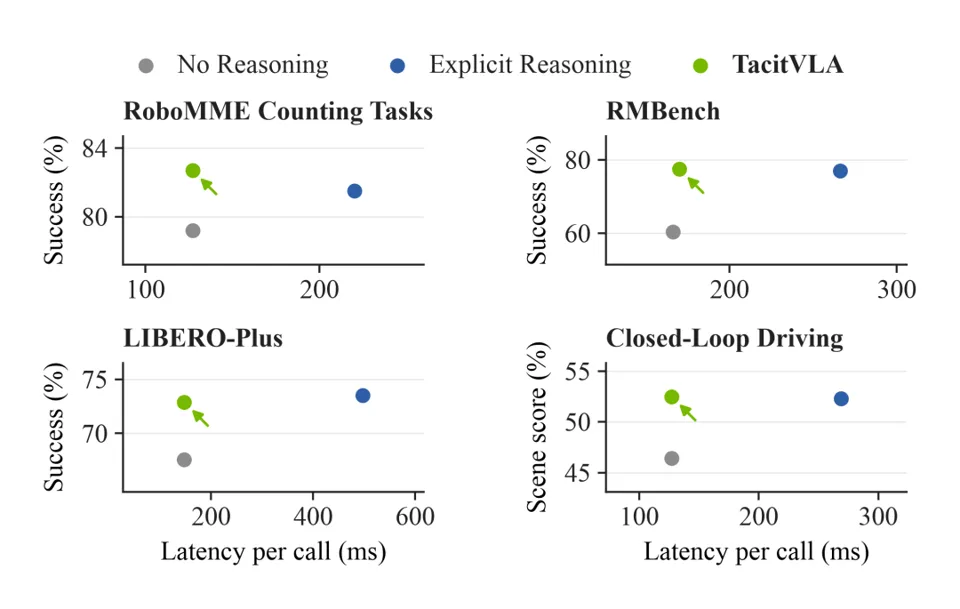
The biggest improvement is on memory benchmarks. On RMBench, TacitVLA achieves an average success rate of 77.5% across four tasks, Explicit Reasoning achieves 77.0%, and the previously published best result is 56.5%. Most of its improvement over No Reasoning (60.4%) comes from the Press Button task, where the number of presses is only recorded in a log. On this task, No Reasoning achieves a 7.7% success rate, while TacitVLA achieves 74.3%.
On RoboMME, when trained on all 16 tasks, TacitVLA achieves an overall success rate of 48.1%, compared with the previous best result of 44.5%. On counting tasks, it reaches 82.7%, compared with the previous best of 66.8%. When trained only on counting tasks, it reaches 89.5%, higher than the human reference score of 88.5% reported by the benchmark. In the human reference setting, the human is only responsible for selecting high-level steps, while the specific actions are executed by an oracle planner, whereas every action of TacitVLA is completed by itself.
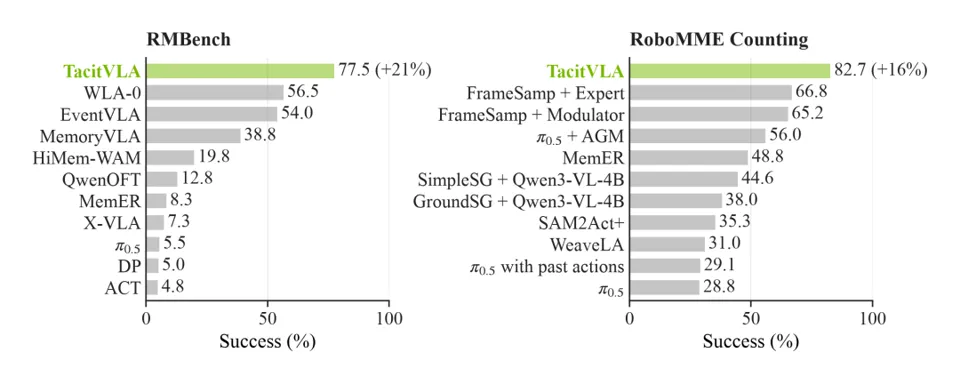
Reasoning is also helpful on tasks that do not require memory. LIBERO-Plus tests seven types of perturbations in a zero-shot manner. On this benchmark, the two reasoning strategies achieve the highest scores among published policies trained only on LIBERO: Explicit Reasoning scores 73.5%, TacitVLA scores 72.9%, and No Reasoning scores 67.6%.
On standard LIBERO, TacitVLA reaches 98.6%, matching the best published result. In closed-loop driving tests on the public AlpaSim challenge scenarios, TacitVLA achieves a scenario score of 52.5%, Explicit Reasoning scores 52.3%, and No Reasoning scores 46.4%. This result is only 2.5 points behind Alpamayo-R1. Alpamayo-R1 is a 10B model that uses four cameras, while TacitVLA has less than half its parameter count and uses only half as many cameras.
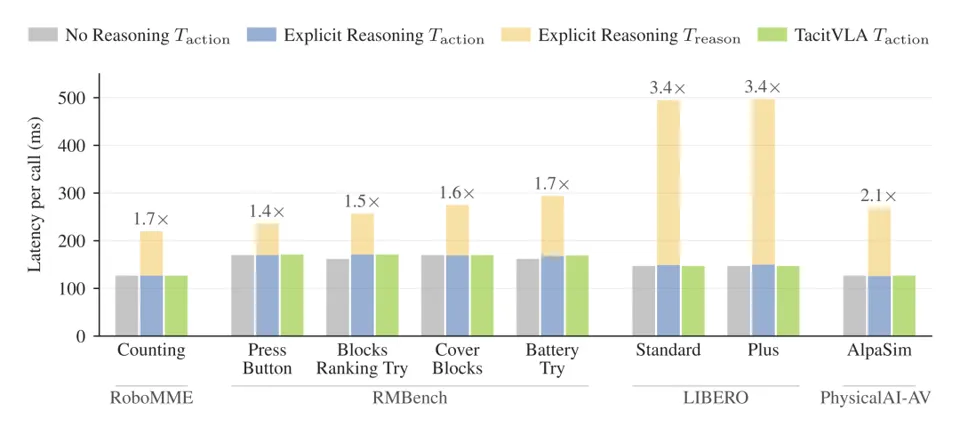
On a single H100 GPU, TacitVLA takes 147 ms to output one action on LIBERO, while Explicit Reasoning takes 495 ms, 3.4 times as long. In autonomous driving, the two take 127 ms and 269 ms, respectively. On memory tasks, Explicit Reasoning is 1.4 to 1.7 times slower. TacitVLA writes logs during execution, taking up at most 23% of the execution time.
Conclusion
The experiments cover robotic manipulation and autonomous driving, as well as tasks that require memory and tasks that do not. In these settings, the benefits of reasoning are transferred to actions through training on reasoning text. On memory tasks, the benefits are also transferred through previously written logs. Reading the reasoning for the current step only makes the policy slower, without making it more successful.
TacitVLA requires no additional models and no scheduler. Any reasoning VLA adopting this structure can be turned into TacitVLA simply by using an attention mask during training to prevent the action expert from seeing reasoning tokens.

© THE END
For reprints, please contact this official account for authorization.
Submissions or report requests: [email protected]