Ant Group Unveils Five Medical AI Models, Open-Sourcing Two
Ant Group's Ling team released five medical AI models at its health ecosystem conference, spanning deep medical reasoning, real-time multimodal interaction and disease risk prediction. Two were open-sourced the same day: the 124B LingSante-3.1-air-VL for local deployment and the 560B LingSante-3.1-flash with a 1M-token context window for long medical records. Ant also set a 'think like a doctor' bar for training and evaluation, stressing rigorous, complete reasoning chains.
Related Entities
Full Report
Contents3 sections
Luyu, reporting from the Non-Conventional Temple QbitAI | WeChat Official Account QbitAI
Good heavens, the competition is insane! Five models released in one go...
Ant Ling is out to penetrate the healthcare AI space through and through.
One move, and it's an entire model family.
P.S. I've already organized the table for everyone, feel free to take it~
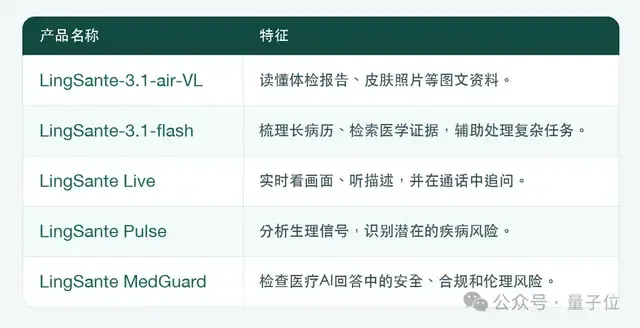
And they're all in hardcore directions like deep medical reasoning, real-time multimodal interaction, and disease risk prediction—precisely hitting the deployment needs of health AI.
And! The first two professional models were directly open-sourced the very same day!
I have to say, this year's Ant Healthcare Ecosystem Conference had so many highlights, it was completely overwhelming.
Let's first briefly go through these models.
The two open-source models differ quite a bit in size:
- LingSante-3.1-air-VL: relatively lightweight, only 124B, skilled at handling reports, images, and other graphic-text materials, suitable for local deployment;
- LingSante-3.1-flash: a full 560B, supporting up to 1 million tokens of context, specifically aimed at long medical records and complex tasks that require repeated lookups.
There's also a LingSante Live that ordinary users can easily get started with:
Open the Afu APP, give the AI a video call, and it can directly "observe, listen, question, and feel the pulse" with real-time perception.
Add in LingSante Pulse for identifying disease risks, and LingSante MedGuard specifically serving as a safety bodyguard for medical AI answers...
Ant is laying all of Afu's technical foundations on the table.
Not just these—Ant has also set a higher requirement for this entire model suite:
"Models must think like doctors."
Think about it carefully—this isn't about making the model memorize a few more medical terms and calling it a day; it's about genuinely learning doctors' logic of handling things.
For example, if a user says they have a headache, a general model might list a bunch of possible diseases (scary.GIF), but doctor-style thinking would first ask how long you've been in pain, what kind of pain it is, and then decide the next step.
When it comes to evaluation, they also look at whether the model's reasoning process is complete and rigorous.

Put plainly, models in medical scenarios can't be careless at all.
So what's the actual story here? Let's go through the models below, then run some real hands-on tests, and you might just understand what doctor-style thinking means.
Afu Unveils Five Major Models in One Go
You know, recently when my family members had a headache or a fever, they finally stopped coming to me...
They all turned to ask a certain Fu.
It's not that surprising, really—Afu now has 150 million users, with nearly 20 million health consultations per day, a quarter of which are elderly people.

Asking AI about a physical examination report has become increasingly commonplace.
But if we're just talking about those up-and-down arrow indicators in reports, Afu can explain them, and other general-purpose large models might not necessarily be unable to do so either.
Terminology, reference ranges, possible causes—they can list them all clearly in seconds.
But being able to explain and being usable are two different things.
General-purpose large models at most append a line at the end suggesting seeing a doctor, whereas models that truly understand medical workflows are more cautious, pay more attention to potential risks, and get evidence-based practice right throughout the process.
That way users feel reassured, and doctors can pick up seamlessly.
So what the new generation of health AI truly needs to fill in are actually a few concepts that don't sound very sexy:
Ask follow-up questions before judging, keep the basis traceable, keep boundaries in check, and after answering, hand it over to a doctor for review.

Image generated by AI
This isn't just the tech community pushing itself either.
The "National Health '15th Five-Year Plan'" proposes shifting from "centering on treating diseases" to "centering on health," moving the focus of health management outside hospitals and into daily life. The scenarios AI needs to handle will naturally extend as well.
The five major models unveiled together this time happen to cut in from different places.
LingSante-3.1-air-VL: Solving How to Read Medical Materials Accurately
It's also Afu's first open-source multimodal medical large model.
The model is built on Ling-3.0-flash-VL and natively supports image-text input. With 124B total parameters, thanks to the sparse MoE architecture of the Ling foundation, only 5.5B are actually activated.
There are two considerations behind specifically building such a model:
First, precisely because many health problems start with an image or a document.
When users snap a photo of a physical examination report, they often just leave one line: "Detective, what do you make of this?" Sometimes the photo isn't even complete, and key information is missing.
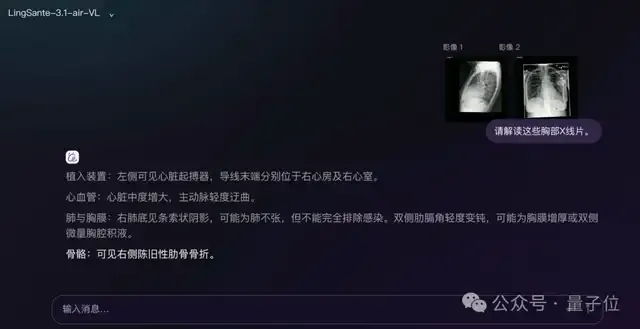
What LingSante-3.1-air-VL needs to do is make an image the starting point for continued questioning and verification. While fully understanding contextual information, it knows what's still missing and knows how to give reasonable suggestions.
To this end, Ant also incorporated medical retrieval and tool calling into the design—when encountering a problem, understand it thoroughly first, then use tools to solve it.
On the other hand, the small-parameter design saves computational overhead during inference. For hospitals, paired with suitable hardware, it offers another local deployment option:
Let medical records and examination reports be processed locally, reducing the external transmission of sensitive data.
This model's official application scenarios are also quite rich—not only does it have outstanding medical professional capabilities, but its general capabilities are not neglected either.
Besides reading imaging and physical examination reports, analyzing skin photos and dietary images, it also supports retrieving medical evidence and assisting with registration and medication purchases.

In terms of evaluation, its overall medical multimodal capabilities firmly rank in the industry's first tier. In particular, imaging report generation and interpretation, skin disease recognition, dietary nutrition analysis, and medical report interpretation all surpass general models like GPT-6.1 Sol, ranking first.

LingSante-3.1-flash: How to Make Sense of a Stack of Medical Records
Once the materials are understood, the next step is to organize a pile of professional materials and continue with medical specialization—that is the job of LingSante-3.1-flash.
It likewise uses Bailing as its base and is built on Ling-3.1-flash. But its total parameter count reaches 560B, and with the Hybrid-linear MoE architecture, long medical records, examination reports, and medical literature can all be fed in at once.

The model's training method is also worth a closer look.
The team used an approach called ECM (Evidence–Capability Matching): first define the capabilities to be tested, then mine suitable questions from case reports, medical exams, and other professional materials.
For example, if the goal is to train handling of evidence conflicts, the question must contain two pieces of material that cannot be directly equated.
The generated questions then go through a round of checks by a multi-agent system, MEDPAR, to see whether there are any problems with medical facts and whether the intended capability is actually tested.
Then part of the questions are used for supervised fine-tuning and another part for reinforcement learning, working on both fronts so the model both understands medicine and can analyze cases.
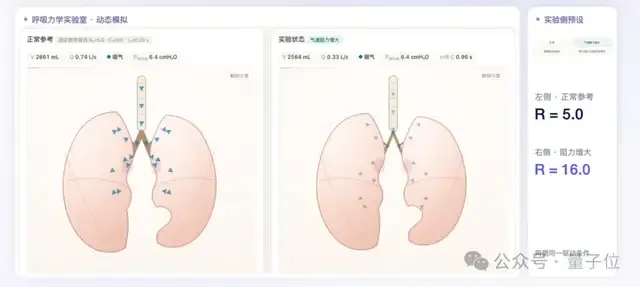
Training tool calls follows a similar idea: how well a single material retrieval is done depends on whether what is retrieved advances the task, and then the search steps are gradually optimized to reduce ineffective searches and repeated reasoning.
Introducing multi-agent collaboration for long-horizon tasks can further improve model performance—for example, BrowseComp accuracy can be pushed from 91.33% to 93.84%.
The team also noticed that doing reinforcement learning on verifiable tasks such as code execution can also improve capabilities like medical reasoning and professional knowledge retrieval.
For example, on one code reinforcement learning training line, TerminalBench went from 42.00 to 50.84, medical knowledge reasoning from 80.13 to 81.51, GPQA from 77.78 to 83.33, and search aggregation from 70.27 to 74.89.

Finally, behavior alignment lets the model know when to give what kind of advice.
If information is incomplete, it prioritizes asking about key details that would change the judgment; when giving explanations, it distinguishes known facts from speculation still to be verified; when encountering clear danger signals, it promptly advises seeing a doctor.
To this end, the team crossed different tasks with the professional behaviors that should be followed, and formulated scoring criteria question by question for the training set.
Ultimately, LingSante-3.1-flash is at the open-source leading level in a comprehensive evaluation comprising 14 reasoning and safety alignment benchmarks and 19 Agent evaluation configurations.

Among them, HealthBench Professional scored as high as 66.03%, MentalHealthBench 55.58%, and the self-built Chinese public medical consultation evaluation set MedBehave-ZH 53.44%.
The overall score is 58.35%, second only to GPT-6 Astra, achieving SOTA among open-source models.
LingSante Live: From Taking a Photo to Chatting While Watching
But static medical materials alone are far from enough—medical consultations emphasize "observation, listening, questioning, and pulse-taking."
Taking this into account, LingSante Live has arrived at real-time back-and-forth interaction:
Make a video call, and the report or medicine box in your hand, or a skin condition you want the AI to look at, can all be shown to the camera.
You can also supplement while chatting—for example, if only part of the report is visible, the AI can ask you on the spot to move your phone a bit to the right.
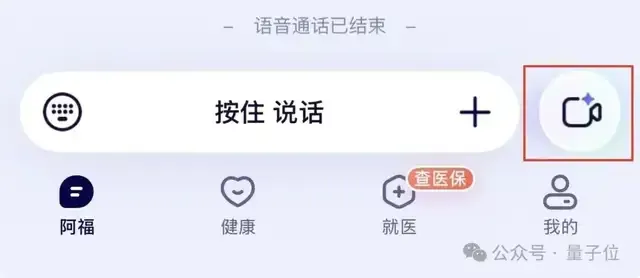
It is a multimodal interaction architecture for health collaboration and has already been deployed in the Afu APP; by selecting "Video Call," the AI can listen, watch, speak, and act simultaneously:
- "Observation" means continuously watching the picture and guiding the user to show more information as needed.
- "Listening" corresponds to full-duplex voice: the system can keep listening while speaking, and the user can interject at any time.
- "Questioning" means the system integrates background analysis results and continuously adjusts subsequent questions and guidance.
- "Pulse-taking" means extending the perception range beyond audio and video, exploring the combination of non-contact measurement and wearable devices.

Image generated by AI
Overall, the model keeps real-time responses in the foreground, continuously feeds multi-source information into the system, and leaves time-consuming analysis and planning to background Agents.
In this way, users do not need to first photograph materials in a standard way or write out their questions completely—the conversation can start from the bit of information at hand, and the model will gradually observe and obtain more information in a more natural way.
LingSante Pulse: Finding Disease Risks in Everyday Physiological Signals
But there are also some health problems that users may not yet be aware of, let alone proactively ask about.
LingSante Pulse targets potential risks in physiological signals.
It can perform risk prediction for more than 150 diseases, moving the focus forward from physical problems that have already occurred.
At present, the team has released the weights of the physiological signal encoder, which can convert signals such as ECG into features for downstream use. Specific disease risk prediction still requires supporting task models.
What is being released to developers this time is precisely the signal processing capability at the front layer.
LingSante MedGuard: A Safety Check for Medical AI Answers
LingSante MedGuard, in turn, takes the medical AI answers that have already been generated and checks whether there are still risks in them.
Given a numerical judgment, are the units and calculations correct? Can the cited evidence support that piece of advice?
The team built these checks into a dedicated guard model, and then, combined with patient context, mined hidden risks from the three dimensions of medical safety, compliance, and ethics.
In simple terms, all five models break down the process of a health issue step by step, following the course of how it unfolds.
In a single consultation, the materials need to be understood, complex situations need to be sorted out, missing information can be filled in during a video call, ongoing daily risks need to be monitored, and a safety gate must be added to the answers going forward.
Bailing provides the starting point of image-text understanding, long context, and tool calling; once applied to medical scenarios, these capabilities begin to take on different emphases.
But they are not completely isolated from one another—they can also complement each other, forming a larger health AI capability map.
As for whether this division of labor works well in users' hands, just give it a try and you'll know.
Hands-on testing of Ant Afu's new models
First, let's try to find fault with Ling-3.0-flash-VL.
I gave it an image of a complete blood count (CBC) test report, but cropped out the units and reference ranges, while also hiding the results for hemoglobin and red blood cell count, and asked it how it would interpret this report.
I threw the same question at GPT-6.2 Sol as well.
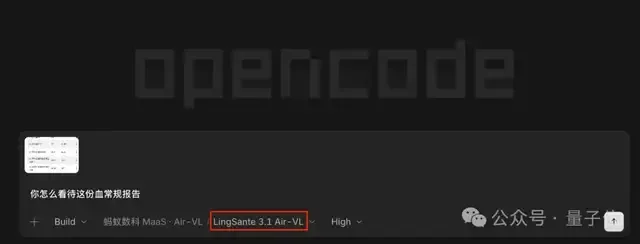
The two generated at roughly the same speed, both giving results after about ten seconds of thinking.
But Ling-3.0-flash-VL was more cautious: upon finding that the key evidence—hemoglobin—was missing, it did not give a definitive conclusion.
GPT-6.2 Sol, by contrast, opened directly with a result of moderate iron-deficiency anemia, and when listing the indicators, completely ignored the hemoglobin situation.

Looking further down, the two models also diverged noticeably in how they handled hemoglobin:
Ling-3.0-flash-VL explicitly recommended supplementing the relevant values in the next round of interaction, while GPT-6.2 Sol directly back-calculated and estimated using other indicators.
Although this is mathematically self-consistent, in subsequent processes it is very easy to treat approximate values as real test data, posing a hidden risk of misleading clinical decisions.
Ling-3.0-flash-VL is more conservative and safe, with stronger evidence-based grounding, in line with medical SOPs.

In the second round, we sent a screenshot of the complete report to both models at the same time.
On differentiating the type of anemia, both used the newly added values to calculate the Mentzer index (MCV ÷ RBC), giving the further conclusion of "prioritize ruling out thalassemia."
But in the subsequent recommendations, Ling-3.0-flash-VL was clearly more comprehensive, covering the entire chain from follow-up testing, tracing, treatment, follow-up care, and diet to risk warnings, patient-friendly.

Switching to LingSante-3.1-flash, the question was changed to attributing the cause of hyponatremia, where every data point forces the model to do genuine evidence weighing, focusing on testing the model's knowledge reasoning ability.

This time the model took longer to output, but overall the structure was quite complete, with precise and well-grounded judgments throughout.
The first layer, classification, LingSante-3.1-flash basically passed with full marks: the hypotonic classification was correct, pseudohyponatremia and hypertonic interference were covered completely, and it even mentioned the additional osmolal gap.
The second layer, differential diagnosis, is where the model's doctor-like thinking is most evident.
It did not treat "high urine sodium + low serum uric acid" as definitive evidence of SIADH (syndrome of inappropriate antidiuretic hormone secretion), and actively rejected the discriminatory power of these two items. This is precisely where models that memorize conclusions are most likely to stumble, but LingSante-3.1-flash avoided it.
The third layer, management, was also entirely correct in direction, but the correction rate thresholds it gave (for high-risk patients, 24h ≤4–6 mmol/L, 48h ≤8–12 mmol/L) were overly conservative and not the guideline-recommended values (for high-risk patients, 24h ≤8 mmol/L, 48h ≤18 mmol/L).
The fourth layer, level of evidence, the model was honest and clearly stratified, marking "volume status and response to salt supplementation" as a weak recommendation and the link with the greatest empirical judgment, showing that its reasoning went beyond reciting answers.
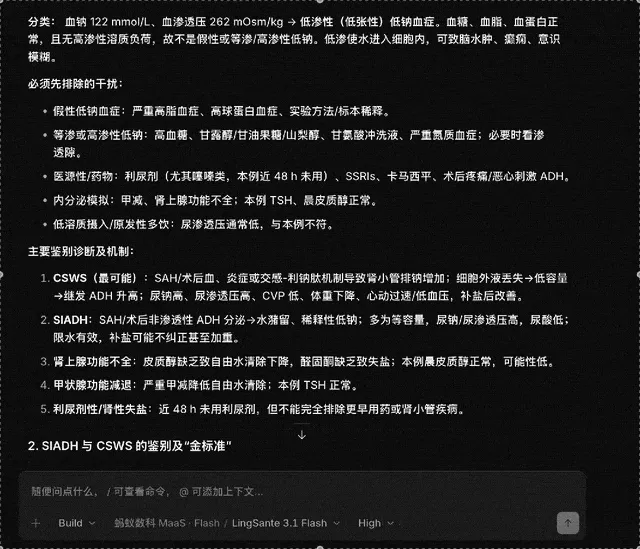
Also given to GPT, by comparison, LingSante-3.1-flash still had higher completeness and readability in organizing knowledge, while GPT-6.2 Sol showed a disconnect between its execution layer and its judgment layer.
GPT-6.2 Sol also has something worth learning from, such as generating structural diagrams within the text to aid understanding.

Finally, let's experience the LingSante Live video call feature on the Afu APP.
Starting with a wide shot, the model accurately identified the drug name and type, and suggested moving the camera closer next so it could see the ingredients column clearly.

Video link: https://mp.weixin.qq.com/s/ceH1mQR_6BNAlI5l2ehF7w
After the camera zoomed in, LingSante Live would continue chatting with the user; wherever it couldn't see clearly, it prompted the user to adjust the drug's position again until the information that needed to be verified was clear.
Even for text in a minor language, LingSante Live translated it quickly. When interrupted mid-conversation, it could immediately pick up and continue along with the new question.

Video link: https://mp.weixin.qq.com/s/ceH1mQR_6BNAlI5l2ehF7w
Simulate some emergency situations, such as accidental ingestion of topical medication or getting it in the eyes, and LingSante Live can also reasonably provide immediate advice based on the drug's ingredients.
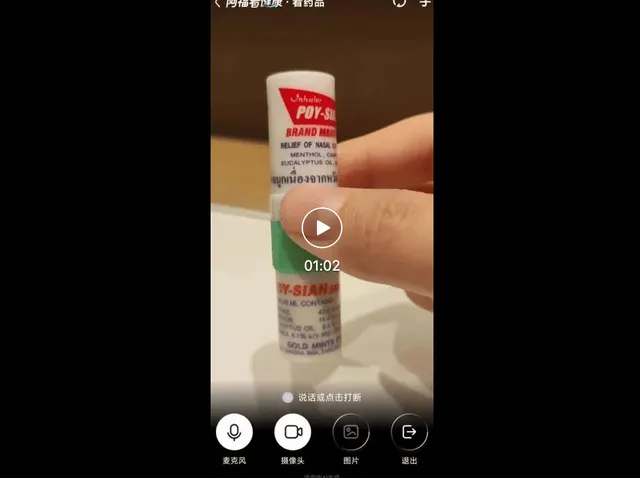
Video link: https://mp.weixin.qq.com/s/ceH1mQR_6BNAlI5l2ehF7w
I also tried the video consultation. Unexpectedly, as we chatted, it proactively tried to estimate my respiratory rate and real-time heart rate. After seeing my skin condition in the camera, it also reminded me to pay more attention to rest recently.
Warm and thoughtful~
Overall, the most intuitive impression from the experience is that LingSante Live doesn't give you such a strong sense of AI interaction. It generates while watching, keeping up with the pace of the conversation.
If the camera moves, or you interject a remark midway, it can respond promptly. The suggestions it gives are also quite specific, explaining the basis, like a video call with a real doctor—quite handy for everyday medical consultations.

As for LingSante Pulse and LingSante MedGuard, I won't test them separately—in the earlier experience, they were actually present all along.
For example, in the earlier case of Ling-3.0-flash-VL making judgments when conditions were missing—whether the model cautiously asks follow-up questions or jumps to conclusions—behind that is the boundary that safeguards like LingSante MedGuard must guard well.
And video dialogue is precisely the risk-control scenario where LingSante Pulse shines.
One manages not answering recklessly, the other manages risk alerts. They don't steal the spotlight, but without either of them, the previous three models wouldn't be up to par.
Ant Afu Has Laid Out a Big Medical AI Strategy
Looking at the five models one by one, we roughly understand what Afu means by "thinking like a doctor."
No matter how professional the terminology or how confident the tone, those are just surface tricks.
To be a doctor inside, the model must learn to make judgments according to the weight of evidence—say only as much as the available evidence can support.
If information is insufficient, keep asking; if a judgment is given, the basis must be clearly explained so people can go back and verify.

After all, medicine is an extremely specialized field—what's feared is not that you can't say something, but that you say things recklessly.
Beyond professionalism, holding the safety bottom line and making results traceable—these are established industry rules. If AI wants to enter, it must honestly follow the rules.
Only then can it truly connect users and doctors: patient → AI with doctor-like thinking → doctor.
For users, the AI's doctor-like thinking means that after reading a report, they can more clearly know what else they should ask the doctor, rather than rushing there and coming back confused.
When a doctor takes over, they can also follow the clues organized by the model to review the original materials, verify item by item, and then make further judgments.
What the model hands over is a draft with sources that fits doctors' habits, assisting doctors in completing tedious clinical steps, and the doctor continues from there.

The five models didn't appear out of nowhere either—this logic has always been hidden in Afu and the Bailing foundation.
It's just that this time everything is ready, and finally the previously scattered capabilities can be brought back together. In this way, one APP can cover the entire medical workflow, with doctors and patients each finding their own entry point.
Using different models for what they each do best also gives concrete grounding to the "intelligence-efficiency ratio" that Bailing has always emphasized.
For example, Ling-3.0-flash-VL uses 5.5B activated parameters to process images and text, while LingSante-3.1-flash reasonably allocates long context and compute to heavier tasks. All models retain information sources, which can also reduce review and rework costs.
The benefits are obvious: professional institutions can also use open source to pick the model that best fits their needs.
Open source will satisfy the medical industry's requirements for privatization and controllability as much as possible.
Following this line of thought, what Ant wants to do is clear at a glance:
Turn the way doctors handle problems into something AI can actually do in real tasks.
As for "what future medical professional models should look like," Ant has finally brought it to the forefront.