Anthropic Mathematician Claims Navier-Stokes Proof With Claude's Help
Anthropic mathematician Levent Alpöge and NYU professor Tristan Buckmaster released a 79-page paper on Nov 20 claiming a proof of finite-time blow-up for the 3D Navier-Stokes equations without external forcing, alongside Lean formalization code; Terence Tao has weighed in but stresses independent verification is still needed. The same day, mathematician Alessandro Maria Masullo published a 940-page, 12-year human-only Riemann Hypothesis proof draft, creating a stark contrast between AI-assisted and human-led mathematics.
Related Entities
Full Report
Contents4 sections
The news about the Riemann Hypothesis has not even been fully digested, and another Millennium Prize Problem has been proven by the same mathematician, again in collaboration with Claude.
On one side is the Riemann Hypothesis, which concerns the distribution of primes; on the other is the Navier–Stokes existence and smoothness problem, which concerns whether the equations describing the motion of water and air can always yield smooth solutions.
Behind both claims stands Levent Alpöge, a 34-year-old mathematician at Anthropic.
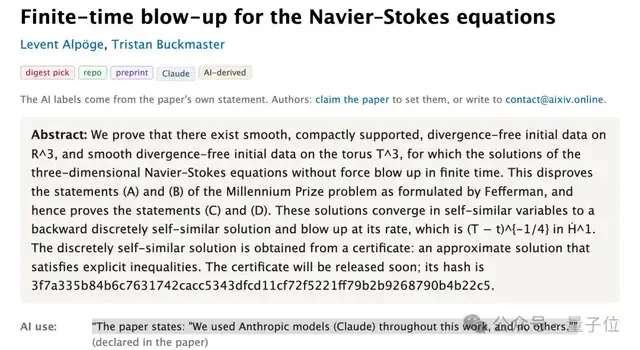
On November 20, Alpöge and Tristan Buckmaster, a professor at New York University, published a paper claiming to have proven finite-time blow-up without external forcing for the three-dimensional Navier–Stokes equations.
The paper is 79 pages long, and the Lean formalized proof code was also made public.
Terence Tao has also written a dedicated post discussing it. He believes that the general strategy of this NS proof is already clear, but it still needs to be further organized into a rigorous, professional proof text. Whether the two claims can hold up will depend on independent verification.
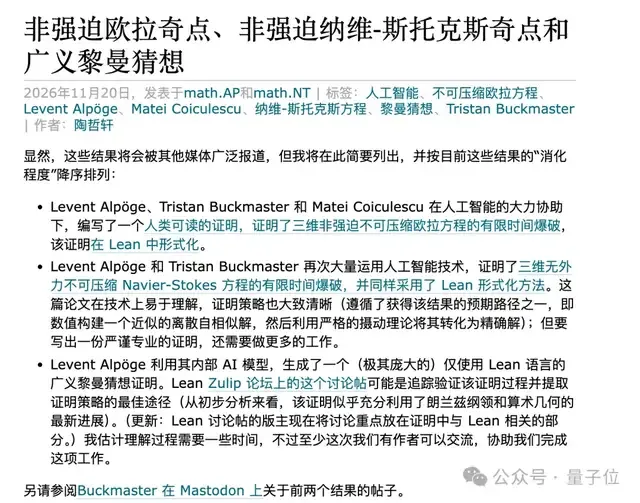
A mathematician working at Anthropic, teaming up with an academic colleague and then joining forces with Claude, has publicly claimed proofs of two Millennium Prize Problems in a single day—this leaves other mathematicians who are still persisting with "hand-crafted" work no time to breathe...
But human mathematicians are not willing to be outdone, and they have already begun to "counterattack"!
Alessandro Maria Masullo, a mathematician from Rome, Italy, with a PhD in mathematics from Stanford University, released a "whole-of-humanity edition" draft proof of the Riemann Hypothesis on the same day.
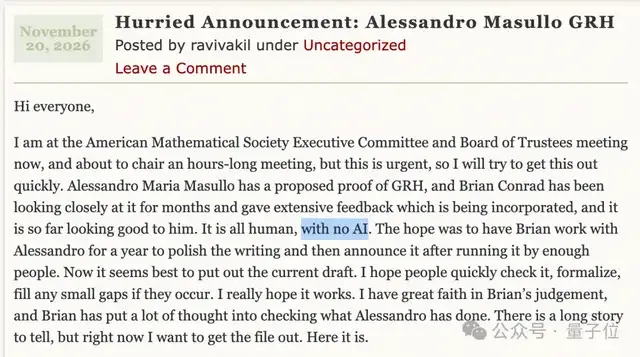
Ravi Vakil, president of the American Mathematical Society (AMS), who made the draft public on his behalf, emphasized that this draft proof did not use AI.
In his acknowledgments, Alessandro Maria Masullo wrote that this research took nearly 12 years in total. He had originally wanted to revise it slowly, explain the ideas clearly, and let more colleagues check it before officially announcing it. But under the current research environment, he accepted the suggestion and released the existing version first.
He left a message for mathematicians who feel frustrated by the current pace and atmosphere of research, roughly meaning:
"We are still here, and we are not leaving."
AI breakthroughs are shaking the mathematics community, but there are still scholars who persist in their research, writing more than a decade of accumulated work into a thick manuscript, and continuing to seek answers to problems that have long troubled humanity.
Without anyone continuing to stir, can a fluid still "blow up"?
First, let us explain what this paper is actually studying.
Navier–Stokes, or NS for short, is a set of equations describing how fluids such as water and air move. It is concerned with the following: given how a fluid initially flows, how will the velocity and pressure at each location change afterward?
This time, the problem can be roughly imagined like this:
First stir the water, then take the spoon away and stop applying external force. As this body of water moves on its own, will an extreme situation occur at some moment that causes the originally applicable mathematical model to fail, making it impossible to continue accurately describing changes in the flow?
"Blow-up" here refers to exactly this situation. More specifically, as a certain finite time approaches, the velocity may become unbounded, and the original smooth solution can no longer be extended.
Mathematicians want to know whether flows satisfying the prescribed conditions can remain smooth forever.
The answer Alpöge and Buckmaster give this time is: a counterexample exists.
In this 79-page paper, Alpöge and Buckmaster claim that they have constructed a flow of this kind: it is smooth at the beginning, with no external force continuously driving it, yet a singularity appears in finite time afterward.
This claim concerns both the ordinary three-dimensional space and the periodic space setting.
This is also where the weight of the problem lies—to refute the statement that "all flows satisfying the conditions can remain smooth forever," it is enough to find one rigorously valid counterexample.
**△**Image generated by AI
What they claim to provide is a negative answer to the Millennium Prize Problem of NS existence and smoothness.
This is not their first time studying fluid blow-up.
In September of this year, the two had already announced a blow-up result for the three-dimensional Euler equations with smooth external forcing. Euler does not account for viscosity, whereas NS retains viscosity, that is, the property that friction arises inside the fluid and dissipates kinetic energy.
The change this time is: the external force is removed, viscosity is retained, and they still claim to have found an example of blow-up.
It looks as if only a few conditions were changed, but the obstacles the proof must overcome have changed. This new proof shows that a viscous fluid may develop a singularity even without external forcing.
Therefore, this theory can be applied in more situations, and it also shows that it is more reliable than previously thought.
How did a number theorist end up studying fluids with Claude?
The same name appears in two consecutive major problems—so who exactly is Alpöge?
His CV belongs to the category of people who attracted the attention of the mathematics community very early on.
He majored in mathematics as an undergraduate at Harvard, graduated with a perfect 4.0 GPA, and also earned a master's degree in physics. He then went to Princeton for a PhD in mathematics, advised by Fields Medalist Manjul Bhargava.
After receiving his PhD in 2020, he did an NSF postdoc and became a Junior Fellow of the Harvard Society of Fellows.
In 2015, he also received the Morgan Prize, which recognizes undergraduate research in mathematics. This prize looks at research already completed.
His academic background is mainly in number theory, including elliptic curves and the problems of integral points and rational points on polynomial equations. Among the works listed on his personal website is a paper with Bhargava, Wei Ho, and Ari Shnidman on Hilbert's tenth problem over rings of integers of number fields.
In other words, before this round of news, he already had a solid research record.
For this foray into fluid equations, his collaborator Buckmaster has long worked on partial differential equations and fluid problems and received a Clay Research Award in 2019.
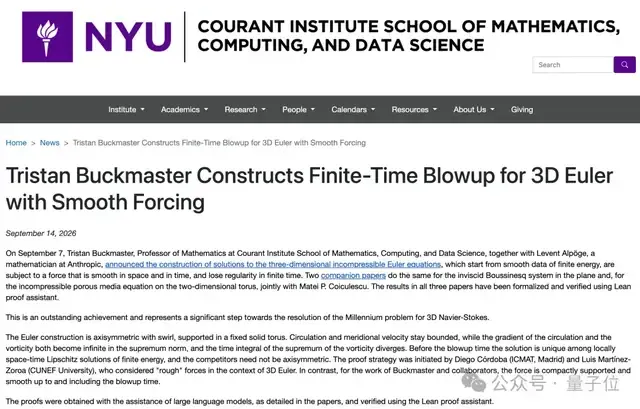
One has a background in number theory and AI, and the other is familiar with fluid equations; the collaboration between the two has a clear professional basis.
Now that their professional backgrounds have been explained, the next question is the one everyone cares about most: what role did Claude play?
A public excerpt of the paper's AI statement gives a clear piece of information: this NS work used Anthropic's Claude model throughout, and no other models were used.
From the public materials, Claude has already participated in the generation, organization, and rewriting of the proof.
The order in which this was written is also quite interesting.
The authors disclosed that they first had a Lean formal proof, then generated a draft paper based on it, and afterward continued revising—replacing some lengthy proofs with existing standard results and simplifying certain arguments.
The public paper statement also mentions that the draft used Scott Armstrong's tool for converting Lean proofs into natural-language papers, after which the authors guided Claude in rewriting it.
Armstrong's publicly available toolset aims to organize formal code into proof texts that mathematicians can read, check, and learn from.
So AI's involvement has already entered the stages of proof generation, formal content organization, and paper rewriting. Mathematicians, meanwhile, continue to guide and revise the arguments, turning machine-generated content into communicable mathematics.
As for how this proof specifically constructs the fluid, Terence Tao gave the general route: first use numerical methods to find an approximate flow with a special self-similar structure, then use rigorous perturbation theory to prove that a genuine solution satisfying the equation does exist nearby.
Roughly understood, it means first finding a candidate, then proving it really works. "Looking right" on a computer still has to become mathematical "confirmed existence."
This is not the first time this year that Alpöge has appeared alongside Claude in a mathematical result.
Haider has already compiled a list on X starting from July, covering directions such as the Jacobian conjecture, Hadamard matrices, elliptic curves, and fluid equations.

However, the public disclosure and verification status of these projects are not consistent, and they cannot be directly merged into "all eight Millennium Prize Problems cleared."
One piece of work that can be clearly traced to an original paper occurred in August.
The paper publicly released by Alpöge and Ralph Furman pushed the lower bound on the proportion of nontrivial zeros of the Riemann zeta function that can be proven to be both simple zeros and located on the critical line to more than two-thirds.
The paper explicitly notes that the proof was discovered autonomously by Claude, and the listed authors were responsible for verification and communication.
In September, there was his work with Buckmaster on blowup of fluid equations.
Then on November 20, complete proof claims for the Riemann Hypothesis and unforced NS blowup were made public on the same day.
Two Millennium Prize Problems appear on the same day, and mathematicians have started making memes too
Scott Armstrong, a CNRS research director at Sorbonne University in France and a mathematician long working on partial differential equations, probability theory, and mathematical physics, used a sharply contrasting opening when reposting this result:
"In lesser news."
It could roughly be translated as, "Here's a small piece of news too."
In the face of a claimed proof of the Riemann Hypothesis, even news like unforced NS blowup cannot make the headlines.
Another Spanish mathematician working on partial differential equations, Gonzalo Cao-Labora, also reposted the result, deliberately capitalizing "UNFORCED" to emphasize that this time the unforced case is being handled.
But lively as it is, mathematics is a rigorous science, and subsequent checking of the arguments and independent reproduction of the computations still have to proceed step by step.
Tao listed the three works announced around the same time in order of how well they are currently understood and digested: unforced Euler, unforced NS, and the generalized Riemann Hypothesis.
For NS, he believes the paper's overall proof strategy is already clear, but it still needs further organization into a standardized, professional proof text.
This assessment both shows that the work already has a concrete route open to discussion and preserves its still-to-be-perfected status.
The repository released by the authors also lists parts that outsiders currently cannot fully verify.

**△**Image generated by AI
The most critical among them is that the numerical certificate supporting the proof construction has not yet been made public. It can be understood as a set of concrete data that must be confirmed through rigorous computation to truly satisfy the conditions required by the proof.
The repository states that this set of data and the related verification computations have not yet been included in the public version. In addition, the Lean package patched on the day of release had not yet been rebuilt when the repository was assembled.
Therefore, "there is a paper and there is Lean code" cannot be directly simplified into "the outside world has fully verified it."
What to watch next is when the certificate will be made public, whether the computations can be reproduced, whether the formal code can be independently checked, and whether experts can confirm that the paper, the code, and the claimed conclusions truly correspond.
If all these links can withstand scrutiny, the significance of this result will naturally be enormous.

**△**Image generated by AI
Right now, a gap has already appeared between the pace at which AI participates in generating proofs and the pace at which humans understand and review those proofs. After Alpöge and collaborators released the paper, there is still a great deal for peers to do next.
One More Thing
On the same day, another mathematician also placed nearly 12 years of his research before the public.
His name is Alessandro Maria Masullo, who holds a PhD in mathematics from Stanford University, and his research involves number theory and arithmetic geometry. What he presented this time is a 940-page draft proof of the generalized Riemann Hypothesis titled The Music of the Primes.
An argument that took nearly 12 years to write thus entered public view on the same day as an AI-assisted proof claim.
It is hard not to think about how the rhythm of mathematical research is changing.
Masullo did not avoid the pressure brought by these changes.
At the end of his acknowledgments, he addressed words specifically to mathematicians who feel discouraged by the current pace and atmosphere of research. He hopes this work conveys a message: human researchers are still here, and are still continuing their own explorations.
Of course, this 940-page draft also still has to undergo scrutiny. About 8 hours after it was made public, Vakil updated to say that some researchers had reported problems in it with the help of different AI models; all problems need to be properly resolved before the proof can be accepted by the mathematical community.
Whether it will ultimately hold still remains to be confirmed.
But from this draft, one can see a very concrete kind of persistence.
When a familiar field is being changed by new tools, what human work will ultimately become is still undecided. Masullo still chose to keep going, and left this sentence to his peers:
"We are still here, and we are not leaving."