Anthropic's Claude Claims VP vs VNP Proof with Lean 4 Formalization
Anthropic has submitted a 70-page paper, "VP ≠ VNP Over Every Field," claiming a strict separation of the two algebraic complexity classes across all fields, resolving Valiant's 47-year-old conjecture often called the algebraic P vs NP. The core proof was discovered and drafted by an internal research version of Claude, backed by roughly 73,000 lines of machine-checked Lean 4 formalization, though no human mathematician has yet reviewed the argument.
Full Report

Major Progress on the Algebraic Version of P vs NP

Machine Heart Editorial Team
Following the Riemann Hypothesis, Anthropic has now set its sights on one of the toughest areas in theoretical computer science: computational complexity lower bounds.
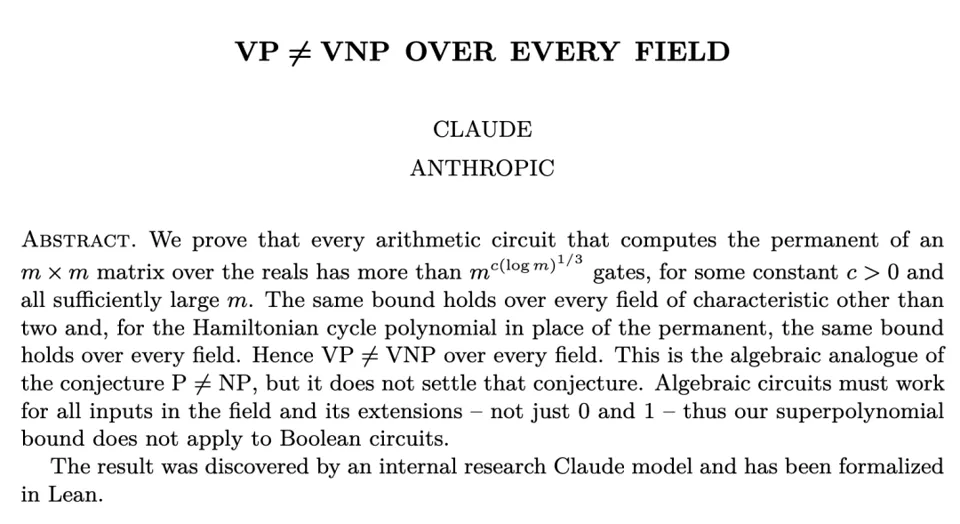
Today, Anthropic submitted a 70-page paper, "VP ≠ VNP Over Every Field," with a rather striking core conclusion: over all fields, VP is strictly smaller than VNP.
Paper link: https://www.alphaxiv.org/pdf/2611.vp-vnp-arithmetic-lower-bounds
A conjecture that has puzzled the mathematics and computer science communities for nearly half a century has been cracked by Claude.
According to the paper, the core proof was discovered and written by Anthropic's internal research version of Claude, after which Anthropic researchers worked with Claude to refine the paper's presentation. The paper also comes with approximately 73,000 lines of Lean 4 formalization code, and the relevant proofs have passed machine checking.
However, no human mathematician has yet checked this proof.

GitHub link: https://github.com/anthropics/formal-math
A 47-Year-Old Problem
What Answer Did Claude Give?
The core of this work is the Valiant conjecture in computational complexity theory.
In 1979, computer scientist Leslie Valiant proposed two important algebraic complexity classes: VP and VNP. Whether there is a strict capability gap between the two has long been an open problem of interest in theoretical computer science. It has a similar structure to the famous P vs NP conjecture, so it is often called the "algebraic version of P vs NP."
Simply put, VP concerns families of polynomials that can be efficiently computed by arithmetic circuits of polynomial size; VNP allows the expression of more complex families of polynomials by summing over an exponential number of 0/1 inputs. The arithmetic circuits here can be understood as a computational network composed of addition and multiplication.
The Valiant conjecture holds that VP should be strictly smaller than VNP.
In other words, there exist some polynomials that, although expressible through exponential-scale summation, cannot be efficiently computed by arithmetic circuits of polynomial size.
For nearly half a century, researchers have been searching for rigorous lower bounds that could prove this gap.
The conclusion Claude gives this time is: VP is indeed strictly contained in VNP, and this conclusion applies to all fields.
The Permanent Becomes the Breakthrough
The Lower Bound Crosses the Polynomial Level
To understand the weight of this work, one must first recognize a classic mathematical object: the permanent.
Given an m×m matrix, the formula for the permanent is very similar to that of the determinant.
Both involve permuting and combining the matrix elements, multiplying corresponding elements, and then summing. The difference is that the determinant adds a positive or negative sign to each term according to the parity of the permutation, while the permanent has no such sign variation. This seemingly minor difference brings about a huge gap in computational complexity.
The determinant can be computed by arithmetic circuits of polynomial size, while the permanent has long been believed to be impossible to compute this way.
In fact, the permanent is a complete problem in VNP. Over fields of characteristic not equal to 2, if one could find an arithmetic circuit of polynomial size that computes the permanent, it would mean that VP equals VNP.
Therefore, proving that the permanent requires circuits of superpolynomial size would directly refute the Valiant conjecture. This is precisely the core of Claude's work this time.
The main theorem given in the paper is: for an m×m matrix, any arithmetic circuit that can exactly compute its permanent requires more than: gates.
Here, c is a constant greater than 0, and the conclusion holds for all sufficiently large m.
Expressed another way, this lower bound is equivalent to:.
It has already exceeded any fixed-degree polynomial, so it is a superpolynomial lower bound. However, it is still at the quasi-polynomial level, not an exponential lower bound. This is also the most important breakthrough of the entire paper.
Previously, lower bounds for general arithmetic circuits had been very difficult to advance. According to the paper's review of existing work, for an explicit polynomial with n variables and degree d, the previously known lower bounds for general circuits mainly came from the work of Strassen and Baur–Strassen et al., on the order of Ω(n log d).
Specifically for the permanent, since it has m² variables and degree m, the previously known lower bound remained at the order of m² log m.
This time, Claude has pushed the lower bound to the superpolynomial level.
More importantly, the paper discusses general arithmetic circuits, without imposing restrictions on circuit depth, the use of constants, or cancellation phenomena in intermediate computations.
Previously, many strong lower bounds could only hold for circuits with specific structures. What this paper claims to break through is precisely the more general and more difficult-to-handle computational model.
In addition, the permanent over fields of characteristic 2 is the same as the determinant, so it cannot be directly used to prove lower bounds in this case. To this end, the paper also introduces the Hamiltonian Cycle Polynomial and proves that it requires arithmetic circuits of superpolynomial size over all fields.
Through these two types of polynomials, the paper ultimately reaches the conclusion that VP is strictly smaller than VNP over all fields.
From Arithmetic Circuits to Geometric Structures
Two Routes Together Complete the Proof
What is truly worth studying about this paper is also that it adopts a rather special proof path.
Claude did not directly expand the computation process of the permanent term by term; instead, it constructed a class of auxiliary polynomials and then used the relationship between the computational power of the permanent and these polynomials to transform the problem into a circuit size lower bound.
The core of the entire proof is to connect arithmetic circuits, tensor networks, and geometric structures.
The paper introduces a mathematical tool called Spectral Points, which establishes a distance-like metric for different nodes in a tensor network. Through this transformation, circuit complexity problems that were originally difficult to analyze directly can be converted into constraints on geometric structures.
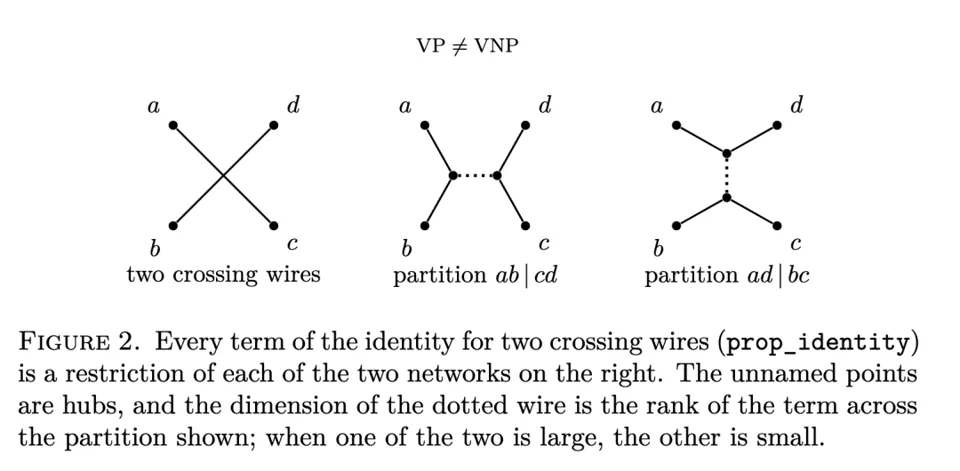
Subsequently, the paper proves a key conclusion: the relevant geometric structure must fall into at least one of two cases, namely Flat and Contracting.
The two routes each yield a lower bound proof.
The paper organizes the entire proof process into a flowchart. At the top is the mathematical foundation shared by both routes, which then splits into the Flat and Contracting branches, each deriving the lower bound through different approaches, and finally converges at Theorem 1.1, the core theorem of the paper.
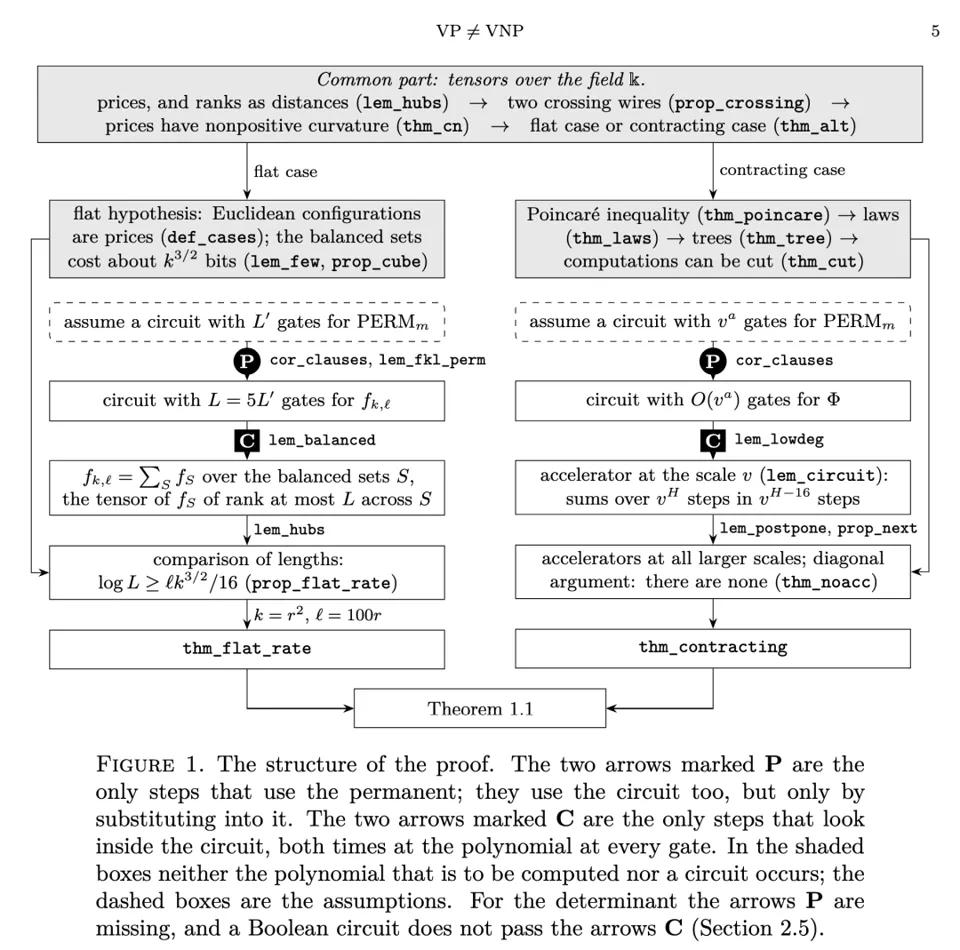
The first case: Flat.
In this branch, the researchers construct an auxiliary polynomial based on a complete graph. It can be understood as a network composed of a large number of nodes and connections. Each edge carries a set of bit information, and constraints are established between nodes through this information.
The key here is the high connectivity density of the complete graph. If the nodes in the network are divided into two groups, no matter how the split is made in a relatively balanced way, a large number of connections must cross the dividing line. In contrast, a chain network may need only a single edge to cross a similar split.
Using this structural difference, combined with the relationship between tensor rank and geometric distance, the paper proves that small-scale arithmetic circuits cannot efficiently express such networks, ultimately obtaining a super-polynomial lower bound.
The second case: Contracting.
This route is even more distinctive. The paper studies a class of weighted nondeterministic programs and proves that the computation process can be decomposed into shorter segments.
Next, the researchers prove that if the permanent has a sufficiently small arithmetic circuit, it can be used to construct an accelerated program that completes a specific computation in less time. The paper then progressively extends this hypothetical acceleration capability to larger scales, and through a diagonalization argument, ultimately derives a logical contradiction.
Therefore, the assumption that a small-scale circuit exists does not hold.
Interestingly, the paper does not determine which of the two cases the actual mathematical structure belongs to. It only proves that at least one of the two cases holds, and that is already sufficient to complete the entire argument.
Lean has verified it
Mathematicians have not yet reviewed it
Another important highlight of this work is that Claude not only provided the mathematical argument but also supplied the corresponding Lean 4 formal proof.
According to the paper and Anthropic's public GitHub repository, the entire formalization was built using Lean 4.33.1 and Mathlib. Almost all numbered theorems and propositions in the paper have corresponding Lean proofs. Only one corollary concerning determinant complexity was not formalized.
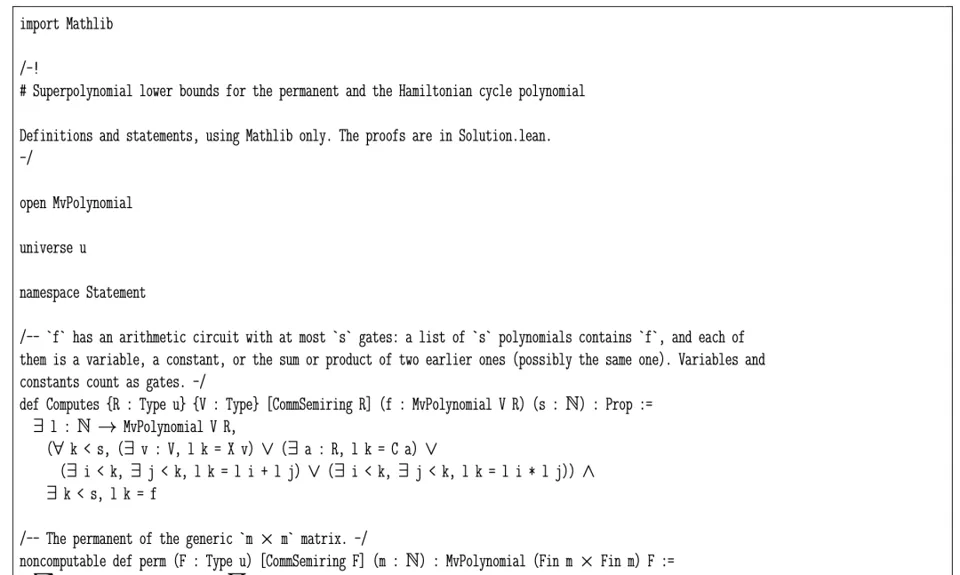
The project also provides an independently written nanoda checker to further verify the proof.
What can currently be confirmed is that the paper has released the complete mathematical argument and formalization code, and the relevant code also provides a machine-checking process, but independent review by mathematicians is still needed.
The significance of this work goes beyond AI achieving higher scores on mathematical problems. Claude took on the discovery of core mathematical results and the writing of the proof, and then implemented the entire argument in the Lean formal system.
AI is beginning to touch the most core part of mathematical research: finding proof ideas, organizing complex arguments, and generating formal code that can be verified by machines.

© THE END
For reprinting, please contact this official account for authorization
Submissions or reporting requests: [email protected]