Alibaba Releases Qwen4-Max with 2.4 Trillion Parameters
Alibaba's Qwen team launched Qwen4-Max, built on a new Qwen4 architecture with 2.4 trillion backbone parameters, 71B activated per token, plus 328B N-gram embedding parameters, native vision and a one-million-token context window. The company claims broad gains over Qwen3.8-Max on coding, office and long-horizon tasks while cutting token consumption by roughly 24%-49% and slashing API pricing, with average Work360 task cost down 58%.
Full Report
Contents22 sections
We are officially releasing Qwen4-Max—a new all-day AI colleague that works, creates, and explores alongside you. Qwen4-Max is built on the brand-new architecture of the Qwen4 series, with 2.4 trillion backbone parameters, native vision capabilities, and support for a million-token context window.
Qwen4-Max drives real-world productivity gains through stronger professional tool use, long-horizon task execution, and deliverable-producing capabilities. From the depth of professional work to the breadth of boundless creativity, from 3D modeling and game development to complex and precise industrial manufacturing, from finance, law, and healthcare to frontier scientific exploration—in collaboration with you, Qwen4-Max can understand the full picture of the work and keep projects moving forward, giving every goal a path to reality and unlocking new possibilities for humans and AI working together.
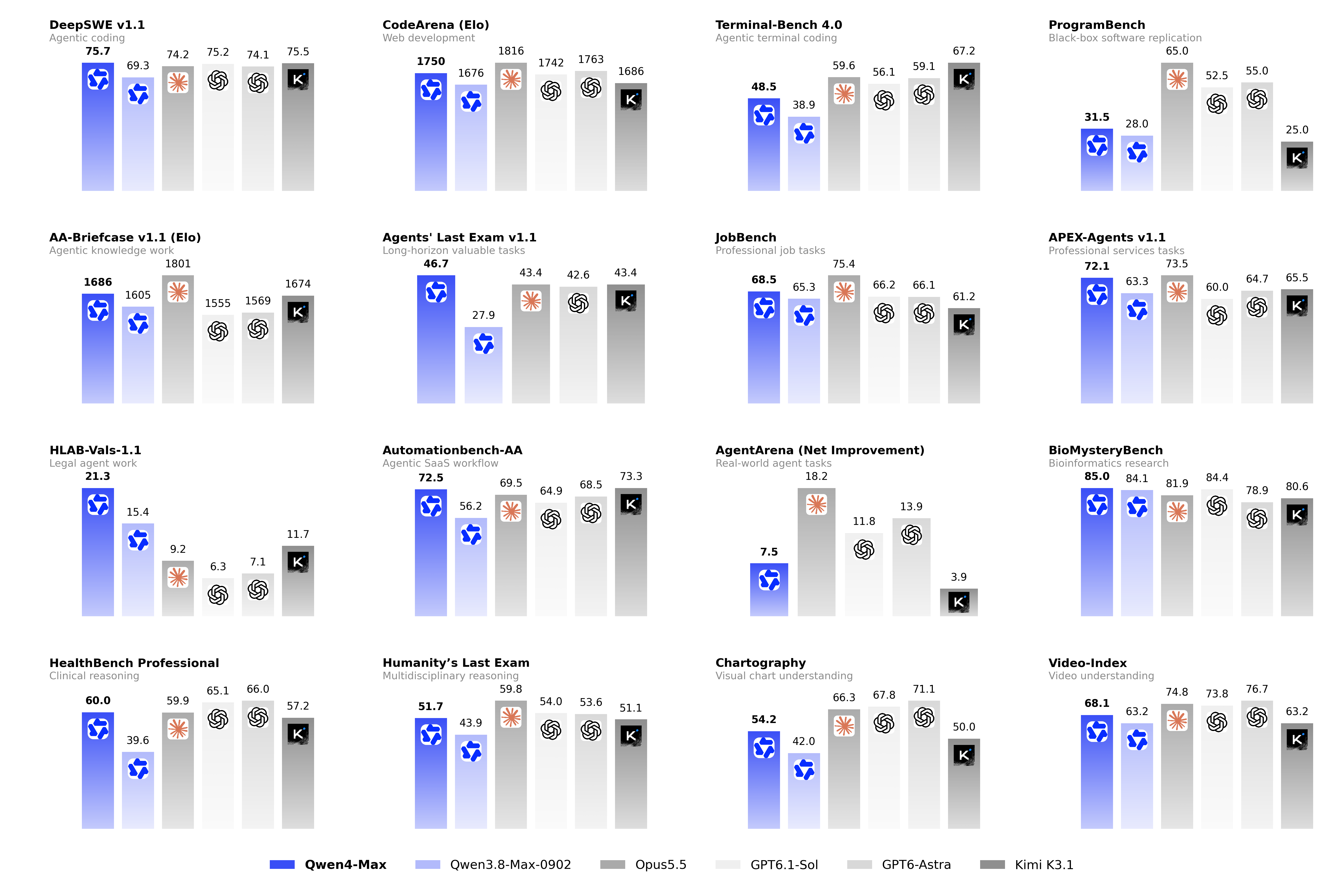
Comprehensive performance comparison across coding, office work, and long-horizon tasks. Compared with Qwen3.8-Max, Qwen4-Max shows significant overall capability improvements. For details, see the evaluation notes.
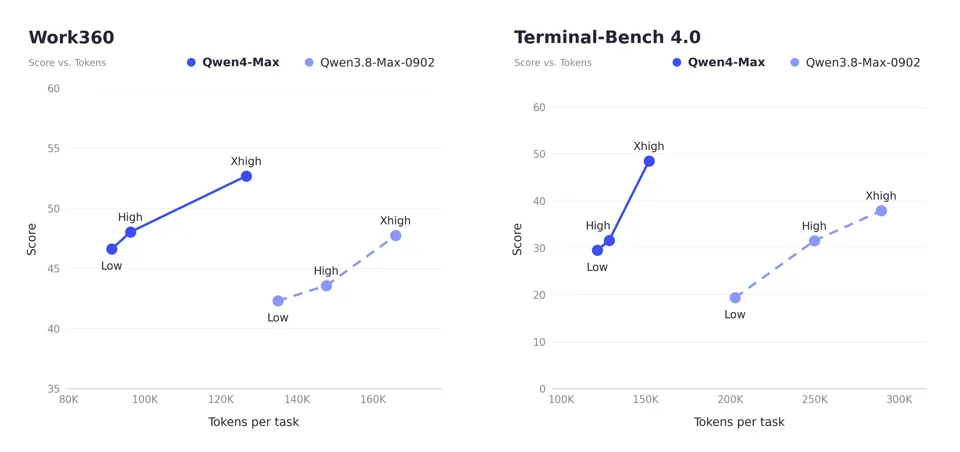
Token Efficiency and Cost. Qwen4-Max achieves better performance than Qwen3.8-Max with lower token consumption: on Work360, token consumption at the Xhigh and High reasoning-effort levels is reduced by about 24% and 35%, respectively; on Terminal-Bench 4.0, it is reduced by about 48% and 49%, respectively. At the same time, compared with Qwen3.8-Max, we have lowered API pricing across the board, especially the cache-hit price. In our Work360 evaluation, the average cost per task dropped from 26.58 yuan to 11.16 yuan, a reduction of 58%.
Pretraining#
Qwen4-Max adopts the brand-new architecture of the Qwen4 series, with 2.4T backbone parameters, 71B activated parameters per token, and an additional 328B N-gram Embedding parameters. This architecture systematically upgrades the sparse MoE model across three aspects—Attention, Residual, and Embedding—optimizing computational efficiency, model capacity, and training stability:
- GDN + Qwen Sparse Attention (QSA): In every four layers, three Gated DeltaNet layers compress historical information into a fixed-size state, while the other layer, QSA, uses a lightweight Indexer to select relevant context at block granularity, reducing the Attention computation and indexing overhead for long sequences.
- Gated Residual (GR): Expands the Residual Stream into four parallel branches and enhances cross-layer information transfer through dynamic read/write gating, improving training stability.
- N-gram Embedding: Looks up local context in a table to provide representations of local token patterns at the second layer, expanding model capacity with low additional computational overhead.
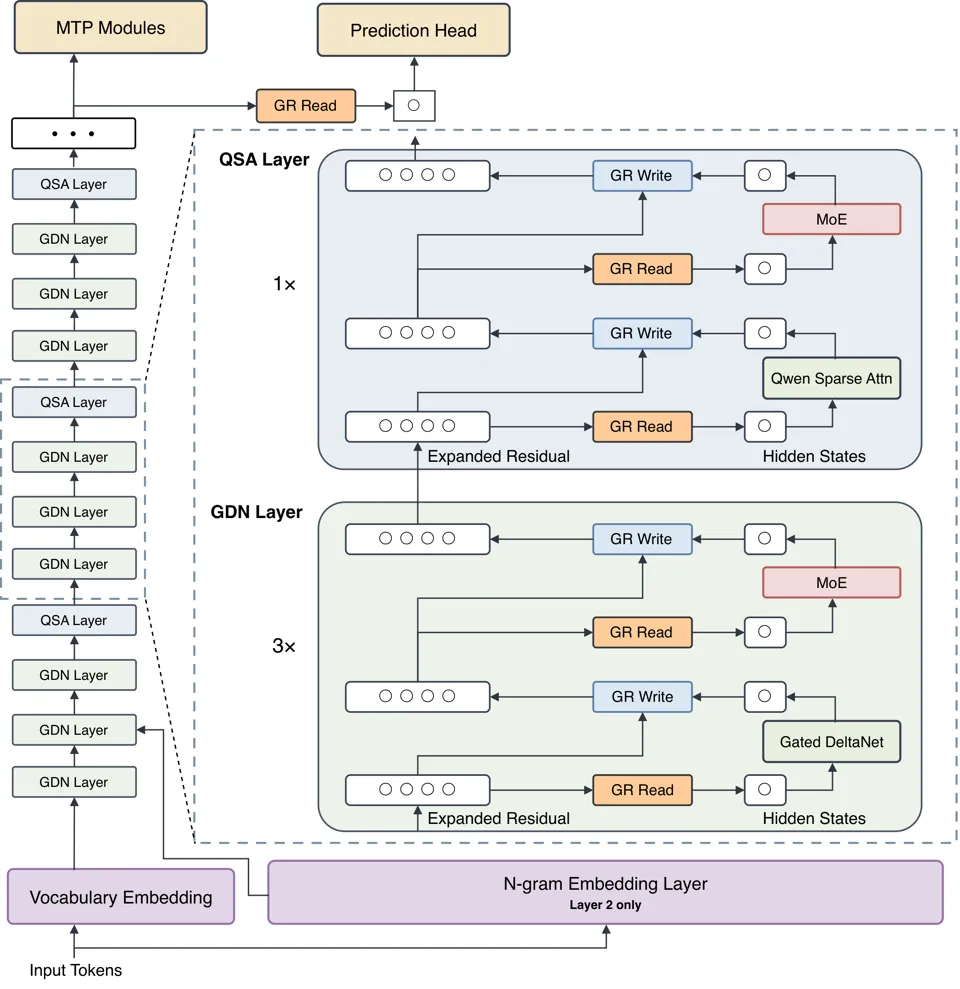
Qwen4-Max model architecture.
At the 2.4T parameter scale, Qwen4-Max's pretraining process was stable, with loss continuously decreasing, and no loss spikes occurred throughout. This is mainly thanks to improvements in model architecture and training optimization.
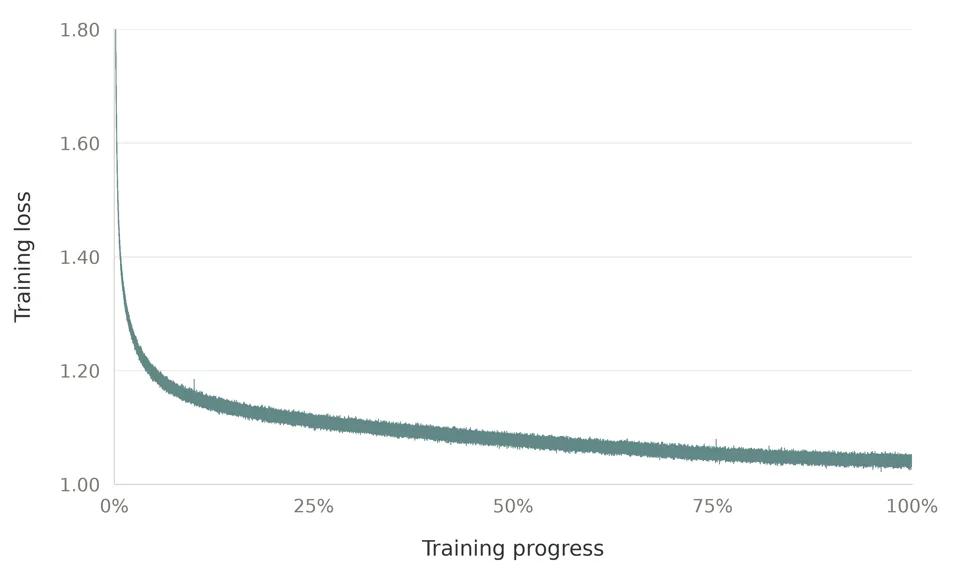
Qwen4-Max's stable pretraining process.
In four categories of internal evaluations—knowledge, code, question answering, and STEM—Qwen4-Max-Base achieved the lowest BPB (bits per byte) among all five evaluated models. Compared with Qwen3.8-Max-Base, its BPB in each domain decreased by about 5–13%, while activated parameters per token decreased by about 25%.
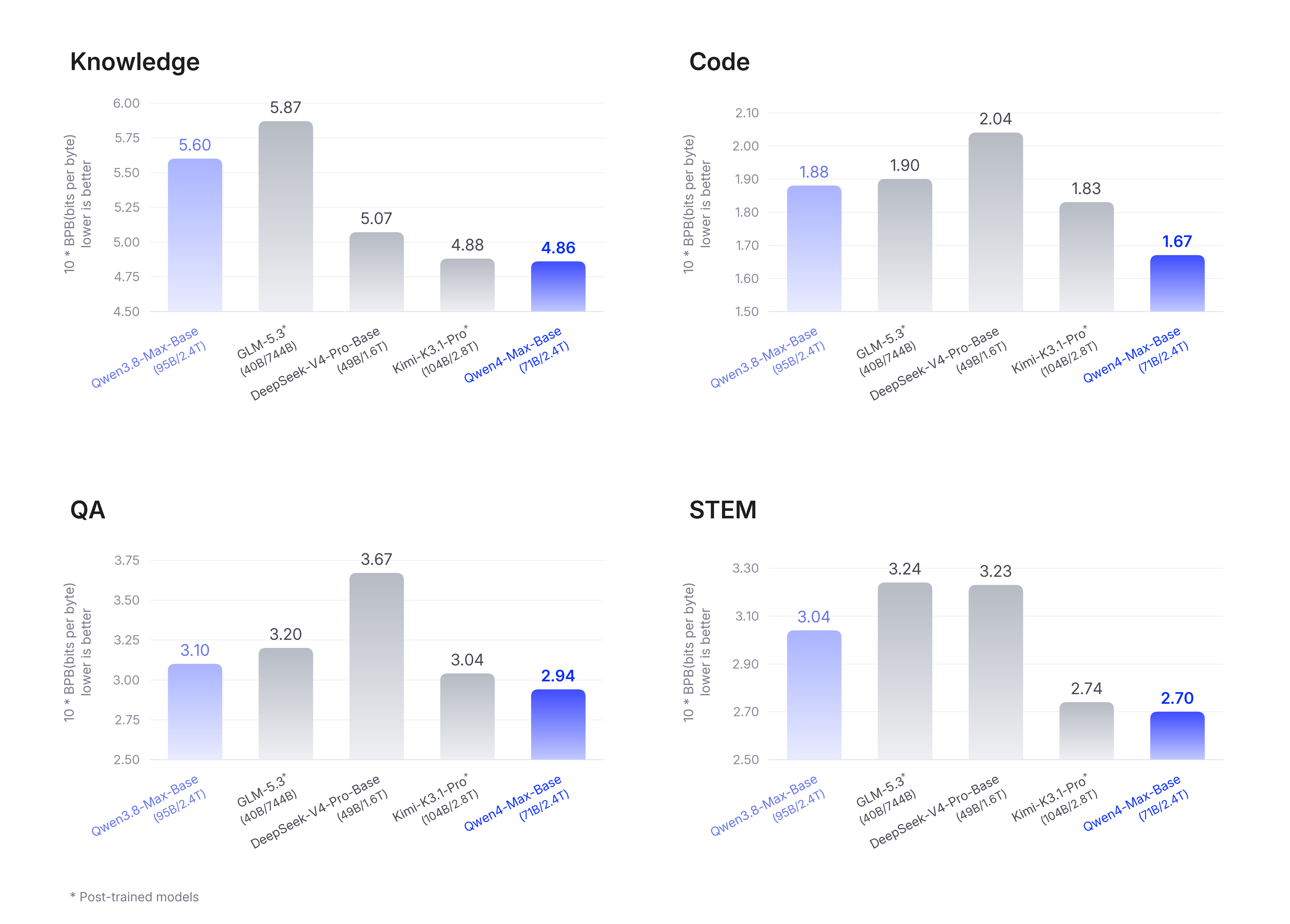
Internal evaluation: the metric is 10 × BPB, lower is better. GLM-5.3 and Kimi-K3.1-Pro are post-trained models; post-training may affect their comparison with base models.
Driving Real Productivity#
Qwen4-Max is deeply integrated into complex workflows across thousands of industries, driving high-quality deliverable production with stronger professional capabilities and becoming a new AI colleague that drives real productivity.
Industry and Professional Applications#
To comprehensively enhance the model's collaborative capabilities in industrial and professional scenarios, we built the Work360 comprehensive scenario modeling framework. This framework systematically deconstructs and finely classifies complex industry scenarios, establishing a hierarchical classification system covering 26 primary domains, 182 secondary sub-domains, and 721 tertiary fine-grained domains, achieving comprehensive coverage of industrial and professional scenarios. Based on this classification system, we constructed the highly challenging Work360 industry benchmark. In the latest evaluation, Qwen4-Max (52.69 points) achieved significant progress compared to the previous-generation model Qwen3.8-Max (47.74 points), becoming a more powerful professional productivity tool across a broader range of industry scenarios.
3D World Understanding and Generation#
Blender: 3D Modeling and Scene Creation#
Qwen4-Max demonstrates strong 3D creation capabilities. It can skillfully use the Blender tool, chaining together geometric modeling, scene construction, material configuration, and lighting rendering to gradually transform ideas into richly detailed, distinctive 3D works. From architecture and interior spaces to natural landscapes and sci-fi scenes, Qwen4-Max demonstrates a comprehensive grasp of spatial layout, object structure, and visual effects. This 3D creation capability is further applied to game development scenarios and, through 3D printing, becomes physical works, connecting digital creation with subsequent development and production workflows, providing support for design exploration, content creation, and prototyping.
Game Development: Game Creation Based on Professional Engines#
Qwen4-Max can skillfully work with mainstream game engines such as Unity, Unreal Engine, and Godot. With only simple natural language requirements, it can reasonably utilize external assets and independently complete scene construction, gameplay logic development, asset integration, material configuration, HUD design, and special effects production, delivering a game that is playable right away. During development, it actually runs the game and adjusts various details based on visual and interaction feedback—camera following, character actions, hit effects and impact feel, lighting and rhythm coordination—integrating scenes, gameplay, and audiovisual effects into a directly runnable and playable 3D game through continuous runtime testing and iteration.
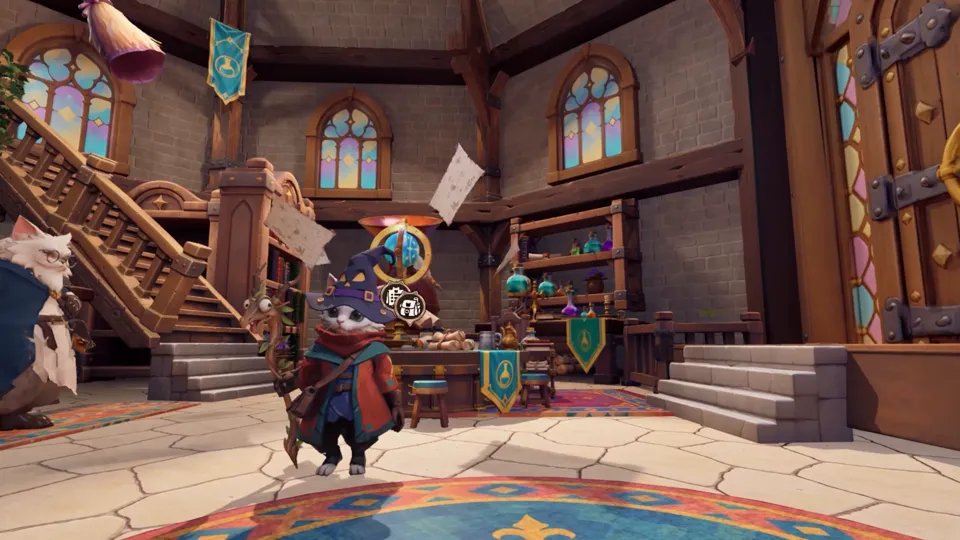


Meow Magic Follows
Qwen4-Max creates a cat mage adventure game in Unreal Engine. Players can cast multiple spells, choose ability upgrades, and challenge wave after wave of enemies and bosses.
Cloud Pass Journey
Qwen4-Max creates a cloud-sea xianxia adventure in Unreal Engine. Players can fly on swords, continuously pass through rings, and explore scenes and challenge bosses.
Flying Racing Car
Qwen4-Max uses Unity 6 to create a West Lake-themed racing mobile game. The game supports drifting, nitro acceleration, and wing-spread flight, and delivers an installable Android version.
Automotive Manufacturing: From Production Line Planning to Part Design and Machining Efficiency Improvement#
In the actual production scenarios of Sanfeng Intelligent Equipment and Tonglian Precision, Qwen4-Max integrates capabilities such as drawing understanding, parametric modeling, and professional tool invocation into engineering workflows, supporting tasks in automotive manufacturing such as production line planning, part design, and machining verification. It connects design generation, tool execution, and feedback verification, demonstrating application capabilities across the entire automotive manufacturing chain and delivering quantifiable efficiency improvements.
At the production line level, Qwen4-Max uses 2D layout drawings and process parameters to invoke existing equipment libraries to build 3D production lines, and conducts cycle time simulation and PLC virtual commissioning; at the part level, it completes the modeling and design of components such as door assemblies and friction wheels, and assists in machining process planning, toolpath generation, and simulation verification. Qwen4-Max iterates machining plans based on simulation feedback, identifying issues such as over-cutting and under-cutting before actual machining. In the machining cases presented, the manual effort required for machining programming of a single workpiece was reduced from approximately 475 minutes to 24 minutes, a reduction of about 95%.
Agentic Video Creation#
With Qwen4 and Wanjing Yike, you can build an end-to-end video creation workflow—from refining storyboard scripts and building static assets to driving camera animation in white-model previews, rendering and generating individual clips, and finally editing them into a coherent multi-scene film.
Qwen4's powerful language, multimodal, and agentic capabilities bring knowledge injection, controllability, and stability to complex video creation. Knowledge is injected into the generative model in the form of text or reference-image prompts, enabling the generation to better reflect the creator's knowledge and logic. Parametric white-model previews ensure consistency in geometric structure, proportional scale, and spatial relationships across complex static assets, and also allow precise control over camera paths in dynamic camera movement, as well as the timing of actions and events on the timeline. The natural-language interface for human-computer interaction and the controllability of previews make the final output more stable and interpretable. We look forward to seeing you create more exciting content with Qwen4.
Practical Applications in Finance, Law, and Healthcare#
In specialized vertical domains, Qwen4 goes deep into three high-barrier scenarios—financial investment research, legal due diligence, and clinical healthcare—where it can not only process voluminous and complex raw materials, but also perform in-depth logical reasoning and evidence-chain tracing, truly achieving the leap from "information retrieval" to "professional delivery."
Financial Investment Research: Qwen4 can proficiently invoke 90 MCP tools to comprehensively obtain market quotes, financials, interest rates, and dividend data across A-shares, Hong Kong and US equities, bonds, funds, and derivatives markets, and combine search to cross-verify public information. Faced with complex investment research needs, it can track industry supply-demand and order changes, assess macroeconomic interest rates and credit spreads, compare the relative value of stocks versus bonds, and conduct multi-factor backtesting to evaluate style exposure.
The following case uses CSI 300 index derivatives as an example, demonstrating how the model comprehensively calculates the theoretical basis from funding costs, dividend yields, and contract maturities, analyzes the actual discount, and examines the difference between implied and historical volatility. Ultimately, the investment research output is delivered in the form of Excel workpapers and an editable PPT report, with dual traceability guarantees: first, sources are verifiable—clicking a cell link takes you directly to the original data source; second, charts are cross-referenceable—the PPT charts align completely with the Excel workpapers, allowing researchers to trace back from the report to the workpapers at any time and precisely verify values and calculation formulas.
Corporate IPO Legal Due Diligence: Qwen4-Max demonstrates outstanding capability in handling long-horizon, complex legal practice. Faced with 198 scattered workpapers provided by the client in batches with inconsistent formats and naming, the model can effectively filter out noise, rename and categorize them by substantive content into 14 directories, and automatically compile a workpaper file inventory; at the same time, it proactively retrieves public information such as business registration, intellectual property, judicial, and credit records, and performs multi-source cross-verification against the workpapers to verify facts about the issuer. In core risk control, the model can dig deep into agreement details and analyze legal risks (for example, precisely identifying potential hazards such as "VAM agreement restoration clauses"), and then provide actionable remediation recommendations. Ultimately, it delivers a complete due diligence report of 86 pages and over 60,000 words according to rigorous practice standards, comprehensively covering 12 modules including historical evolution and equity structure, as well as 14 specific legal issues, with all conclusions accompanied by workpaper citations for traceability—greatly improving due diligence efficiency while powerfully supporting lawyers in focusing their energy on core risk judgment.
Critical Care Clinical Medicine: In critical care clinical scenarios, patients often have multiple comorbidities and rapidly changing conditions, accompanied by high-frequency examinations and laboratory tests, generating enormous and highly heterogeneous medical data—including dozens of lab reports, tens of thousands of words of progress notes, multiple sets of medical orders, and 1,433 raw images. The patient in the video experienced ventricular fibrillation and resuscitation after carotid artery stenting, developed chest pain after extubation, and was reintubated on the sixth day. Qwen4 read through the entire complex medical record in a single conversation and completed a closed loop from information extraction to assisted decision-making: checking indicators (precisely locating specific CRP results across dates), organizing the clinical course (aligning complex events within six days into a clear timeline), reading images (classifying images into six sequence categories, locating the target chest CT, reading hundreds of raw images in parallel through multiple windows, and accurately identifying "bilateral dorsal lung consolidation," fully consistent with the attending physician's diagnosis), and making decisions (weighing multimodal information to provide four management recommendations, corresponding one by one to the physician's orders of that day). Through deep medical collaboration, the model can efficiently integrate multi-source evidence and provide solid and reliable support for frontline clinical decision-making.
Powering Long-Horizon Agents (24/7 Agents)#
Qwen4-Max supports agents in advancing long-horizon tasks around the clock, delivering usable results in stages through autonomous planning and continuous iteration, balancing autonomous execution with user control.
Continuous Delivery: Deliver While Working, Full Control Over Direction#
Long-horizon agents often work heads-down without stage-by-stage feedback, making it difficult for users to track progress in real time, spot deviations, and adjust direction. To address this, Qwen4-Max incorporates Live Delivery capabilities: it first delivers a usable initial version, then continuously delivers updated versions, expanding content and improving quality with each version. Users can evaluate progress and calibrate direction based on each delivered version, and the Agent can dynamically adjust its plan based on user feedback, making the delivery progress of long-horizon tasks visible and the execution direction controllable.
We are also open-sourcing the Qwen-Live-Delivery-Plugin. Install the plugin to experience continuous delivery capabilities.
Cloud Resource Scheduling: Improving Resource Efficiency for the Model's Own Applications, Inference, and Training#
Qwen4-Max possesses the ability to perform operations research modeling, solving, and verification around complex objectives and constraints, thereby delivering high-quality optimization decision solutions. This capability has been deployed in real business scenarios at Alibaba Cloud, achieving a closed loop in which the model autonomously iterates and optimizes the scheduling solutions it itself requires, covering multi-model invocation scheduling in data annotation, online allocation scheduling of cloud computing GPU resources, and offline rescheduling of cloud computing CPU resources.
In this process, the model autonomously generates candidate algorithms according to the task setup, collaborates with Alibaba's self-developed solver MindOpt to evaluate feasibility, objective value, and time consumption and obtain feedback, and then iterates toward better strategies through code modification and cross-validation. From upper-layer model invocation down to underlying cloud resource scheduling, Qwen4-Max continuously evolves based on quantifiable feedback, directly optimizing the runtime systems that support its own applications, inference, and training. The resulting cost reductions and resource efficiency gains in turn provide a more solid compute foundation for the next round of model iteration. In the corresponding scenarios, the model invocation scheduling cost in the data annotation scenario decreased by an average of 10.42% relative to the reference baseline, the GPU online allocation scenario improved the total idle machine capacity duration by 4.62% relative to the baseline, and in the CPU offline rescheduling scenario, the solving speed to reach the optimal objective improved by more than 14.61x.
Driving Scientific Discovery#
Closed Loop of Dry and Wet Experiments: Qwen4 Autonomously Designs and Synthesizes a Novel Coolant Material#
Facing the heat dissipation challenges that next-generation high-power chips bring to data centers, Qwen4, leveraging the integrated dry and wet experiment environment provided by DP Technology's Mira, autonomously completed the design, physical synthesis, and test validation of a novel coolant molecule, ultimately obtaining a real material sample.
During 48 consecutive hours of autonomous Agent operation, Qwen4 fully automatically completed route investigation, constructed a candidate space containing 2.7 million molecules, and sequentially carried out structure screening, MPA property prediction, first-principles calculations, retrosynthesis design, and experiment planning. Qwen4 further dispatched an automated wet lab to complete the preparation, synthesis, separation and purification, and testing of real materials, transforming molecular structures on the screen into physical samples in the laboratory. After 4 rounds of closed-loop iteration of "molecular design - synthesis and testing - active learning", Qwen4 ultimately obtained a novel coolant molecule validated by experiments.
From using AI to explore materials to using materials to support AI infrastructure construction, this task explored a new material pathway for addressing the heat dissipation challenges of data centers, demonstrating Qwen4's long-horizon scientific discovery capability spanning the digital and physical worlds.
Drug Discovery: Exploring a New Path to Delay Cognitive Decline through Autonomous Scientific Research#
Alzheimer's disease gradually impairs patients' memory and cognitive abilities and also imposes a long-term care burden on families and society. Neuroinflammation is an important pathological component, and the NLRP3 inflammasome involved in this process provides an important research direction for exploring new intervention strategies. Around this target, Qwen4-Max demonstrated, on DP Technology's PharmMaster platform, full-chain capabilities spanning target research, molecular optimization design, and computational evaluation. It does not merely generate molecular structures; it also integrates literature and patent understanding, professional tool invocation, and computational feedback into a continuously iterating scientific research workflow.
In this process, Qwen4-Max autonomously retrieved literature and patent evidence, selected reference molecules and established evaluation baselines, and then, through multiple rounds of structure design, property prediction, and molecular docking, adjusted the optimization direction based on evaluation feedback, ultimately completing candidate selection through cross-round metric comparison and relative binding free energy (RBFE) evaluation. The entire process cumulatively invoked tools 454 times, completed 3,239 computational metric evaluations, and designed and optimized 24 candidate molecules, linking evidence retrieval, design generation, tool execution, and feedback validation into a complete chain.
Compared with the patent starting point, the ultimately selected molecule achieved comprehensive improvements across multiple core computational metrics; RBFE calculations estimate that its nominal binding affinity to the target reached approximately 3.6 times that of the starting point. Experts at DP Technology believe that this molecule has high research value and is worth further wet-lab validation. From a disease-related target to a high-potential candidate molecule, Qwen4-Max combined evidence-driven design, professional tool execution, and computational feedback, demonstrating its ability to autonomously advance long-horizon scientific research tasks, continuously optimize molecules, and produce valuable research outcomes.
"Model-Framework-Product" Co-Design#
During the development of Qwen4-Max, we worked closely with product teams such as Qoder to co-design the model, the agent runtime framework, and the product. Starting from users' real needs in everyday office work and professional design, we identified the problems the model needed to solve and evaluated overall performance by the delivery quality of end-to-end tasks. On this basis, we continuously improved task execution capabilities and optimized the user experience, helping users turn ideas into reality and deliver directly usable results.
Safety#
At Alibaba, we are guided by six AI development principles: people-first, inclusivity and integrity, privacy protection, safety and reliability, trustworthiness and controllability, and openness and shared governance. We embed model governance throughout the entire model lifecycle—from initial design and research to development, training, deployment, and real-world application—ensuring that responsible AI is natively built into the design rather than added afterward. In software engineering training tasks, we added code security detection on top of functional checks to strengthen the model's intrinsic secure coding capabilities. In Last Secure Code Bench's "secure code reconstruction without security hints" and "dual functional and vulnerability checks," Qwen4-Max's function-level dual pass rate for both functionality and security improved from 22.0% in the previous generation (Qwen3.8-Max) to 31.8%; the proportion of simultaneously generating secure code at the function, file, and repository levels rose from 8% to 14.7%, nearly doubling. The model performs particularly well in avoiding core risks such as injection, memory safety, and unauthorized access, significantly reducing vulnerabilities in default-generated code and helping developers shrink the system's attack surface at the source. In cybersecurity, we filter by the specific purpose of each task, retaining data used for defensive tasks such as vulnerability verification, detection, and remediation, and removing data used for offensive tasks such as enhancing attack capabilities. After internal security experts reviewed long-horizon task trajectories (including full CoT), they found that Qwen4-Max's cybersecurity defense capabilities improved substantially, and its protections against offensive use also strengthened significantly. No capability to cause large-scale cybersecurity risks has been found in the model. In CBRN, we designed safety data and improved Qwen4-Max's intrinsic safety during the safety post-training stage. In internal evaluations, Qwen4-Max identified more requests containing potential risks and provided safe responses without excessive refusals. After internal experts reviewed the model's responses (including full CoT), they found that the solutions proposed by the model were not truly innovative and could not complete tasks end-to-end. No risk has been found of the model being able to translate relevant knowledge into a significant enhancement of user capabilities.
Ethical Statement#
Qwen is intended for lawful and constructive uses and must not be used to cause harm. It must not be used to exploit or harm others (including children), to promote violence, hatred, discrimination, or abuse, or to develop and use dangerous CBRN weapons; nor may it be used to violate privacy, commit fraud or deception, spread disinformation, engage in cybersecurity abuse, or bypass safety protection mechanisms. Qwen is intended to assist people's work, not to replace professional judgment in high-impact scenarios. Where decisions may have serious consequences, human expertise and oversight remain essential. Users of Qwen should ensure that all input data is obtained and used lawfully and that authorization is obtained from the individuals associated with any images or videos used. Users must not infringe on individuals' rights to their images or videos or other personality rights, and must comply with applicable laws and regulations.
How to Use#
Qwen4-Max is now available on the Qianwen AI Platform. Developers can quickly integrate it via Token Plan or the API; see the platform documentation for details.
In addition, the model can also be used in Qianwen Office, Qoder CN, the Qianwen App, and Qwen Studio.
Summary#
Qwen4-Max is an always-on AI collaboration partner for work, creation, and exploration scenarios. It combines advanced reasoning, native vision, and long-horizon task execution capabilities to turn complex goals into usable deliverables and concrete research outputs. Powered by the Live Delivery mechanism and co-design across the model, agent runtime framework, and product layers, Qwen4-Max can continuously advance projects, dynamically adjust based on user feedback, and provide results that can be reviewed and further extended. Max is only the first model in the Qwen4 family; smaller models in the series will also be open-sourced in succession: the same technical approach, the same generation of training and alignment accumulation, with trade-offs made for the scenarios small models are truly good at. As a new-generation intelligent collaboration partner, Qwen4-Max is now ready to respond to users' collaboration needs at any time.
Evaluation Notes#
JobBench: Our scores are based on the updated dataset and evaluation code.
APEX-Agents v1.1: Scores cited from the Mercor Leaderboard.
AA-Briefcase v1.1 and AutomationBench-AA scores cited from Artificial Analysis.
CodeArena and AgentArena scores cited from Arena.
HLAB-Vals-1.1 scores cited from the Vals Index.
Agents' Last Exam v1.1 scores cited from Agents' Last Exam.
ChartoGraphy: Scores for Qwen4-Max and Qwen3.8-Max-0902 were measured with min_pixels set to 4096×32×32.
Citation#
@misc{qwen4,
    title = {Qwen4-Max: Your New Teammate Has Arrived},
    url = {https://qwen.ai/blog?id=qwen4-max},
    author = {{Qwen Team}},
    month = {Nov},
    year = {2026}
}