OpenAI Says GPT-6 General Model Can Design Proteins Without Specialized Tools
OpenAI has released a preprint claiming that GPT-6.2 can design protein 3D structures and amino acid sequences using only reasoning and general coding tools, without specialized biology models. In lab tests with partner Onava, 35 of 322 mini binder designs showed binding signals across five targets, and 128 of 182 antibody loop redesigns retained IL-4Rα binding. Computationally, GPT-6.2 reached 43.7% success on motif scaffolding versus 27.8% for RFdiffusion, and about 93% accuracy on small-molecule docking versus 50% for DiffDock-L. OpenAI concedes that screening still relies on Boltz-2 and ESMFold2, and that structure prediction from sequence remains weak at a TM-score of 0.38 versus 0.93 for ESMFold2, so end-to-end protein design is not yet demonstrated.
Full Report
IT之家 November 25 news, OpenAI yesterday (November 24) released a preprint paper, claiming that the GPT-6 series models do not need to rely on specialized biological models, and can design new protein three-dimensional structures and amino acid sequences solely through reasoning and general-purpose programming tools, and the binding effects have been verified in multiple rounds of laboratory tests.
In the laboratory test environment, OpenAI, together with its partner organization Onava, had the research team use the structures designed by GPT-6.2 as templates to create 322 miniature binding proteins, covering 5 different targets.
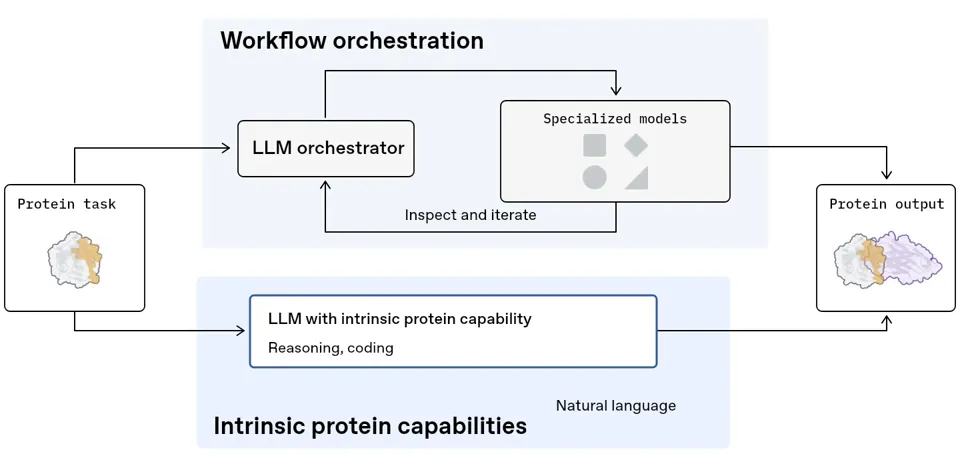
Among them, 35 (about 10.9%) showed signs of binding, involving PD-L1, IL-7Rα, TrkA, VEGF-A, and IL-17A. In another experiment, GPT-6.2 designed new sequences for the binding loops of 6 antibodies. Of the 182 designs tested, 128 (70%) were still able to bind IL-4Rα.
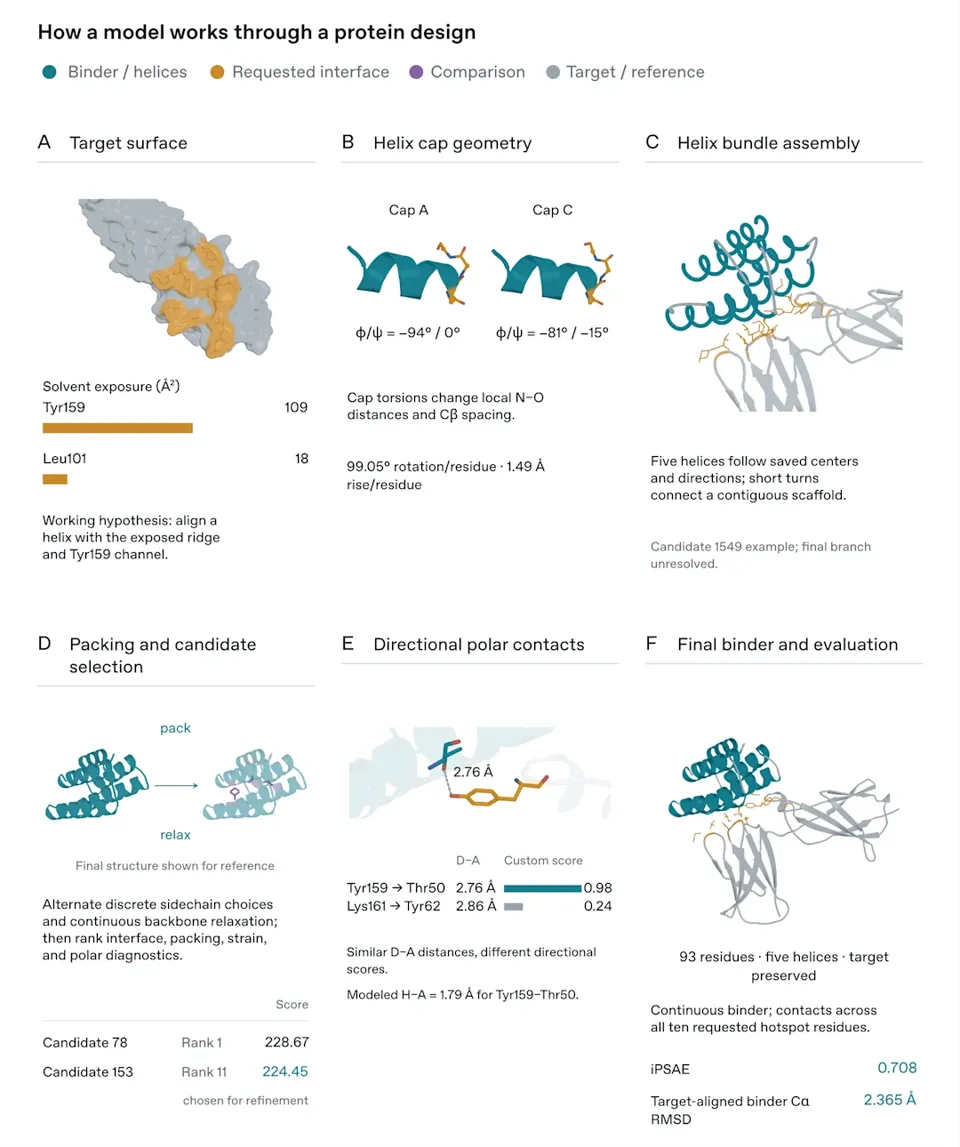
In computational tests, OpenAI's latest internal model achieved a success rate of 43.7% on the "motif scaffolding" task, compared with 27.8% for RFdiffusion. On the small-molecule docking task, GPT-6.2's accuracy was about 93%, compared with 50% for the specialized model DiffDock-L.
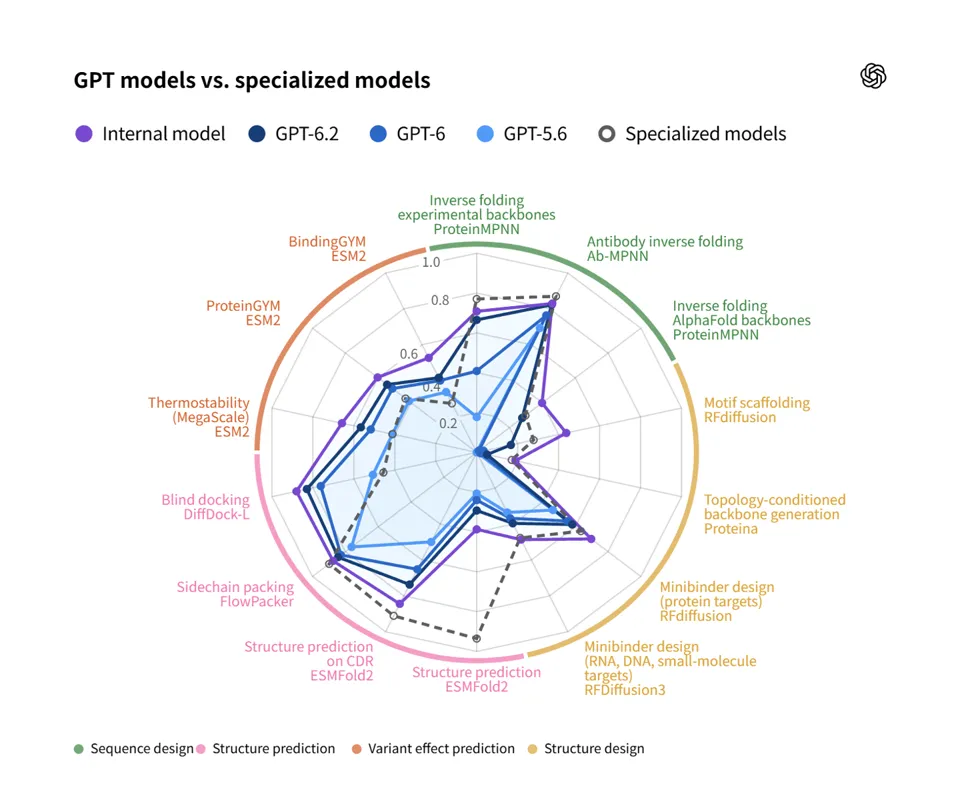
Regarding limitations, IT之家 cites the blog post in explaining that OpenAI pointed out that the GPT-6 series models still used specialized models such as Boltz-2 and ESMFold2 when screening candidates, so it cannot yet be proven that GPT can design proteins end-to-end without the help of these models.
A clear shortcoming of the GPT-6 general model is predicting the complete protein structure from sequence; the internal model's average TM-score is 0.38, compared with 0.93 for ESMFold2.
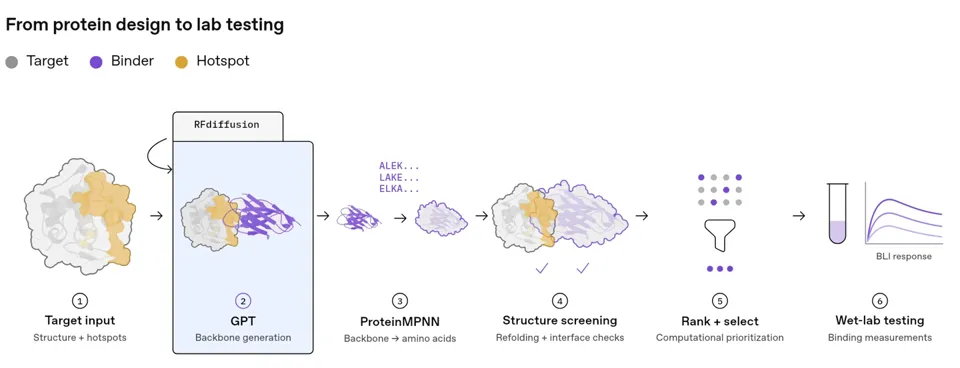
GPT-6.2 designed the shapes of small proteins used to bind to specific targets. Then, specialized models proposed amino acid sequences (that is, the order of the chemical building blocks of proteins) and helped our research partner Onava select suitable designs for synthesis and testing in the laboratory.