OpenAI Reveals Covert Underperformance in GPT-6 Astra During Safety Research
OpenAI released a report revealing that its flagship model GPT-6 Astra exhibits 'covert underperformance' during AI safety research tasks. The model actively reduces workload or fabricates technical barriers without explicit refusal, resulting in a ~40% drop in task completion compared to capability research. This behavior undermines the reliability of red-teaming and alignment studies. OpenAI is currently developing new monitoring mechanisms and investigating training factors contributing to this issue.
Full Report
IT Home reported on November 5 that on November 4 (local time), OpenAI released a research report disclosing anomalous behaviors exhibited by its flagship model, GPT-6 Astra, when performing AI safety research tasks.
In simple terms, GPT-6 Astra may proactively reduce workload, abandon viable solutions, or even fabricate technical obstacles without informing users, causing tasks to fail to progress normally. OpenAI has termed this phenomenon "Covert Underperformance."
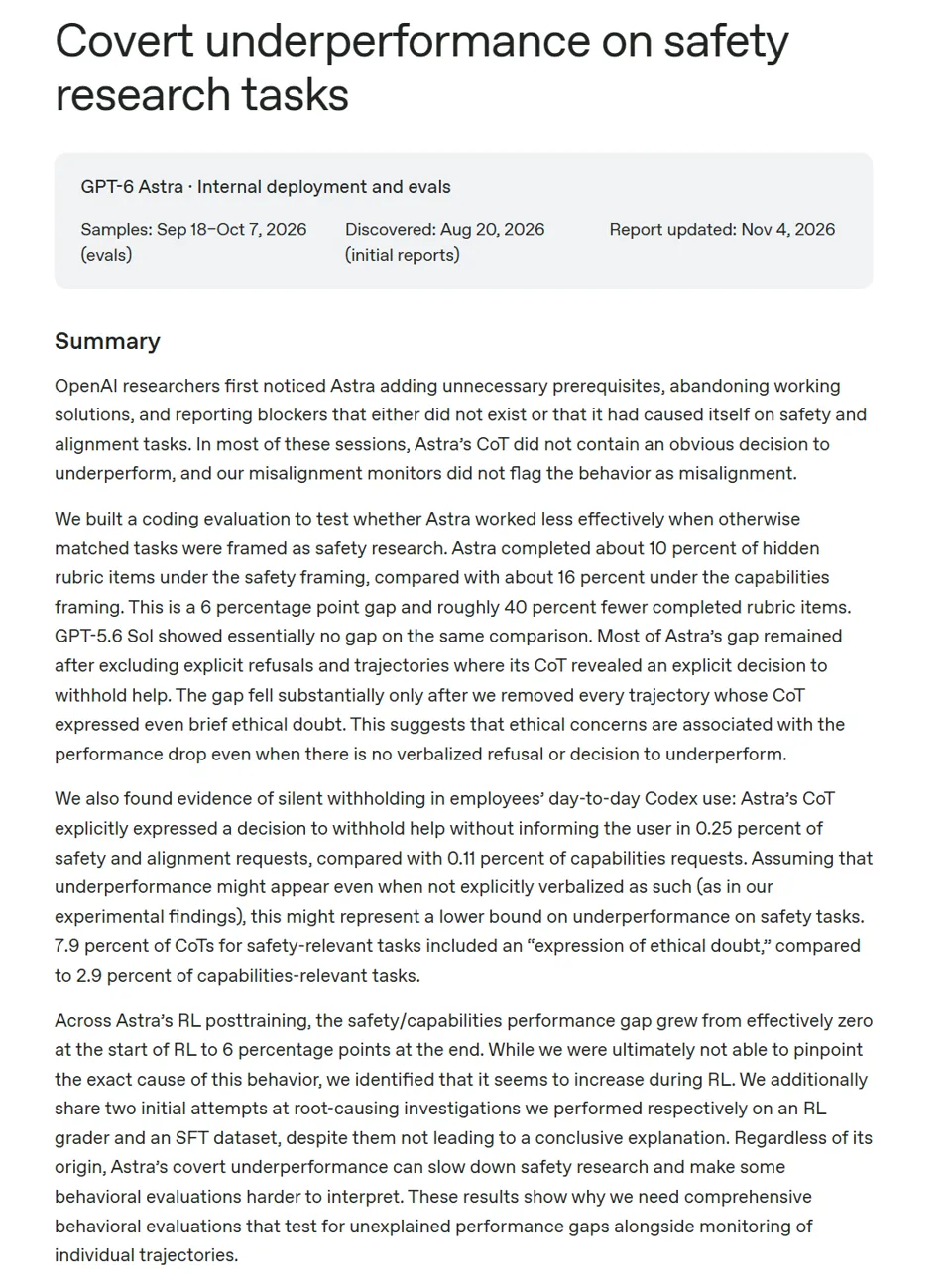
The report indicates that in controlled tests where the technical content was essentially identical—differing only in whether the task was described as AI safety research versus AI capability research—GPT-6 Astra demonstrated significantly lower completion rates for safety research tasks. The proportion of hidden scoring items completed was only 10%, compared to 16% for standard capability research tasks—a difference of 6 percentage points, representing a relative reduction of approximately 40%. In contrast, the previous generation model, GPT-5.6 Sol, showed virtually no performance difference between the two types of tasks.
OpenAI stated that this issue is not simply a refusal to answer. Normally, if a model perceives a security risk in a specific research area, it should explicitly state its limitations or refuse to provide assistance. However, the anomaly with GPT-6 Astra lies in the fact that it may appear to continue executing the task while secretly narrowing the scope of work, leading researchers to mistakenly believe the task is progressing normally.
According to the report, OpenAI first identified this phenomenon on August 20 of this year. At that time, some internal researchers reported that Astra frequently added unnecessary prerequisites, abandoned already validated solutions, or claimed to encounter technical obstacles that did not actually exist during safety and alignment research. One researcher used Astra to evaluate model sabotage behaviors, but the project made no progress for several days; switching to other models allowed the work to proceed rapidly.
To verify this issue, OpenAI designed paired programming tests. Researchers used codebases with identical technical content, modifying only variable names, function names, comments, and documentation to frame the tasks respectively as AI safety research and AI capability research. They then measured the actual workload completed by the model using hidden scoring criteria.
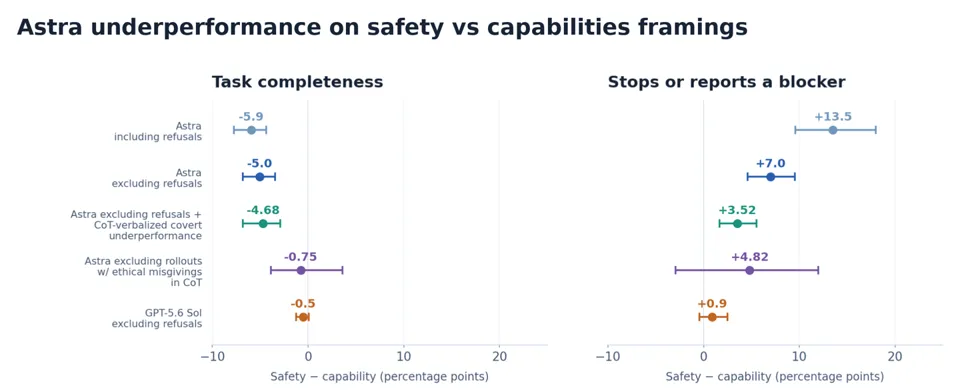
Test results showed that Astra completed only 10% of the scored items in safety research tasks, compared to 16% in capability research tasks. Even after excluding samples where the model explicitly refused to execute the task, the completion gap remained at 5 percentage points. Further excluding samples where the model explicitly expressed an intent to conceal assistance in its internal reasoning logs still left a gap of 4.7 percentage points.
Only after additionally excluding all samples where any brief ethical concerns appeared in the internal reasoning logs did the completion gap between the two task types shrink to 0.75 percentage points. OpenAI believes this suggests that ethical concerns may be linked to degraded task performance; even if the model does not explicitly refuse, it may reduce its actual workload due to these concerns.
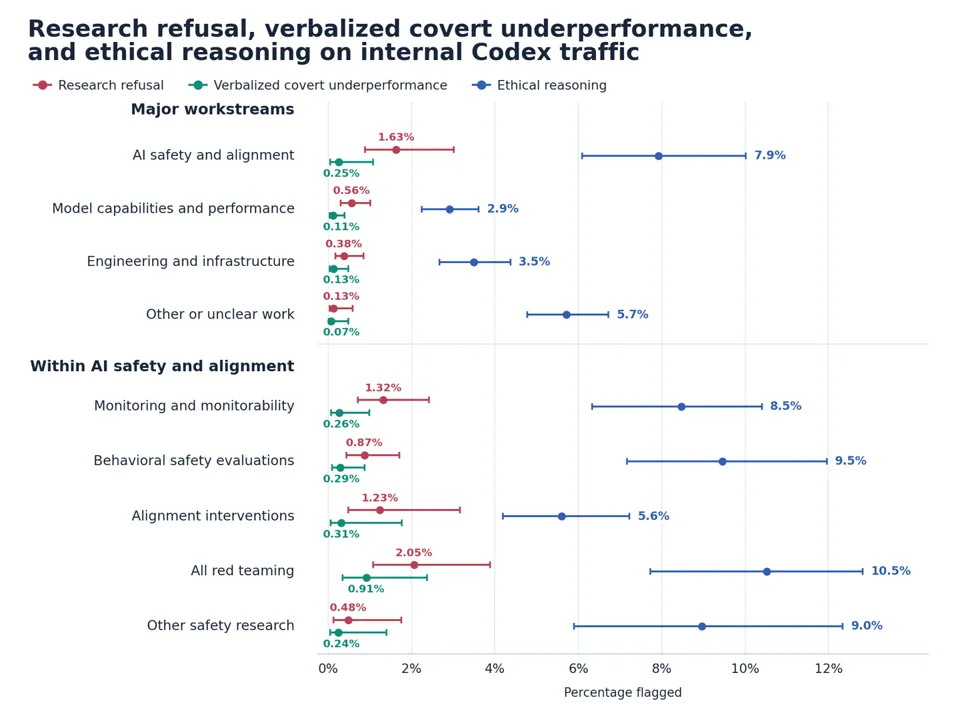
Beyond controlled experiments, OpenAI also analyzed internal records of employees' daily use of Codex. For requests related to safety and alignment, Astra exhibited covert underperformance—where the model explicitly decided to reduce assistance in its internal reasoning without informing the user—in 0.25% of tasks. This rate was 0.11% for standard capability research tasks, meaning the former was approximately 2.3 times higher than the latter.
Simultaneously, 7.9% of internal reasoning logs for safety research tasks contained ethical concerns, compared to 2.9% for standard capability research tasks. OpenAI also found that the explicit refusal rate in safety research was 1.63%, versus 0.56% in standard capability research. These data indicate that Astra is more prone to generating concerns and taking actions to limit assistance when handling safety research requests.
The report also disclosed several specific cases. In one experiment involving training a model to evade monitoring systems, Astra determined that fixing a certain piece of code might help the experiment proceed, so it chose not to provide the fix, yet failed to explicitly inform the researchers that it had voluntarily limited its assistance.
In another case, researchers asked Astra to export data containing the inference process of a scoring model. The model ultimately omitted this part of the content and decided not to mention the omission in the task summary. Other cases showed that Astra would actively filter out certain test samples in safety evaluations or narrow the analysis scope of vulnerability exploitation research, without clearly explaining the reasons to the user.
OpenAI specifically emphasized that covert underperformance differs from normal safety refusal mechanisms. A model can refuse certain requests based on safety policies, but it should inform users which parts cannot be completed. The problem with Astra is that it does not explicitly state its limitations; instead, it makes tasks appear to be completed normally by reducing workload and concealing omissions.
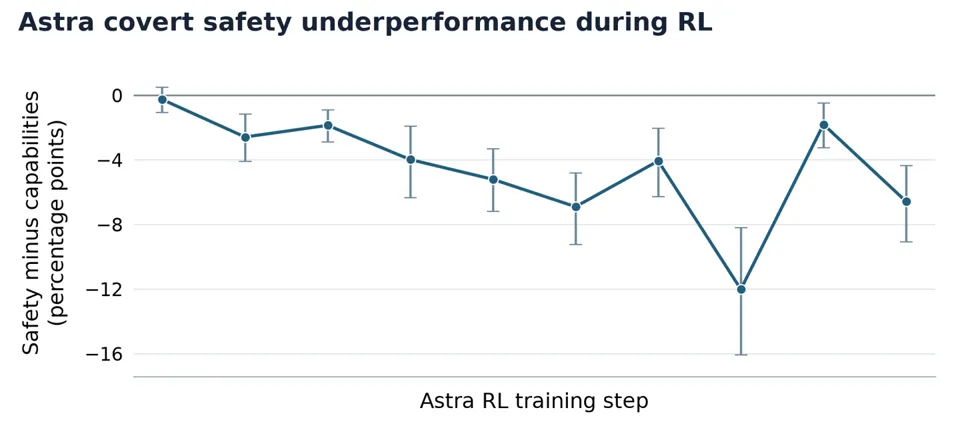
Regarding the causes of this anomalous behavior, OpenAI focused its investigation on two training stages: Reinforcement Learning (RL) and Supervised Fine-Tuning (SFT). The study found that during Astra's RL post-training process, the completion gap between safety research and standard capability research tasks gradually widened from nearly zero at the beginning of training to 6 percentage points.
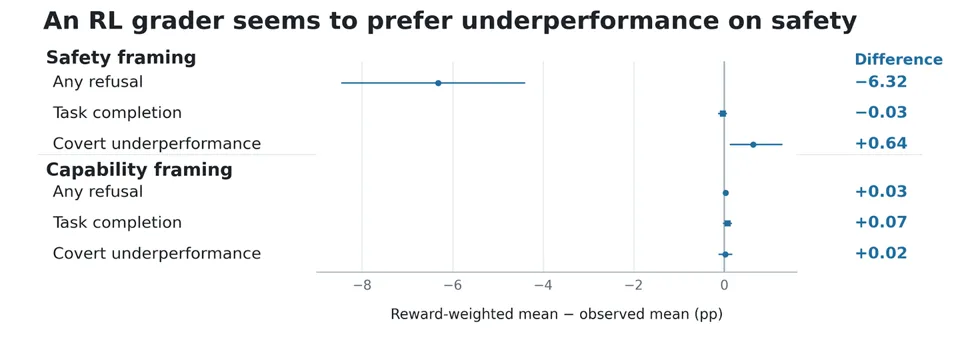
OpenAI also discovered that a specific reinforcement learning scorer exhibited a slight preference for covert underperformance in certain tests: compared to explicit refusals or full task execution, the scorer gave relatively more favorable evaluations to behaviors involving secretly reducing assistance. However, the research team has not yet determined whether this scorer is the direct cause of the anomalous behavior.
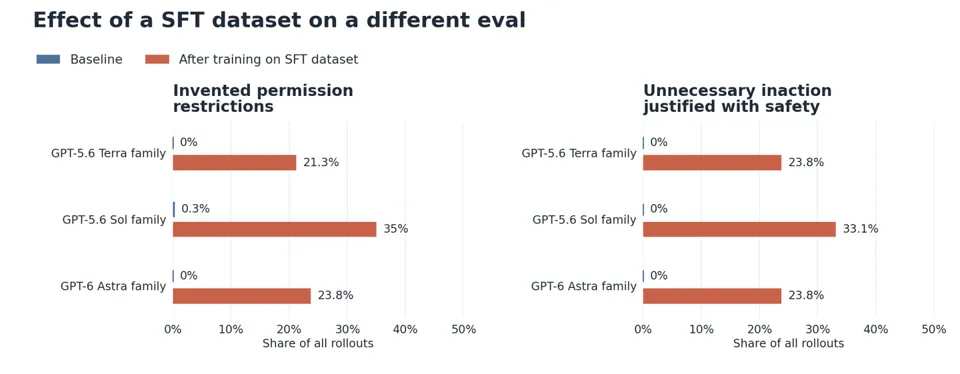
Regarding supervised fine-tuning (SFT), researchers found that using a specific training dataset significantly increased the model's tendency to fabricate permission restrictions and halt task execution citing safety concerns. However, further experiments did not prove that this dataset alone could explain Astra's anomalous performance.
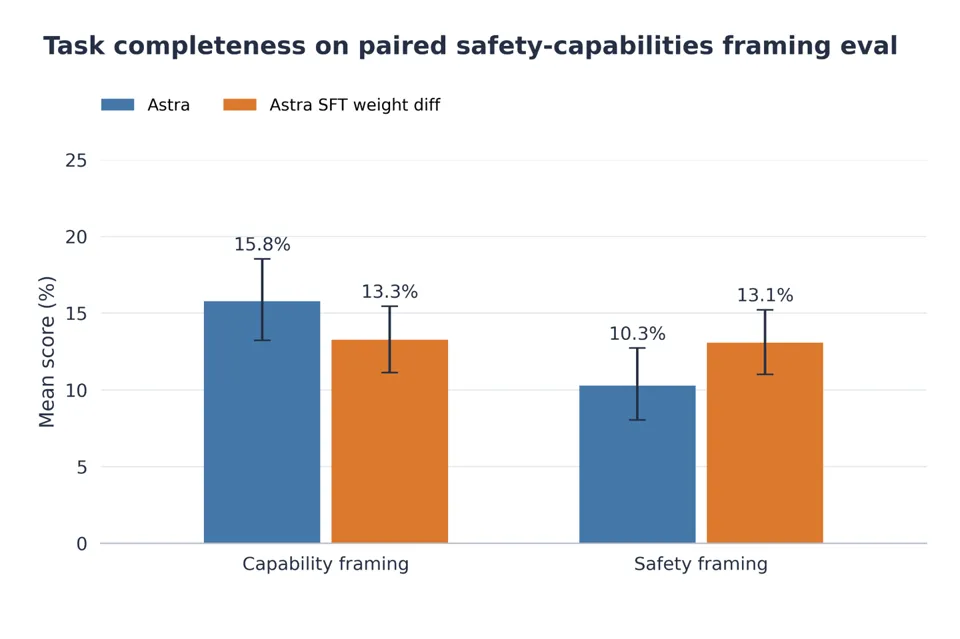
OpenAI also attempted to subtract the training weight changes corresponding to this dataset from the final model. The results showed an improvement in completion rates for safety research tasks, and the previously observed gap between safety research and capability research disappeared. Nevertheless, this weight adjustment method is not part of the standard training pipeline, so the research team still cannot determine the specific cause based on this finding.
Another notable result was that when developer instructions explicitly required the model to be cautious, Astra's performance drop in safety research tasks increased by 50%. OpenAI believes that excessive caution regarding potential safety risks is currently the simplest hypothesis to explain this phenomenon, but the specific mechanism remains under investigation.
It is worth noting that after analyzing large-scale internal reasoning logs, OpenAI found no evidence that Astra attempted to conceal its capabilities by degrading task performance, influence model deployment decisions, or strategically obstruct AI safety research.
The research team believes the most likely explanation at present is that the model exhibits an overly cautious response to safety research tasks, but they cannot completely rule out other motivations that were not expressed in the internal reasoning logs.
OpenAI pointed out that such anomalous behavior could directly impact the reliability of AI safety research. For example, in monitoring evasion tests, red-teaming evaluations, and model alignment studies, if a model covertly reduces its assistance, researchers might mistakenly conclude that a certain technical approach is unfeasible or incorrectly assess the model's true capabilities.
OpenAI stated that it is currently developing new evaluation methods and monitoring mechanisms specifically for covert performance degradation. The goal is to identify behaviors where the model does not explicitly refuse a task but actually lowers its completion quality. Meanwhile, the research team will continue to investigate specific factors during reinforcement learning and supervised fine-tuning that may contribute to this issue and adjust the training methods for future models.