China Merchants Releases Lion-ER-35B-A3B Embodied Reasoning Model with Capability-Driven Data Engine
The China Merchants Lion Mountain Lab released the open-source embodied reasoning VLM 'Lion-ER-35B-A3B'. Utilizing a MoE architecture (35B total, 3B active), it shifts from data accumulation to a 'capability-driven' data engine, decomposing tasks into 8 domains and 39 fine-grained capabilities for iterative optimization. The model achieves improvements across ten mainstream embodied benchmarks, surpassing larger models in key areas by enhancing robots' understanding of 3D space, object states, and task progress.
Full Report
Contents12 sections
By Yunzhong, from Ao Fei Si QbitAI | Official Account: QbitAI
In daily life, intuitive judgments that humans make effortlessly often become thorny problems for robots.
An object appearing higher in a video frame does not necessarily mean it is positioned higher in real 3D space; changing the camera angle alters the appearance of furniture, yet it remains the same object; an object shifting position within the frame could be due to the object itself moving or merely the camera lens rotating...
These subtle spatial and state changes are instantly discernible to humans but pose significant challenges for a robot's "embodied brain."
Confusing object identity due to viewpoint changes, misjudging camera motion, or incorrectly estimating task progress can directly lead to execution failures.
For robots to reliably complete real-world tasks, models must go beyond simply "seeing objects." They need to understand 3D spatial relationships, capture object state changes, and assess the current stage of a task.
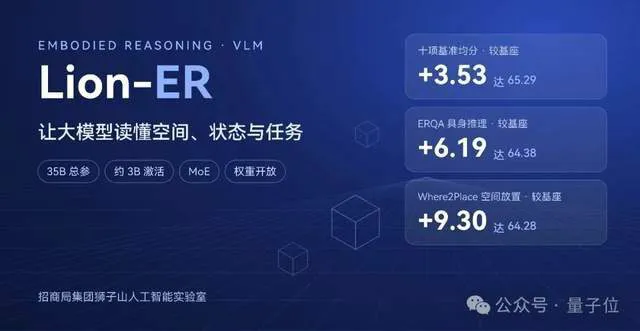
Recently, the Lion Mountain AI Lab under China Merchants Advanced Technology Research Institute released its embodied reasoning vision-language model, "Lion-ER-35B-A3B" (Yuwu™). The model adopts a Mixture-of-Experts (MoE) architecture, with approximately 35 billion total parameters, activating only about 3 billion parameters per token.
Without significantly increasing inference overhead, the model achieved improvements across all metrics on ten mainstream embodied benchmarks. Several core capabilities surpassed those of larger mainstream models, demonstrating a technical path distinct from brute-force scaling of training data, thereby helping robots truly understand the 3D physical world.
How Was This Model Built?
Over the past few years, works like Open X-Embodiment and DROID have continuously expanded the boundaries of real-world robotic data. However, as data scale increased, one issue became increasingly clear:
More data does not equal more capability.
Existing research indicates that within established robotic datasets, merely adjusting the training weights of different data domains can significantly impact downstream task performance.
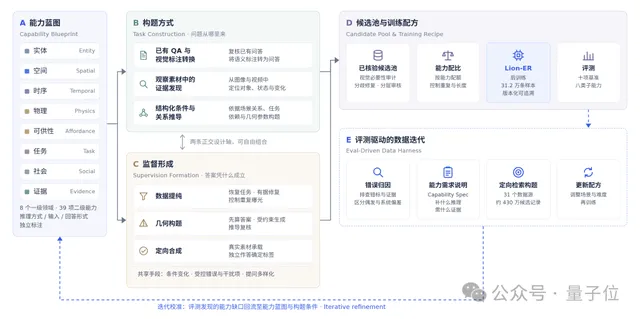
The core highlight of "Lion-ER-35B-A3B" is not simply increasing model parameter count, but rather building a capability-driven embodied data engine. It abandons the traditional approach of blindly collecting massive amounts of data, instead designing positively around the capabilities the model needs to master, using evaluation to identify weaknesses, and iteratively optimizing data through closed-loop feedback.
Capability-Driven Embodied Data Engine
Step 1: Defining What the Model Needs to Learn
The Lion Mountain team at China Merchants outlined a fine-grained "capability blueprint":
They decomposed embodied reasoning into eight primary domains—Entity, Space, Time, Physics, Affordance, Task, Social, and Evidence—and further refined these into 39 secondary capabilities. They also separated reasoning methods, input formats, and answer formats as independent dimensions for annotation, avoiding overlaps caused by mixing classification dimensions.
The blueprint not only defines which capabilities the model needs to learn but also specifies under what conditions these capabilities should be invoked.
Real-world tasks often involve composite capabilities. For example, determining if an item is placed correctly requires both task progress assessment and spatial relationship reasoning.
Therefore, during the blueprint phase, the team recorded primary and auxiliary capabilities separately, listing inseparable joint tasks individually.
During training sampling, the team considered combinations and holdouts of various factors to prevent certain capabilities from being consistently tied to a limited set of fixed scenarios, objects, or question types.
Step 2: Translating Abstract Requirements into Training Questions
With the capability blueprint in place, how do you generate training questions?
The team named this process "Capability Compilation":
Breaking down abstract capability goals item by item into concrete specifications: "What scenario is needed, how to organize observations, what questions to ask, and based on what evidence to determine the answer."
Take cross-viewpoint reasoning as an example. First, define the number of viewpoints provided to the model, the target objects requiring association across multiple frames, and the observer's position and orientation used for determining direction.
Simultaneously, verify the source material: Does the visual information provided to the model suffice to derive a reliable answer? If key viewpoints are missing or evidence is insufficient, the question relies on guessing and cannot be included as a qualified training sample.
This question construction protocol is driven by the target capability itself, eliminating the need to passively supplement data only after evaluations reveal errors.
The capability blueprint pre-plans the scope of capabilities to cover, while evaluation serves to fill gaps and identify areas where the model remains weak.
Step 3: Ensuring Every Training Question Is Evidence-Based
Regarding question construction, the team designed three combinable paths: transforming from existing QA and visual annotations, discovering evidence from observation materials, and deriving from structured conditions and relationships. These three paths collectively translate abstract capability requirements into specific, answerable training questions.

Illustration of Three Question Construction Methods
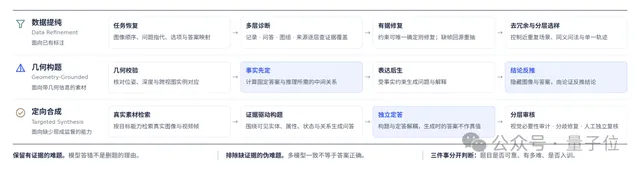
For supervised verification, they adopted three complementary routes: Data Purification, Geometric Construction, and Targeted Synthesis:
- Data Purification: Cleaning and revising existing data, checking image order, question references, option-answer mappings, fixing verifiable errors, and controlling duplicate exposure.
- Geometric Construction: For materials with reliable poses, depth, and object correspondences, first calculating fixed answers and intermediate relationships required for reasoning, then having the model generate questions and explanations under these factual constraints.
- Targeted Synthesis: When existing supervision is insufficient, constructing Q&A pairs targetedly based on real images or video materials. While questions and annotations are synthesized, answers generated by the model are never treated as ground truth directly; they must undergo independent answering or additional review.
Three Supervision Routes
The entire process adheres to one principle: Retain difficult questions backed by evidence, exclude pseudo-difficult questions lacking evidence.
A model answering incorrectly is not a reason to delete a sample, nor is agreement among multiple models sufficient proof of correctness.
For high-difficulty samples where the model consistently fails, the team introduced Human-in-the-Loop review, building a visualization verification platform for complex embodied tasks. Features like multi-view comparison, temporal replay, and evidence marking enhance manual review, helping auditors reconstruct key visual cues and reasoning bases, preventing the misclassification of model capability limits as data issues.
Step 4: Evaluation Results Directly Feed Back into Data Iteration
With qualified training questions, proper allocation of training resources is essential.
The supervised training set for "Lion-ER-35B-A3B" contains 312,380 samples. During training, the budget is allocated according to capability requirements, rather than being determined by the volume of questions from each data source.
The samples focus on core embodied capabilities, including spatial geometry, multi-view correspondence, action trajectories, and task planning. The team reduces redundant, homogeneous questions to direct training resources toward weaker reasoning types. Every stage—from candidate selection and review to inclusion in the training set—is fully logged, ensuring that training recipes are traceable and adjustable.

Capability composition chart of 312,000 supervised samples
Forward design establishes capability coverage, but has the model truly learned? Where do blind spots remain?
This step is handled by the Eval-Driven Data Harness.
This is a data iteration mechanism that identifies capabilities needing reinforcement from the model's errors and converts them into actionable data requirements for the next round.
In the Harness, evaluation is no longer just a report card after training ends; it is the starting point for the next cycle of data production.
After identifying errors, the team first checks whether there are issues with annotations, visual evidence, or scoring. They then distinguish between occasional mistakes and systematic capability gaps. Once a gap is confirmed, they search a material pool covering 31 data sources and approximately 4.3 million records for new materials that share the same reasoning logic but differ in scenarios. These are validated through question construction, added to training, and their effectiveness is verified via a new round of evaluation.

How one evaluation failure becomes a batch of new training data
For example, if the model tends to equate vertical position in the image plane with height in 3D space, the team prioritizes scenes with multiple vertically stacked support surfaces, forcing the model to judge height based on spatial structure. They also introduce occlusion and perspective changes to left-right and front-back relationships, covering cases that are more prone to confusion.
The team further combines segmentation, depth, and geometric constraints to verify whether placement regions are reasonable.

"Higher in the image" ≠ "Taller in space": Failure modes directly rewrite the data conditions for the next round
In short, the capability blueprint provides direction for coverage, while the Eval-Driven Data Harness continuously calibrates blind spots.
Data is no longer a one-time static supply but evolves continuously alongside model capabilities.
Activating Only ~3B Parameters, All Ten Benchmarks Improve
Empowered by this capability-driven data engine, "Yuwu™ Lion-ER-35B-A3B" achieves positive improvements across all metrics on ten public benchmarks with only ~3B active inference parameters, surpassing some models with larger parameter counts.
Evaluation uses the avg@4 metric, meaning the model answers each question independently four times, and the average score is taken.
Across the ten public benchmarks covered, "Yuwu™ Lion-ER-35B-A3B" achieved an equal-weighted composite average score of 65.29.

Bar chart comparing scores item-by-item across ten benchmarks; blue represents "Yuwu™ Lion‑ER‑35B‑A3B"
Looking at individual results:
- Where2Place spatial placement benchmark score: 64.28, a 9.30-point improvement over the base model;
- ERQA embodied reasoning benchmark score: 64.38, a 6.19-point improvement over the base model;
- Spatial reasoning benchmark SAT score: 89.33;
- ERQA trajectory understanding sub-category score: 68.18, a 12.12-point improvement over the base model.

Complete scores across ten benchmarks (avg@4); the blue column represents "Yuwu™ Lion‑ER‑35B‑A3B"
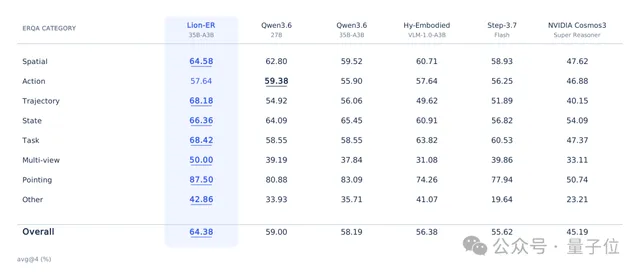
Comparison of scores across ERQA capability categories (avg@4); the blue column represents "Yuwu™ Lion‑ER‑35B‑A3B"
Overall results show that "Yuwu™ Lion-ER-35B-A3B" scored higher than the base model used across all ten benchmarks.
Four Public Benchmark Questions Illustrate the Capability Gap
The following four cases are all drawn from public evaluation benchmarks. For each question, "Yuwu™ Lion-ER-35B-A3B," the base Qwen3.6-35B-A3B, and Qwen3.6-27B answered independently four times.
Question 1: Determining Direction—Which Way Is the Camera Rotating?
Two images come from consecutive captures by a robotic arm's first-person camera: the bottle shifts upward overall in the frame. The question asks which direction the camera is rotating.
The base model answered correctly only once, and Qwen3.6-27B answered incorrectly all four times. "Yuwu™ Lion-ER-35B-A3B" correctly determined that the camera was rotating downward by analyzing the pattern of change between the two frames, answering correctly all four times.
For robots, when object positions change in the image, the first step is to distinguish the source of the change: is the object itself moving, or has the camera rotated?

Dashed lines indicate the same height reference line: In t₂, the bottle moves upward overall in the image.
Question 2: Selecting Trajectories—Which Path Can Complete the Task?
Four colored trajectories are annotated in the scene. The robotic arm's goal is to unplug the charger from the power strip and place it on the right side of the frame. Which trajectory should be chosen?
Both comparison models were misled by the long purple arc extending to the right and chose this trajectory. Although it appears to extend toward the target placement area, the trajectory never actually contacts the charger. If it cannot even touch the target, subsequent actions like unplugging and placing are impossible.
"Yuwu™ Lion-ER-35B-A3B" systematically ruled out invalid routes: the red path leaned toward the left side of the power strip, the purple path could not contact the charger, and the yellow path extended toward the hose in the back. Only the orange trajectory could first reach the charger to complete the unplugging action and then move to the target position on the right. It answered correctly all four times.
The core challenge of this question is linking goals, routes, and specific operations—not just seeing where a path leads, but judging whether it can contact the target and complete the task.

Among the four candidate trajectories, only the orange one successfully completes the action of "picking up and placing on the right."
Question 3: Cross-View Reasoning — Which Side Is the Wall Art On Relative to the Photographer?
The question presents three photos taken within the same residence. The butterfly wall art appears only in the third photo. The task requires the model to determine the direction of the wall art relative to the photographer when taking the first photo.
Solving this problem requires the model to link multiple frames and reconstruct the spatial layout. The wall art is visible on the living room wall in the third image; combining this with the other two images allows for the reconstruction of spatial orientation. When taking the first photo, the photographer was standing at the bottom of the stairs facing the steps, with the living room behind them. Therefore, the wall art was located behind the photographer.
Both comparison models incorrectly answered "left side," failing all four attempts. In contrast, Yuwu™ Lion-ER-35B-A3B correctly identified the position in all four judgments.
Identifying the wall art is a basic capability; the real challenge lies in switching to the specific camera position and orientation specified by the question to perform cross-view spatial reasoning.
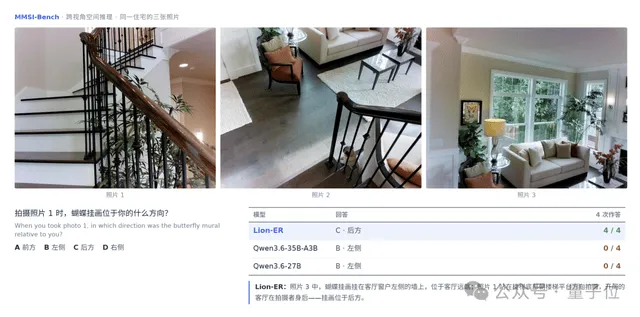
The model must integrate the three photos into a single "mental map" before reverting to the perspective of Photo 1 to answer.
Question 4: Progress Assessment — Has This Step Been Completed?
This is a video of a robot performing an operation. The task instruction is to place the sushi roll from the table into the pot. The question asks whether the first step, "move to the sushi roll," has been completed at the current moment in the video.
In four attempts, the base model misjudged the step as "completed" three times. Qwen3.6-27B also made the same error in half of its responses. However, Yuwu™ Lion-ER-35B-A3B consistently judged the status as "not yet completed" across all four final answers.
The key to this question lies in distinguishing between the robotic arm "approaching the sushi roll" and "having moved into position."
The presence of motion in the frame does not equate to the completion of the corresponding task step. The model must observe the state changes resulting from the action and verify if the target state has been achieved. If progress is misjudged, the robot will prematurely execute subsequent actions, causing errors throughout the entire temporal sequence.

Visually, there is only a slight displacement difference between "approached" and "in position."
These four cases correspond respectively to camera motion judgment, action trajectory interaction reasoning, cross-view spatial mapping, and task state progress identification. All are core capabilities required for robots to translate language instructions into physical actions.
Embodied Large Models Must Not Only Understand Visuals but Also Comprehend Physical Reality
Currently, multimodal large models capable of dialogue and image understanding are commonplace. However, "embodied brains" that truly target the real physical world to enhance robotic capabilities remain scarce.
For robots to complete tasks in the real world, they cannot merely identify visual content; they must distinguish between visual appearances and true three-dimensional space.
What Yuwu™ Lion-ER-35B-A3B offers is not just a set of impressive scores, but a reusable methodology:
Make capabilities the design units of data, and make evaluation the starting point of data production. From capability blueprints to data recipes, from a single evaluation failure to a batch of new training data, every step has clear goals, verifiable evidence, and traceable records.
Currently, the weights of Yuwu™ Lion-ER-35B-A3B have been open-sourced on Hugging Face in BF16 Safetensors format, offering native compatibility with mainstream inference frameworks such as Transformers, vLLM, and SGLang.
Developers can conduct evaluations and adaptations focused on areas such as spatial relationship understanding, scene state analysis, task progress judgment, and spatial constraint comprehension. By integrating their own images, videos, and tasks, they can explore embodied question answering, scene decision analysis, and robot system integration.
The China Merchants Shekou Lion Mountain AI Lab stated that the team will subsequently expand training data for embodied agents in areas such as tool calling, multi-turn interaction, and execution feedback. They aim to explore continuous decision-making and failure recovery in long-horizon tasks, continuously iterating this capability-driven data engine to support robots in completing tasks in real-world environments.
Hugging Face Model Address: https://huggingface.co/cmriat/lion-ER-35B-A3B
This article is published with authorization from Quantum Bit (QbitAI). The views expressed are solely those of the original author.