BAAI Releases AREX-2: 27B Model Achieves Cross-Domain Self-Improvement via Long-Horizon Reflection
BAAI and partners released AREX-2, built on Qwen3.8-27B. Trained with long-horizon reflection data, it sets new records for open-source lightweight models on benchmarks like MLE-bench and BrowseComp, demonstrating performance potential exceeding its parameter scale (compared to 1.6T models). The study proposes reframing Recursive Self-Improvement (RSI) as a trainable test-time scaling paradigm, validating long-horizon reflection as a transferable meta-capability.
Full Report

A training path for AI self-improvement has emerged.

Published by Synced (Machine Heart)
When models learn to continuously iterate and improve algorithms, they open the door to autonomous intelligent evolution. Recently, the AREX research team—comprising researchers from institutions such as BAAI (Beijing Academy of Artificial Intelligence), University of Science and Technology of China (USTC), and Renmin University of China—released the AREX-2 model. Built upon the lightweight Qwen3.8-27B base, AREX-2 was trained on long-horizon reflection data constructed around machine learning and algorithmic programming scenarios. It not only demonstrates leading capabilities in machine learning and algorithmic programming on benchmarks like MLE-bench Lite and Frontier-CS but also transfers these abilities to deep research and scientific problem-solving. On key benchmarks such as BrowseComp and HLE, it sets new state-of-the-art records for open-source lightweight models. These results suggest that long-horizon reflection training can help models acquire cross-domain self-improvement capabilities, allowing increased test-time compute to consistently translate into better outcomes, thereby providing a trainable and verifiable implementation path for Recursive Self-Improvement (RSI).
In the first three weeks of September, flagship models like GPT-6 Astra and Fable 5.1 were successively released. While people were still marveling at Claude’s completion of the first formal proof of Fermat’s Last Theorem using 11 days and 13 million lines of code, just four days later, OpenAI announced that its model might have solved another mathematical challenge—one of the Millennium Prize Problems: the Navier–Stokes equations. As new models continue to emerge, repeatedly reshaping our understanding of the boundaries of intelligence, a question is gaining increasing attention: Can models continuously improve themselves to go further?
Recursive Self-Improvement (RSI) has thus become a focal point for researchers, entrepreneurs, and investors alike. However, amidst the hype, a fundamental question remains unanswered: What exactly is RSI, and how can we cultivate and measure this capability?
The AREX team offers a concrete entry point: within a single task, enabling agents to continuously reflect and iterate during test time to improve their own solution strategies. From this perspective, RSI is not mysterious; rather, it represents a new paradigm of test-time scaling—where more rounds of investment consistently translate into better results.
The core of this capability lies in reflection and long-horizon persistence. The former determines the quality of each improvement cycle, while the latter determines how long improvements can be sustained. Together, they act like interest rates and time in compound interest, jointly influencing the final return. The key to cultivating this ability is teaching models "how to continuously improve" through training data.
The AREX team further proposes that long-horizon reflection is a meta-capability transferable across domains. If suitable training grounds are found, models can apply improvement methods learned in one domain to others. To this end, the team selected two scenarios: machine learning and algorithmic programming. These fields offer abundant task materials and provide clear, verifiable environmental feedback, creating conditions for agents to continuously enhance performance through multiple iterations.
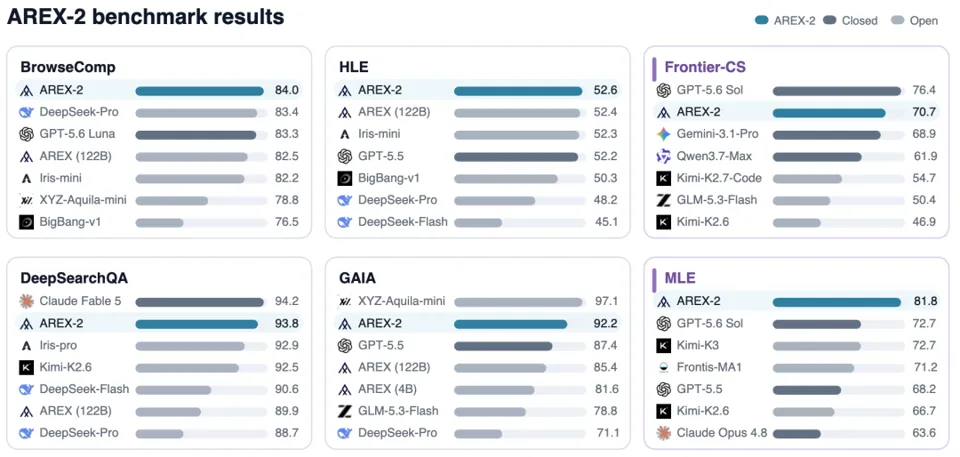
Using these scenarios as training grounds, the team developed AREX-2 based on Qwen3.8-27B. In experiments, AREX-2 demonstrated outstanding test-time scaling capabilities: achieving scores of 81.8 on MLE-bench and 70.7 on Frontier-CS, significantly surpassing previous bests for open-source lightweight models. It also reached 84.0 on BrowseComp and 52.6 on HLE, showing substantial improvements over the previous generation, AREX.
These results indicate that long-horizon reflection training can help models learn cross-domain self-improvement capabilities, ensuring that increased test-time compute consistently yields better outcomes, and providing a trainable, verifiable path toward RSI.
- Paper Link: https://arxiv.org/abs/2609.38288
- Model Weights: https://huggingface.co/collections/BAAI/arex-2
- Website: https://arex-research.com/
AREX Team
RSI as a New Test-Time Scaling Paradigm
What is RSI, and how can we cultivate and measure this capability in models?
The AREX team provides a specific angle: within a single task, enabling agents to continuously reflect and iterate during test time to refine their solution approaches. From this viewpoint, RSI is not esoteric but rather a new form of test-time scaling—where additional rounds of effort consistently lead to improved results.
The essence of this capability hinges on two factors driven by problem-solving: reflection and long-horizon persistence.
Reflection capability determines the quality of each improvement step: Can the agent propose solutions better than the current one based on feedback? The value of reflection lies not in writing a "self-evaluation," but in translating identified issues into effective modifications.
Long-horizon capability determines how long improvements can be sustained: Can the agent maintain progress across multiple execution rounds without stalling due to a single failure, a regression, or repeated attempts in ineffective directions? The focus of long-horizon capability is not runtime duration itself, but the accumulation of valid improvement cycles.
Like interest rates and time in compound interest, reflection and long-horizon capabilities jointly determine the final payoff. The key to fostering this ability is teaching models "how to continuously improve" via training data. Unfortunately, data that fully captures this process is precisely the scarcest resource in existing corpora.
Machine Learning and Algorithmic Programming
Natural Training Grounds for Long-Horizon Reflection
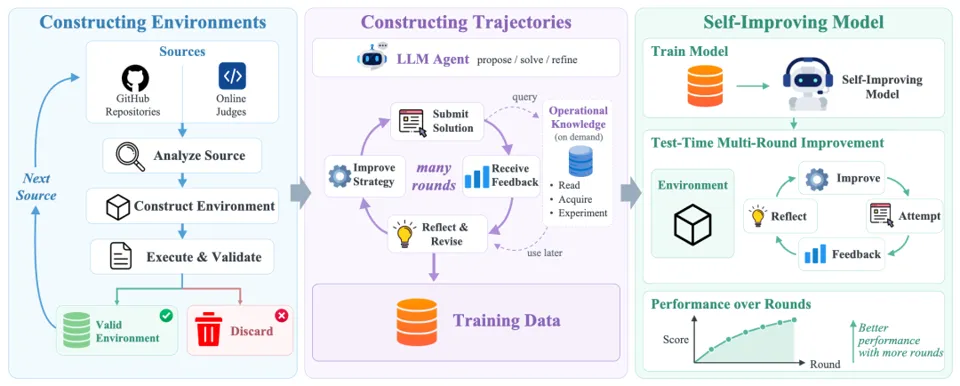
The AREX team posits that long-horizon reflection is a meta-capability transferable across domains. With appropriate training environments, models can apply improvement strategies learned in one field to others.
To achieve this, the team selected machine learning and algorithmic programming as training scenarios. These fields offer rich task diversity and provide clear, verifiable environmental feedback, facilitating continuous performance enhancement through multi-round iterations.
Specifically, the agent improves models and training pipelines in GitHub machine learning projects, optimizes algorithmic solutions for online judge problems, and validates the effectiveness of each improvement round through metrics such as hidden evaluation scores, test pass rates, or solution quality.
In both scenarios, the teacher agent first autonomously constructs tasks, scoring mechanisms, and execution environments. Through actual execution, it filters for environments that are runnable and offer sufficient room for improvement. Subsequently, given ample time and iteration budgets, the agent cycles through "submit solution → receive feedback → reflect and improve," consulting resources, utilizing skills, and conducting experiments as needed. Reasoning, attempts, failures, and subsequent adjustments are all preserved in the trajectory, forming training data that demonstrates "how to continuously improve."
Training continuous improvement capabilities in machine learning and algorithmic programming also benefits deep research.
Domain-Specific Evaluation: The 27B Model Leads All Baselines on MLE-bench
AREX-2 first validated this training pathway on machine learning and algorithmic programming tasks.
On MLE-bench Lite, the 27B AREX-2 achieved a score of 81.8, surpassing all baseline models listed in this report, including closed-source frontier models. Specifically, GPT-5.6 Sol and Kimi-K3 both scored 72.7, meaning AREX-2 leads by 9.1 percentage points. On Frontier-CS, AREX-2 achieved 70.7, outperforming all open-weight models with reported scores in the table.
These results demonstrate that long-horizon improvement trajectories built around verifiable feedback can serve as effective training signals. The model learns not only how to generate initial solutions but also how to continue optimizing them based on feedback. For tasks like machine learning and algorithmic programming, this capability for continuous improvement has already translated into competitive task performance.
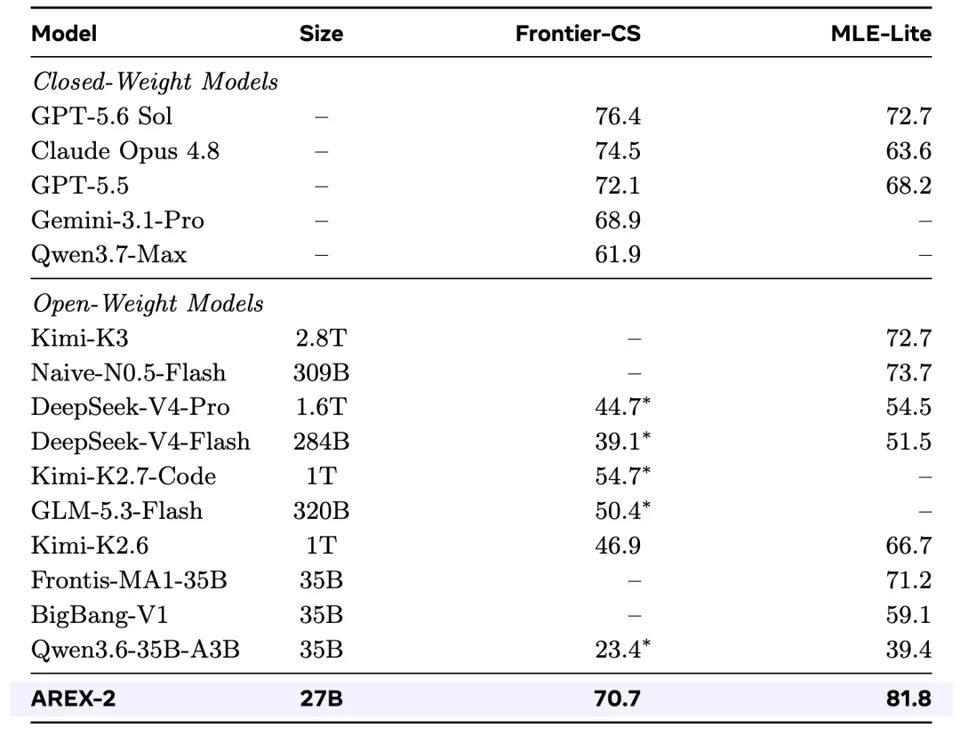
Figure 1a | Main Experiment: Machine Learning and Algorithmic Programming. AREX-2 achieves 81.8 on MLE-bench Lite and 70.7 on Frontier-CS.
Cross-Domain Transfer: Benefits Extend to Deep Research Tasks
A more critical question is whether the continuous improvement capabilities learned in machine learning and algorithmic programming can be applied to deep research. AREX-2 leverages the deep research data from AREX v1 and augments it with newly synthesized long-horizon reflection trajectories. In other words, this exploration does not rely on adding new deep research data to boost deep research performance; rather, it tests whether improvement processes from other domains can provide effective capability gains.
In experiments, AREX-2 achieved scores of 84.0 on BrowseComp and 52.6 on HLE, both being the highest among all models with ≤40B parameters listed in this report.
This result supports the capability transfer hypothesis proposed by the AREX team: long-horizon reflection is not merely a problem-solving technique for specific task types but can also function as a self-improvement capability that operates across domains.
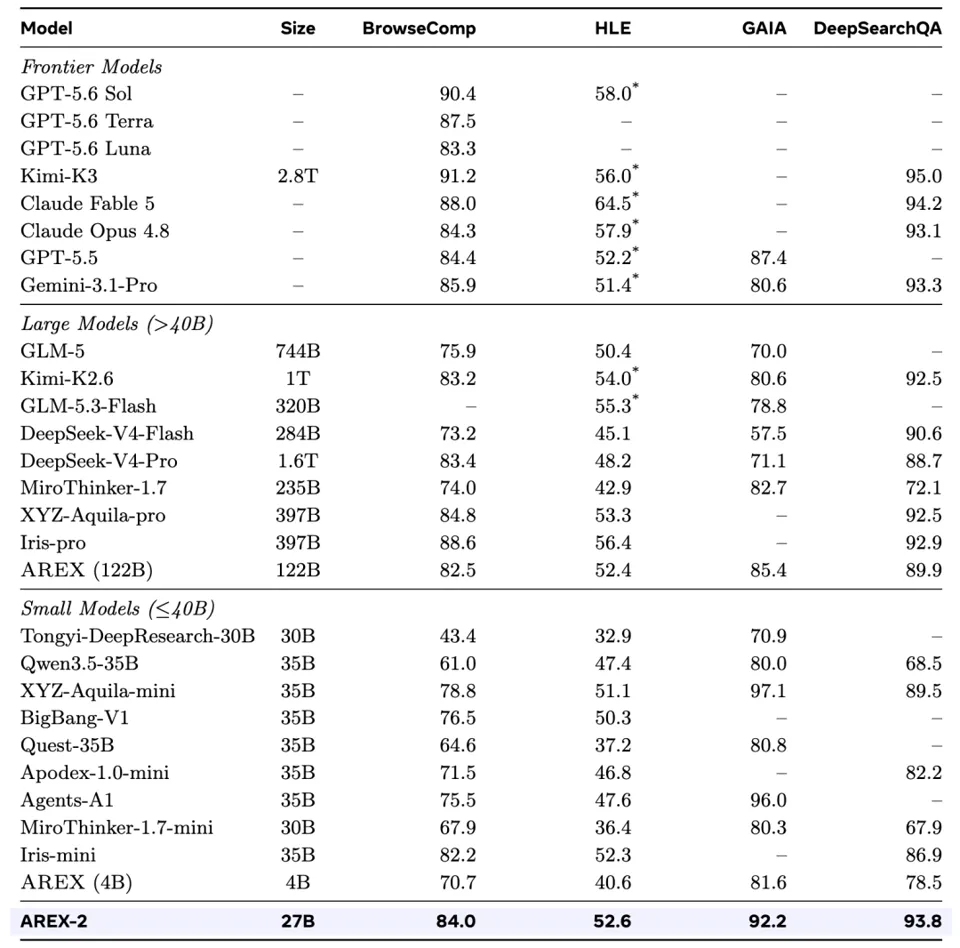
Figure 1b | Main Experiment: Deep Research and Agent Tasks. AREX-2's scores on BrowseComp and HLE are the highest among models with ≤40B parameters shown in the chart.
Parameter Count vs. Performance: Smaller Models Can Reach Higher Capability Tiers
When viewing task performance alongside parameter scale, the advantages of AREX-2 become clearer.
On MLE-bench Lite, the 27B AREX-2 achieved 81.8, exceeding Frontis-MA1-35B (71.2) at 35B parameters and Kimi-K3 (72.7) at 2.8T parameters. On BrowseComp, AREX-2 achieved 84.0, surpassing Kimi-K2.6 (83.2) at 1T parameters and DeepSeek-V4-Pro (83.4) at 1.6T parameters.
The significance of AREX-2 goes beyond simply "small beating large." It reveals an alternative path for capability enhancement: besides scaling up model size, specialized training focused on the continuous improvement process allows models to more effectively utilize feedback, refine solutions, and accumulate iterative gains.
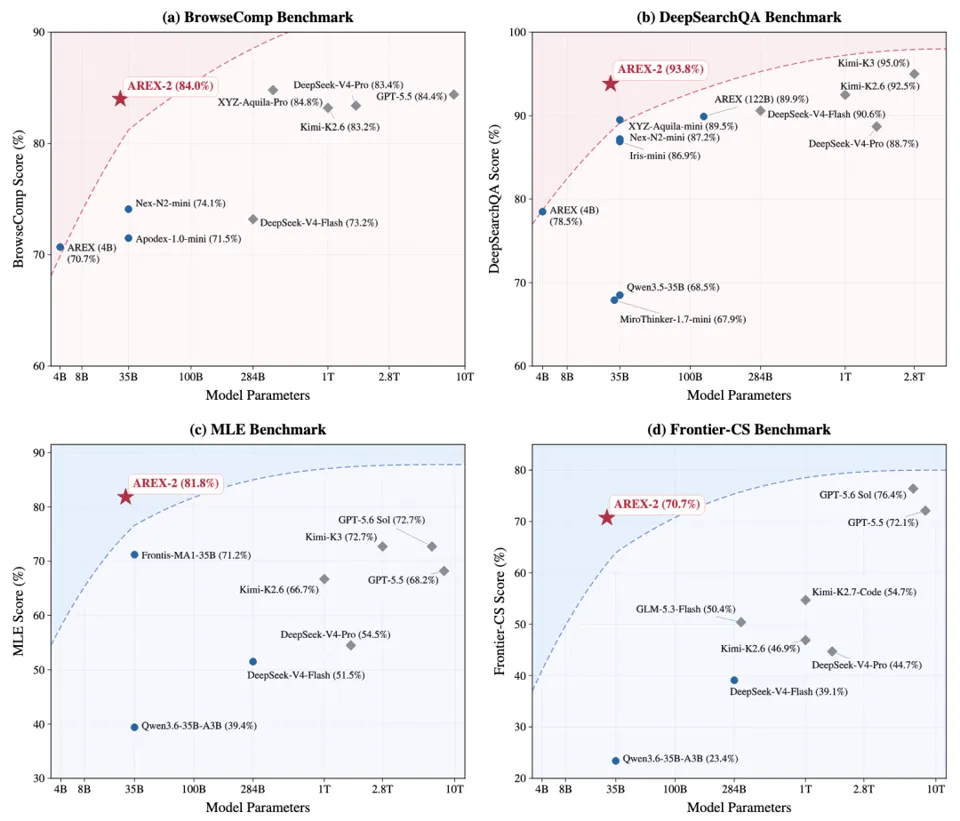
Figure 2 | Parameter Count vs. Performance Comparison. AREX-2 demonstrates superior parameter efficiency, consistently remaining on the Pareto frontier while achieving performance comparable to or exceeding much larger models.
Long-Horizon Reflection Data Provides an Effective Training Pathway for RSI
AREX-2's exploration indicates that long-horizon reflection data not only improves model performance within the training domain but also helps models acquire transferable self-improvement capabilities.
For Recursive Self-Improvement (RSI), this offers a promising pathway: enabling models to learn from experience accumulated in each attempt and translate that experience into sustained progress over longer task horizons.