HKUST and Tencent Hunyuan Open Source Rosetta to Curb Catastrophic Forgetting
Tencent Hunyuan's multimodal foundation model team and HKUST jointly propose Rosetta, a compositional native multimodal pretraining method that tackles catastrophic forgetting when a foundation model acquires new capabilities such as image generation. Accepted at NeurIPS 2026, the full pretraining, inference and evaluation code plus model weights are open-sourced, scaling from a single GPU to thousand-GPU clusters.
Related Entities
Full Report

Any time you want to "grow new capabilities" on top of an existing base model, this general solution applies.

After training one flagship model, do you have to start from scratch when training the next version? The base model can't be reused, and the resulting waste of resources is a real headache.
After training a VLM base model, you continue training additional capabilities such as image generation, only to find that the base model's original capabilities have degraded. The money was burned for nothing, which is an even bigger headache.
When you add image generation capability to a large model, why does it become worse at answering questions it could previously handle? This is also a long-standing challenge in native multimodal pretraining. Language models learn to predict the next token, while image generation needs to handle continuous visual signals. When these objectives are placed into the same model, the gradients from the new task may overwrite the representations already learned, causing catastrophic forgetting. Even adopting a Mixture of Experts (MoE) model, or a Mixture of Transformers (MoT) that isolates the understanding and generation branches, does not necessarily avoid this problem during joint training.
Recently, a research team from Tencent Hunyuan's Multimodal Base Model Group and the Hong Kong University of Science and Technology jointly proposed Rosetta (Compositional Native Multimodal Pretraining), attempting to thoroughly solve this problem at the level of underlying architecture and optimization mechanisms. The work has been accepted by NeurIPS 2026, and the full set of pretraining (supporting single-GPU to thousand-GPU clusters), inference, and evaluation code, as well as model weights, have been fully open-sourced to the community.
- Paper: https://arxiv.org/abs/2607.00293
- Code: https://github.com/Lxiangyue/Rosetta
- Model: https://huggingface.co/tencent/Rosetta-inference
Caption: After adding the text-to-image task (+T2I), MoE and MoT suffer a cliff-like forgetting on the language capability MMLU, while Rosetta steadily maintains the base model's capabilities and generates high-quality images.
Breaking down the pain points:
MoE "grabs experts," while MoT isolates too rigidly and still loses points
When packing understanding and generation into the same Transformer (such as the Transfusion paradigm), there are two mainstream approaches in the industry, but each has its own pitfalls:
The first path is standard MoE. All modalities share a single router, which looks convenient, but things go wrong as soon as joint training begins — the gradients produced by continuous image generation (Flow Matching) have high variance and strong signals, and can easily "grab" the experts originally responsible for language or understanding and overwrite them, leading to routing collapse.
The second path is the structural isolation camp (represented by MoT and Bagel). Since they fight, just split the Attention QKV projections and FFN into two separate sets, with understanding and generation each taking their own path.
Sounds stable? Under the premise of strictly aligning activated parameters, the team ran a pure pretraining comparison experiment from scratch, and the results were quite counterintuitive: during full joint pretraining without freezing the understanding branch, whether MoE or MoT, as soon as the image generation task was added, language and code capabilities almost instantly dropped to zero — BBH and MBPP fell directly to 0 points.
There are two reasons: first, as long as there is implicit coupling between parameters, the generation signal will still bias the original routing distribution (the routing heatmaps in the paper confirm this; MoT's text routing also shifted significantly after adding image generation); second, although hard structural isolation can preserve old capabilities under certain settings, it also blocks the channel for "cross-modal synergy" — understanding cannot help generation, and generation cannot feed back into understanding, while the model's total parameter count also inflates by nearly 20% for nothing (whereas Rosetta maintains exactly the same total parameter budget as standard MoE).
This is the "forgetting–synergy" dilemma that native multimodal pretraining cannot avoid: the model should be able to grow new capabilities at any time like building blocks without damaging old capabilities, while also allowing different modalities to truly exchange what they have.
Rosetta's solution: attention learns together,
FFN grows separately, gradients are "aligned" with momentum
Just as the historical Rosetta Stone bridged the semantic gaps between different ancient scripts, Rosetta's design approach is very restrained and highly engineering-friendly, doing only two things at its core.
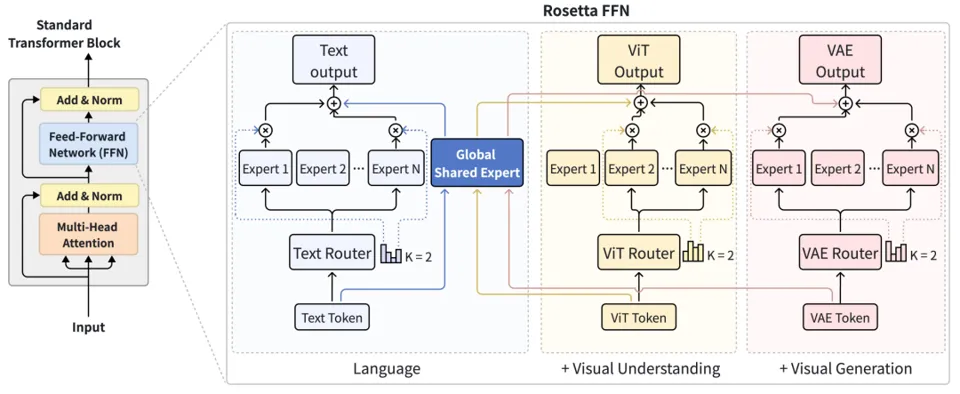
- Architecturally, "merge the mainstream, split the side kitchens": unified attention + compositional FFN
Since hard-splitting Attention would block cross-modal communication, Rosetta simply retains a fully shared Unified Attention, allowing tokens from text (Text), visual understanding (ViT), and image generation (VAE) to perform full contextual interaction within the same semantic space.
What is truly prone to knowledge overwriting is the FFN layer that serves as the "knowledge base." Rosetta confines the expansion to the FFN and splits it into two parts:
- Plug-and-play modality-specific experts: Text, ViT, and VAE each have their own independent router and dedicated expert pool. To add new modalities in the future (such as audio, video, 3D, or embodied motion control), there is no need to tear everything down and retrain—just attach a new set of routers and experts like snapping together Lego bricks.
- Global Shared Expert: Tokens from all modalities must pass through the same shared expert. It acts like a "translator" between different modalities, giving fine-grained visual generation signals a chance to enrich the representations of language and understanding in return.
- "Zero-overhead stop-loss" in optimization: Momentum-Anchored Orthogonal Projection (MAOP)
Splitting things up is not enough. Since the global shared expert has to take in gradients from all modalities at once, the gradients of new tasks and old tasks will still conflict (i.e., gradient inner product). In the past, gradient surgery (such as PCGrad) was commonly used to resolve gradient conflicts, but anyone who has done distributed training of large models knows that PCGrad requires keeping a separate computation graph and gradient cache for each task. When running LM + MMU + T2I three-task parallelism, not only does it incur extra memory overhead, but training throughput also drops by 3x directly, making it completely unworkable on FSDP clusters.
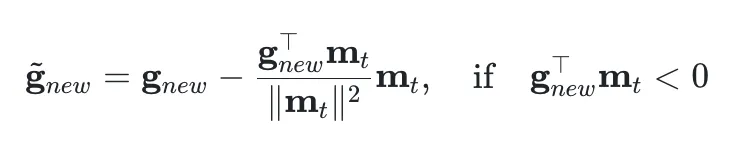
In Rosetta, the authors of this paper propose a very clever solution—MAOP (Momentum-Anchored Orthogonal Projection). In fact, optimizers (such as AdamW) have always maintained first-order momentum (i.e., exp_avg) during training, which naturally records the main direction of the model's historical updates and serves as an "implicit anchor" for old knowledge. MAOP does not require an extra backward pass or additional memory allocation; it only needs to compute the inner product of the current mixed gradient and the momentum when updating the shared expert:
If the directions are consistent (), it means the new task is helping the old task, so let it pass directly;
If a conflict occurs (), the component of the gradient that "undermines" the historical momentum is removed via orthogonal projection, keeping only the update directions that do not interfere with each other:
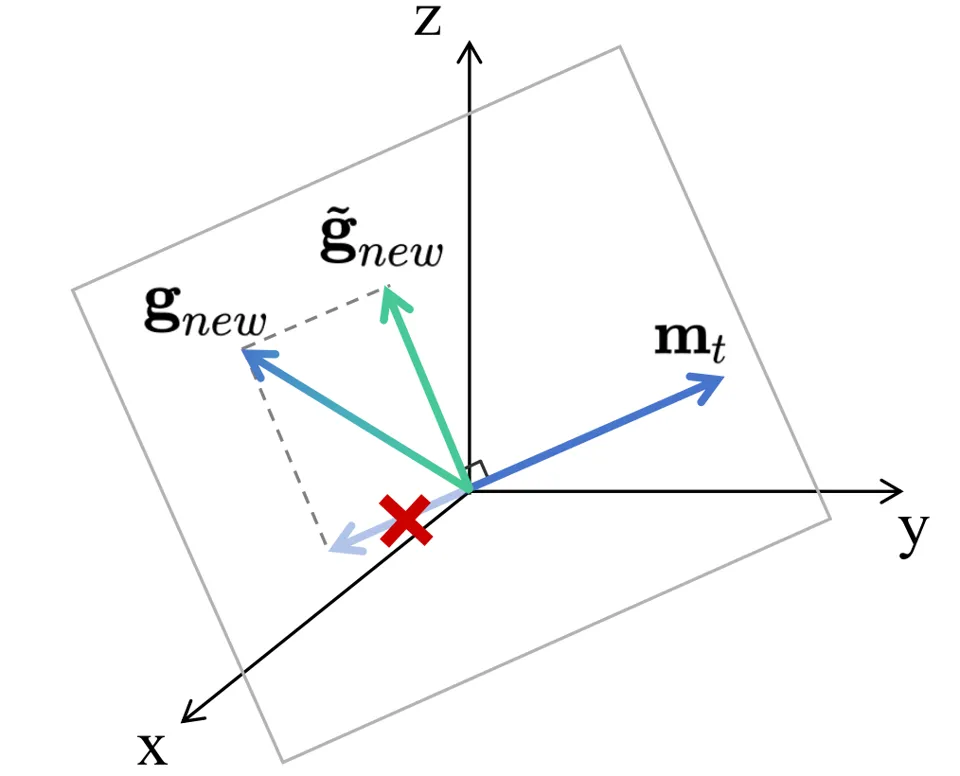
Combined with local inner-product All-Reduce reduction in a distributed environment, MAOP achieves strictly zero extra memory and zero computational time overhead. In actual measurements, enabling MAOP in an FSDP environment leaves single-GPU peak memory completely unchanged (still 58.8 GB/GPU), and training throughput is exactly the same (still 8,602 tokens/s/GPU).
Measured performance:
Old capabilities are retained, understanding improves across the board, and image generation is faster and better
To cleanly measure the benefits of the architecture itself, all comparison models (standard MoE, MoT, and Rosetta) use the same pretraining base, with the same visual encoder (Qwen3-VL ViT) and image generation encoder (FLUX.2 VAE) frozen, and under the same random seed and data mixture ratio, they go through three stages of progressive mixed training in sequence: 300B text base → joint visual understanding training (about 4 million MMU samples, mixed at MMU = 0.8.2) → full-modality joint expansion (including about 100 million T2I samples, mixed at T2I:MMU = 0.6.25.15), with no downstream SFT instruction tuning throughout, directly testing the raw scores of the base models.
Anyone who has done pretraining knows that looking only at the final benchmark leaderboard scores can sometimes be misleading. What truly determines whether an architecture can be scaled and deployed is long-horizon training dynamics. The following set of training dynamics plots fully records all underlying metrics during the 200K-iteration generation expansion stage, and the comparison curves are very brutal:
- Language and understanding loss reveal the truth at a glance (see the middle and right plots in the bottom row): at the moment the T2I image generation task is introduced, the LM Text Loss of MoE and MoT shoots up directly from ~1.72 to ~2.15 and keeps drifting upward, while MMU Text Loss also instantly jumps to around ~1.0—this means the language representations of the base model have already "blown up" at the optimization level. Rosetta, by contrast, keeps both understanding losses pinned at the lowest levels throughout (LM stable at ~1.75–1.80, MMU stable at ~0.80), fundamentally blocking catastrophic forgetting.
- Deeper convergence lower bound, with routing capacity steadily high (see the middle and right plots in the top row & the left plot in the bottom row): from the zoomed-in view of steps 180K–200K, Rosetta not only pushes the overall Total Loss to a lower level (~1.44 vs ~1.53), but even the newly added T2I Image Loss converges deeper than that of MoE and MoT (~0.766 vs ~0.773/0.771). More importantly, on Capacity Rate (the proportion of tokens successfully routed and not dropped due to congestion), a metric of MoE router health, Rosetta stays steadily at a high level of around 0.955 throughout, clearly ahead of MoT (~0.94) and MoE, which falls below 0.90 in the early stage—indicating that even under high-frequency shocks from heterogeneous modalities, the router never suffers overload collapse.
- The "V-shaped reversal" of MMBench (see the left plot in the top row): when image generation was first introduced, all three models inevitably experienced a brief drop, but MoE and MoT then fell into low-level oscillations of 40–46 points and never climbed back up; only Rosetta, after a brief adaptation in the first 20K steps, rose rapidly and steadily returned above 50 points, opening a generational gap of more than 5 points from the baseline.
Why does even MoT, which has physical isolation, suffer from routing drift? The routing heatmaps below provide the answer.
The paper captures two key checkpoints—before adding image generation (55K steps) and after 30K steps of image generation training (85K steps)—and visualizes the expert activation probability distribution across layers for text tokens during MMLU inference:
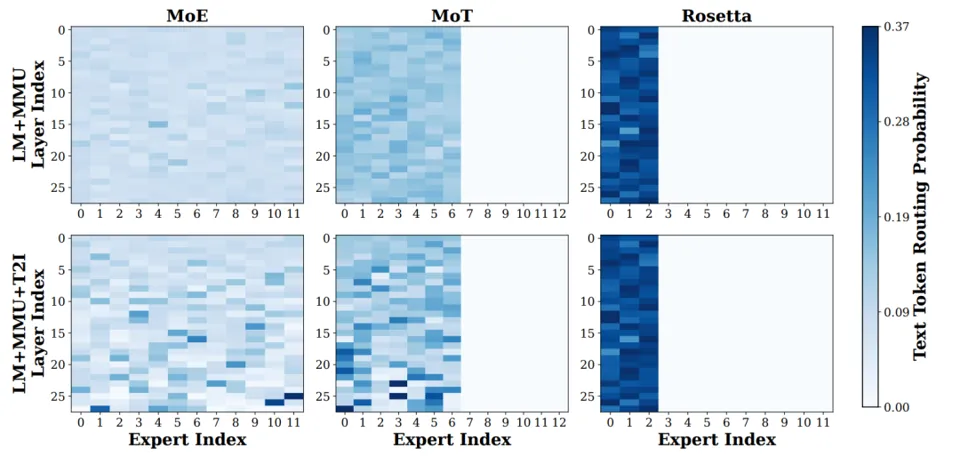
- MoE (left column) is completely "reshuffled": after adding image generation, the activation distribution of experts originally responsible for text reasoning shifts dramatically, proving that a router without modality constraints has already crowded out and overwritten the language experts;
- MoT (middle column) also fails to hold: this is the most counterintuitive finding—given that understanding and generation already have separate expert pools, why does the routing distribution for text tokens still show visible changes? This directly demonstrates that physically separating experts at the architectural level alone is insufficient to immunize against cross-modal interference; as long as implicit coupling exists under joint optimization, generation gradients will still perturb the original feature distributions and routing decisions;
- Rosetta almost replicates the original: before and after adding image generation, the expert activation heatmaps for text tokens across all 28 layers are nearly identical. In other words, Rosetta does not take the easy way out by "freezing parameters"; instead, while performing full joint training, it uses "modality-specific routing + MAOP gradient projection" to precisely preserve the previously established cognitive neural pathways.
Reflected in the final quantitative benchmarks, the gap becomes even more striking:
- Language and code capabilities are preserved, and MBPP even improves: after adding T2I training, the MMLU scores of MoE and MoT (Bagel) are halved from 50+ to 26.3 and 27.1, and both the complex reasoning benchmark BBH and the code benchmark MBPP drop to 0. In contrast, Rosetta's MMLU holds steady at 49.2, BBH retains 46.8, and MBPP even rises against the trend from 36.2 before image generation to 42.4.
- Visual understanding comprehensively surpasses the "pre-image-generation" state: compared with the Pre-T2I checkpoint before adding image generation, after incorporating the image generation task, Rosetta achieves positive growth across all six multimodal understanding benchmarks (MMMU, MMBench-EN/CN, POPE, AI2D, RealWorldQA), truly realizing cross-modal synergy where "generation promotes understanding."
- Leading in both image generation quality and convergence efficiency: under strict alignment of identical activated parameters and training steps, Rosetta's text-to-image loss converges faster and deeper, with FID on COCO-30K dropping to 14.05 (MoT: 15.58, MoE: 17.80), and the compositional generation benchmark T2I-CompBench reaching 45.5 (also leading comprehensively on CLIPScore and HPSv2)—proving that preserving the semantic foundation not only does not slow down image generation, but actually enables visual generation to learn more stably and quickly.
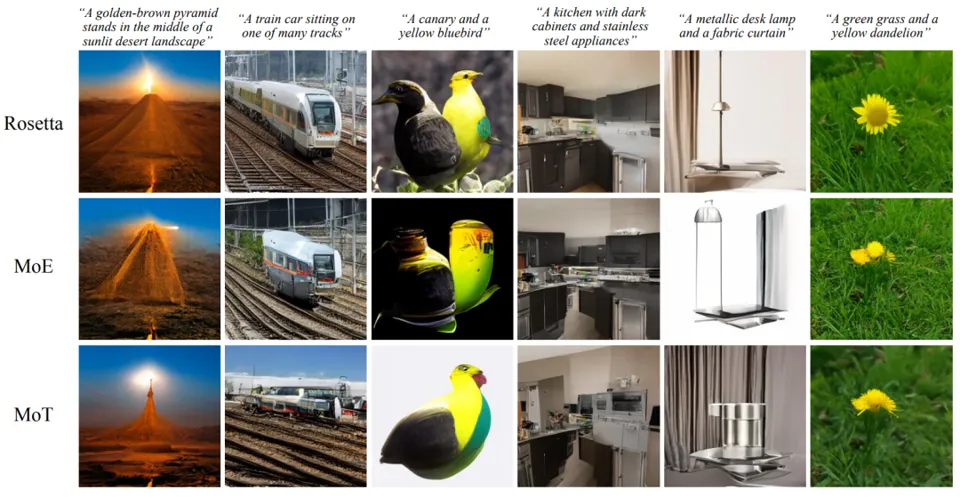
Caption: Comparison of native base model image generation under the same training steps (without fine-tuning). Thanks to faster convergence and semantic alignment, Rosetta effectively avoids the semantic drift and structural distortion of the baselines.
Extended reflection: any approach that "grows new capabilities" on an existing base model can use this general solution
Although the experimental validation in this paper focuses on "text + visual understanding + image generation," what Rosetta targets is actually a more fundamental general proposition: whenever new capabilities are extended outward from an existing base model—whether video generation, 3D perception, embodied intelligence VLA, or vertical professional domains such as financial quantitative analysis—one almost always encounters the same problem of old and new gradients conflicting and catastrophic forgetting.
Facing such problems, Rosetta provides a "general solution" approach that is agnostic to modality and domain: new capabilities are handled by plug-and-play dedicated experts, while the shared foundation is protected by the zero-memory-overhead MAOP. There is no need to burn GPU hours retraining from scratch every time a new function is added, nor to worry about washing away the original general reasoning capabilities, enabling the base model to truly possess the evolutionary ability to "grow continuously with reusable compute."
Conclusion and on-site exchange at NeurIPS 2026
From hundred-billion to trillion-token base model iterations, retraining from scratch every time a new modality is added, or washing away the hard-earned base model capabilities because of a new task, is a huge waste of compute. Rosetta's exploration in Hunyuan multimodal base model pretraining proves one thing: the combination of modular isolation and gradient-level lossless projection can fully enable the base model to grow continuously like building with Lego, without adding extra memory or compute tax.
Currently, all of Rosetta's code (including training code) and pretrained weights have been open-sourced, and training is already supported from a single GPU to thousand-GPU clusters. Peers working on base model architecture, native multimodal architecture, embodied base models, and continual pretraining are welcome to try it out and exchange ideas.
NeurIPS 2026 on-site Poster exchange information
- Paper: Rosetta: Composable Native Multimodal Pretraining
- Time: December 8, 2026 (Tuesday) 17–20 (Sydney local time, Poster Session 2)
- Location: NeurIPS 2026 Sydney main venue (ICC Sydney) · Hall 1-4 · Booth #S3807
- Everyone is welcome to come to the Poster booth at the conference to talk with us face-to-face about multimodal pretraining architecture and lessons learned!
Author bio
Liu Xiangyue is a fourth-year PhD student at the Hong Kong University of Science and Technology, advised by Professor Tan Ping. He previously interned at the Tencent Hunyuan Foundation Model team and participated in the architecture design of Hunyuan Image 3.5. His main research directions are: native multimodal large model pretraining architecture, sparse mixture-of-experts (MoE) scaling, and unified models for cross-modal generation and understanding. He has published Symbiotic-MoE (ECCV 2026), Rosetta (NeurIPS 2026), and others.
- Personal homepage: xiangyueliu.github.io

© THE END
For reprints, please contact this official account for authorization.
Submissions or press inquiries: [email protected]