Ant Group's Robbyant Open-Sources LingBot-Navi Navigation Model with Spatial Memory
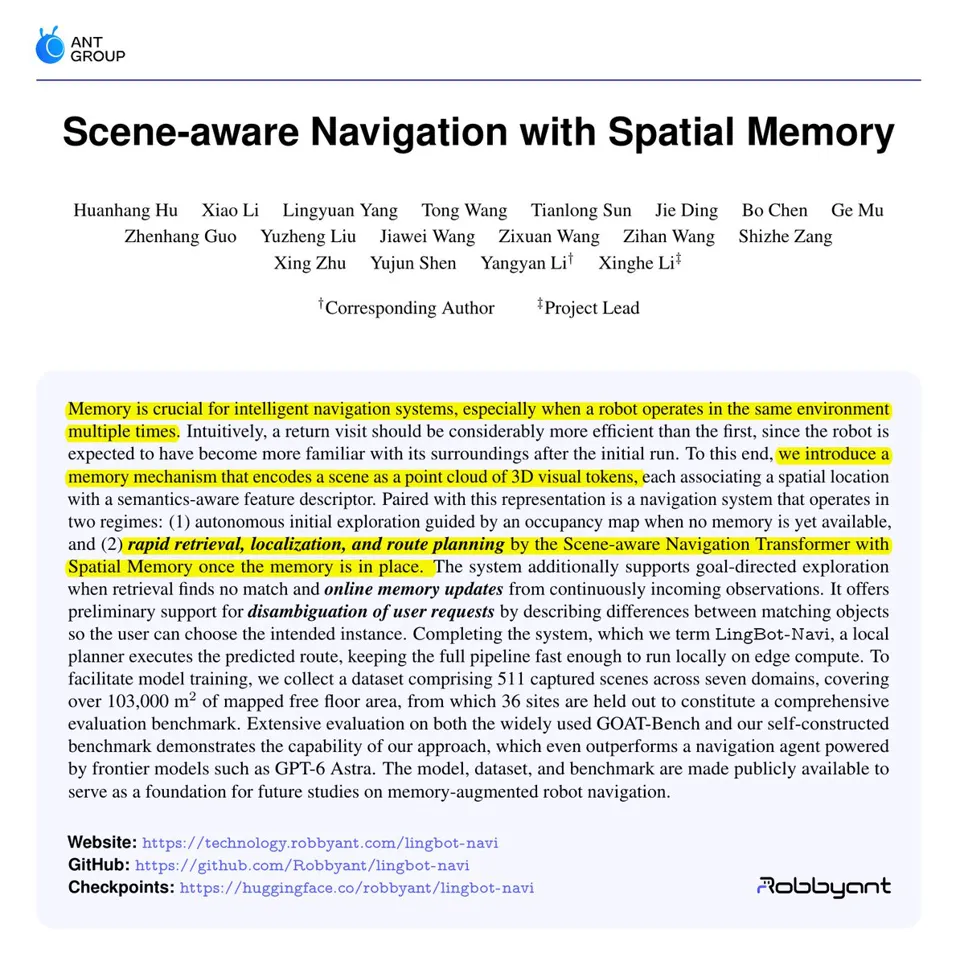
Robbyant, Ant Group's embodied AI unit, has open-sourced LingBot-Navi, a navigation model that gives robots persistent spatial memory across tasks, so performance improves the longer a robot works in one place. It requires no pre-built map, constructing a 3D memory of layout, object positions and traversable paths during exploration, and pairs 3D surface locations with vision-language features to locate out-of-view targets. A scene-level planner predicts routes on the remembered layout while a local planner handles motion, obstacle avoidance and arrival detection.
Related Entities
Full Report
Rohan Paul (@rohanpaul_ai) · 2026-11-26 21
Robbyant (@robbyant_brain, Ant Group's embodied AI company) just open-sourced LingBot-Navi, a navigation model that gives robots a memory of the places they've explored.
It keeps spatial memory across tasks, so the more a robot works in one place, the faster it gets.
Most vision-language navigation models (models that take a plain-language instruction plus what the camera sees and work out where to go) start from zero on every task, so a robot that found a room this morning searches the whole floor again this afternoon.
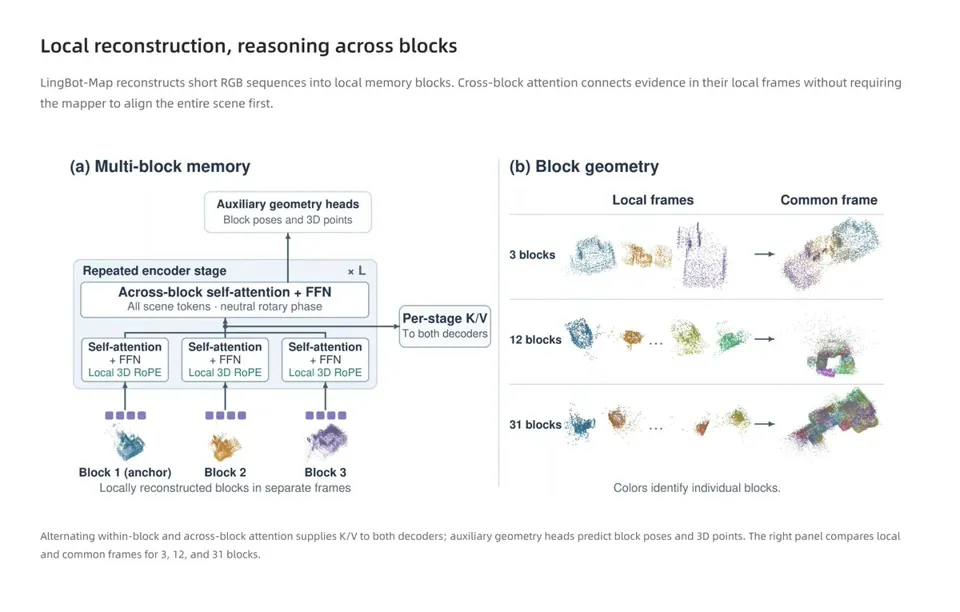
Navi needs no map up front: it builds a 3D memory while it explores, covering the layout, where objects sit and which paths are open, and keeps that memory for the next task.
Its spatial memory pairs 3D surface locations with visual-language features, linking what the robot saw to where it saw it. This lets it locate targets such as "the table by the window," even when they are out of view.
A scene-level planner then finds the target and the robot on that remembered layout and predicts the route, while a local planner handles the actual moving, dodging obstacles and knowing when it has arrived.
The speed-up shows up where the area or target has already been seen and remembered, and in a brand-new place Navi may be about the same as other models.
It is designed to run on the robot itself, so camera images and user requests stay on the device.