蚂蚁集团开源 LingBot-Navi 导航模型 让机器人拥有空间记忆
蚂蚁集团旗下具身智能公司 Robbyant 开源了导航模型 LingBot-Navi,核心创新是让机器人在跨任务中保留空间记忆,在同一环境中工作越久速度越快。该模型无需预先建图,在探索过程中自建包含布局、物体位置与可通行路径的 3D 记忆,并将 3D 表面位置与视觉语言特征配对,从而定位视野外的目标。系统由场景级规划器负责在记忆地图上预测路线,局部规划器负责避障与到达判断。
报道正文
Rohan Paul (@rohanpaul_ai) · 2026-11-26 21
Robbyant (@robbyant_brain, Ant Group's embodied AI company) just open-sourced LingBot-Navi, a navigation model that gives robots a memory of the places they've explored.
It keeps spatial memory across tasks, so the more a robot works in one place, the faster it gets.
Most vision-language navigation models (models that take a plain-language instruction plus what the camera sees and work out where to go) start from zero on every task, so a robot that found a room this morning searches the whole floor again this afternoon.
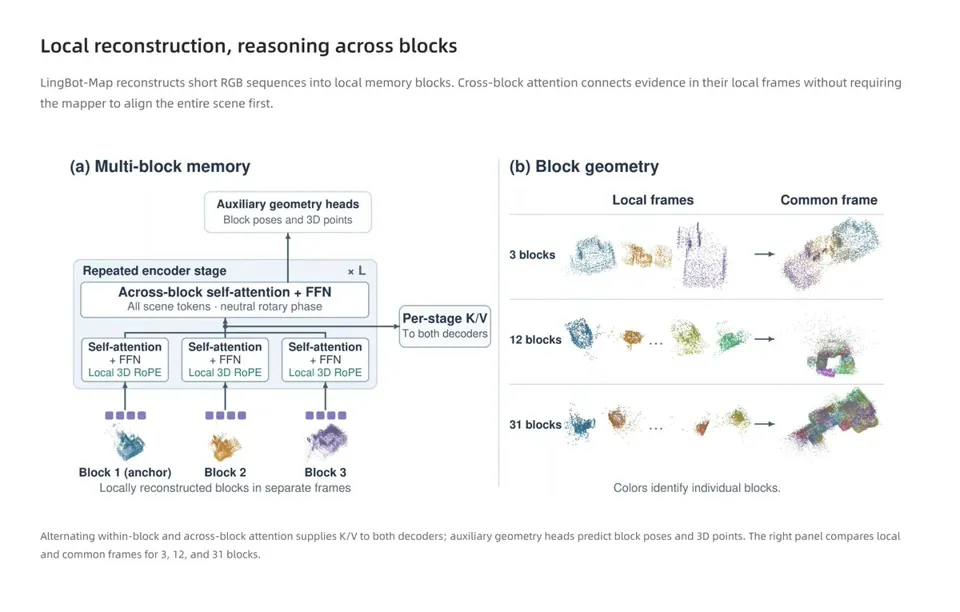
Navi needs no map up front: it builds a 3D memory while it explores, covering the layout, where objects sit and which paths are open, and keeps that memory for the next task.
Its spatial memory pairs 3D surface locations with visual-language features, linking what the robot saw to where it saw it. This lets it locate targets such as "the table by the window," even when they are out of view.
A scene-level planner then finds the target and the robot on that remembered layout and predicts the route, while a local planner handles the actual moving, dodging obstacles and knowing when it has arrived.
The speed-up shows up where the area or target has already been seen and remembered, and in a brand-new place Navi may be about the same as other models.
It is designed to run on the robot itself, so camera images and user requests stay on the device.