China Telecom Open-Sources 285B Xing4.1 Model Trained on Ascend
China Telecom released Xing4.1-Preview, a 285B-parameter open-source MoE model with 17B activated parameters per token and million-token context, targeting coding and long-horizon agent tasks. It was trained end-to-end on 8,192 Ascend 910C chips with MindSpore, and the accompanying 32-page technical report discloses architecture choices, the 8,000-GPU cluster training scheme and agent post-training methods.
Full Report
Contents7 sections

Training trillion-parameter large models on domestic chips: someone has finally laid out the construction blueprints
henry from the Non-Obvious Lab
QuantumBit | WeChat Official Account QbitAI
8,192 Ascend cards, 285 billion parameters, million-token context, and a full 32-page technical report.
Within the domestic software and hardware ecosystem, very few have ever laid their cards on the table this thoroughly when it comes to training trillion-parameter-scale large models.
Following the open-sourcing of the on-device model Xing4.0-29B-A4B in September this year, China Telecom recently released another flagship open-source model at the trillion-parameter scale—
Xing4.1-Preview.
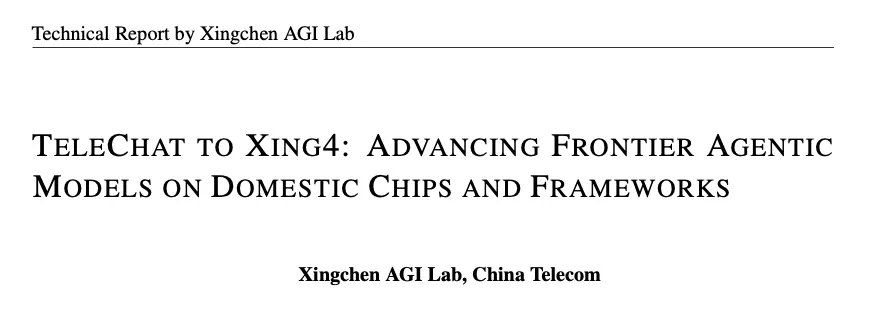
It is reported that this new model was trained from start to finish on 8,192 Ascend 910C cards and MindSpore, pushing the scale of domestic chips training domestic models all the way to the trillion-parameter level.
The technical report behind it further open-sources the architecture selection, the eight-thousand-card cluster training scheme, and the Agent post-training methodology.
It is fair to say that in the past, when people talked about training models on domestic compute, all the outside world saw was a single line like "successfully ran through," or a few scattered benchmark scores.
This time, those who come later and want to build clusters on domestic compute finally have a blueprint they can build from.
Focused on code and long-horizon Agents, breaking into the mainstream top tier
Let's look at the model itself first.
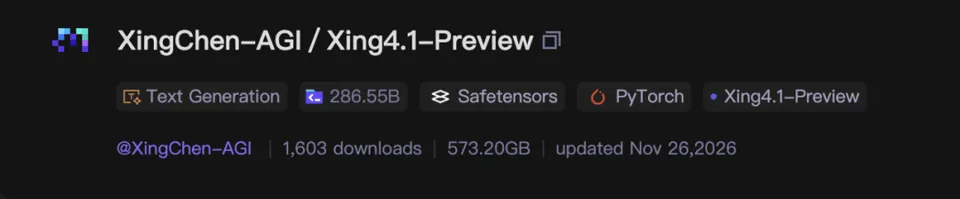
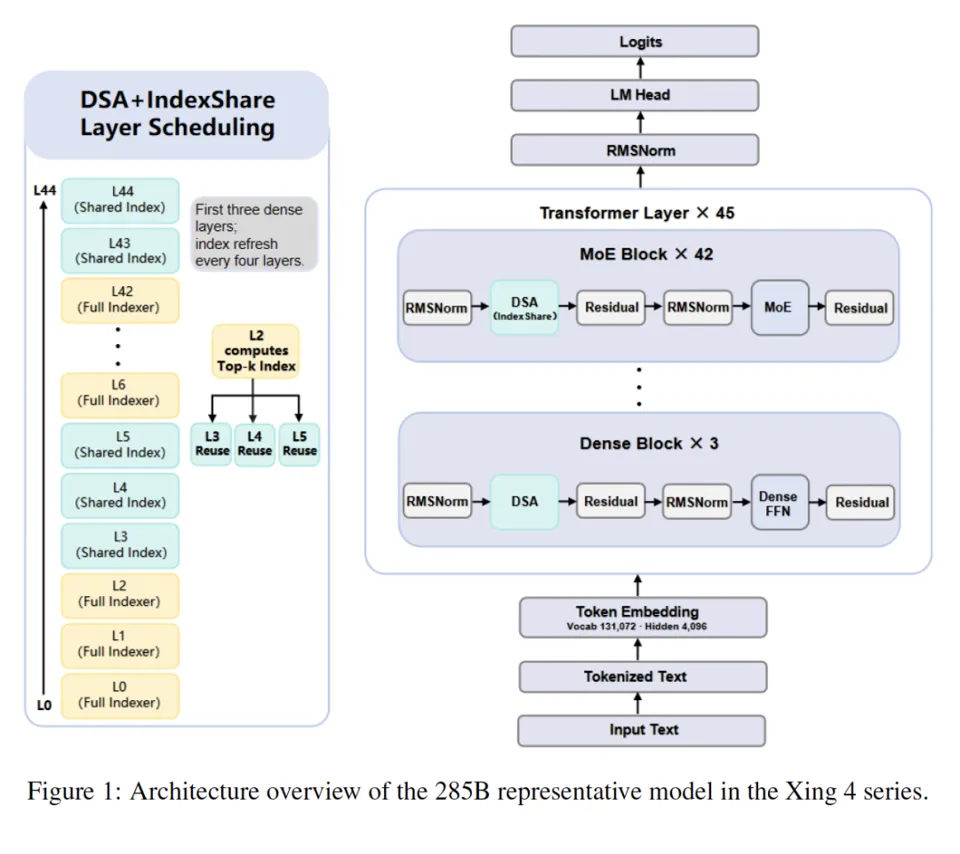
Xing4.1-Preview this time focuses on code programming and long-horizon complex Agent tasks, adopting a MoE (Mixture of Experts) architecture, with 285 billion total parameters, 17 billion parameters activated per token, and support for million-token context.
Behind this model configuration is the team's trade-off between complex task capability and inference efficiency.
The team explains in the technical report that the more complex the task and the longer the execution chain, the more a sufficiently large parameter scale is needed to support planning and error correction, and the more an ultra-long context is needed to hold the complete task history.
But on the other hand, Agents often need to call the model continuously and repeatedly. As the context keeps growing, the latency of each generation step accumulates in serial execution, slowing down the entire task.
So, to give the model both the capability to handle complex tasks and sufficiently fast per-call performance, the team set two hard constraints on model scale: total parameters below 300 billion, and activated parameters per token below 20 billion.
Ultimately, Xing4.1-Preview adopted a configuration of 285 billion total parameters and 17 billion activated parameters, using the MoE architecture to control the computational cost of each inference while retaining a relatively large parameter scale.
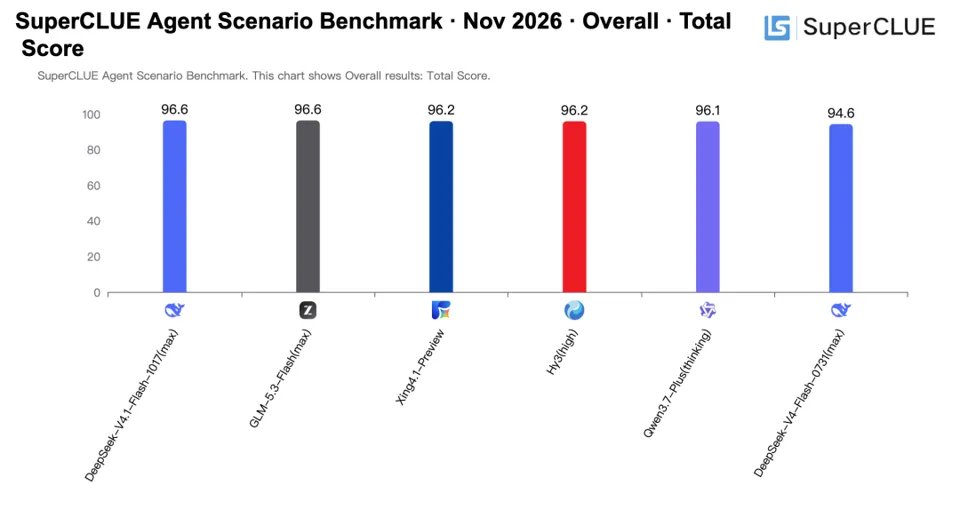
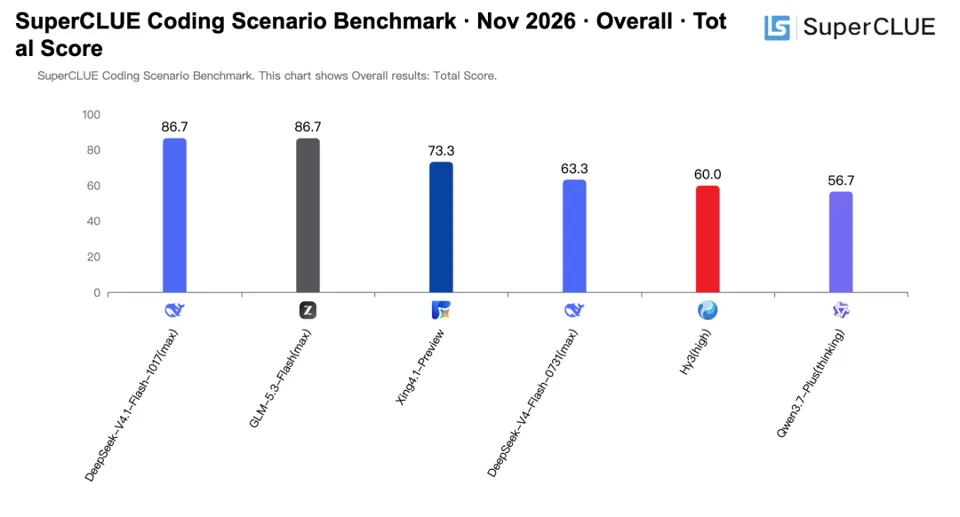
In third-party evaluations, this design also broke into the top three on the two core-scenario overall leaderboards released by SuperCLUE in November 2026.
In the Agent scenario, it scored 96.2 points, tied for third with Hy3 and just 0.4 points behind the leader.
In the code scenario, it scored 73.3 points, also ranking third and leaving the fourth-place DeepSeek-V4-Flash-0731 a full 10 points behind.
Beyond the leaderboards, Xing4.1-Preview has also undergone validation in real business scenarios. According to China Telecom, Xing4.1-Preview has already been trialed at scale in the internal TeleAgent scenario.
For the broader community of external developers, Telecom has now opened up the model weights and provided API access.
In addition to the native MindSpore format, the team also provides converted PyTorch-format weights, supporting deployment via tools such as Transformers, SGLang, and vLLM.
Those interested can give it a try.
From model structure to training system: how to make good use of 8,192 Ascend cards
Having covered the model, let's now look at how Xing4.1-Preview was actually trained.
In the technical report, the team first points out the characteristics of the Ascend 910C: relatively strong matrix computing capability, but relatively limited vector computing and memory bandwidth.
In other words, although the 910C computes matrices quickly, once vector operations and memory reads/writes cannot keep up, progress slows down.
At the same time, as model scale grows and context lengthens, the pressure on memory usage and data movement also increases, and once placed in an eight-thousand-card cluster, the challenges of inter-card communication and multi-card coordination become prominent.
To address the above bottlenecks, the team's overall solution is:
Around the hardware characteristics of the Ascend 910C, co-design the model architecture and the training system, so that the model fully leverages the chip's computing advantages while the eight thousand cards train collaboratively and efficiently.
Model architecture: let matrices compute more, make long-context overhead smaller
First, in terms of model architecture, the most intuitive change in Xing4.1-Preview is making the network "wider" and "shallower."
Under a comparable parameter budget, the team once compared two schemes: one with 60 layers and narrower experts; the other with 45 layers and wider experts.
The study found that when experts are widened, the matrix multiplication blocks become larger, which precisely feeds the matrix compute that Ascend excels at; while cutting 15 layers significantly reduces the overhead of normalization, routing, scheduling, and other vector- and serial-leaning operations.
Tests show that this single adjustment alone raised large-scale training throughput by about 10%
In addition, to handle the pressure of million-token context, the model strings several mechanisms into a pipeline:
MoE activates on demand to control computation, MLA compresses historical KV memory, DSA sparsely filters out the historical positions that truly need attention, and then IndexShare refreshes the index once every 4 layers while the middle 3 layers directly reuse it.
According to the paper's simulation results under 256K context, this combination boosts Prefill throughput by up to 4.68x compared with a pure MLA baseline.
Finally, the team also customized the cmHC fused operator for Ascend to stabilize multi-path residual training.
On the inference side, DSpark block-level speculative decoding is used to convert serial generation into matrix computation as much as possible, and measured results show decoding throughput raised by 2.67–3.77x.
Training System: Making 8,192 GPUs Wait Less, Duplicate Less, and Waste Less VRAM
The model architecture determines how computation is organized, while what MindSpore HyperParallel's training system needs to solve is how to distribute this work across 8,192 GPUs.
For a model with hundreds of billions of parameters like Xing4.1-Preview, a single GPU's VRAM simply cannot hold it.
The common approach in the past was pipeline parallelism, which splits the model by layers and assigns them to several groups of GPUs to compute in relay. But the problem is obvious: as long as the preceding group hasn't finished computing, the GPUs behind can only wait idle.
So the team switched to HSDP hybrid sharding to directly replace pipelining.
The core of this scheme is to split into two tiers based on the network speed differences within the cluster:
Within the same supernode, the interconnect speed between GPUs is extremely fast, so model parameters are sharded and stored across GPUs, and when computation reaches a certain layer, they are temporarily gathered nearby.
Between different supernodes, the network speed is relatively slow, so each keeps a complete replica and only synchronizes updates once after computation finishes, minimizing cross-node transfers.
Combined with overlapping scheduling that "computes the current layer while prefetching the next layer's data," VRAM holds up, and pipeline idling is eliminated.
Paper measurements show that after removing pipeline parallelism, training throughput improved by 16.1%.
Beyond the sharding scheme, the system layer also made several refinements in computation, VRAM, and host scheduling.
The Muon optimizer used for parameter updates was changed so that each group designates one GPU to compute centrally and then distribute, eliminating redundant computation across multiple GPUs.
For 256K long sequences, VRAM is kept in check through fine-grained selective recomputation, while the sparse index module returns results layer by layer in advance, shortening wait times.
To address host scheduling interference that tends to occur in eight-thousand-GPU clusters, the team also implemented CPU core binding and core isolation, bringing an additional 5%–10% throughput improvement at the 8,192-GPU scale.
Combined with the aforementioned hybrid sharding, the entire training system overhaul brings about 15%–30% end-to-end throughput improvement, which is even more pronounced in long-sequence scenarios.
In the live broadcast of Xingchen large model training launched last night jointly with Xinhua Net and QbitAI, the Xingchen team provided a more intuitive reference:
The industry had previously circulated the claim that "early 910B out-of-box efficiency was only one-fifteenth of H200," while China Telecom, based on prior accumulation, achieved 60% of NVIDIA's equivalent compute out of the box on 910C; from initially reusing FSDP and hitting pitfalls to switching to HSDP, and then to coordinated tuning at the scheduling and operator layers, training efficiency was ultimately raised to 93%.
In terms of stability, compared with the approximately 90% cluster availability when Llama trained on over 16,000 H cards in earlier years, the Xingchen team achieved over 96% overall availability on domestic large-scale clusters, and compressed fault recovery from 3 hours to the minute level.
Post-Training: TeleGym — Teaching Models to "Get the Job Done"
In the post-training stage, the team built an execution foundation called TeleGym, connecting sandbox environments, workspaces, result validation, and the self-developed TeleAgent along with external Agent frameworks such as Claude Code and OpenCode to the same set of interfaces.
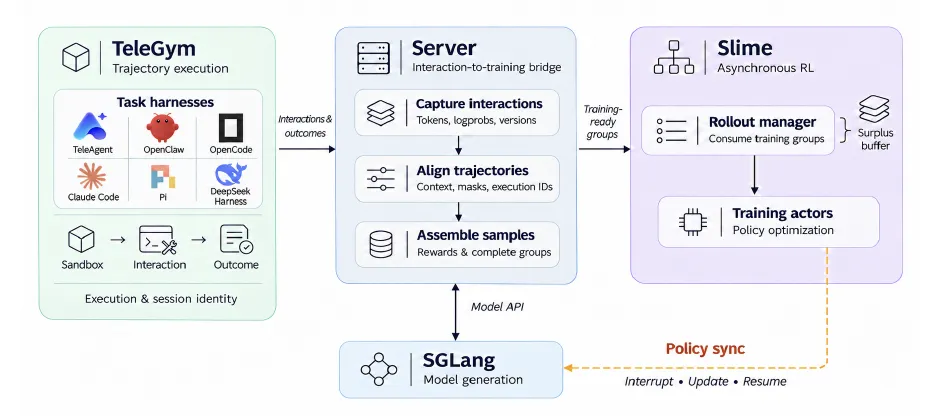
With this foundation, the model can directly operate in real environments, and the complete trajectory of "what was done and whether the results are correct" is fed directly into policy optimization.
To address the problem of varying task lengths and idle devices in long-horizon Agent training, TeleGym separates task sampling and parameter updates into different device pools for asynchronous progression, and introduces a Partial Rollout mechanism.
Whenever policy weights are updated, long tasks that haven't finished don't need to start over; instead, generation is paused, the workspace, session, and current progress are retained, and execution continues with the new weights, while recording the policy version corresponding to each trajectory segment.
Giving Model Iteration More Certainty in Our Own Hands
Finally, placing Xing4.1-Preview in a broader industry context, the collaboration between domestic compute and domestic models has already passed the "can it be used" stage and is entering the "how to use it well" stage.
The current issue with domestic compute is no longer whether there are enough chips, but whether competitive large models can be trained from scratch on them.
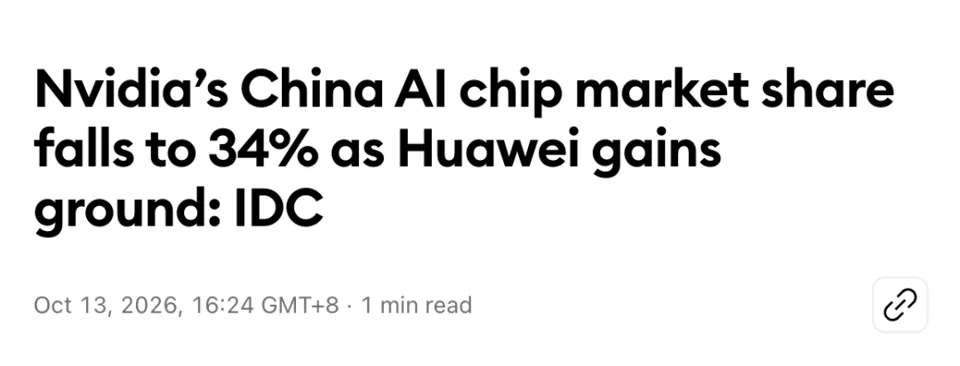
IDC's statistics on China's data center AI chips for the first half of 2026 show that total domestic AI accelerator shipments reached 2.008 million units.
Among them, non-GPU accelerators (NPU, ASIC, etc.) shipped 1.016 million units, a year-over-year increase of nearly 80%, surpassing GPUs in a half-year period for the first time.
In terms of applications, in September this year, Huawei disclosed that more than 40 models have been natively trained on Ascend and CANN.
At the same time, mainstream open-source models have begun to carry large-scale online inference on domestic chips at the hundred-thousand-GPU level.
It can be said that as domestic hardware gradually falls into place, whether it can support large-scale model training and real-world application deployment has become the key test of this compute foundation's quality.
And China Telecom happens to be among the first players to settle down and thoroughly run through this entire chain.
The early TeleChat2 series covered different scales including 3B, 7B, 35B, and 115B; the subsequent TeleChat3-MoE further explored hundred-billion to trillion-level architectures and cluster engineering;
By the Xing4 series, from the 29B model open-sourced in September this year to the 285B model released this time, the focus has further converged on code, million-token context, and long-horizon Agent tasks.
At the end of the technical report, the team also revealed their next step: they are currently training a trillion-parameter model in this series on the Ascend platform.
And this time, the team not only delivered a 32-page "construction blueprint," but also, in last night's livestream, brought the backend dashboard for training a trillion-parameter model on a domestic ten-thousand-GPU cluster directly in front of the camera.
During the livestream, the team also discussed the real difficulty of training a large model from scratch within the domestic ecosystem: academic accumulation is almost entirely on CUDA, so switching to a domestic framework is equivalent to starting from zero—every step has to be reproduced independently, and training a trillion-parameter model is truly uncharted territory.
Many hidden pitfalls that cannot be seen at 285B emerge once you reach a trillion—for example, the trillion-parameter model once showed the strange phenomenon of having a lower Loss than 285B while performing worse in evaluations. It was eventually traced to the previously tolerated "percentile" training-inference error; only after aligning layer by layer from FFN to Attention and reducing it to 8e-8 did performance return to normal. The same batch of data that was perfectly fine on 285B also produced glitches on the trillion-parameter model.
This is precisely where the value of this 32-page technical report lies.
The validated operator solutions, communication strategies, memory management, and post-training system not only support this 285B model, but can also serve directly as the starting point for the next-generation trillion-parameter model.
The team can continue to adjust the architecture and expand task boundaries based on existing accumulation, without having to explore from scratch in every iteration.
Making these engineering details public also provides a concrete reference for other teams preparing to build clusters on domestic compute—
which architectures fit the chip characteristics, which stages are prone to bottlenecks, and which optimizations have already been validated at the eight-thousand-GPU scale.
It goes without saying that the supply and usage conditions of external compute may still change, and future model R&D depends precisely on the ability to independently and continuously iterate on domestic compute.
Xing4.1-Preview this time delivered open-source weights and API services, and also disclosed the complete training methodology on domestic compute.
For China Telecom, these engineering accumulations deposited in the underlying foundation give the next generation of model R&D an added certainty that it can arrange on its own.
Reference links: [1]https://huggingface.co/XingChen-AGI/Xing4.1-Preview [2]https://www.modelscope.ai/models/XingChen-AGI/Xing4.1-Preview [3]https://arxiv.org/html/2611.22115v1
One-click triple support:****"Like" "Repost" "Little Heart"
Welcome to leave your thoughts in the comments!
— End —
🌟 Light up the star 🌟
See frontier tech progress every day