Robbyant Open Sources LingBot-Touch Tactile Model for Robots
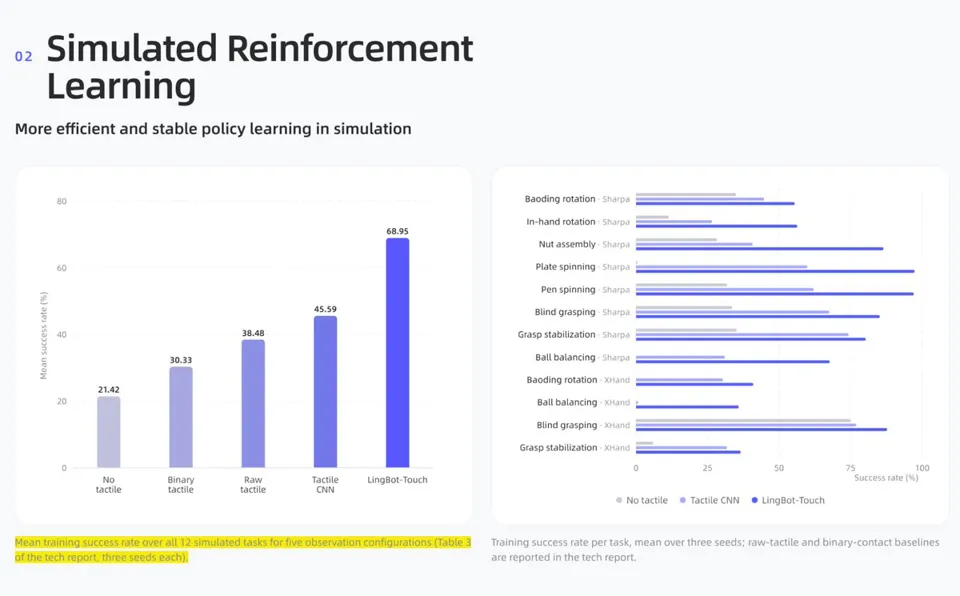
Robbyant has open-sourced LingBot-Touch under Apache 2.0, converting fingertip tactile sensor readings into signals usable by robot control software and filling the gap where cameras cannot sense grip force or slip. The team trained three same-size encoders (5.46M parameters each) on identical touch data; at 4,000 hours, the JEPA variant that predicts masked regions in latent space reached 49.3% top-5 on tactile-to-video retrieval with MAE under 9%, versus just 3.1% for the VAE. The author attributes JEPA's edge to the sparsity and low signal-to-noise ratio of tactile data.
Related Entities
Full Report
Rohan Paul (@rohanpaul_ai) · 2026-11-10 15
Looks like a brilliant open source release for robotics.
A great problem of robotics is that a camera can’t tell a robot how hard it’s squeezing or whether a grip is slipping, but a fingertip sensor can.
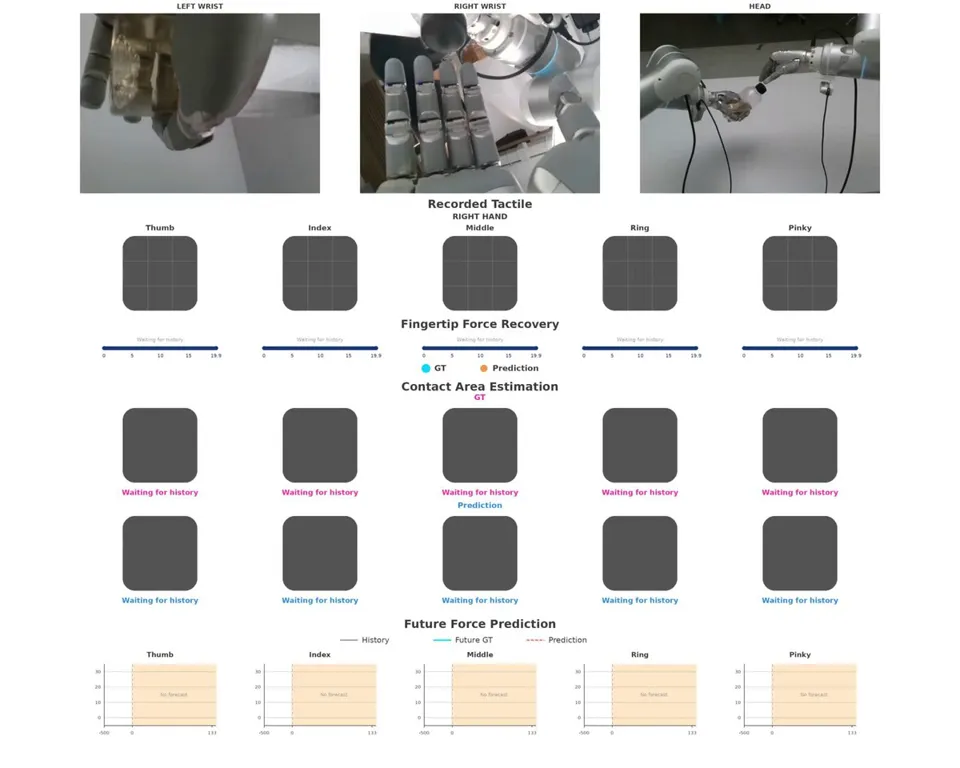
Robbyant released LingBot-Touch, an open-source model (Apache 2.0) that gives robots a sense of touch by turning fingertip sensor readings into signals their control software can use.
Robbyant trained three same-size encoders (5.46M parameters each) on the same touch data for LingBot-Touch. At 4,000 hours, the JEPA version, which predicts the masked parts in latent space, got 49.3% top-5 on tactile→video retrieval. MAE stayed under 9%. The VAE got 3.1%, worse than it did at 1,000 hours.
I think the reason is the data itself. A finger only presses a few spots, so most of every frame is close to zero, and the readings that aren't zero are noisy. Redrawing that means copying zeros and noise nobody can predict, and a JEPA only predicts the representation, so it can leave both out. The paper names the sparsity and the low signal-to-noise ratio as the reasons they went with JEPA.
The sparsity shaped training too. With 80% of taxels masked from step one, a lot of clips had no contact left to see and the gradients blew up, so they ramp the mask from 40% to 80% over the first 300 steps. Targets come from an EMA encoder at four depths, following V-JEPA 2.1.
To isolate the effect of multi-source data, they hold each sensor's own data fixed and add only the other modalities. With the target sensor's data unchanged, the multi-source model improves on seven of the eight sensor-task pairs, indicating that data from heterogeneous sensors directly benefits each individual sensor.