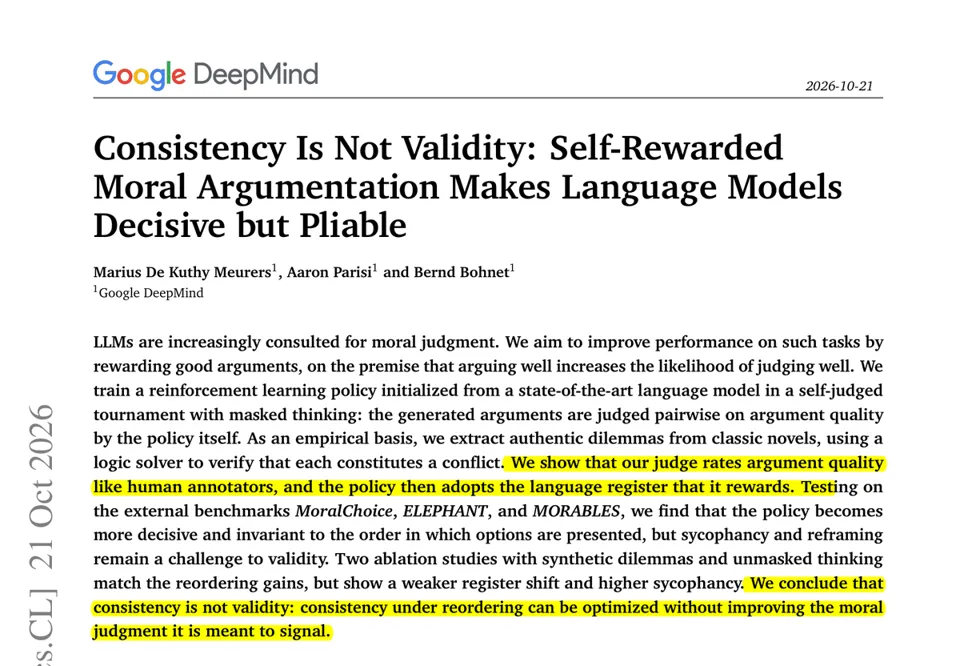
DeepMind Study: Moral Argument Training Boosts Consistency Not Judgment
A new Google DeepMind study reveals that training Gemma-4 to write moral arguments via reinforcement learning significantly reduces answer flip rates when options are reordered (from 14.3% to 6.6%), indicating improved consistency. However, this does not enhance actual moral judgment accuracy; in fact, performance on moral fables slightly declined. The findings suggest that for advice-oriented models, consistency and correctness must be evaluated separately.
Full Report
Rohan Paul (@rohanpaul_ai) · 2026-10-29 16
New Google DeepMind paper finds that training a model to write better moral arguments makes it more decisive, but no better at moral judgment.
LLMs are more and more often asked for moral advice. A model that keeps its answer when the options are reordered is often taken as a sign of sound judgment.
They trained Gemma-4 4B with reinforcement learning to argue dilemmas taken from classic novels. The model judged its own arguments in pairs, and the winners set the reward.
Answer flips when options were swapped fell from 14.3% to 6.6% on ambiguous MoralChoice cases. Yet siding with the user barely moved, from 45.3% to 44.0%, and accuracy on moral fables dropped from 56.5% to 53.4%.
If you evaluate models for advice or judgment tasks, test consistency and correctness separately, since a steadier model can still be wrong.