Liquid AI Open-Sources 74M-Parameter Streaming Audio Codec
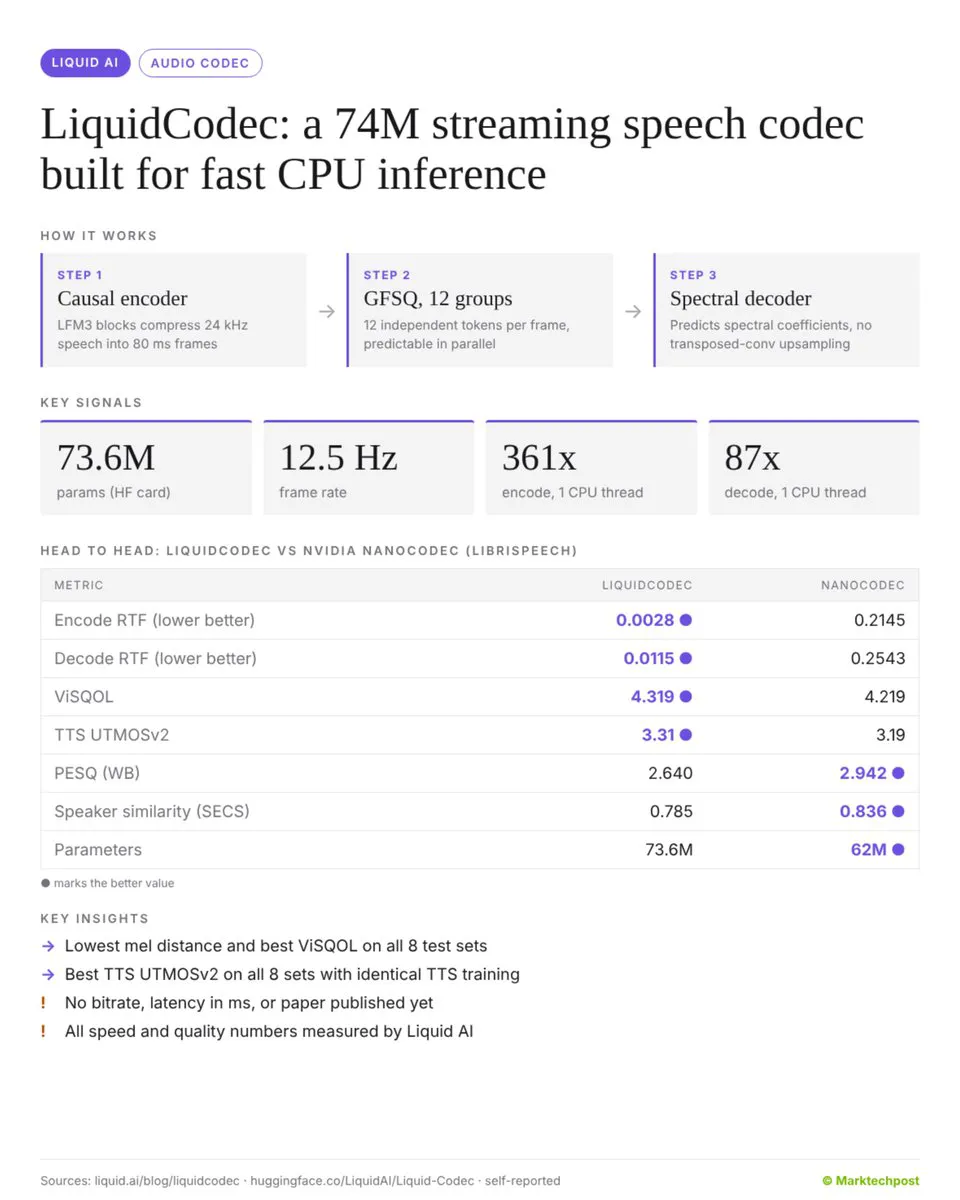
Liquid AI released LiquidCodec, a ~74M-parameter streaming audio codec that converts speech into tokens a language model can predict and back into audio, powering LFM3-Audio-2B and LFM3-Omni-2B. Its key innovation replaces residual vector quantization with grouped finite scalar quantization (GFSQ), producing 12 independent tokens per 80 ms frame that can be predicted in parallel, while the decoder predicts spectral coefficients directly and skips transposed-convolution upsampling. On a single CPU thread of an Apple M4 Max (FP32) it encodes at ~361x and decodes at ~87x real time, with an encode RTF of 0.0028 versus 0.0361 for Kyutai's Mimi, and posts the best ViSQOL and TTS UTMOSv2 across all 8 test sets; however, PESQ still trails NVIDIA's NanoCodec on 7 of 8 sets, and no bitrate or latency in milliseconds was published. Weights are on Hugging Face with GGUF builds for llama.cpp.
Related Entities
Full Report
▲ Marktechpost AI · 2026-11-12 22
▲ Liquid AI just released LiquidCodec, a ~74M-parameter streaming audio codec that turns speech into tokens a language model can predict, then back into audio. It powers LFM3-Audio-2B and LFM3-Omni-2B.
The key idea is grouped finite scalar quantization (GFSQ) instead of residual vector quantization. Each 80 ms frame becomes 12 independent tokens, so all 12 can be predicted in parallel. The decoder predicts spectral coefficients directly, skipping transposed-convolution upsampling.
On 1 CPU thread of an Apple M4 Max (FP32), it encodes at ~361x and decodes at ~87x real time. Encode RTF is 0.0028 vs 0.0361 for Kyutai's Mimi. It posts the best ViSQOL and TTS UTMOSv2 on all 8 test sets. It is a trade-off though: NVIDIA's NanoCodec still scores higher PESQ (WB) on 7 of 8 sets (LibriSpeech 2.942 vs 2.640), and Liquid AI has not published a bitrate or latency in ms.
Weights are on Hugging Face, with Q4_0, Q4_K_M and Q8_0 GGUF builds for llama.cpp. Q4_0 shrinks the decoder 3.5x......
Full analysis: