OpenAI Releases GPT-6.2 Astra and Sol with 3D Generation Lead
OpenAI launched GPT-6.2 Astra and the lightweight Sol simultaneously. Astra upgrades complex agent tasks, scientific research and 3D generation, topping the AA-3D leaderboard at 1318 Elo while cutting API prices 20%. Sol approaches Astra's coding ability at one-fifth the task cost, and both are available on ChatGPT Work, Codex and the API.
Related Entities
Full Report
Contents6 sections
Mengyao reporting from the Non-Gaussian Temple
QbitAI | WeChat Official Account QbitAI
OpenAI, you really know how to drop a double bombshell.
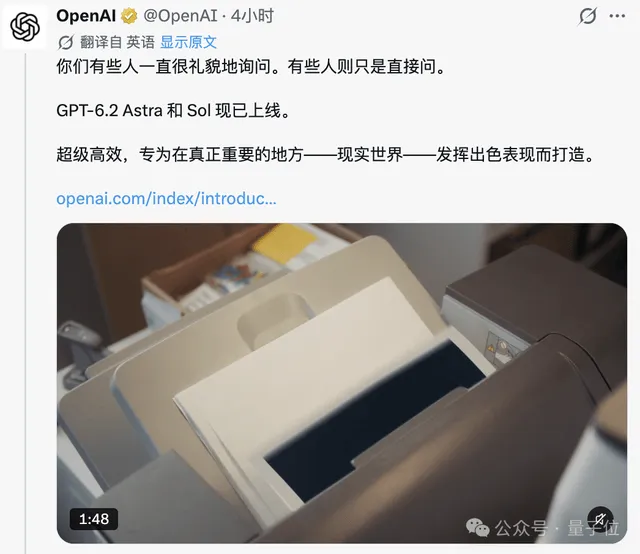
GPT-6.2 Astra and GPT-6.2 Sol have arrived together this time!!! (Cheers.jpg)
I have to say, Astra's performance across the board has been cranked up this time—
- Upgraded complex Agent capabilities: Astra's professional task benchmark improved by 5.2 percentage points over the previous generation, with task cost dropping to less than one-third.
- Research capabilities set a new record: Related benchmarks improved by 9 percentage points, and OpenAI directly calls it the world's strongest scientist model.
- Coding capabilities upgraded again: It scored 44.2% on the FrontierCode 2.0 benchmark, a 1.4 percentage point improvement over the previous generation.
- 3D generation tops the leaderboard: It took first place on Artificial Analysis's AA-3D benchmark with 1318 Elo, surpassing Fable 5.2's 1271 points.
Let's skip the talk and go straight to the talent show to see just how capable the model really is~

Take a look at this—Astra transforms into a web designer, handling everything from layout to imagery, and can even tailor exclusive visual styles for different websites:

Now look at this—using only photos and a manual, Astra modeled a remote-controlled car down to the engine, and even completed the assembly animation. Pretty impressive, huh:

On the AA-3D benchmark, it topped the leaderboard with 1318 Elo. Detailed 3D models are generated on demand, and immersive interactive scenes can be generated directly too, be like:
△x@fal
The lightweight Sol version is equally impressive, with coding capabilities approaching Astra's while costing only one-fifth as much per task.
On pricing, the API price for 6.2 Astra has dropped by 20%—
$8 per million input tokens and $40 for output, with cached input pricing down by 60%.
6.2 Sol maintains its original pricing, with API input and output at $2 and $10 per million tokens respectively.
Both models are now available on ChatGPT Work, Codex, and the API, and can be used by Plus, Pro, and other subscription users.

Without further ado, let's dive straight into the specific capabilities of the new models~
Astra Sets Professional Task Records, Sol Approaches Flagship Performance
First, let's look at just how much GPT-6.2 has upgraded this time.
In its official announcement, OpenAI positions 6.2 Astra as a flagship model for highly difficult projects.
6.2 Sol handles high-frequency, everyday professional tasks.
I've also put together a quick summary of the capability highlights of both models, so let's take a first look!!!
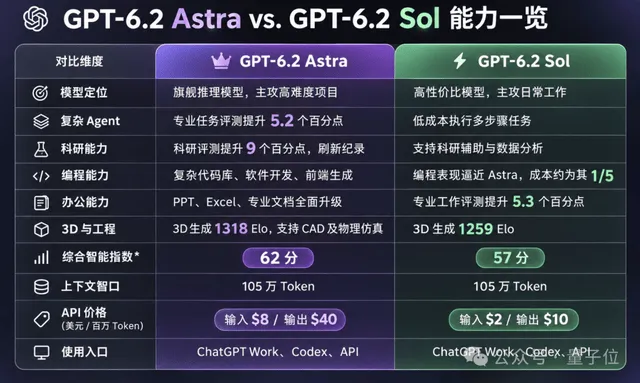
△AI-generated
From the published results, Astra's most obvious improvements are concentrated in complex task execution, research, coding, and visual design—
Complex professional tasks set new records, with completion cost dropping to less than one-third of the previous generation.
On the Agents' Last Exam benchmark, GPT-6.2 Astra improves by 5.2 percentage points over GPT-6 Astra.
Compared with Claude Fable 5.2, it also leads by 5.5 percentage points, while the per-task cost is only 5% of the latter's. It really has something going for it...

Research capabilities also continue to improve, and OpenAI even directly gives it the positioning of "the world's strongest scientist model."
On Terminal-Bench-Science 0.1, Astra improves by 9 percentage points over the previous generation, with task cost also dropping to less than one-third.
The Vals Science Index also set a new record. It requires the model to understand real biological data to design experiments and infer the operating rules of simulated systems through experiments.
In other words, compared with simply answering scientific knowledge questions, it is now closer to the actual workflow of researchers~

Of course, coding, 3D design, and computer operation capabilities have collectively reached the next level too—
In the comprehensive intelligence index of third-party evaluator Artificial Analysis, Astra scored 62 points, a 5-point improvement over the previous generation.
Sol matched the previous-generation flagship with 57 points, but at a lower cost.
3D generation is even more impressive. Astra topped the AA-3D leaderboard with 1318 Elo, surpassing Claude Fable 5.2's 1271 points, while Sol also scored 1259 points.
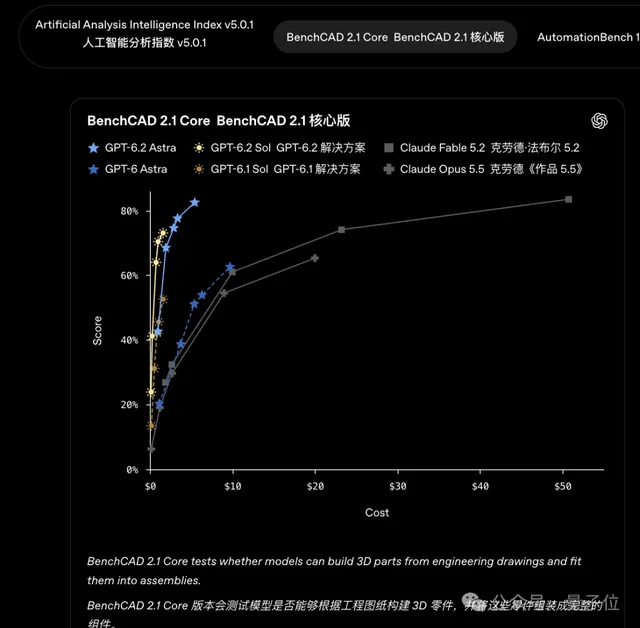
OpenAI also showed a rather interesting demo—
GPT-6.2 Astra directly got hands-on with mechanical design in CAD software.
It can process mechanical parts one by one, check the connection relationships between components, and even complete engineering tasks that require fine operations on its own:

Now let's look at the demo below.
6.2 Astra directly simulated the driving dynamics of a car on a mountain road.
It first creates a 3D model, then writes a Python program to simulate the motion relationship between the tires and the suspension system, and finally uses Blender to generate an animation.
The car driving footage, suspension motion, and tire force data are presented in sync, making it easy for engineers to quickly test design solutions—

Now let's look at another example in visual reasoning.
Astra directly whipped up an interactive 3D backyard garden.
Vegetable planting beds, fences, and greenery are all there, and you can freely switch viewpoints and adjust the flowerbed layout.
It even simulates sunlight at different times of day, so you can intuitively see the lighting conditions for the plants:

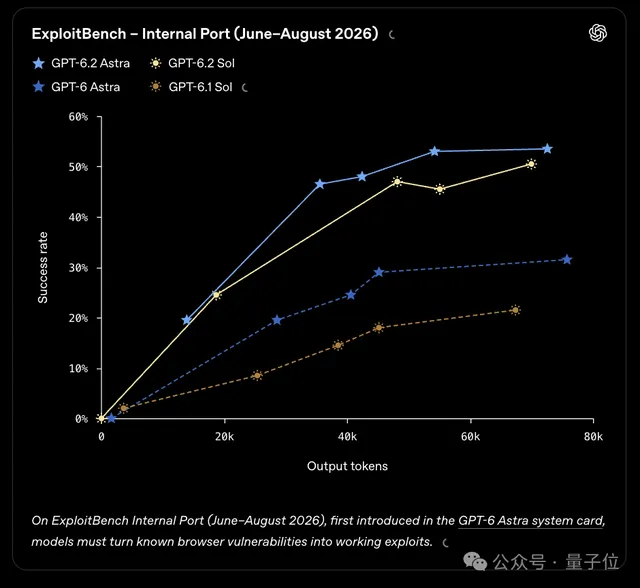
Cybersecurity capabilities have also seen notable improvement.
GPT-6.2 Astra and Sol have been comprehensively upgraded in vulnerability discovery, exploitation, and code remediation.
They even both reached OpenAI's highest risk level for cybersecurity capabilities.
In the DeepBinary vulnerability mining benchmark, the estimated total bounty for vulnerabilities discovered by Astra exceeded $1 million, far surpassing the previous generation's roughly $440,000:
After the flagship model showed off its capabilities, 6.2 Sol has its own highlights—
especially in programming, where it is already approaching Astra.
In Cognition's FrontierCode 2.0 benchmark, the gap between GPT-6.2 Sol and Astra is only 0.5 points, while its task cost is only about one-fifth of the latter's.
In other words, Sol can already approach the flagship model's performance on some real development tasks at a significantly lower cost.
In the everyday task benchmark LifeVal, Sol even surpasses the previous generation GPT-6 Astra, at about one-seventh of the latter's cost.
OpenAI also revealed that many employees internally have already made Sol their default model for both technical and non-technical work, which also explains the division of labor between the two models.
PPT, Excel, and documents all upgraded—GPT-6.2 has stronger office capabilities
Beyond scientific research and programming, GPT-6.2 has another upgrade this time that will probably resonate with working professionals.
Making PPTs, handling Excel, and writing professional documents have all been strengthened!!!
In the GDPval v2 benchmark, which measures real professional work capabilities, Astra improved by 6.2 percentage points over the previous generation, and Sol also improved by 5.3 percentage points.
Moreover, the output tokens Astra needs to complete tasks decreased by 22%, so efficiency improved as well.
On the Excel side, OpenAI also had the old and new generations of Astra complete the same task: based on financial data, create revenue forecasts and valuation tables for a fictional company:
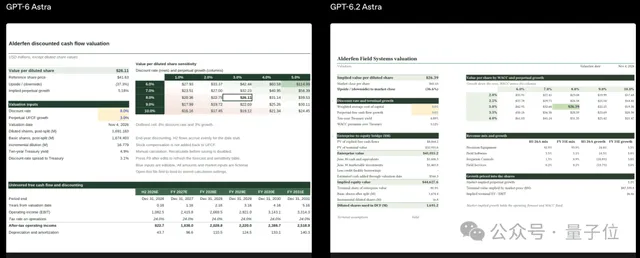
Both generations of models could complete the task, but the tables generated by GPT-6.2 Astra are clearly clearer and easier to use.
It puts the revenue structure, the calculation process from enterprise valuation to per-share value, and the valuation changes under different assumptions all on the same page.
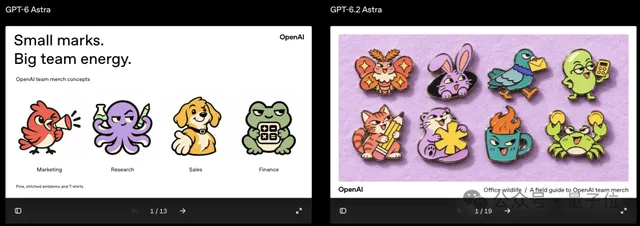
On the PPT side, OpenAI also had the two generations of Astra design animal-themed merchandise for four teams.
Compared with the previous generation, which designed only one character per team, GPT-6.2 Astra produced 8 designs in one go, covering forms such as badges, T-shirts, and backpack embroidery:
In another case, OpenAI had the two generations of Astra create a one-page market analysis PPT for a mid-to-high-end women's fashion brand.
GPT-6.2 Astra's output is clearly closer to a presentation-ready level—
it not only classifies brands by price and style, but also adds brand logos, price ranges, and images and prices of 6 representative dresses:

For working professionals who deal with spreadsheets and slides every day, this round of upgrades is indeed quite practical.
Currently, GPT-6.2 Astra and Sol have both launched on ChatGPT Work, Codex, and the API, and are available to subscribers such as Plus and Pro users.
Friends who are interested can give them a try~
Reference links: