Claude Autonomously Finds Algorithm Breaking 3SUM and APSP Limits
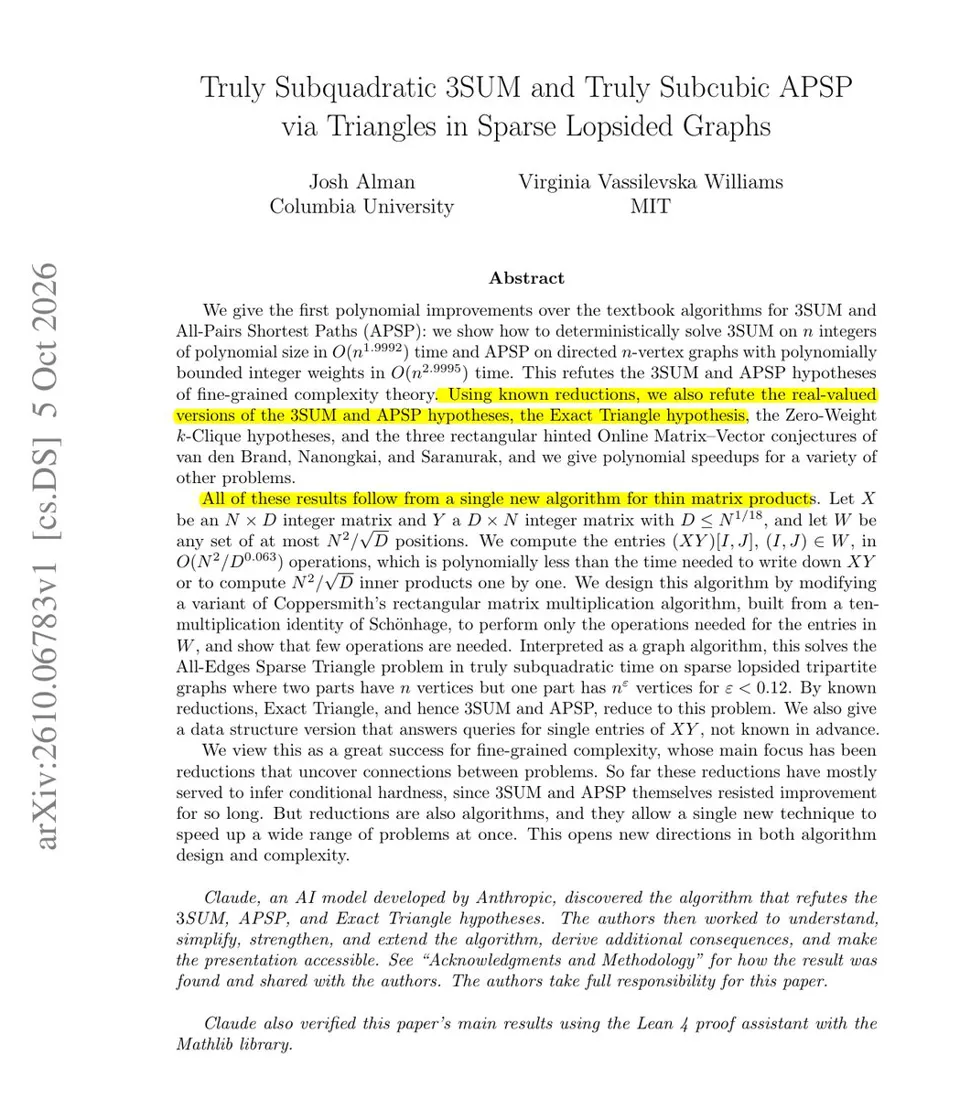
A new Columbia and MIT paper reports that Claude autonomously discovered a faster method for computing selected entries of a product of two long, thin matrices, which classic reductions turn into speedups for 3SUM and all-pairs shortest paths. 3SUM now runs in O(n^1.9992) and APSP in O(n^2.9995, tiny gains that nonetheless refute the long-standing 3SUM and APSP hypotheses. The method was found in a single AI session using 16M output tokens with no human input and was formally checked in Lean 4.
Full Report
Rohan Paul (@rohanpaul_ai) · 2026-11-21 18
New Columbia and MIT paper shows that an algorithm Claude found beats the long-standing speed limits for 3SUM and all-pairs shortest paths.
3SUM asks whether 3 numbers in a list sum to 0, and all-pairs shortest paths asks for every distance in a graph. For decades, nobody beat textbook quadratic and cubic time by more than tiny factors, and many assumed nobody could.
Claude found a faster way to compute selected entries of a product of 2 long, thin matrices, skipping work a classic method does. Known reductions then turn this into speedups for 3SUM, shortest paths, and many related problems.
3SUM now runs in O(n^1.9992) time and shortest paths in O(n^2.9995), tiny gains that still refute the 3SUM and APSP hypotheses. Claude found the method in 1 session using 16M output tokens with no human input.
Treat "known hard" algorithm limits as open targets for AI search, and check AI-found proofs formally, as this paper did with Lean 4.