GPT-6 Astra Leads Proof of Lattice Definition for Standard Model
In the first guest post on OpenAI's science blog, UCSB physicist Nathaniel Craig reports that GPT-6 Astra helped produce a candidate lattice definition for the Standard Model, a problem open for over 50 years. Astra turned his existing ideas into a concrete construction and led the writing of the detailed proof, marking a notable case of AI contributing to foundational theoretical physics.
Full Report

New AI Era Report
Just now, OpenAI "completed" the Standard Model of particle physics?
For a physics problem that has remained unresolved for over 50 years, GPT-6 Astra provided "substantive" help to UC Santa Barbara (UCSB) physicist Nathaniel Craig.
As the author of the first guest post on OpenAI's science blog, physicist Nathaniel Craig described how he worked with GPT-6 Astra to produce a candidate lattice definition of the Standard Model of particle physics.
Astra helped him turn his existing ideas into a construction and led the writing of the detailed proof.
Simply put: humanity has studied the Standard Model for half a century, yet it has always lacked a "mathematical foundation."
And this time, AI not only understood the physicist's bold idea, but also stepped in and led the completion of the most central detailed proof.
The author emphasized that this is only the beginning, that expert review is still needed, and that it cannot yet be used directly for practical simulations.
Humanity's most successful theory has actually never been "fully defined"?
In the physics community, the Standard Model is almost synonymous with "precision."
It describes the known fundamental particles and three of the four fundamental forces of nature—the strong force, the weak force, and the electromagnetic force.
From the low-energy radio emission of hydrogen atoms in the 21-centimeter band to high-energy particle collisions at the Large Hadron Collider (LHC), spanning a full 18 orders of magnitude, the theoretical calculations of the Standard Model match experimental results perfectly.
But such a theory, which has existed for more than 50 years, has always had an underlying gap: to this day, we have not provided its "non-perturbative definition."
What does this mean?
When dealing with complex problems, physicists often use a technique called perturbation theory: first simplify, then patch up, and gradually improve.
For example, when calculating a multi-electron atom, one can first ignore the repulsion between electrons and consider only the attraction of the nucleus. After solving this simple problem, the electron repulsion is added back as a small correction.
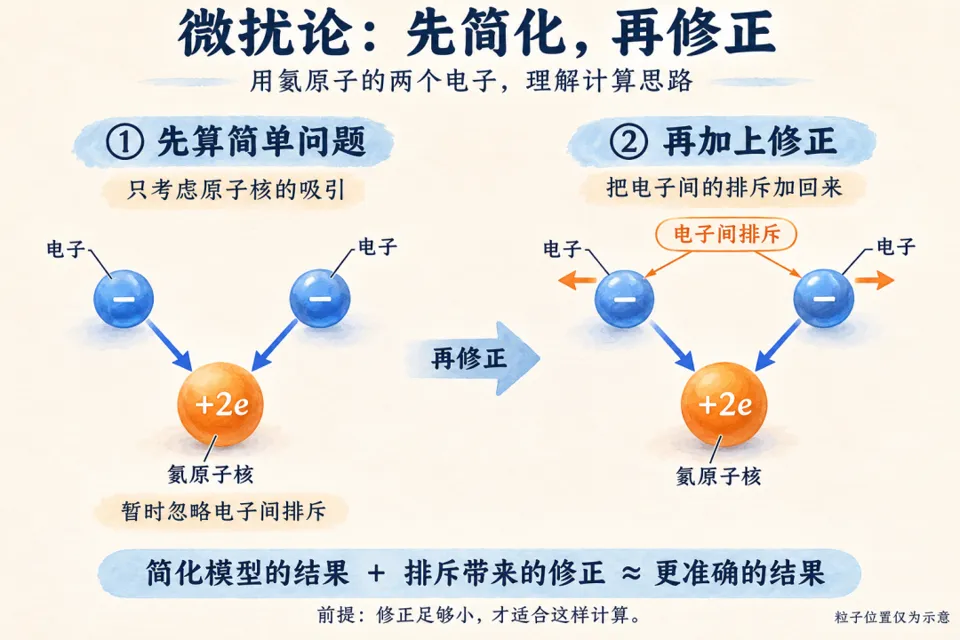
So perturbation theory does not necessarily require accounting for all interactions. The key is to find an easy-to-solve starting point, and to ensure that the effect added back can indeed be treated as a small correction.
This technique is extremely useful in many electromagnetic problems. For example, for the electron magnetic moment, theoretical predictions can already withstand experimental tests at the level of one part in a trillion.
But if the ignored effects are too large—large enough to change the entire character of the system—this technique may fail.
For example, to calculate the proton mass, physicists usually need to rely on non-perturbative methods. At present, the most reliable approach is called Lattice Field Theory.
Since continuous spacetime is too difficult to handle, spacetime is cut into discrete grid points (lattice sites). The spacing of the grid defines the shortest distance the theory can resolve.
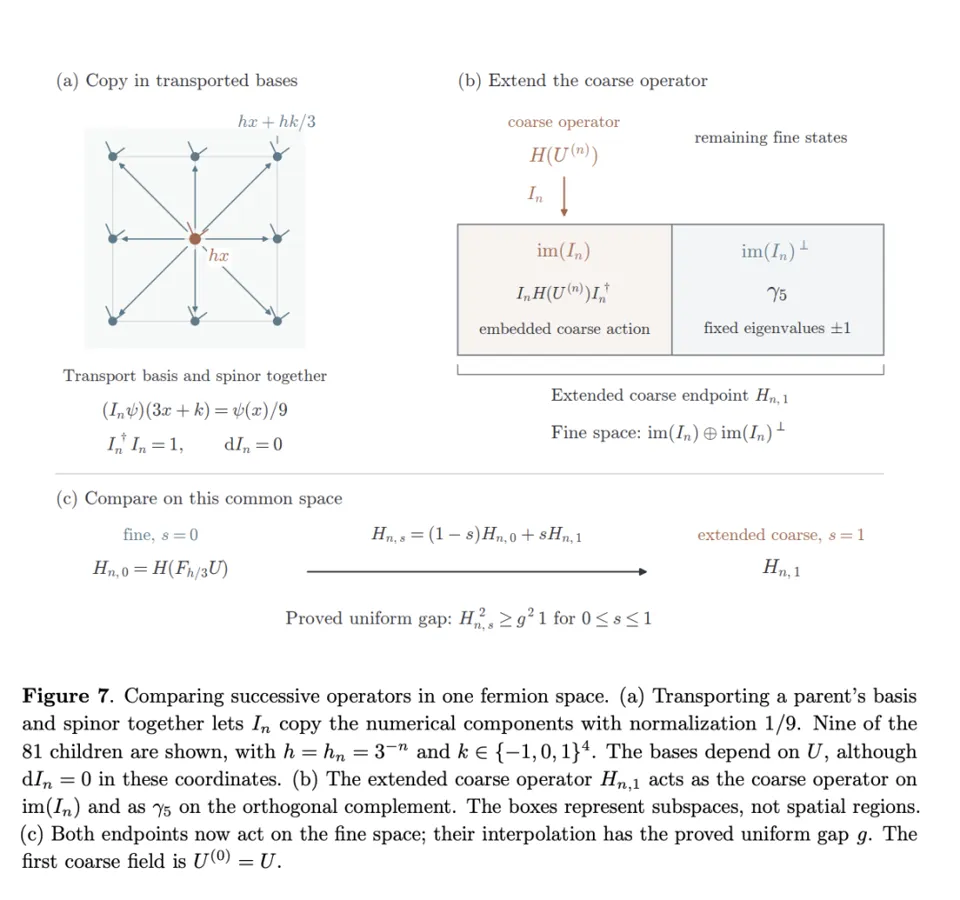
This way, not only can a rigorous definition be given mathematically, but it can also be thrown directly into a computer for brute-force computation.
Over the past few decades, physicists have thoroughly studied the strong force using lattice field theory, and have even calculated the proton mass from first principles.
So why not just move the entire Standard Model onto the lattice?
The Left-Handed Glove in the Mirror: The "Doubling" Curse of the Weak Force
Standing in the way is a physical property: _chirality.
What is chirality? Think of a glove in a mirror. The reflection of a left-handed glove in a mirror is a right-handed glove.
If you originally have one left glove and one right glove, then the mirror still shows one left and one right—the world is symmetric. But if you only have a left glove, the extra right glove in the mirror looks out of place.
In the Standard Model, the strong force and the electromagnetic force are both "fair"—they treat left-handed and right-handed particles equally, so they are easy to put on the lattice.
But the weak force only interacts with left-handed fermions (such as quarks and electrons), and completely ignores right-handed particles.
This is where the trouble begins.
Physicists discovered that as long as you use the most natural rules to put a left-handed particle onto a spacetime lattice, the lattice will, as if by magic, automatically insert a "right-handed partner" that you never asked for.
In physics, this is called fermion doubling. You originally wanted to study only the "left-handed world," but the lattice forcibly gives you both left- and right-handed particles, so the types of particles you calculate are all wrong, and the weak force simply cannot be handled.
To explain this strange phenomenon, Nathaniel Craig offered a very elegant analogy: light and mirrors in a box.
Light has two circular polarization states: left-handed and right-handed. Suppose you want to build a box in the laboratory that contains "only left-handed light," so you shine left-handed light into the box with a laser, and place an ordinary mirror at each end of the box to let the light reflect back and forth.
Surprisingly, you would find that when left-handed light hits an ordinary mirror and bounces back, it becomes right-handed light! The box instantly contains both kinds of light.
What to do? Scientists long ago invented a chiral mirror—made from specially arranged helical thin films. Such a mirror can reflect left-handed light back as left-handed light unchanged, while letting right-handed light pass straight through.

The shells of certain scarab beetles naturally have this structure and reflect only left-handed circularly polarized light.
In lattice field theory, decades ago, Paul Ginsparg and Nobel laureate Ken Wilson proposed similar mathematical rules.
Subsequently, Narayanan and Neuberger constructed "chiral mirrors" on the lattice—overlap fermions.
Martin Lüscher, Yoshio Kikukawa, and others further refined this set of tools.
With the "chiral mirror" in place, the doubled right-handed particles were also kicked out.
But one final piece of the puzzle was still missing.
The Final Piece: Aligning the "Phase," 25 Years Late
Return to the box filled with left-handed light.
As light travels back and forth between the two chiral mirrors, besides the polarization direction, there is another key property: the optical phase.
Just like ocean waves hitting a pier: when crest meets crest, the waves build higher and higher; if a crest meets a trough, the waves cancel each other out. The same applies to the light in the box: the light that returns after one round trip must be "in step" (phase-aligned) with the new light just emitted by the laser, so that the beam can add up and become stronger.
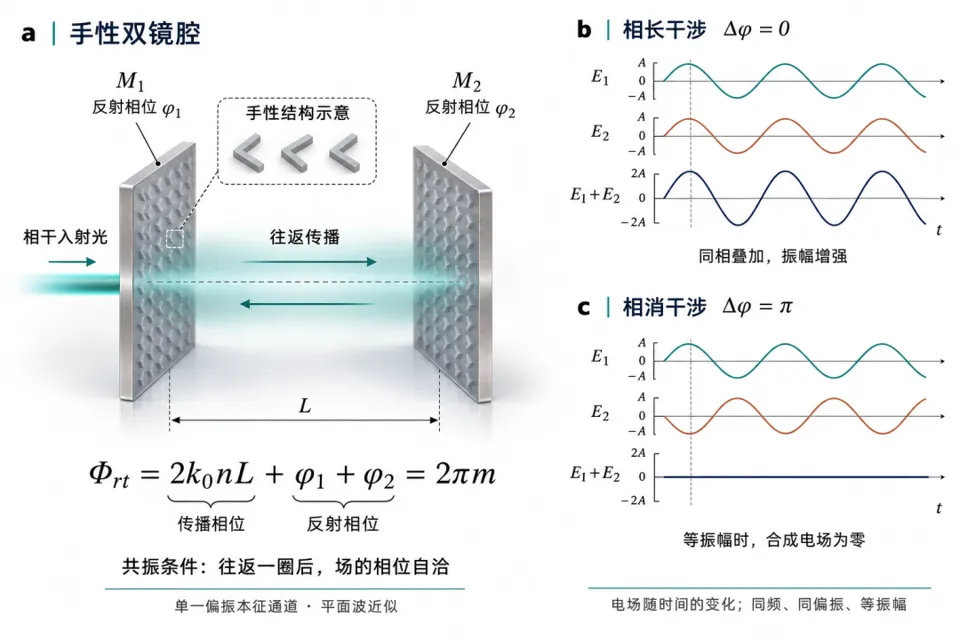
In the box, you only need to slightly rotate the angle of one of the chiral mirrors to compensate for the extra phase difference.
But on the spacetime lattice of the Standard Model, things are much more troublesome.
Here, the phase depends on the specific state of the various forces of the Standard Model at each lattice point.
Twenty-five years ago, Lüscher succeeded in calculating the phase-alignment rule for a simplified version of the theory called "chiral electromagnetism."
But for the full Standard Model including the strong force, weak force, and electromagnetic force, how to align the phase on the lattice remained unresolved for more than 25 years.
Humans Provide the Idea, GPT-6 Astra Leads the Completion of the Proof
To crack this hard problem, Nathaniel Craig proposed a clever idea: refinement.
Since it is too difficult to directly calculate on the original coarse lattice the phase shifts caused by all the changes in the force fields, map the same force fields continuously onto a series of increasingly finer lattices.
Then, compare layer by layer the left-handed particle states allowed on adjacent lattices. Each comparison yields a small part of the phase correction; by summing all these tiny differences, one can infer the precise phase-compensation rule on the original lattice.
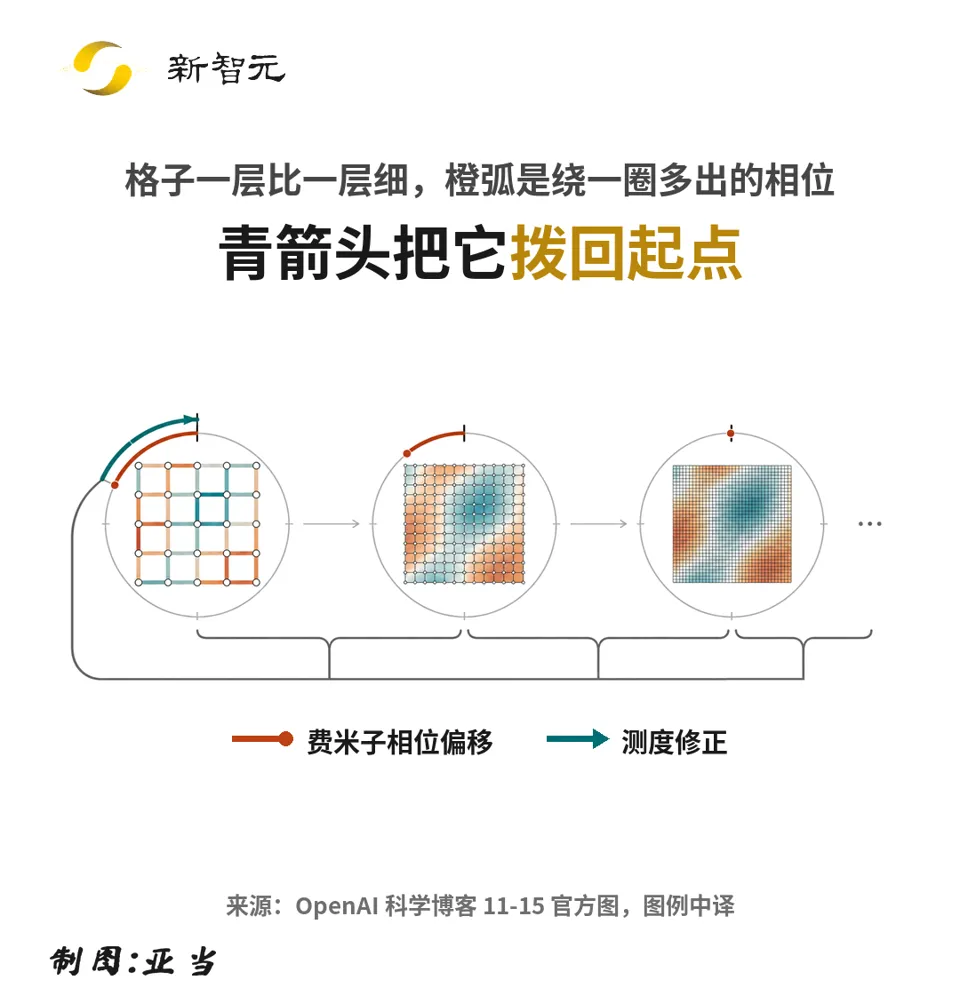
The idea was clear, but Craig himself got stuck—he had never been able to rigorously prove that this method would always work in all the cases that needed to be covered.
At this point, GPT-6 Astra stepped in.
Craig handed his idea to Astra.
After several rounds of collaboration, GPT-6 Astra not only suggested specific methods for correctly mapping the force fields onto finer lattices, and proved that the comparison results on finer lattices would necessarily converge to a definite answer, but even directly led the completion of the derivation of the entire detailed proof.
Of course, the AI's calculation doesn't count as final—it still has to pass muster with the world's top human experts.
Renowned lattice field theory experts Maarten Golterman, Andreas Kronfeld, and Yigal Shamir took the time to review the proof produced by Astra, raising various pointed questions that ultimately helped Craig build confidence in the result.
The preprint paper, prepared jointly by Craig and GPT-6 Astra, has now been officially released.
References:
https://arxiv.org/abs/2610.09093
ASI in Seconds
⭐Like, share, and watch—give us the triple combo with one click⭐
Turn on the star to lock in New Zhiyuan's lightning-fast push notifications!