UW and Microsoft Unveil DualPM Dual-Track Agent Learning Method
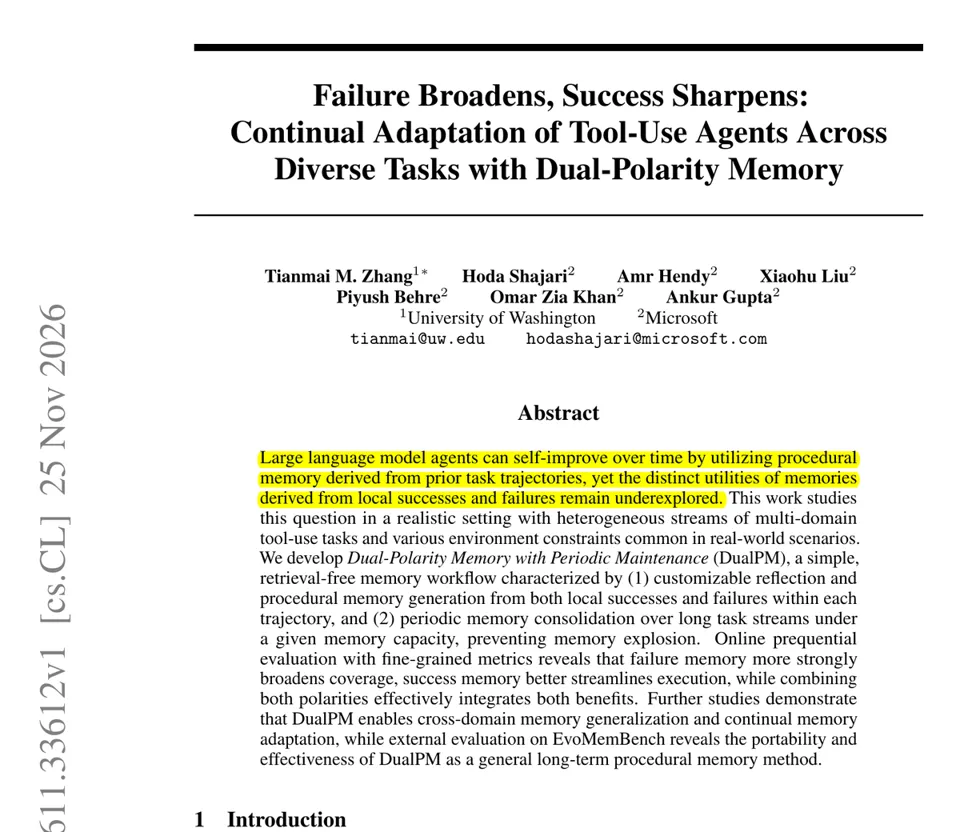
A joint University of Washington and Microsoft paper introduces DualPM, which reflects on every agent run, writes separate success and failure lessons, and merges them into two capped lists every 20 tasks. Tested with GPT-5.5 on 720 multi-domain tool-use tasks, failure lessons raised needed-tool discovery from 75.2% to 81.0%, success lessons cut turns from 6.1 to 5.4, and combining both lifted answer accuracy from 68.1% to 73.2%. The finding: failure lessons widen tool search while success lessons speed execution, so cost-sensitive deployments can rely on success lessons alone.
Full Report
Rohan Paul (@rohanpaul_ai) · 2026-11-26 21
New University of Washington and Microsoft paper finds that lessons from an agent's failures widen its tool search, while lessons from successes make it faster.
Agents can improve over time by saving lessons from past tasks, but most methods learn mainly from wins or judge only final success. It was unclear whether lessons from failures and successes do different jobs.
They built DualPM, which reflects on every run, writes success and failure lessons, and merges them into 2 capped lists every 20 tasks. They tested it with GPT-5.5 on 720 multi-domain tool-use tasks per setting, with tools hidden behind a search function.
Failure lessons raised the share of needed tools found from 75.2% to 81.0%, while success lessons cut turns from 6.1 to 5.4. Using both lifted answer accuracy from 68.1% to 73.2%.
For agents that learn on the job, keep separate lessons from failures and successes, and use success lessons alone when cost matters most.